Chemistry - Term 3
0.0(0)
Studied by 4 people Call Kai
 Learn
Learn Practice Test
 Spaced Repetition
 Match
Match Flashcards
 Knowt Play
Card Sorting
1/33

Earn XP
Description and Tags
Last updated 8:27 AM on 7/26/23
Name | Mastery | Learn | Test | Matching | Spaced | Call with Kai | Chat |
|---|
No analytics yet
Send a link to your students to track their progress
34 Terms
1
New cards
matter
anything that takes up space and has mass
2
New cards
pure substances
a subsection of matter which can be made of elements or compounds
3
New cards
mixture
a subsection of matter which contains two or more substances which are not chemically combined
4
New cards
elements
cannot be decomposed into simpler substances. On a molecular level, each element is composed of only one kind of atom
5
New cards
compounds
substances composed of two or more elements, so they contain two or more kinds of atoms
6
New cards
The Periodic Table of Elements
tabular array of the chemical elements organised in groups and periods by atomic number
7
New cards
groups
there are 18 groups (vertical rows) on the Periodic Table. Each element in a group has the same number of valence electrons
8
New cards
periods
there are 7 periods (horizontal rows) in the Periodic Table. Each element in a period has the same number of electron shells, and the number of elements in a period corresponds to the number of electrons that fit in the valence shell.
9
New cards
important groups and reactivity
* Alkali metals and halogens are very reactive elements and vividly react with each other
* Alkaline earth are reactive, and react easily with water, acids or halogens
* Noble gases are inert elements, i.e. They do not react with anything and exist as single atoms
Note: there a few known compounds containing the noble gas Xe or Kr, e.g. XeF6
10
New cards
atoms, molecules & lattices
* A molecule contains atoms bonded together
* Lattice contains atoms, molecules or ions bonded together
* Atoms are the most basic "building block" of life (make up molecules)
11
New cards
3 main categories of elements
metals, non-metals, semi-metals (aka metalloids)
12
New cards
how are elements organised in the PT?
in order of increasing atomic number (not atomic mass)
13
New cards
nucleus
the “centre” of the atom, made of protons and neutrons and is orbited by electrons
14
New cards
protons
(p+) carry electrical charge equal to +1
15
New cards
neutrons
neutrons have a neutral charge or no charge
16
New cards
electrons
(e-) orbit the nucleus at high speed and carries a charge equal to -1 and is ca. 1840 times lighter than a proton or neutron
17
New cards
neutral atoms
have an equal amount of electrons as protons
18
New cards
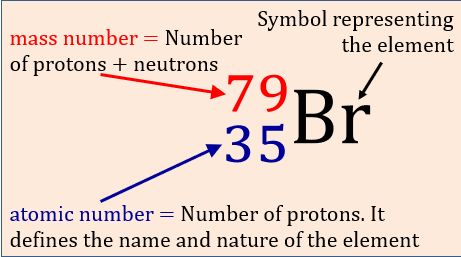
mass number
(formula) the number of protons + neutrons, symbol = A
19
New cards
atomic number
the number of protons; it defines the name and nature of the element, symbol = z
20
New cards
Isotopes
every element exists as a mixture of atoms with different numbers of neutrons. Atoms with the same number of protons but different number of neutrons are called isotopes. Isotopes can be either stable or unstable
21
New cards
electron configuration
The arrangement of electrons in any element can be represented by its *electron configuration.* Electrons moving around the nucleus of an atom are organised in different *energy levels* or *electron shells*
22
New cards
electron shells
* *1st shell: up to 2 electrons (lowest energy levels)*
* *2nd shell: up to 38 electrons (2nd energy level)*
* *3rd shell: up to 8 electrons (3rd energy level)*
* *4th shell: up to 18 electrons (4th energy level)*
Electrons in the *most outer shell* of an atom are called *valence electrons*
23
New cards
metals in the periodic table
* A very large group of the elements that conducts electricity and heat
* They typically have high melting and boiling points
* Usually, metals are:
* Strong
* Malleable (can be hammered into sheets)
* Ductile (can be drawn into wire)
* Lustrous (shiny when freshly scratched)
24
New cards
non-metals in the periodic table
* These are poor conductors of heat electricity
* Their melting and boiling points are much lower
* Most non-metals have poor strength, are brittle and are dull in appearance
25
New cards
metalloids in the periodic table
* These elements have both metallic and non-metallic properties
* For example:
* They partially conduct electricity
* Usually strong but also brittle
* They are called semi-conductors
* Include B (Boron), Si (Silicon), Ge (Germanium), As (Arsenic), Sd (Antimony), Te (Tellurium) and Po (Polonium)
26
New cards
Group 1: Alkali Metals
* Include Li, Na, K, Rb, Cs and Fr
* Have 1 valence electron therefore +1 charge ions
* Very reactive and need to be stored in kerosene as the react violently with water and oxygen
* Have low melting & boiling pints compared to other metals
* Low densities (with first 3 being able to float)
* Soft and can be cut with a knife
27
New cards
Group 2: Alkaline Earth Metals
* Include Be, Mg, Ca, Sr, Ba and Ra
* Have 2 valence electrons (hence, group 2)
* Solid at room temperature
* Similar properties to alkali metals but higher density, less reactive and harder
28
New cards
Transition Metals
* Metals located between Groups 2 + 13
* A ranger of valencies but will *lose electrons* when reacting and *form positive ions*
* All solids except Mercury (Hg)
* Most are *malleable, ductile and lustrous*
* Known as *'super metals'* as they are very *good conductors* of heat and electricity, very strong and hard and have high melting and boiling points
* Many are used as catalysts e.g. Ni, Cu, Pd, Ru & Pt
29
New cards
Group 17: Halogens
* Include: F, Cl, Br, I, At
* Atoms have *7 valence electrons*
* All non-metals *have low melting and boiling points*
* *Very reactive -* never occur free in in nature
* All exist as diatomic molecules except at e.g. F2, Cl2
30
New cards
Group 18: Noble Gases
* Include He, Ne, Ar, Kr, Xe and Rn
* Have 8 valence electrons (except He which has 2) and therefore their outer electron shell is full
* *Do not react* with other substances (inert)
* *Colourless, odourless, tasteless*
* *Very low melting & boiling points*
* Exist as single, unattached atoms
* Can conduct electricity and 'fluoresce' with each producing a different colour
31
New cards
Ions
an atom or group of atoms with an electric charge
32
New cards
cation
an ion with a positive charge
33
New cards
anion
an ion with a negative charge
34
New cards
ionic bonding
* Ions have a full outer (valence) shell of electrons, so are more stable than atoms
* Involves the transfer of electrons from one atom to another
* Occurs to form more stable species with full outer shells
* Electrostatic attraction between the ions form the bond