Exam 3 study guide
 Call Kai
 Learn
 Practice Test
 Spaced Repetition
 Match
 Flashcards
 Knowt Play
1/96

There's no tags or description
Looks like no tags are added yet.
97 Terms
What are the 3 guilds of reproductive strategies?
non guarders
open substrate or broadcast spawners
brood hiders (burry their eggs)
guarders
substrate choosers
nest spawners
bearers
external
internal
What is an example of a non-guarder fish?
The two spot red snapper
they gather in large numbers on the edges of reefs and they broad cast spawn in the mid water column
The burbot
the only fresh water gadid and instead of doing spawning in the water column they do it near the benthos
capelin
they spawn on some beaches in Newfoundland hoping their eggs stick to the gravel and sand
Pike
Sockeye salmon
mother sometimes tries to hide the brood by flapping its body against the ground to try and remove silt so the eggs may develop in the interstitial spaces
Trout
same as sockeye salmon
What are some examples of guarder fishes
Substrate chosers
lumpfish
when he identifies a spot, he will change colors to turn red to attract a female who will lay her eggs on the spot where the male will fertilize the nest. the male will then protect the eggs from predators and fan the eggs.
the spraying characin
they jump on a leaf and spawn so that the fertilized eggs are on a leaf, this means that the male must splash the eggs to keep them moist until they hatch
Nest Spawners
Siamese fighting fish (gouramis)
they create bubble nests and spawn their eggs into that
The bluegill (other sunfishes too)
they protect their eggs
stickle backs
the male creates a nest and then the female comes and lays her eggs, the male will encourage her, then after the male go into the nest and fertilize the eggs
What are some examples of bearers?
internal reproduction
viviparity/ovoviviparity
chondrichthians
guppies
redfish
mouth brooders
cichlids
external
many syngnathid fishes (seahorses, pipefish, sea dragons)
eggs stick to parent or inside parent (sea horses)
nursery fish
this is a forehead brooder, they bear their eggs on their forehead
What size eggs do hagfish have?
1-3 cm
What does egg size relate to?
offspring size
Describe hagfish ovarian development
Mature eggs are released from the ovary into the coelom then are laid by the cloaca
Describe hagfish testicular development
They have a single gonad that is small. When mature sperm will be released within their coelom, this sperm is released throughout pores on their body. In lamprey this is similar but sperm is released through pores and the cloaca.
Describe lamprey ovarian development
Same as hagfish but much smaller eggs and many more
Describe Chondrichthyes ovaries
They have 2 ovaries but only one produces the eggs, the other acts as an endocrine gland. They have gymnovarian eggs that get released into the coelom then enter the oviduct via the ostium (analogous to the fallopian tube). The egg will then travel through the oviduct and depending on the reproductive strategy it will either lay the egg, hatch the egg in its body and release it with a yolk sack still attached or an oocyte will travel directly to the uterus and develop without any egg shell forming being nourished by the mother.
Describe Chondrichthyes testes
There are 2 testes, one larger than the other. There is a epididymis which is a tube that is connected to the anterior kidney which secretes fluids that protect the sperm. The urogenital sinus leads to the male’s claspers, sperm then travels through the claspers and get delivered to a female via internal fertilization.
What is different in teleostei in terms of kidneys and testes?
They is full separation between them which is not true for sarcopterygii, cladista, chondrostei and neopterygii.
What is the difference between gymnovarian fishes and cystovarian fishes?
Gymnovarian fishes have an ostium that leads to an oviduct whereas cystovarian fishes just from ovary to oviduct without an ostium.
Comparison Table

What fish has the smallest eggs?
Flying fishes at 0.25mm
What determines how a fish feeds and its trophic position?
the morphology of mouth parts
the length and anatomy of the digestive tract
their behavior (swimming)
Describe suction feeding
the buccal cavity expands and creates a vacuum to engulf the prey
common in wrasses
Describe ram feeding
the buccal cavity expands, no vacuum is created, they just swim foward to cover area (typically very large areas as many are large fishes)
they are common in planktivorous fishes
what is an example of a shredder/tearer?
the cookie cutter shark
Describe manipulation feeding
It is nipping scraping rasping and gripping (parrot fish). They play important roles in coral reef ecosystems by maintaining reef integrity and functionality.
An inferior mouth describes…
bottom feeding
A subterminal mouth describes…
bottom feeding
A terminal mouth describes…
Generalist feeding
A superior mouth describes…
surface or upwards feeding
Fish can have teeth in their mouth or they can be toothless. T/F
True, some fishes have pharyngeal mouth parts or teeth on the roof of the mouth and tongue
Describe the adaptations of the shark intestine to its diet
spiral valve intestine slows down progression of large swallowed chunks to maximize digestion
Describe the intestine to body length ratio relationship
The more plant like material you eat the longer your intestine to body length ratio
What is the difference of the pyloric caeca in mammals & birds to fish?
mammals and birds
plays a role in hind gut fermentation
fishes
increase the SA of the intestine for absorption of sugars and amino acids
Explain how diet affects the presence of gill rakers
Gill rakers are likely to appear in plankton eaters as a way to help filter their food
What species has undergone disruptive selection?
Twaite shad and allis shad (different species used to be the same)
gill rakers fine in the allis shad but quick thicker and less amount in the twaite shad
3 spine stickle back
limnetic form vs benthic form → they are morphologically different as well as having different numbers of gill rakers
Why does disruptive selection occur?
to minimize competition
What kind of character displacement is there in cichlids?
Their pharyngeal jaw and tooth morphology
What character displacements are present in arctic char?
foraging niche
body size
mouth morphology
4 sympatric morphs

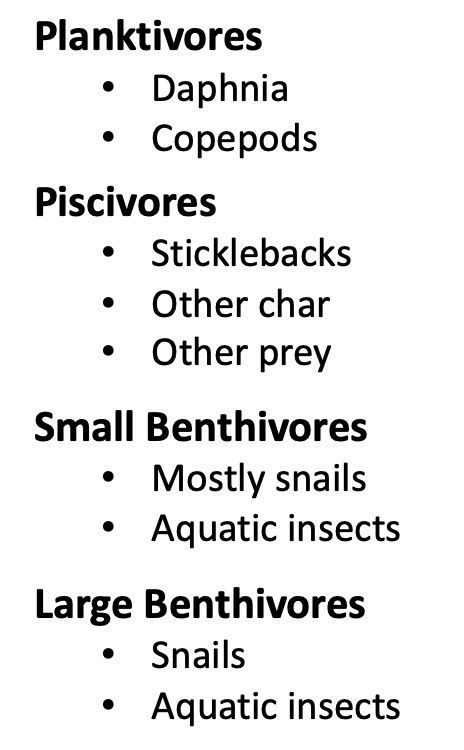
Describe the diet of planktivores, piscivores, small benthivores and large benthivores
What cells are common in electroreception and in the inner ear?
Hair cells

What structures are used in electroreception of Chondrichthyans?
Ampullae of lorenzini
What structures are used in electroreception of non-chondrichthyans?
tuberous organs
ampullary organs
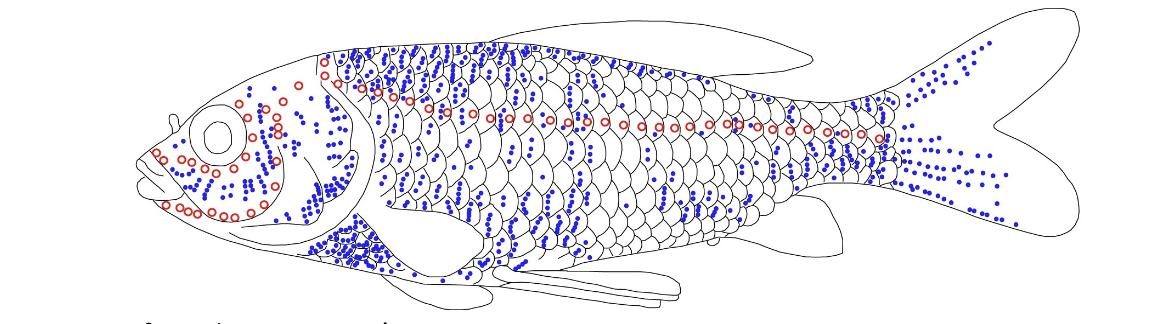
What are the blue dots? what are the red dots?
Blue
superficial neuromasts
they are omnidirectional and are responsible for the direction and velocity of water movement
Red
canal neuromasts
they are anterior posterior detectors and they detect pressure change, water acceleration and low frequency vibrations

Describe the functions of ampullae of lorenzini
They are concentrated on the heads of chondrichthians as well as some lungfish, redfish and sturgeons. They have hair cells in each ampulla (pore) and they are able to detect changes in electrical potential. This takes form in being able to detect the ionic differences at the gill/sea interface of prey as well as the electrical impulses generated by their muscles. They have modified hair cell clusters called stereo cilia and they do not bend, the change in the electrical potential of other creatures causes the cell to depolarize directly.
Some evidence suggests that they can detect the variation in the earths electromagnetic field which may aid in homing and migration behavior.
What was the experiment done by kalmijn et al in 1971?
They put a flatfish in sand under an agar gel dome, therefore it would let ions and electrical impulses out but the scent of the fish would not be transmitted. They were testing if it was truly the ampullae of lorenzini that were detecting the fish.
The sharks found the fish overtime without visual or scent cues.
Describe the analogy to the direction of current (anode and cathode) in fish cells
ampullae of lorenzini
cathode (negative) like as it receives electrical impulses from the environment
teleosts
knife fishes and catfishes send out electric discharges hence an anodal (positive) like cell
What is the electricity that electric fishes generate used for?
electroreception
navigation, orientation, and the location of prey
predation or defense
they can immobilize prey or it can be used as a defense against predation
electro communication
talking between fishes
What modification do electric fishes have to generate electricity?
modified skeletal muscles that create action potentials that are solely to generate electricity

what are some examples of electric modifications?
The sash’s organ
generates a weak field
electric organ
generates a strong field
hunter’s organ
generates a strong field
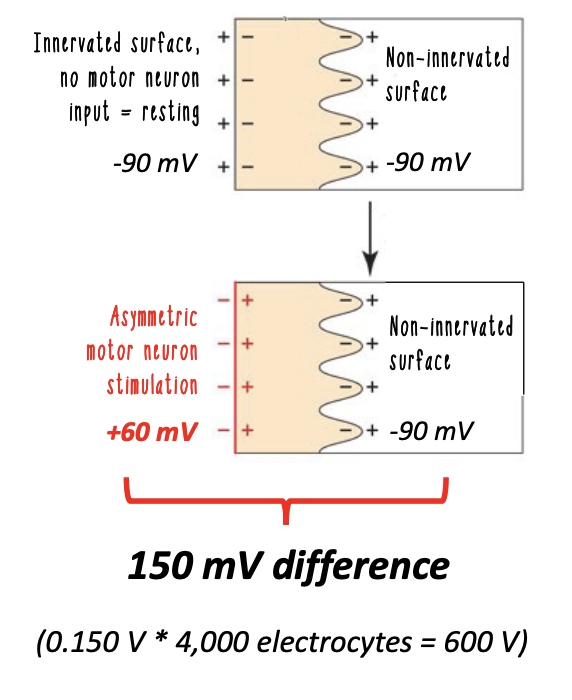
Each one is made of thousands of individual muscle fibers called electrocytes, and again they lack any contractile properties so the stimulation is done by voluntary motor neurons and it has no where to go so they manage to discharge the electricity into the environment.
Describe the process of the motor neuron stimulating the electrocytes asymmetrically
motor neuron stimulates electrocyte that was initially at rest
potential changes due to Na+ influx via a voltage gated channel found on the innervated side of the cel
creates a voltage gradient across the cell from front to back
voltage difference harnessed and summed across other electrocytes
discharged
unknown mechanism
Describe low-frequency ampullae receptors and tuberous receptors
Low frequency ampullary receptors
they are cathodal (receives electrical impulses) and they act like ampullae of lorenzini which involve gel pores and hair cells
tuberous receptors
they are anodal (sends out electrical impulses) and they behave as waves and they get disturbed they can detect that disturbance. this is done using hair cells and when 2 different fields of like this overlap there can be some form of communication.
some knife fishes will change their frequency of the electric field so they avoid interference, giving each fish a kind of unique voice.

What are the 2 important processes that are housed in the inner ear of fishes
The vestibular system
Auditory perception
What does the vestibular system do?
it is responsible for the detection of angular and lateral acceleration
it sends information to the brain to determine balance, orientation and equilibrium
What does the Auditory perception system do?
it detects sound/pressure waves in the water
it sends information to the brain to interpret those sounds
The toad fish
has been to space
is a good model for looking at the semi circular canals
they have 3 otoliths per side
they have 3 ampullae containing Christa ampullaris per side
What are ampullae?
They are at the base of each semicircular canal and they contain hair cells
What are cupula?
a gelatinous shell positioned around the crust amupullaris, when this is displaced by lateral and angular accelerations, it causes the movement of fluid within the semicircular canals and moves the hair cells that creates a signal to send to the brain.
What is the crista ampullaris?
it is the base/tissue holding the hair cells
What is the pars superior?
The part of the inner ear containing the vestibular system
what is the pars inferior?
the part of the inner ear responsible for the auditory system
Describe the Auditory system
Pressure/sound waves activate hair cells in the auditory system
can be amplified via swim bladder
The otoliths transmit the vibration from the aquatic environment to the auditory hair cells
How do hair cells transmit information to the brain?
When their stereo cilia are displaced relative to the cells kinocilium
stereo cilia are displaced when the fluid in the cupula is displaced via angular or lateral acceleration, as well as the otoliths vibrating in response to sound waves.
How can otoliths be used by population biologists?
Otoliths grow continuously, they are analogous to tree rings so you can estimate the age of an animal
you do have to kill the fish to obtain the otolith though
What frequency does the swim bladder amplify?
The ultrasonic range
How do fishes produce sound?
Drumming
using muscles attached tot he swim bladder to beat out a rhythm
present in gads, drum fish, and croakers
Stridulating
they rub bones or other body parts together
done by seahorses, many coral fishes, and serpent majors
Farting
Actually used as communication
What is Drumming used for?
Warning calls
Territoriality
Sexual communications
the number of drums and frequency increase significantly during spawning and courtship
What is an example of a fish that uses farting as a form of communication?
The herring
this group of fishes have physostomous swim bladders meaning they can take air through their esophagus and expel it as fast repetitive ticks
it is mainly used as an alarm call
What is specific gravity (SG)?
the mass of a substance with volume x / the mass of freshwater with volume x
What is the SG of Freshwater?
1
What is the SG of Saltwater?
1.02-1.03
What is the SG of Muscle?
1.05-1.10
What is the SG of Bone?
2
What is the SG of cartilage?
1.1
What is the SG of lipids and oils
0.9-0.93
Some fishes can produce things called wax esters, what is its SG?
0.86
Sharks make squalene, what is its SG?
0.86
What is the SG of most fishes?
1.06-1.1
What is buoyancy?
A production of lift via physiological or structural means required to counteract the weight of a body.
What is hydrodynamic lift?
Generating lift by moving its pectoral or caudal fins
Which fishes generate lift with their pectoral fins?
Actinopterygiians
Which fishes generate lift with their caudal fins?
Chondrichthyes and sturgeons
How does having a heterocercal caudal fin generate lift in sharks?
It directs water downwards instead of horizontally and that action generates lift
What is another way to generate lift (not pectoral or caudal)?
By incorporating low density compounds - wax ester or squalene
What is the another way to help generate lift (not hydrodynamic or incorporating low density compounds)?
Remove high density compounds - example: Gulper eel → reduced amount of bone in skeleton
What is another way to help generate lift (not hydrodynamic, incorporating low density or removing high density compounds)?
Gas inclusion (swim bladder)
What is Boyle’s law?
IT says that pressure * volume is constant, if pressure increases, volume will decrease and if pressure decreases volume will increase.
Change of depth in the upper meters of the ocean means large changes in the swim bladder volume, however the difference of volume is much less drastic if you are much further down in the ocean.
How does a physostomous swim bladder work?
The fish has to swim to the surface to gulp air which will travel down the esophagus then travel into the swim bladder which it can control how much it retains depending on where it wants to be in the water column.
How does a physoclistous swim bladder work?
The autonomic nervous system controls the inflation of this kind of swim bladder, when a fish with this swim bladder wants to rise, it swims upwards and as it rises the swim bladder expands.
When it wants to stay at a new depth, the bladder slightly deflates → this is controlled by the parasympathetic nervous system.
When the fish wants to move deeper, it re-inflates the swim bladder to become neutrally buoyant at that depth since the bladder will be shrinking due to increase in pressure. this is done by sympathetic control of the nervous system.
How is the Physclistous swim bladder inflated?
Blood must remove some of its O2 to then enter the swim bladder via the rete mirable
It removes the O2 from the hemoglobin by increasing the pH of the blood, this increase in pH is called the root effect
What is the Root effect in detail?
It occurs in the gas gland, it is anaerobic metabolism, not aerobic
CO2 and lactate are able to be secreted by this gland to make the blood more acidic to release some of the O2 from the hemoglobin in the blood
when the fish dives deeper pressure sensors tell the gas gland to do anaerobic respiration to release acidic compounds into the blood stream to disassociate the oxygen from hemoglobin
When the levels of free O2 in the blood exceed that of the gas gland/swim bladder it will diffuse across that barrier and inflate the swim bladder.

What happens to a physoclistous swim bladder whenever a fish rises in the water column?
The swim bladder expands
it liberates some oxygen into the blood
it deflates
What happens to a physostomous swim bladder whenever a fish rises in the water column?
it burps or farts to release some air
What is the dominant lift strategy for lotic fishes?
gas inclusion
physostomous
hydrodynamic lift
What is the dominant lift strategy for epipelagic fishes?
Gas inclusion (physostomous)
hydrodynamic lift
increase in low density compounds
What is the dominant lift strategy for mesopelagic fishes?
gas inclusion (physoclistous)
hydrodynamic lift
increase in low density compounds
What is the dominant lift strategy in bathypelagic fishes?
a reduction in high-density compounds