AST 205 Final Flashcards Prep
 Call Kai
 Learn
 Practice Test
 Spaced Repetition
 Match
 Flashcards
 Knowt Play
1/43

There's no tags or description
Looks like no tags are added yet.
44 Terms
Why are asteroids and comets important?
Remnants from birth of our Solar System that provide clues about its formation and evolution. Studying them helps us understand the early conditions of the solar system.
Altered course of biological evolution
Asteroid
Comet
Meteor
Meteorite
Rocky leftover planetesimal orbiting the Sun
Icy remnant orbiting Sun regardless of size
Flash of light in sky caused by asteroid or comet entering the atmosphere
Any piece of rock that hits the ground (asteroid, comet, or even another planet)
Early Days - Asteroids hard to find because…
They are small and far away, making them difficult to detect with early observational techniques.
What is NEAR
The first spacecraft to land on an asteroid and send signals back from the surface of Eros
Properties of Asteroids
Not spherical in shape (potato-shaped_
gravity not strong enough to compress rocky material
odd shapes imply that some are fragments from asteroid collisions
Where is the main asteroid belt?
2.2 and 3.3 AU from the Sun

Jupiter affects the asteroid belt…
Jupiter causes gaps in the asteroid belt (like the moons and Saturn’s rings)
Explains why no planet ever formed in this region
Asteroids, and why they could not form a planet
(solar nebula, collisions, Jupiter…)
Region of the asteroid belt probably contained enough rocky material to form Mars/Earth-size planet
Collisions among planetesimals frequently disrupted their orbits
Gravitational resonances with the formation of Jupiter had a stirring effect
All of these points results in planetesimals unable to form a planet
Composition classes of asteroids:
measured by what?
C: dark carbonaceous
S: moderately bright, stony
M: metallic (rare)
P: outer solar system, dark, organics(?)
D: dark, red, trojans
measured by reflection spectra (not precise…)
Asteroids related to Meteors
Some meteorite material was molten
Even the largest asteroid formed by accretion of smaller bodies would not get hot enough to melt silicates or metals
Accretion Heating
another source of heating?
**another source is radioactive decay of 26Al
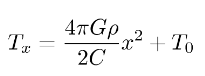
HED Meteorites related to…
Vesta
Giant impact blasted them out
Dark “hydrated” material farther out in SS?
Vesta is a stunted planet
Comets help us understand our SS…
teach us about formation processes from outer SS just like asteroids do for inner SS
Comets Characteristics
Dirty snowballs
Sublimation of ices in the nucleus creates rapidly escaping atmosphere called the coma
Tail always points AWAY from the Sun, regardless of direction of orbit
Two tails: ionized gas tail and dust tail
Comet Tails
orientation?
key discovery?
first indication of solar wind - gas pressure not enough to understand violent effects
tangled magnetic field carried along
fields comb through comet, grab charged particles
collisions bring along neutral atoms/molecules
strings out plasma tail
dust tail pushed by sunlight
Where do comets come from?
Oort Cloud and Kuiper belt - don’t last many passes by the Sun
Comet orbits fit no pattern - elliptical paths can change directions
Some comets do have an orbital pattern (but VERY elliptical paths beyond orbit of Pluto) → visit more frequently
Oort cloud or Kuiper belt comets may get too close to a planet and be altered in its orbit, or trapped.
Oort Cloud Comets
Formed in vicinity of jovians, flung into large, random orbits by gravitational encounters with planets
Classes of Comets
Long Period Comets
200 yrs+
Intermediate Comets
30-200yrs
Short Period Comets
< 30yrs
Kuiper Belt Comets
Lie in the same general region they were formed
Orbits match patterns of the SS
Pluto’s Atmosphere and Surface
Nitrogen haze - weather?? snow??
Young Mountains - more activity
“Heart”
Unusual Snakeskin - sharper than expected features
Why don’t Neptune and Pluto collide?
They are in a 3:2 resonances (Pluto has an eccentric orbit)
Plutinos
KBO that have same period and semimajor axis as Pluto as well as 3:2 resonance with Neptune
KBO objects
Cubiwanos - KBOs not resonating with Neptune
Twotinos KBOs in 1:2 resonance with Neptune
KBO classified based on resonance with Neptune
Dwarf Planet Definition
It is in orbit around Sun
Sufficient mass so that it assumes hydrostatic equilibrium (roundish) shape
HAS NOT cleared its neighborhood
“Plotoid” is name for dwarf planets like Pluto
An Explanation for the Oort Cloud: Nice Model
Slight drift initially due to angular momentum loss of disc material
In time, J and S came to a 2:1 resonance
configuration unstable
process scattered comets into Oort cloud
Results in highly eccentric orbits - accreted cometary material from collisions
LaGrange Points
Locations in space where objects are sent out and stay put, relative to the Earth and Sun (in our case)

Earth gets constantly bombarded, but why don’t we see it?
Atmosphere acts as a great filter
Where do you know the rocks are meteorites?
Antarctic Ice Fields
meteorites fall on ice
transported within ice
exposed as stagnant ice evaporates
Classification of Meteorites
Compositions
Evolutionary State
Origin
Composition
Irons
Stony-Irons
Stones
Evolutionary State
Primitive - no significant temperature/pressure reprocessing since formation (only stones)
Differentiated - has been subjected to significant “history”
Brecciated - mixture of different evolutionary states - don’t really talk about this state
Origin from Asteroid belt
Stony Meteorites (Examples)
Chondrites - chondrules with globule mineral structure
Achondrites - no chondrules
Carbonaceous Chondrites - really primitive
Cl carbonaceous chondrites don’t have chondrules (ice during formation?)
Parent bodies of meteorites are
Asteroids (based on orbits)
Provides variety for thermal/chemical histories (i.e. differentiated meteorite from differentiated asteroid)
Lunar origins, too!
Martian origins, too lol
Basalt meteorites arise from Vesta (achondritic)
Ages of Meteorites - how to find
Use Radioactive isotopes - measure gas retention rate or solidification age
If we estimate ages, we can gauge age of SS
Processed Meteorites - how?? human evolution?
Once been part of larger object that processed original material of the solar nebula into another form
most accessible form of iron in early ages - transition from bronze age to iron age
Zodiacal light (direction it moves?)
Dust in the plane of the ecliptic
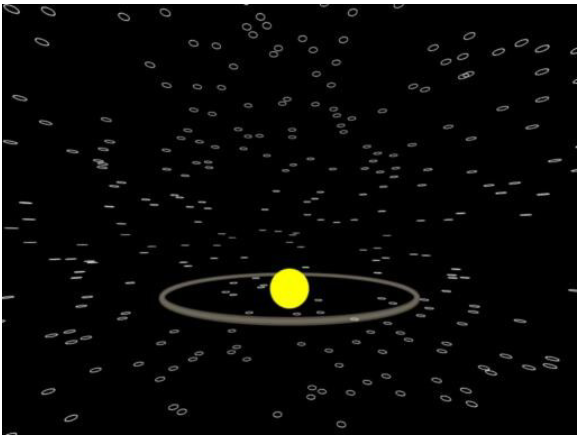
Dust clouds in the SS orbit the sun in the same plane and direction as the planets.
Gegenschein (Counterglow)
what is it?
direction?
what does it show?
SS dust scatters light back and forth
antisolar direction
this and zodiacal light demonstrate that there is a lot of dust and it will keep building up
Dust
what is it?
what three mechanisms alter its orbit?
what do planets do to dust
Small bodies in SS with limited lifetimes
Three mechanisms:
Radiation Pressure
Poynting-Robertson Effect
Yarkovsky Effect
Planets also clear dust
Radiation Pressure - Equation
what ratio can you make?
Radiation Force/Force of Gravity
(ratio ~1 for small grains, so they will spiral out)

Poynting-Robertson Effect
Doppler Effect related to this effect?
Aberration of Light
A drag force causing particles of a particular size to spiral into the sun.
Two Parts:
Radiation Pressure Term - points along a line connecting the Sun and the grain
Mass-loading Drag - effective rate of mass loss as the grain re-radiates the solar energy
Drag causes small bodies to spiral into the sun - clear bodies as large as 1m since the SS was formed
Due to Doppler Effect, motion of the body increases the momentum of photons in forward direction (larger “p” acts like a drag)
Apparent position of an object is shifted due to the motion of the observer - aberration depends on velocity
Poynting-Robertson Effect Equation
a_d = radius of dust grain
r = orbital distance of dust grain from sun

Yarkovsky Effect Steps:
Radiation from Surface
Prograde Motion
“Afternoon” = warmest region. Emits most photons and raises orbit
Orbit
Radiation from Sun

Yarkovsky Effect Attributes
Emissions of thermal radiation differ due to rotation of body.
Rotation is prograde, raise orbit
Rotation is retrograde, lower orbit
Moves km-sized objects
Summary of Dust Movement Effects (small to large)
Solar Wind (10^-9-10^-7m)
blows out
Radiation Pressure (10^-7-10^-5m)
blows out
P-R Effect (10^-5-10^-1m)
spirals in
Yarkovsky (10^-1-10^1m)
Kepler (10^1m+)