UNLV - KIN 223 - Chapter 9 - Homework, Assessment, and Lab Q&As
 Call Kai
 Learn
 Practice Test
 Spaced Repetition
 Match
 Flashcards
 Knowt Play
1/50

There's no tags or description
Looks like no tags are added yet.
51 Terms
When kicking a ball forward, the knee is
Extended
Which is *not* a type of synovial joint?
Suture
A meniscus could be found in which joint?
Knee
Select all the knee ligaments that are deep tot he articular capsule and prevent anterior and posterior movement of the femur on the tibia
Anterior and posterior cruciate ligaments
The multiaxial joint in which the spherical end of one bone fits into the cuplike socket of the other bone is called a ________ joint.
Ball-and-socket
Select all the components of the hip joint that contribute to its stability
-Deep acetabular socket
-Acetabular labrum
-Strong articular capsule
-Reinforcing muscles and ligaments
The glenohumeral and hip joints are both ball-and-socket. Which feature of the hip joint makes it more stable than the glenohumeral joint?
Deeper joint socket
Which action describes turning the sole of the foot medially, as in checking the bottom of a shoe for gum?
Inversion
Select all that are examples of angular motion across a joint.
-Flexion
-Adduction
Synovial fluid is found
Within the synovial cavity
The joint capsule has an inner layer called the
Synovial membrane.
An articular capsule is present in
Synovial joints
In fibrous joints, the articulating surfaces are held together by
Dense regular connective tissue
Sutures are joints that are found
Between certain bones of the skull
Functionally, a gomphosis is categorized as a
Synarthrosis
What type of cartilage is located between bones in a symphysis?
Fibrocartilage
The metatarsophalangeal joint allow movement in two planes and are classified as _______ joints.
Condylar
Which joint is multiaxial?
Ball and socket
Based on its range of motion, the elbow is classified as a(n) _______ joint.
Uniaxial
In general, the movements demonstrated at plane joints between the carpals are
Gliding movements
Which does *not* correctly pair a movement with its opposing movement?
Elevation - Retraction
A movement that increases or decreases the angle between two bones is a(n) _______ motion.
Angular
The coracoclavicular ligament is a _______ ligament that connects the clavicle to part of the _______.
Strong; scapula
When protracting the jaw or making small side-to-side movements during chewing, the temporomandiubular joint makes _______ movements.
Gliding
The fibrocartilage rim that deepens the hip socket is the
Acetabular labrum
Which is *not* a correct pairing of a joint with its common name?
Glenohumeral joint - Elbow
The elbow is a _______ joint.
Hinge
In addition to its hinge function, when the knee is _______ it allows for some slight _______.
Flexed; rotation
Common, wear-and-tear arthritis, in which repeated use of a joint gradually wears down the articular cartilage, is known as
Osteoarthritis
The fixed point around which a lever rotates is the
Fulcrum
When considering joints in the human body, the most common lever type is the
Third-class lever
1. The term arthritis does not imply a specific disease. It actually describes
2. Signs and symptoms of arthritis do not include
3. Causes of arthritis include
1. Inflammation of one or more joints
2. A joint that is cold tot he touch relative to other parts of the body
3. All of these are correct
-Autoimmune attack
-Infectious agents
-Crystal formation in the joint fluid
-Wear and tear age-related changes of the cartilage
1. Some of the age-related changes in the articular cartilage that contribute to osteoarthritis include
2. True or false: Surgical replacement of the damaged joint is the only treatment for osteoarthritis
3. Rheumatoid arthritis is a multisystem, autoimmune disease in which the immune system attacks the connective tissue of the body and therefore differs from osteoarthritis. The organs other than the joints affected in rheumatoid arthritis include
1. All of these are correct
-Little cracks in the cartilage allow synovial fluid to enter and damage the local bone
-Reduced numbers of chondrocytes in the cartilage
-Chondrocyte manufactured matrix becomes less resillient
2. False
3. All of these are correct
-Blood vessels
-Skin
-Lungs
-Portions of the eye
-Heart
Identify which type of movement is occurring in each figure.

Left, top to bottom:
Dorsiflexion
Plantar flexion
Right, top to bottom:
Eversion
Inversion

Label the structures of the knee joint. Note that the top figure is the anterior deep view, and the bottom figure is the posterior deep view.
Left, top to bottom:
Lateral meniscus
Tibial collateral ligament
Medial meniscus
Right, top to bottom:
Anterior cruciate ligament
Fibular collateral ligament
Posterior cruciate ligament
Classify the following images into the types of synovial joints they represent.
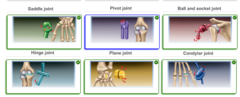
Saddle Joint: Green
Pivot Joint: Purple
Ball-and-Socket Joint: Red
Hinge Joint: Light Blue
Plane Joint: Yellow
Condylar Joint: Dark Blue
Fill in the blanks with the terms provided. Not all terms will be used.
A joint, or *articulation*, is the place of contact between bones, between bone and *cartilage*, or between bones and teeth. Bones are said to *articulate* with each other at a joint. The scientific study of joints is called *arthrology*.
Label the figure with the items provided. Labels may be used more than once.

Red Square/Arrow: Resistance
Gray Triangle: Fulcrum
Blue Arrow: Effort
Which is *not* a part of all synovial joints?
Labrum
Which part of a synovial joint may be reinforced by ligaments and tendons?
Articular capsule
All synovial joints allow movement in multiple planes
False
Label the components of a typical synovial joint.

Left: Ligament
Right, top to bottom:
Articular cartilage
Joint cavity
Synovial membrane
Indicate whether each motion is abduction of adduction.
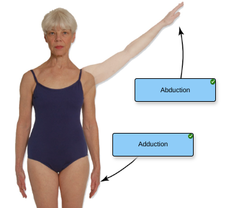
Top: Abduction
Bottom: Adduction
Which of the following commonly occur at the joints in elderly individuals? Check all that are correct.
-Osteoarthritis
-Articular cartilage begins to break down in weight-bearing joints
Select all the joints associated with shoulder movement.
-Sternoclavicular
-Acromioclavicular
-Glenohumeral
Select all that are components of the hip joint.
-Head of the femur
-Acetabulum
-Acetabular labrum
Select all the articulations that make up the knee joint.
-Tibiofemoral
-Patellofemoral
Match each lever class with the location of its effort, resistance, and fulcrum.
*First-Class Lever*: Fulcrum is between the resistance and effort
*Second-Class Lever*: Effort is between the fulcrum and the resistance
*Third-Class Lever*: Resistance is between the fulcrum and effort
The type of fibrous joint that are immobile and found only between certain bones of the skull are called _______.
Sutures
A lever is a rigid object that rotates around a fixed point called the __________.
Fulcrum
The talocrural joint is also known as the _______ joint.
Ankle