Marine Science Lab Midterm
 Call Kai
 Learn
Learn Practice Test
 Spaced Repetition
 Match
Match Flashcards
 Knowt Play
1/79

There's no tags or description
Looks like no tags are added yet.
Name | Mastery | Learn | Test | Matching | Spaced | Call with Kai | Chat |
|---|
No analytics yet
Send a link to your students to track their progress
80 Terms
Scientific theory
Hypothesis, Experiment, Conclusion, Scientific Fact, Scientific Theory
Dark dorsal and white ventral coloration what is this called on a shark? and what is it adapted for?
Countershading and open ocean

Inferior Mouth
bottom feeder

Subterminal Mouth
Bottom feeder

Terminal Mouth
Gets prey right in front
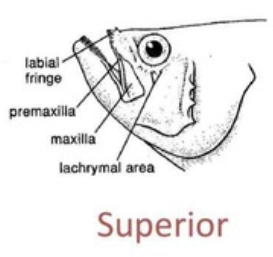
Superior Mouth
Gets prey it sees above

Rounded
Effective for acceleration and maneuvering, not for long distance swimming
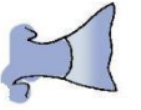
Truncate
Effective for acceleration and maneuvering, not for long distance swimming

Emarginate
Effective for acceleration and maneuvering, not for long distance swimming

Forked
Generally efficient for most uses

Luncate
High speeds for long distances, but slow accelerations and poor maneuverability
Exhibits radial symmetry and includes jellyfish and sea anemones
Cnidaria
Unsegmented with soft bodies and includes snails, clams, and squids.
Mollusca
Segmented bodies, jointed appendages, and an exoskeleton and includes crabs and shrimp
Arthropods
Exhibits pentamerous symmetry and includes sea stars and sea urchins
Echinodermata
Animal larger than a few mm, segmented, often with surface scales or bristles
Annelida
Ecological benefits of a salt marsh ecosystem
Habitat – provides food and shelter for many species of fish, invertebrates, and birds. Also, important nursery ground for fish, crustaceans (e.g. shrimp, crabs), and other organisms.
Highly productive environment and acts as carbon sink – removes CO2 and sequesters carbon in plant tissue & sediment
Filters toxins and excess nutrients from land runoff, improving coastal water quality
Salt marsh absorbs wave energy and protects the coast from storm surge
What is the dominant plant observed in the salt marsh at Oaks Creek
Spartina alterniflora
3 invertebrates we caught
Shrimp
Box Jellyfish
Blue Crab
3 fish we caught
Flounder
Butterfly Ray
Gray Snapper
Linnaean classification
Domain, Kingdom, Phylum, Class, Order, Family, Genus, Speices
Write “xeno quad” correctly
Xeno quad (first letter capitalized in first word then underlined)
Coriolis deflects objects to the _____ in the Northern Hemisphere
Right
Coriolis deflects objects to the _____ in the southern hemisphere
Left
Wind is the result of air moving from ____ to _____ pressure
High to low
2 conditions needed for hurricanes to form
Warm water
Coriolis
3 Parts of a hurricane
Eye
Eye Wall
Rain Bands
Hurricanes are ___ pressure systems
low
What direction do hurricanes rotate in the Northern Hemisphere
counter-clockwise
What is the term for hurricanes that form in the Western Pacific
Typhoons
Where are the strongest winds located (not quadrant but part of hurricane)
Eye wall
Wind coming from the south is south or north wind?
South wind
What is the worst side (quadrant) of a hurricane in terms of strongest winds and storm surge?
Right front quadrant
What is storm surge? and two factors that cause it?
Flow of ocean water onto land due to storm.
High winds
Low pressure
Beside storm surge, what are other hazards of hurricanes
Flooding, Strong winds, Tornados, Lightning, and Heavy rain
What was the deadliest natural disaster in the U.S. history
Galveston hurricane
When is hurricane season
June 1st-Novemeber 30th
1 inch
2.54 centimeters
1 cm
10 millimeters
1 meter
100cm or 1,000mm
1 kilometer
1,000m
1 pound
454 grams
1 kilogram
2.2 pounds or 1000g
In the northern hemisphere when a object is traveling north the object will be deflected to the?
East
In the northern hemisphere when a object is traveling south the object will be deflected to the?
West
In the southern hemisphere when a object is traveling north the object will be deflected to the?
West
In the southern hemisphere when a object is traveling south the object will be deflected to the?
East

Male blue crab
Narrow abdomen

Female Blue crab
Broad Abdomen
Benthos
Organisms living on or in the sea floor
Epiflora
Plants living on bottom
Epifauna
Animals living on bottom
Infauna
Burrowing animals
Nekton
Swimmers (can swim against current)
Pelagic
Swimming in open ocean (not near bottom)
Demersal
Can swim but prefer to lay on bottom
Niche
Role in ecosystem. A habitat with more niches will have more species
stripes (disruptive coloration)
Camouflage with vegetation and surface ripples or break up outline of animal
Mottled
Camouflage with rocks/bottom
Poster (brightly colored)
Warming coloration (poisonous or venomous) or advertise presence to rival or mates
Benefits of Bioluminescence
mating, attracting prey, scaring predators
Photophores
light organs
Bilateral
1 plane of symmetry divides into mirror-like halves (lobster)
Radial
Several planes of symmetry can be drawn to divide into mirror-like halves (jellyfish)
Pentamerous
Can be divided into 5 sections (sea stars)
Why do sharks have dermal denticles?
helps to reduce drag
Sea Ice
Frozen seawater, forms in oceans
Land Ice
glaciers, ice shelves (form on land, can break off into sea to form icebergs)
Effects of melting sea ice and land ice
Many animals depend on sea ice for survival
coastal flooding and erosion
increases ocean temperature, which then can raise sea level
Polar bonds
Water is a polar molecule with electrons unequally shared.
Hydrogen bonds
Form between water molecules as positive charges are attracted to negative charges
Freshwater density
1 g/cm³ = 1000 kg/m³
Average salinity of seawater
35 ppt
Factors that affect salinity of a body of water
Increase in salinity can be caused by high evaporation, freezing of sea water, and tides. Factors that decrease are runoff from land, precipitation, and glacier or sea ice melting
Describe how salinity and temperature affect density. Which factor has a greater effect on density of seawater? Which factor has a greater effect on the density of the ocean?
As temperature decreases, density increases. colder water=denser water
saltier water=denser water. As salt increases, salinity increases.
Temperature has a greater effect on seawater and on the density of ocean
Describe surface currents
Surface currents are driven by the wind and transfers heat to poles
Describe deep currents (thermohaline circulation).
Driven by density and transfer oxygen to depths.
Rice trunk
water control box inside the park that can control the water levels between the marsh and the pond
Sea oaks
Tall, subtropical coastal grass that grows on the dunes
Refractometer
tool used to quickly measure salinity of a liquid when help up to light