Chapter 23: Indian and Southeast Asian Art
Key Notes
- Time Period: Ancient Times to Present
- Culture, beliefs, and physical settings
- The Indus Valley civilizations were among the most advanced for their time.
- Cultural centers in India became the home of great civilizations and dynasties.
- Some of the world’s greatest philosophies and religions developed in India.
- Early Indian religions often separated the cosmic from the earthly realm. All the religions in this area (i.e., Hinduism and Buddhist) adopted this world view.
- The Indian religions generated unique artistic expressions, such as the Buddhist stupa and the Hindu temple.
- Buddhism, Hinduism, and Jainism are image-friendly religions.
- Cultural interactions
- Asian art is influenced by global trends, and in turn influences global trends.
- Trade routes connected Asia with the world.
- Other religions such as Christianity and Islam have had a dramatic impact on the arts in India.
- Material Processes and Techniques
- The art of India is some of the oldest in the world with the longest continuous tradition.
- Indian artists employ a wide range of materials including ceramics and metal.
- Distinctive to India is the development of Buddhist stupas.
- Indian art extensively employs stone and wood carving.
- Indian art specializes in wall and manuscript painting.
- Tapestry is an Indian specialty.
- Audience, functions, and patron
- Indian art has a rich tradition of depicting mythical and historical subjects.
- Architecture is generally religious.
- Theories and Interpretations
- Art history as a science is subject to differing interpretations and theories that change over time.
Historical Background
- India's history is characterized by invasions and assimilations due to the attractiveness of the fertile Indus and Ganges valleys.
- The invaders settled in India, leading to a cosmopolitan culture that is a layering of disparate populations.
- India has eighteen official languages, with Hindi only spoken natively by 20% of the population.
- India has diverse religious concentrations of Hindus, Muslims, Jains, Buddhists, Christians, Sikhs, and tribal religions.
- Geographically, India has a broad range, including the world's tallest mountains, vast deserts, and tropical forests.
- India is considered one of the most diverse countries globally.
Patronage and Artistic Life
- The arts have a critical role in Indian life, and most rulers have been generous patrons of art.
- Buildings, sculptures, and murals were commissioned by rulers to enhance civic, religious life and their own glory.
- The interconnectiveness of arts is essential to understanding Indian artistic life.
- Monuments in India are conceived as a combination of arts with a single artistic vision led by an artist as a team leader.
- Indian monuments have a surprising uniformity of style due to the interconnectiveness of arts.
- The design of religious art and architecture was determined by a religious advisor to ensure agreement with canonical texts and diagrams.
- Indian artists were trained comprehensively, including everything from making a brush to creating intricate miniatures or vast murals.
- Artistic training in India is highly organized, with artists trained as apprentices in workshops.
Key Terms
- Ashlar masonry: carefully cut and grooved stones that support a building without the use of concrete or other kinds of masonry
- Bas-relief: a very shallow relief sculpture
- Bodhisattva: a deity who refrains from entering nirvana to help others
- Buddha: a fully enlightened being. There are many Buddhas, the most famous of whom is Sakyamuni, also known as Gautama or Siddhartha
- Cella: the main room of a temple, where the god is housed
- Darshan: in Hinduism, the ability of a worshipper to see a deity and the deity to see the worshipper
- Garbha griha: a “womb chamber,” the inner room in a Hindu temple that houses the god’s image
- Horror vacui: (Latin, meaning “fear of empty spaces”) a type of artwork in which the entire surface is filled with objects, people, designs, and ornaments in a crowded and sometimes congested way
- Hypostyle: a hall with a roof supported by a dense thicket of columns Iconoclasm— the destruction of religious images that are seen as heresy
- Mandorla: (Italian, meaning “almond”) an almond-shaped circle of light around the figure of Christ or Buddha
- Mithuna: in India, the mating of males and females in a ritualistic, symbolic, or physical sense
- Mudra: a symbolic hand gesture in Hindu and Buddhist art
- Nirvana: an afterlife in which reincarnation ends and the soul becomes one with the supreme spirit
- Puja: a Hindu prayer ritual Sakyamuni: the historical Buddha, named after the town of Sakya, Buddha’s birthplace
- Shikara: a bee-hive shaped tower on a Hindu temple
- Shiva: the Hindu god of creation and destruction
- Stupa: a dome-shaped Buddhist shrine
- Torana: a gateway near a stupa that has two upright posts and three horizontal lintels. They are usually elaborately carved
- Urna: a circle of hair on the brows of a deity, sometimes represented as focal point
- Ushnisha: a protrusion at the top of the head, or the top knot of a Buddha
- Vairocana: the universal Buddha, a source of enlightenment; also known as the Supreme Buddha who represents “emptiness,” that is, freedom from earthly matters to help achieve salvation
- Vishnu: the Hindu god worshipped as the protector and preserver of the world
- Wat: a Buddhist monastery or temple in Cambodia
- Yakshi (masculine: yaksha): female and male figures of fertility in Buddhist and Hindu art
Buddhist Philosophy and Art
- Buddhism is the dominant religion in Southeast Asia and is still practiced today.
- Buddhism teaches individuals how to cope with a world full of misery.
- The central figure of Buddhism is Buddha, who rejected worldly concerns and sought fulfillment as an ascetic.
- Buddha is not considered a god in Buddhism.
- In Buddhism, life is believed to be full of suffering and an endless cycle of birth and rebirth.
- The aim of every Buddhist is to achieve oneness with the supreme spirit and end the cycle of birth and rebirth.
- This can only be achieved by accumulating spiritual merit through good works, charity, love of all beings, and religious fervor.
- Buddhist art has a rich cultural iconography. Some of the most common symbols include:
- The Lion: a symbol of Buddha’s royalty
- The Wheel: Buddha’s law
- Lotus: a symbol of Buddha’s pure nature. The lotus grows in swamps, but mud slides off its surface.
- Columns surrounded by a wheel: Buddha’s teaching
- Empty Throne: Buddha, or a reminder of a Buddha’s presence.
- Buddhas are portrayedin a compact pose with little negative space, typically seated in a lotus position with a wheel marking on the souls of their feet.
- Treatment of drapery varies from region to region, with Central India having tight-fitting drapery and Gandhara featuring heavy robes.
- Buddhas are generally frontal, symmetrical, and have a nimbus or halo around their heads.
- Bodhisattvas, helpers of the Buddha, are usually depicted near the Buddha.
- Buddhas' moods vary but most suggest meditation. Hand gestures called mudras, reveal Buddhas' actions and feelings.
- The head has an ushnisha or top knot, hair has tight curls, and extremely long ears.
- Yakshas and yakshis are distinctive figures that appear frequently in Indian popular religion and are often incorporated into the Buddhist pantheon.

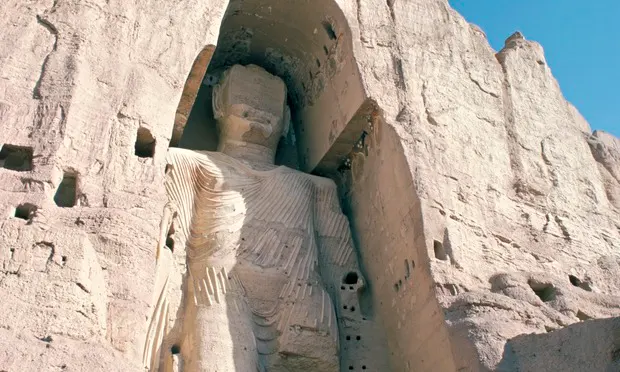
➼ Gandharan
- Details
- By Buddha from Bamiyan
- 400–800; destroyed in 2001
- cut rock with plaster and polychrome paint,
- Found in Afghanistan
- Form and Content
- First colossal Buddhas.
- Two huge standing Buddhas, one 175 feet tall, the other 115 feet tall.
- Smaller Buddha: Sakyamuni, the historical Buddha.
- Larger Buddha: Vairocana, the universal Buddha.
- Niche shaped like a halo—or mandorla—around the body.
- Buddhas originally covered with pigment and gold.
- Cave galleries weave through the cliff face; some contain wall paintings and painted images of the seated Buddha.
- Function
- Pilgrimage site linked to the Silk Road.
- Pilgrims can walk through the cave galleries into passageways that lead to the level of the Buddha’s shoulders.
- Legs are carved in the round; originally pilgrims were able to circumambulate.
- Caves were part of a vast complex of Buddhist monasteries, chapels, and sanctuaries.
- Context
- Located near one of the largest branches of the Silk Road.
- Bamiyan, situated at the western end of the Silk Road, was a trading and religious center.
- These Buddhas served as models for later large-scale rock-cut images in China.
- Destroyed by the Taliban in an act of iconoclasm in March 2001.
- Image
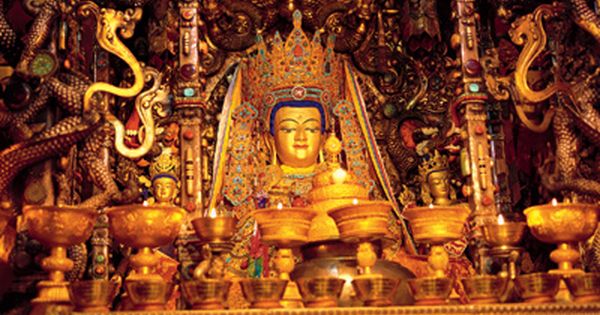
➼ Jowo Rinpoche enshrined in the Jokhang Temple
- Details
- From Yarlung Dynasty
- believed to have been brought to Tibet in 641
- gilt metals with semiprecious stones, pearls, and paint; various offerings
- Found in Lhasa, Tibet
- History
- Statue thought to have been blessed by the Buddha himself; believed to have been crafted in India during his lifetime; said to have his likeness.
- Believed to have been brought to Tibet in 641.
- Temple founded in 647 by the first ruler of a unified Tibet.
- Disappeared in 1960s during China’s Cultural Revolution.
- In 1983, the lower part was found in a rubbish heap and the upper part in Beijing; restored in 2003.
- Enshrined in the Jokhang Temple, Tibet’s earliest and foremost Buddhist temple.
- Function
- Served as a proxy for the Buddha after his departure from this world.
- Often decorated, clothed, and presented with offerings.
- Context
- Depiction of Buddha Sakyamuni as a young man around the age of twelve.
- Most sacred and important Buddhist image in Tibet.
- Jowo means “lord.”
- Khang means “house.”
- Image
Buddhist Architecture
- The stupa is the main place of early Buddhist worship and is a mound-shaped shrine without an interior.
- It is a reliquary that contains sacred objects, and worshippers gain spiritual merit by being in close proximity to it.
- The worshipper ascends a staircase from the base to the drum, while walking in a clockwise or easterly direction.
- The stupa's distinctive shape, like a giant hemisphere, and the direction of prayer with the sun, give it cosmic symbolism.
- The stupa represents Mt. Meru, the mountain at the center of the world in Buddhist cosmology that connects the earth and the heavens.
- Stupas, like the one at Sanchi, have a central mast of three umbrellas at the top, symbolizing the three jewels of Buddhism.
- The square enclosure around the umbrellas symbolizes a sacred tree surrounded by a fence.
- Four toranas at the cardinal points of the compass act as elaborate gateways to the structure.
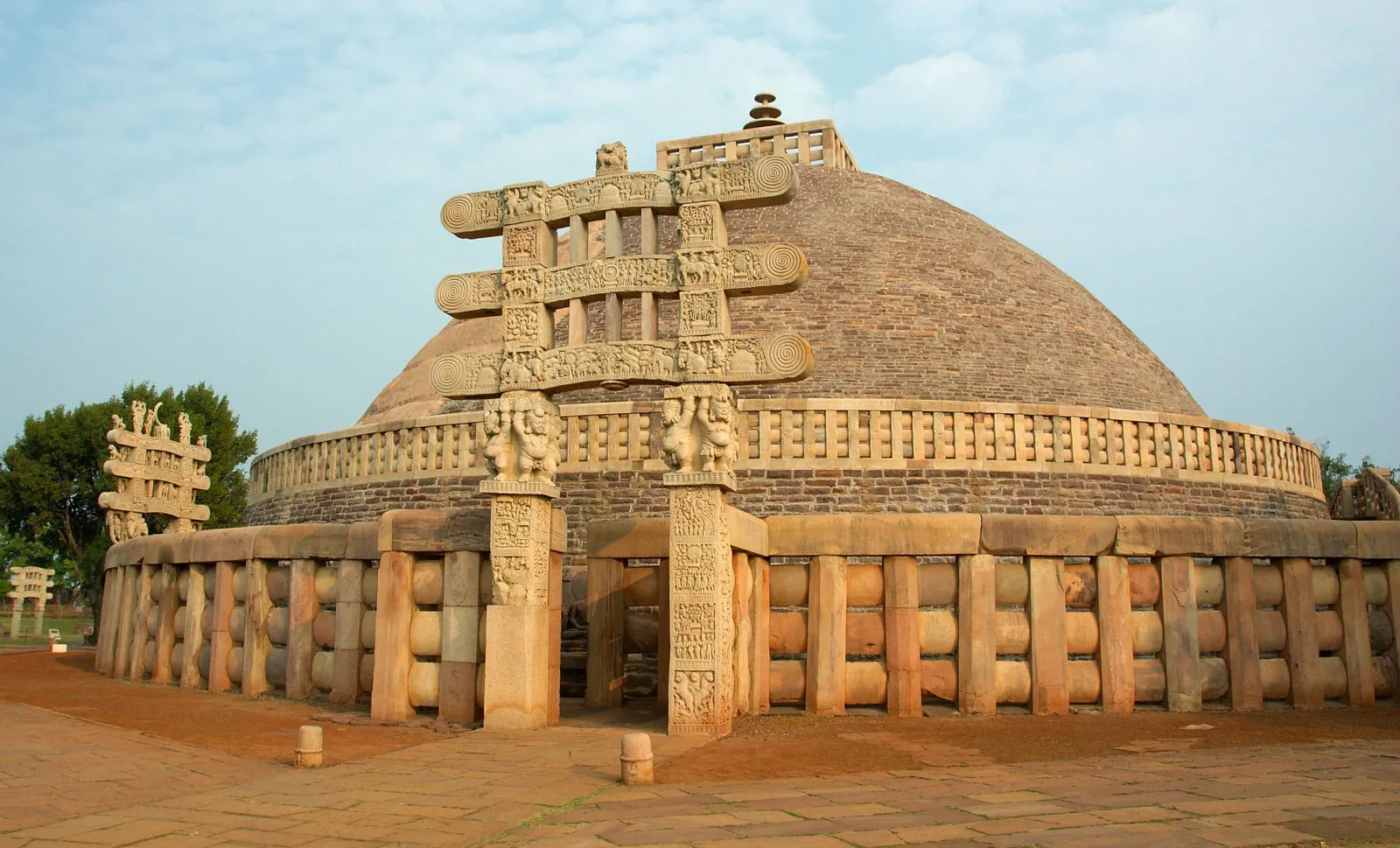
➼ Great Stupa
- Details
- From Buddhist, Mauyra, late Sunga Dynasty
- 300 B.C.E.–100 C.E.
- stone masonry, sandstone on dome, Sanchi
- Found in Madhya Pradesh, India
- Function
- Pilgrimage site.
- A Buddhist shrine, mound shaped and faced with dressed stone containing the relics of the Buddha.
- The worshipper circumambulates the stupa clockwise along the base of the drum; circular motion suggests the endless cycle of birth and rebirth.
- Form
- Three umbrellas at the top represent Buddha, Buddha’s law, and monastic orders.
- A railing at the crest of the mound surrounds the umbrellas, symbolically representing a sacred tree.
- Double stairway at the south end leads from base to drum, where there is a walkway for circumambulation.
- Originally painted white.
- Hemispherical dome is a replication of the dome of heaven. Seated Buddha from second level from the Later Gupta period.
- Toranas
- Four toranas, or gateways, at cardinal points of the compass, grace the entrances.
- The orientation of the toranas (east, south, west, and north) and the direction of ritualistic circumambulation correspond with the direction of the sun’s course: from sunrise to zenith, sunset, and nadir.
- Torana: richly carved scenes on the architraves:
- Buddha does not appear himself but is symbolized by an empty throne or a tree under which he meditated.
- Some of these reliefs may also represent the sacred sites where Shakyamuni Buddha visited or taught others about the jataka stories or past lives of the Buddha.
- Horror vacui of composition.
- High-relief sculpture.
- Pre-Buddhist Yakshi figures symbolize fertility.
- Context: Donors’ names are carved into the monument: 600 inscriptions reveal the project was funded by women as well as men, common people as well as monks.
- Images
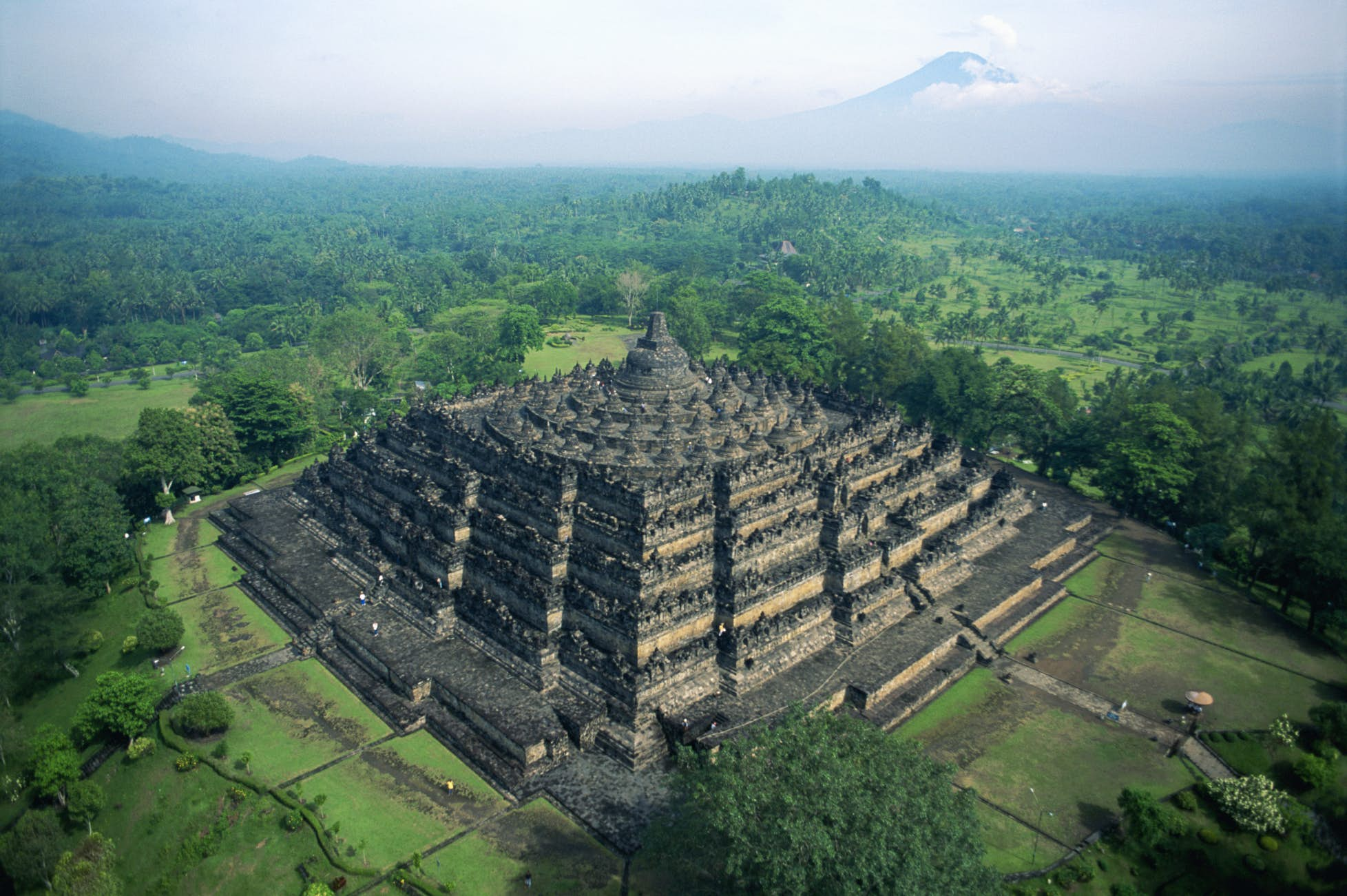
➼ Borobudur Temple
- Details
- From Sailendra Dynasty
- c. 750–842
- volcanic stone masonry
- Found in Central Java, Indonesia
- Form
- Pyramid in form; aligned with the four cardinal points of the compass.
- Square-shaped plan with four entry points.
- Rubble faced with carved volcanic stone.
- Built on a low hill rising above a wide plain.
- Content
- This massive Buddhist monument contains 504 life-size Buddhas, 1,460 narrative relief sculptures on 1,300 panels 8,200 feet long.
- 72 openwork stupas containing a Buddha, each with a preaching mudra.
- Six identical square terraces are placed one atop the other, like steps;
- three smaller circular terraces are placed on top;
- the lowest level functions as the base of the structure, with a square floor plan;
- the second level recedes 23 feet from the edge of the base so that the space is wide enough for processions.
- Each terrace is a level of enlightenment.
- On the top is an enclosed stupa.
- Divided into three sections, representing three levels of Buddhist cosmology:
- Base: represents the lowest level of experience;
- those who are aligned with their desires on Earth;
- the world of desire and negative impulses;
- sculptures here show the deeds of self-sacrifice practiced by the Buddha in his previous births and the story of his last incarnation as Prince Siddhartha.
- Body: five terraces in which people abandon their earthly desires;
- this is the world of forms—people have to control these negative impulses;
- sculptures here show the pilgrimage of the young man, Sudhana, who sets out in search of the Ultimate Truth.
- Superstructure: an area that represents a formless world, in which a person experiences reality in its purest stage, where the physical world and worldly desire are expunged.
- Function
- A place of pilgrimage.
- Built as a stupa.
- Context
- Meant to be circumambulated on each terrace; six concentric square terraces topped by three circular tiers with a great stupa at the summit.
- Iconographically complex and intricate; many levels of meaning.
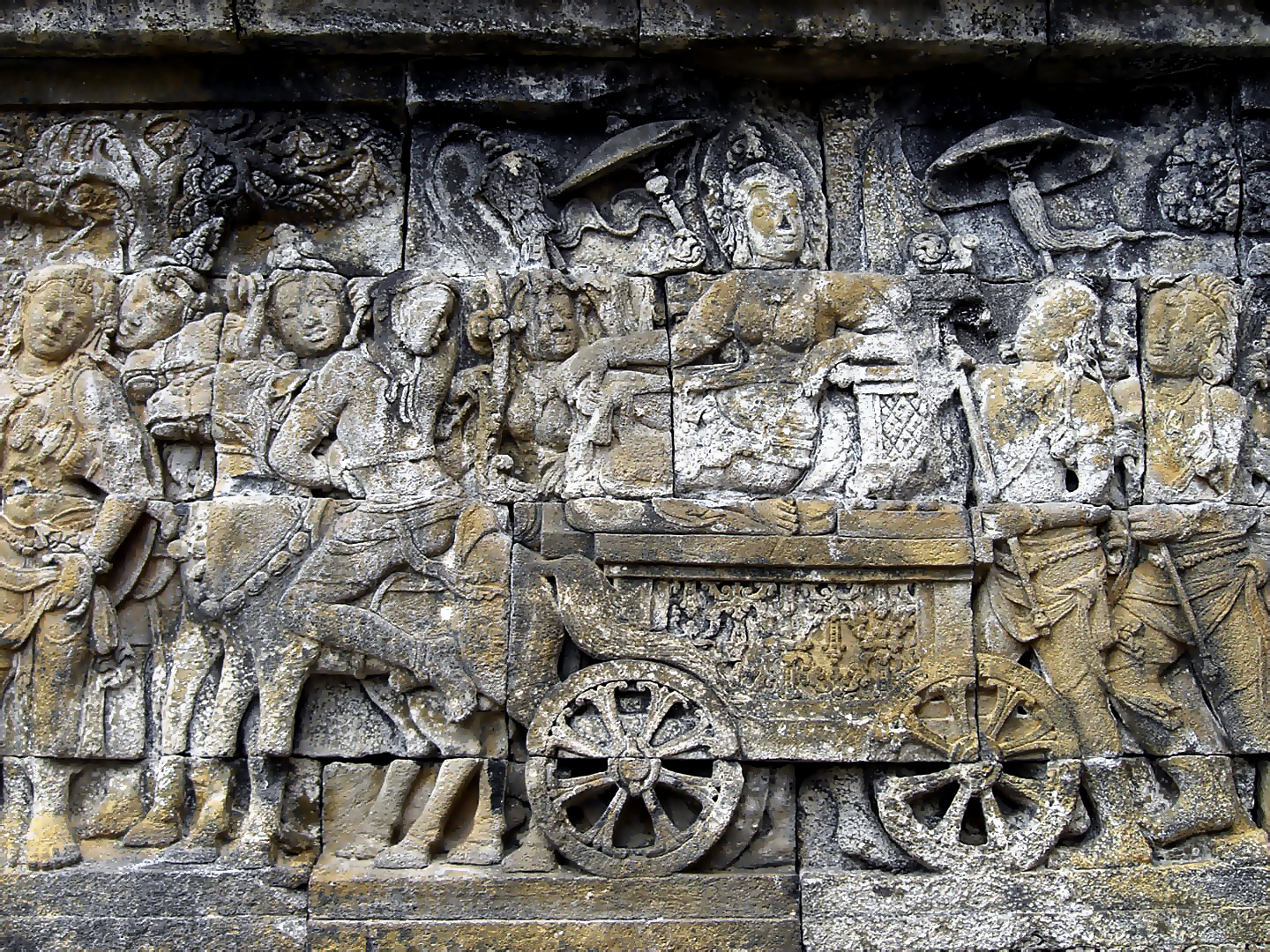
- Queen Maya riding a horse carriage retreating to Lumbini to give birth to Prince Siddhartha Gautama
- Densely packed scene; horror vacui.
- The queen is majestic and at rest before giving birth.
- Ready to give birth to her son, Prince Siddhartha Gautama, the Buddha.
- She is brought to the city in a great ceremonial procession.
- Images
Hindu Philosophy and Art
- Hinduism is a complex religion with many sects, each devoted to the worship of one of its many gods.
- The religion's name is an umbrella term meaning "the religions of Hindustan (India)".
- Folk beliefs and sophisticated philosophical schools coexist within Hinduism.
- All forms of Hinduism focus on the infinite variety of the divine, whether it is expressed in the gods, in nature, or in other human beings.
- Orthodox Hindus accept the Vedic texts as divine in origin and maintain aspects of the Vedic social hierarchy, which assigns a caste of ritual specialists known as Brahmins to officiate between the gods and humankind.
- Every Hindu is to lead a good life through prayer, good deeds, and religious devotion to break the cycle of reincarnation.
- Shiva is one of the principal Hindu deities, who periodically dances the world to destruction and rebirth.
- Other important deities include Brahma, the creator god; Vishnu, the preserver god; and the great goddesses who are manifest as peaceful consorts, like Laksmi and Parvati.
Hindu Sculpture
- Temple sculpture is integrated with the architecture of the building.
- Mithuna, pairs of divine couples, are depicted on some temple exteriors and doorways.
- Sexual allusions are common but not obscene.
- Hindu sculptures emphasize the curves and lines of the body and often depict dance poses.
- Temple surfaces are ornamented with organic and geometric designs, such as lotus flowers, temple bells, and pearls.
- Images inside the temple are considered idols and are treated with respect and deference.
- Worshippers experience the divine through seeing the invoked image, or darshan, and performing puja, a ritual offering to the deity, which is mediated by temple priests.
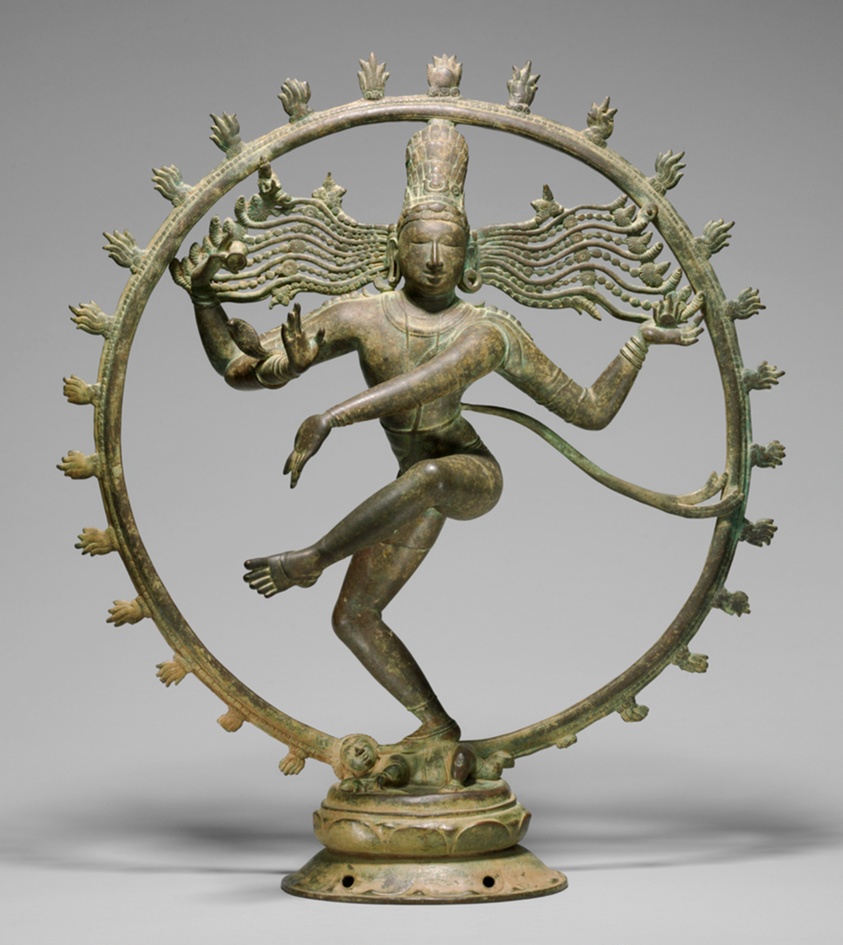
➼ Shiva as Lord of Dance (Nataraja)
- Details
- From India (Tamil Nadu), Chola Dynasty
- C. 11th century CE
- Cast bronze
- Found in Metropolitan Museum of Art, New York
- Form
- Shiva has four hands.
- One hand sounds the drum that he dances to; another carries a flame of destruction; the other two offer the abhaya mudra, a gesture that allays fear.
- Epicene quality showing an idealized, nearly nude, male figure.
- Flying locks of hair terminate in rearing cobra heads. Often depicted in a flaming nimbus, vigorously dancing with one foot on a dwarf, the Demon of Ignorance.
- Fire around Shiva represents the borders of the Hindu cosmos; covered with flowers when carried in processions.
- Function
- The sculpture becomes the receptacle for the divine spirit when people pray before it; therefore, the sculpture is royally treated with gifts, food, and incense.
- The sculpture can be bathed and clothed.
- A hole is at the bottom of the sculpture for the placement of a pole so that it can be used in processions and covered by flowers.
- Context
- Shiva periodically destroys the universe so that it can be reborn again.
- He unfolds the universe out of the drum held in one of his right hands; he preserves it by uplifting his other right hand in a gesture indicating “do not be afraid.”
- Shiva has a third eye barely suggested between his other two eyes; he once burned the god Kama with this eye.
- The message is that belief in Shiva can achieve salvation.
- The distribution of this figure due to the patronage of a queen, Mahadevi.
- Image
Hindu Architecture
- Hindu temples are not used for congregational worship, but as the residence of a god.
- The temples are solidly built with small interior rooms, with a tiny cella at the center where the sacred statue of the main deity is placed.
- Hindu temples are constructed with thick walls to protect the deity from outside forces.
- Hindu temples have a more vertical character in northern India, with large towers and subsidiary towers imitating the shape at various scales.
- In south India, major temples form "temple cities" with layers of concentric gated walls surrounding a network of temples, shrines, pillared halls, and colonnades.
- Hindu temples found in Cambodia are based on a pyramidal plan with a central shrine surrounded by subshrines and enclosed walls.
- Temple exteriors are covered with sculpture, filling every blank spot on the surface.
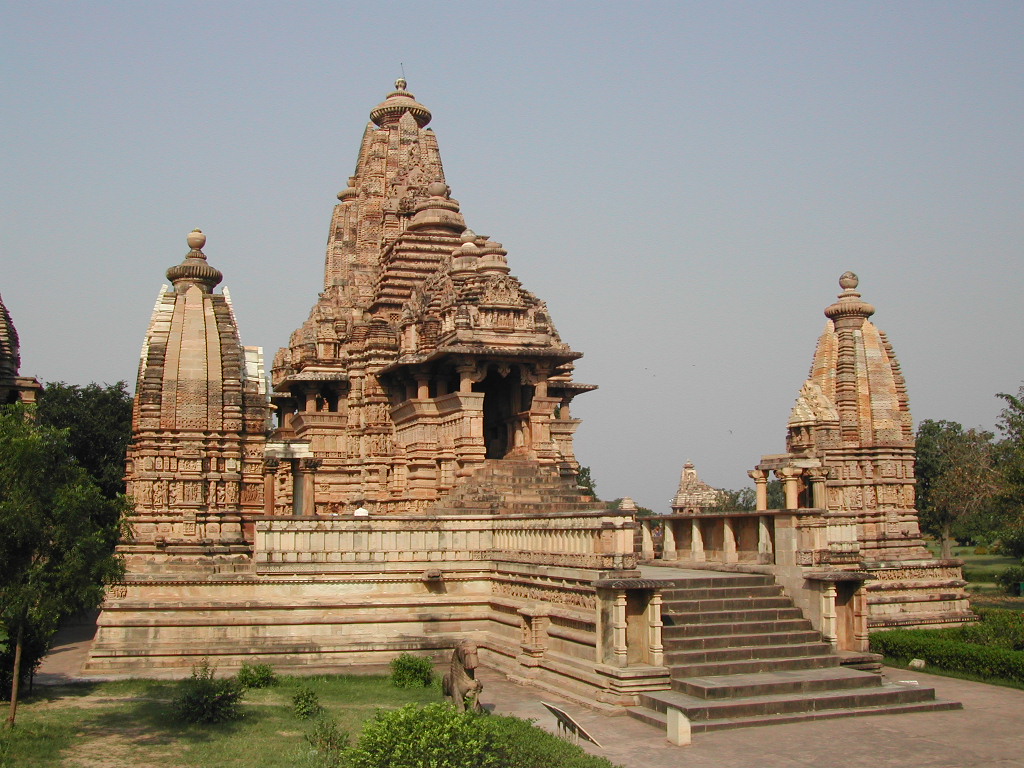
➼ Lakshmana Temple
- Details
- From Chandella Dynasty
- 930–950
- sandstone
- Found in Khajuraho, India
- Form
- The temple is placed on a high pedestal, or plinth, to be seen from a distance. It appears like rising peaks of a mountain range.
- Compact proportions.
- East/west axis: it receives direct rays from the rising sun.
- The building is a series of shapes that build to become a large tower; complicated intertwining of similar forms called a shikara.
- In the center is the “embryo” room containing the shrine.
- The embryo, called a garbha griha, is very small with only space enough for a limited number of people. It is meant for individual—not congregational—worship.
- Materials: Ashlar masonry; made of fine sandstone.
- Sculpture
- Bands of horizontal moldings unite the temple.
- The sculpture on the surface harmoniously integrates with the architecture.
- The figures are sensuous with revealing clothing.
- Erotic poses symbolize regeneration.
- Sexuality is frankly expressed.
- Function
- It is a Hindu temple grouped with a series of other temples in Khajuraho.
- The temple is dedicated to Vishnu.
- Patron: Yashovarman, a leader in the Chandella Dynasty, built the temple to legitimize his rule; completed by his son, Dharga, after his death.
- Context: Worshippers move in a clockwise direction starting at the staircase to circumambulate the temple.
- Image
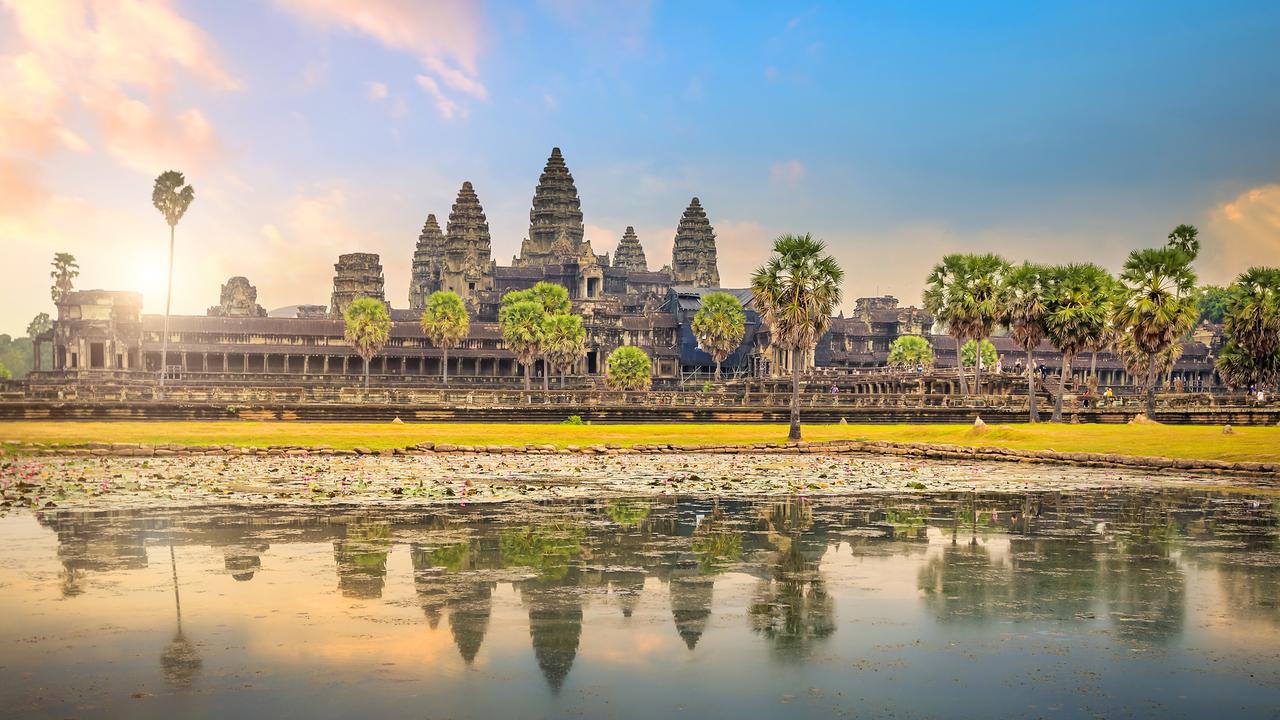
➼ Angkor Wat Temple
- Details
- The temple of Angkor Wat, and the city of Angkor Thom
- From Angkor Dynasty
- c. 800–1400
- stone masonry, sandstone
- Found in Cambodia
- Form
- Main pyramid is surrounded by four corner towers; a temple-mountain.
- Corbelled gallery roofs; influenced by the Indian use of corbelled vaulting.
- The entire complex is made of stone; most surfaces are carved and decorated.
- Horror vacui of sculptural reliefs.
- Sculpture in rhythmic dance poses; repetition of shapes.
- Function
- Dedicated to Vishnu; most sculptures represent Vishnu’s incarnations.
- May have been intended to serve as the king’s mausoleum.
- Hindu temples functioned primarily as the home of the god.
- Patronage
- Angkor Wat was the capital of medieval Cambodia, built by King Suryavarman II.
- The complex was built by successive kings, who installed various deities in the complex.
- The kings often identified themselves with the gods they installed.
- Context
- The complex has a mixed Buddhist/Hindu character.
- Mountain-like towers symbolize the five peaks of Mount Meru, a sacred mountain said to be the center of the spiritual and physical universe in both Buddhism and Hinduism.
- Image
Painting
- Indian painting excels in miniature watercolor illustrations on paper, used for book illumination or as individual album leaves.
- The Rajput School is a famous Indian painting school that illustrated Hindu myths and legends, especially the life of Krishna.
- Indian painting also focuses on individual portraits with immediacy and freshness, and compositions tend to be crowded and colorful.
- Perspective is upwardly tilted to show the surface of objects, while floral patterns contribute to the richness of expression.
- Figures are delicately painted and seem small compared to the landscape, with a doll-like character that adds to the fairy-tale-like quality of the stories being illustrated.
- Indian painting has a heightened and intense use of color, with black lines outlining figures, and figures often gesticulate wildly to show a wide range of emotions.
- Nature is viewed as friendly and restorative, and Indian painting is generally anonymous, with few known artist names even among the greatest masters.
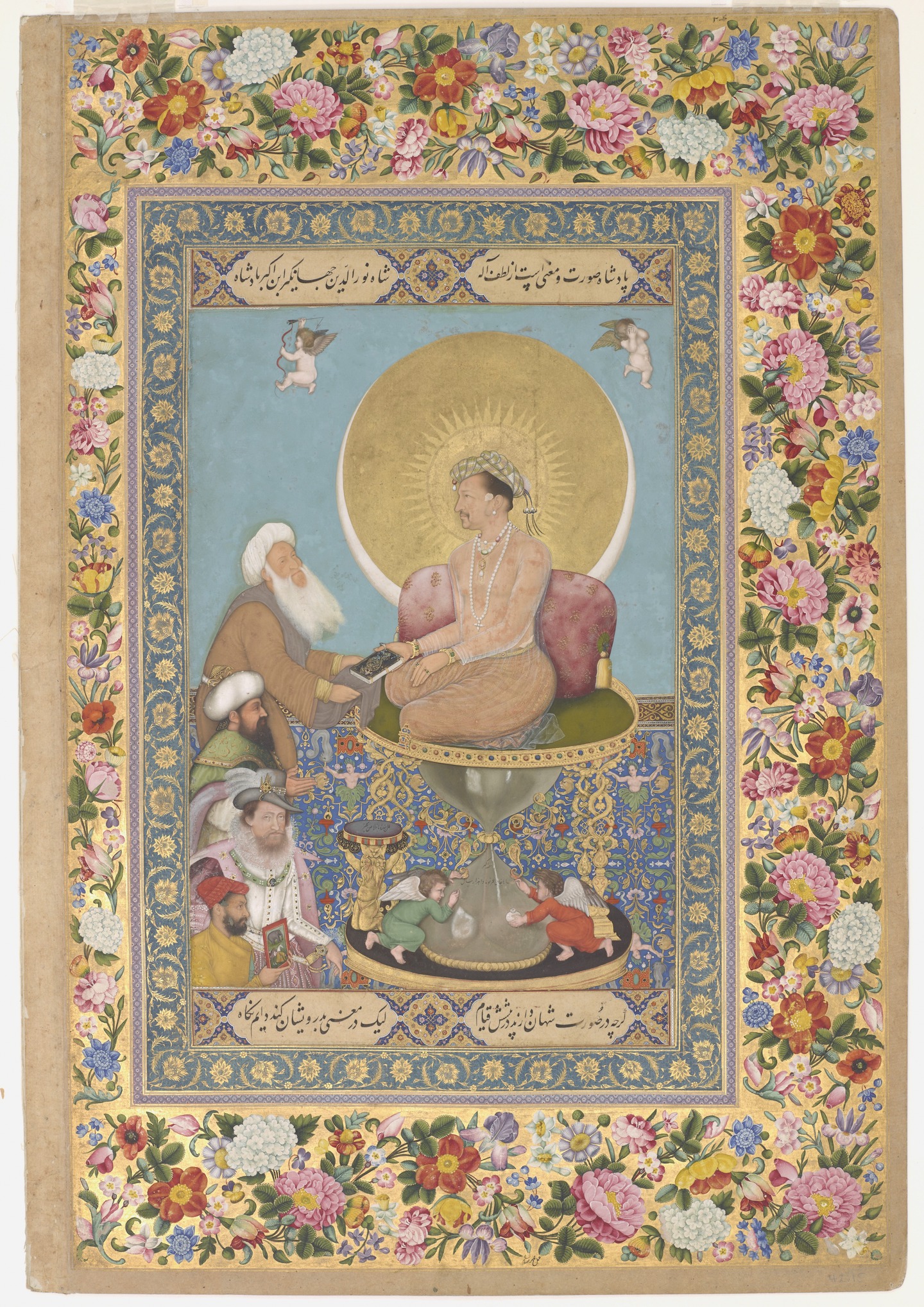
➼ Jahangir Preferring a Sufi Shaikh to Kings
- Details
- By Bichitr
- c. 1620
- watercolor, gold, and ink on paper
- Found in Freer Gallery of Art, Washington, D.C.
- Content
- Jahangir is the source of all light; he is surrounded by a halo of the sun and moon.
- Jahangir is near the end: seated on an hourglass throne; sands of time running out.
- Jahangir wears a single pearl as a devotion to an eleventh century saint.
- Sufi Sheik is handed a book by Jahangir, or perhaps the holy man is handing Jahangir the book—the book is placed on a cloth so that the sheik does not touch Jahangir.
- The sheik was the superintendent of the shrine at Ajmer, where Jahangir lived from 1613–1616.
- Holy men are placed above and rank higher than all others; the painting is thought to represent the importance of spiritual life over worldly power.
- The Ottoman sultan (not a real portrait) is placed higher than James I, but shows deference to Jahangir.
- James I of England is in the lower left-hand corner; less important than Jahangir, as his position implies; the portrait based on a diplomatic gift probably by artist John de Critz, given by ambassador Sir Thomas Roe.
- The artist, a Hindu, holds a miniature with two horses and an elephant—perhaps gifts from his patron.
- The artist is in lower left-hand corner; he symbolically signs his name on the footstool beneath Jahangir.
- Quotations
- Quotation, in frame: “Though outwardly shahs stand before him, he fixes his gazes on dervishes.”
- Angels wish Jahangir a long life by writing on the hourglass, “O Shah, may the span of your life be a thousand years.”
- Context
- Jahangir had many artists follow him wherever he went; he wanted everything recorded.
- He sought to bring together things from distant lands.
- Cross-cultural influences from Europe: a Renaissance carpet is in the background; figures of small cherubs are copied from European paintings; there is a halo behind Jahangir.
- Great interest in the Mughal court for European allegorical portraits, techniques, and motifs.
- Image