Animal Diversity II
Cell Development and Fate
Determinate vs Indeterminate Development
Determinate Development: Cell fate is determined early in development.
Indeterminate Development: Cell fate is determined later, allowing for more flexibility in developmental outcomes.
Experimental Studies in Development
Researchers often conduct experiments where they remove or reposition cells in developing embryos (e.g., in frogs and chickens) to observe impacts on growth and differentiation.
Questions include:
Does removing a cell halt development?
Can a cell survive if moved to a different location?
Will the cell retain its original fate or take on a new role due to the surrounding signaling environment?
Embryonic Development Observations
Coel Development:
Cells move apart during development to form the mouth and other structures.
In deuterostomes, cell layers form on top of one another, affecting fate determination.
Challenges in Developmental Studies:
An example discussed involved manipulating a gene in mice to study signaling, where the expression timing was crucial.
New findings can lead to unexpected outcomes, such as brain anomalies instead of cancer.
Clades of Protostomes
Spiralia
Embryos develop using spiral cleavage
Most live in water
Move using cilia or contractions of the body musculature
Two clades
Platyzoans
flatworm - no circulatory (use gas diffusion) or respiratory systems
Lophotrochozoans
Phylum Mollusca
Trochophore: a free-living larva
Lophophore: a horseshoe-shaped crown of ciliated tentacles surrounds the mouth used in filter-feeding
Ecdysozoa
animals that molt
exoskeleton
hard external shell
2 groups
arthropods
nematodes
Excretion + Osmoregulation
Network of fine tubules runs through body
Flame cells located on the side branches
Flagella move water and excretory substances into the tubules and then to pores located between the epidermal cells through which the liquid is expelled
Metabolic wastes are excreted into the gut and eliminated through the mouth
Nervous System and Reproduction
Simple nervous system
Anterior cerebral ganglion and nerve cords
Eyespot can distinguish light from dark
Reproduction
hermaphroditic
sexual reproduction
asexual regeneration
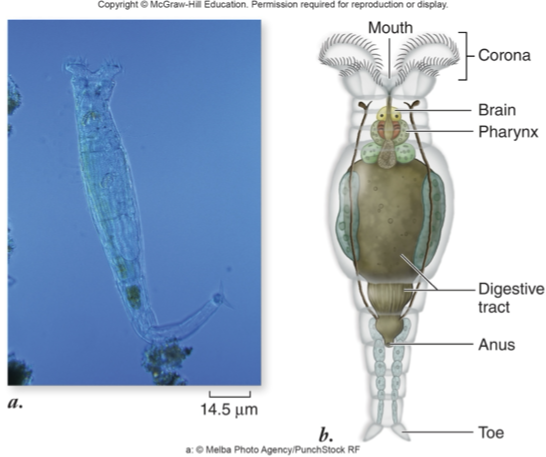
Rotifer
Platyzoans
Bilaterally symmetrical, unsegmented pseudocoelomates
Highly developed internal organs
Corona – “wheel animals”
Conspicuous ring of cilia at anterior end
Used for locomotion and sweeping food into the mouth
Characteristics of Animals
Animal Segmentation:
Repeated patterns observable in evolution, helping characterize different species.
Some organisms show a decentralized nervous system.
Unique Features in Eumetazoans:
Nematocysts used for prey capture are noted characteristics of specific phyla, demonstrating their ecological role.
Gastrovascular Cavity Structure
Observations:
Single opening for intake and digestion, leading to a short gastrovascular cavity.
Example: Capture of prey such as brine shrimp via paralyzing toxins.
Evolutionary Branching in Animals
Understanding how animals branch off evolutionary trees is essential for studying biodiversity and ecosystem dynamics.
Discussion of invasive species and their impact on local ecology was highlighted, emphasizing the importance of environmental monitoring.
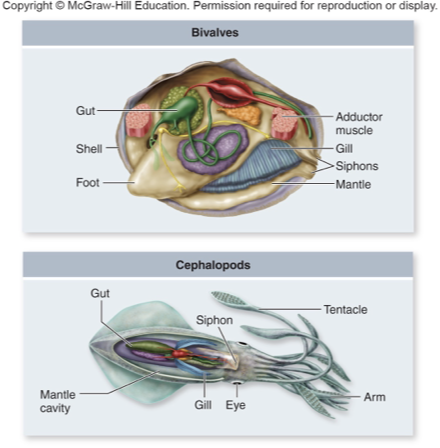
Lophotrochozoa (Mollusks) and their Anatomy
Clams,snails,slugs,octopuses
Mantle
thick epidermal sheet
bounds mantle cavity
secrete shell
Foot
primary means of locomotion
divided into arms or tentacles in cephalopods
Internal Organs
Coelom is reduced
digestive, excretory, and reproductive organs are concentrated in a visceral mass
ctenidia - gills in aquatic mollusks
Circulatory system - open in most mollusks, allowing blood to flow freely through the body cavity.
Mollusk Body Plan
Shell
Protects against predators and adverse environments
Secreted by outer surface of mantle
Clearly not essential – repeated loss or reduction
Typical shell has 2 layers of calcium carbonate
Internal layer may be mother-of-pearl or nacre
Pearls are formed by coating foreign object with nacre to reduce irritation
Radula
Rasping, tonguelike structure used in feeding
Used to scrape up algae
Bivalves do not have a radula
Gills used in filter feeding
Waste Removal and Circulatory System
Nitrogenous waste removal – nephridia
Consist of cilia-lined openings called nephrostomes
Tube to excretory pore to mantle cavity
Circulatory system
Open circulatory system
Hemolymph sloshes around hemocoel
3-chambered heart
Cephalopods have a closed circulatory system
Mollusk Reproduction
Most mollusks are gonochoric (individuals are either male or female)
A few are hermaphroditic
Some oysters change sex
Most engage in external fertilization
Gastropods have internal fertilization
Mollusk zygote undergoes spiral cleavage
Classes of Mollusks
Polyplacophora - Chitons
Gastropoda - limpets, snails, slugs
Bivalvia - clams, oysters, scallops
Cephalopoda - squids, octopuses
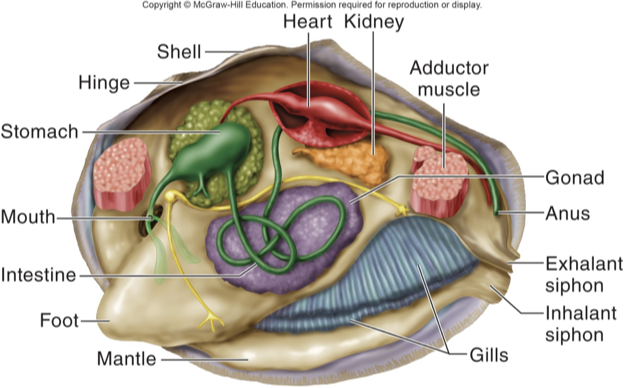
Bivalvia
Includes clams, scallops, mussels, oysters, and others
Most marine, some freshwater
No radula or distinct head
Have 2 shells (valves) hinged together
Adductor muscles counter hinge ligament
Water enters through inhalant siphon and exits through exhalant siphon
Cephalopoda
Only mollusk with closed circulatory system
Foot has evolved into a series of arms equipped with suction cups
Beak-like jaws, toxic saliva
Characteristics of cephalopods differ significantly from bivalves; they have complex behaviors without an external shell.
Functional aspects were demonstrated through dissections, emphasizing anatomical adaptations for mobility and feeding.
Siphons and skin
cephalopods lack external shell
Jet propulsion using siphon
ink can be ejected from siphon
Chromatophores allow for changing skin color for camouflage or communication
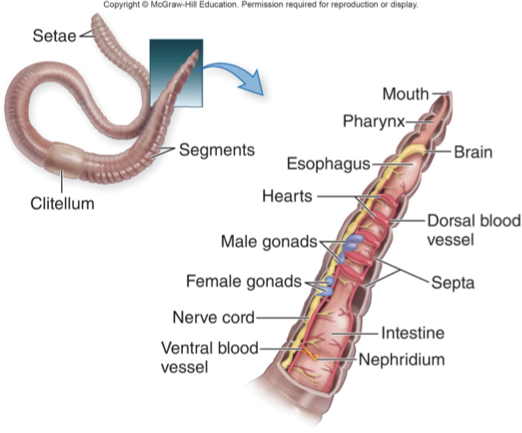
Lophotrochozoans: Phylum Annelida (earthworm)
Segmented worms
Body built of repeated units
Body plan
Head has well-developed cerebral ganglion
Sensory organs in ringlike segments
Many species have eyes
Segments divided internally by septa
Each segment has a pair of excretory organs, a ganglion, and locomotory structure
Closed circulatory system
Ventral nerve cord
Locomotion
Coelomic fluid creates a hydrostatic skeleton
Alternating muscle contractions allows complex movements
Chaetae – bristles of chitin found in most groups
Closed circulatory system
Gas exchange by diffusion across body surfaces
Excretory system – nephridia similar to mollusks
Arthropods Success
Segmentation
In some classes specialized into tagmata
Head, thorax, abdomen
Head and thorax may be fused into cephalothorax or prosoma
Exoskeleton
Made of chitin and protein
Protects against water loss
Must undergo ecdysis – molting
Jointed appendages
May be modified into antennae, mouthparts, or wings
Can be extended and retracted
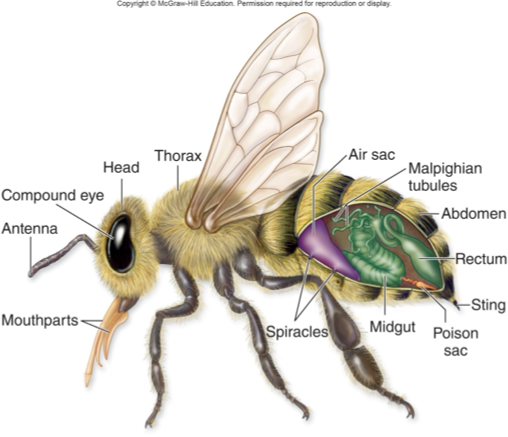
Circulatory and Nervous system and Eyes
Open circulatory system
Nervous system
double chain of segmented ganglia
ventral ganglia control most activity
Compound eyes are found in many arthropods
Composed of independent visual units called ommatidia
Other arthropods have simple eyes, or ocelli
May be in addition to compound eyes
Have single lenses
Distinguish light from darkness