Electron shells and atomic orbitals
Electron shells:
- Formula for the number of electrons each shell can hold 2n^2
- Electrons orbit the nucleus in energy levels or electron shells.
- The energy level is determined by the principal quantum number (n).
- The larger the value for n the further away from the nucleus the shell is and the higher the energy.
| n (quantum number) | shell | number of electrons |
|---|---|---|
| 1 | 1st | 2 |
| 2 | 2nd | 8 |
| 3 | 3rd | 18 |
| 4 | 4th | 32 |
Atomic orbitals:
- Only two electrons can ever be in a single orbital
- The two electrons must have opposite spins
The s-orbitals:
- Spherical in shape
- All shells contain an s-orbital
- S-orbitals can hold 2 electrons
The p-orbitals:
- 3D dumbbell shape
- All shells from n=2 upwards contain 3 p-orbitals
- There are three p orbitals px, py and pz
D and f-orbitals:
- 5 d-orbitals (from n=3 upwards)
- 7 f-orbitals (from n=4 upwards)
| Shell (quantum no.) | s (no. of orbitals) | p | d | f | Max electrons |
|---|---|---|---|---|---|
| 1 | 1 | N/A | N/A | N/A | 2 |
| 2 | 1 | 3 | N/A | N/A | 8 |
| 3 | 1 | 3 | 5 | N/A | 18 |
| 4 | 1 | 3 | 5 | 7 | 32 |
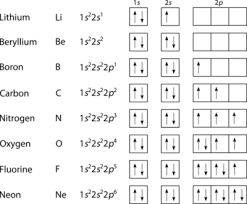
Filling orbitals:
- Lowest energy orbitals are filled first
- Sub-shells are filled singly first
- When all equal energy sub-shells contain one electron they pair up with another electron with an opposite spin