Class 3
Your company explains that they need to cut your
salary due to business problems. They tell you they
will cut it by 10% in 2018 and again by 10% in 2019,
but in 2020 they will raise it by 20%. So in 2020, you
will be making the same amount as you are right
now (2018)
Do you agree? Explain Your reasoning? Prove it!
→ Calculation Breakdown
Assume your initial salary in 2018 is $100 for simplicity.
First Cut (2018):
A 10% cut reduces your salary:Salary after 2018=100−(100×0.10)=100×0.90=90\text{Salary after 2018} = 100 - (100 \times 0.10) = 100 \times 0.90 = 90Salary after 2018=100−(100×0.10)=100×0.90=90
Second Cut (2019):
Another 10% cut is applied to the reduced salary:Salary after 2019=90−(90×0.10)=90×0.90=81\text{Salary after 2019} = 90 - (90 \times 0.10) = 90 \times 0.90 = 81Salary after 2019=90−(90×0.10)=90×0.90=81
Raise (2020):
A 20% increase is applied to the reduced salary:Salary after 2020=81+(81×0.20)=81×1.20=97.2\text{Salary after 2020} = 81 + (81 \times 0.20) = 81 \times 1.20 = 97.2Salary after 2020=81+(81×0.20)=81×1.20=97.2
Final Comparison
Your salary in 2020 is $97.20, which is 2.8% lower than your initial salary of $100.
Conclusion
You will not be making the same amount in 2020 as you were in 2018. The compounding effect of successive cuts and a raise results in a lower overall salary.
Prices of gas in:
1965: 31.2 cents
1975: 56.7 cents
1985: 119.6 cents
How much did gas prices increase between 1975 to
1985?
How much cheaper was gas in 1965 compared to
1975?
1. Gas Price Increase Between 1975 and 1985
To calculate the absolute and relative increase:
Absolute Increase:
Absolute Increase=Price in 1985−Price in 1975\text{Absolute Increase} = \text{Price in 1985} - \text{Price in 1975} Absolute Increase=Price in 1985−Price in 1975Absolute Increase=119.6−56.7=62.9 cents\text{Absolute Increase} = 119.6 - 56.7 = 62.9 \, \text{cents} Absolute Increase=119.6−56.7=62.9cents
Relative Increase:
Relative Increase=(Absolute IncreasePrice in 1975)×100\text{Relative Increase} = \left( \frac{\text{Absolute Increase}}{\text{Price in 1975}} \right) \times 100 Relative Increase=(Price in 1975Absolute Increase)×100Relative Increase=(62.956.7)×100≈110.9%\text{Relative Increase} = \left( \frac{62.9}{56.7} \right) \times 100 \approx 110.9\% Relative Increase=(56.762.9)×100≈110.9%
Answer: Gas prices increased by 62.9 cents (about 111%).
2. How Much Cheaper Gas Was in 1965 Compared to 1975
To calculate the absolute and relative difference:
Absolute Difference:
Absolute Difference=Price in 1975−Price in 1965\text{Absolute Difference} = \text{Price in 1975} - \text{Price in 1965} Absolute Difference=Price in 1975−Price in 1965Absolute Difference=56.7−31.2=25.5 cents\text{Absolute Difference} = 56.7 - 31.2 = 25.5 \, \text{cents} Absolute Difference=56.7−31.2=25.5cents
Relative Difference:
Relative Difference=(Absolute DifferencePrice in 1975)×100\text{Relative Difference} = \left( \frac{\text{Absolute Difference}}{\text{Price in 1975}} \right) \times 100 Relative Difference=(Price in 1975Absolute Difference)×100Relative Difference=(25.556.7)×100≈44.9%\text{Relative Difference} = \left( \frac{25.5}{56.7} \right) \times 100 \approx 44.9\% Relative Difference=(56.725.5)×100≈44.9%
Answer: Gas was 25.5 cents cheaper in 1965 compared to 1975, which is about 45% cheaper.

1. Inflation Rate Between 2007 and 2008
The formula to calculate the inflation rate is:
Inflation Rate=CPI in 2008−CPI in 2007CPI in 2007×100\text{Inflation Rate} = \frac{\text{CPI in 2008} - \text{CPI in 2007}}{\text{CPI in 2007}} \times 100Inflation Rate=CPI in 2007CPI in 2008−CPI in 2007×100
From the table:
CPI in 2007 = 207.3
CPI in 2008 = 215.3
Inflation Rate=215.3−207.3207.3×100=8.0207.3×100≈3.86%\text{Inflation Rate} = \frac{215.3 - 207.3}{207.3} \times 100 = \frac{8.0}{207.3} \times 100 \approx 3.86\%Inflation Rate=207.3215.3−207.3×100=207.38.0×100≈3.86%
Answer: The inflation rate between 2007 and 2008 is approximately 3.86%.
2. Salary Adjustment to Keep Pace with Inflation
If a salary of $50,000 is to keep pace with inflation, it needs to increase by the same percentage as the inflation rate.
Increase in Salary=Current Salary×Inflation Rate\text{Increase in Salary} = \text{Current Salary} \times \text{Inflation Rate}Increase in Salary=Current Salary×Inflation RateIncrease in Salary=50,000×0.0386=1,930\text{Increase in Salary} = 50,000 \times 0.0386 = 1,930Increase in Salary=50,000×0.0386=1,930New Salary=Current Salary+Increase in Salary=50,000+1,930=51,930\text{New Salary} = \text{Current Salary} + \text{Increase in Salary} = 50,000 + 1,930 = 51,930New Salary=Current Salary+Increase in Salary=50,000+1,930=51,930
Answer: The salary would need to increase by $1,930 in absolute terms to keep pace with inflation.
]
Lie Detector / Polygraph
Should polygraph tests be used as an acceptable form of evidence in a criminal trial?
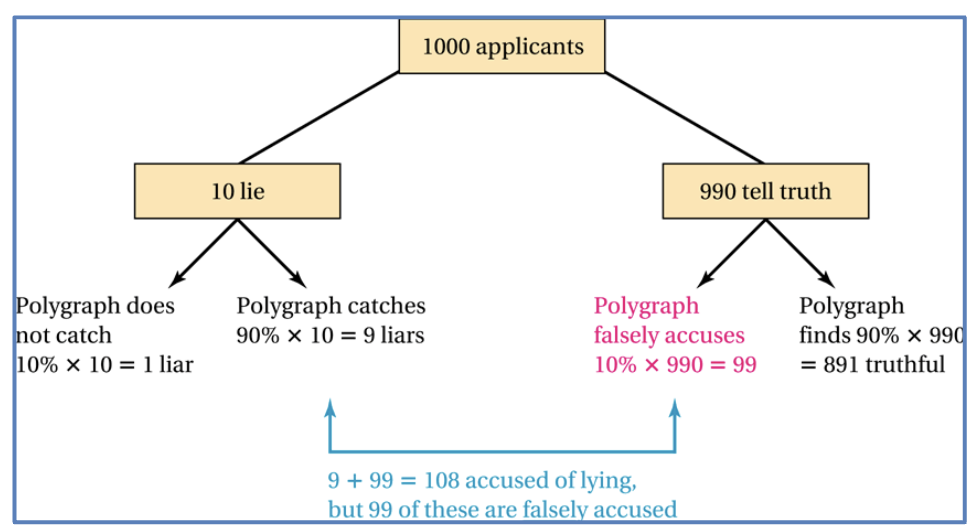
Suppose that 1000 job applicants take a
polygraph test, 1 in 100 lie, and the
polygraph is 90% accurate. How many of
those applicants who were accused of
lying were actually telling the truth?
Positive = Lie
Negative = Truth
→ Total number of applicants = 1000
Proportion who lie = 1 in 100, so P(Lie)=1100=0.01P(\text{Lie}) = \frac{1}{100} = 0.01P(Lie)=1001=0.01
Proportion who tell the truth = 99 in 100, so P(Truth)=99100=0.99P(\text{Truth}) = \frac{99}{100} = 0.99P(Truth)=10099=0.99
Polygraph accuracy = 90%, meaning:
If someone lies, the test will correctly identify them as lying 90% of the time: P(Positive test∣Lie)=0.9P(\text{Positive test} | \text{Lie}) = 0.9P(Positive test∣Lie)=0.9
If someone tells the truth, the test will correctly identify them as truthful 90% of the time, meaning the false positive rate is 10%: P(Positive test∣Truth)=0.1P(\text{Positive test} | \text{Truth}) = 0.1P(Positive test∣Truth)=0.1
We need to calculate the number of applicants who were accused of lying (i.e., those with a positive test result) but were actually telling the truth.
Bayes' Theorem Formula:
Bayes' Theorem helps us calculate the probability of being truthful given a positive test result:
P(Truth∣Positive test)=P(Positive test∣Truth)×P(Truth)P(Positive test)P(\text{Truth} | \text{Positive test}) = \frac{P(\text{Positive test} | \text{Truth}) \times P(\text{Truth})}{P(\text{Positive test})}P(Truth∣Positive test)=P(Positive test)P(Positive test∣Truth)×P(Truth)
Where:
P(Positive test)P(\text{Positive test})P(Positive test) is the total probability of getting a positive test, which can be calculated using the law of total probability:
P(Positive test)=P(Positive test∣Lie)×P(Lie)+P(Positive test∣Truth)×P(Truth)P(\text{Positive test}) = P(\text{Positive test} | \text{Lie}) \times P(\text{Lie}) + P(\text{Positive test} | \text{Truth}) \times P(\text{Truth})P(Positive test)=P(Positive test∣Lie)×P(Lie)+P(Positive test∣Truth)×P(Truth)
Now, let's calculate step by step.
Out of the applicants who were accused of lying (those with a positive test result), approximately 99 were actually telling the truth.
Test Results
true positive → A test correctly reports a positive
result
false positive → A test incorrectly reports a
positive result
true negative → A test correctly reports a
negative result
false negative → A test incorrectly reports a
negative result
Lie Detector /Polygraph