IC103 Lecture 6.docx
IC103
Introductory Economics for Business and Finance
Lecture 6
Nur Amalina Binti Borhan




Reading (S/G/G, 10th ed.)




- Section 17.1
o except boxes 17.1, 17.2,“Looking at the Maths” in page 525.
- Box 17.3 is optional
- Section 17.2 (including threshold concept 15),
- “Looking at the Maths” on page 535 excluded,
- Box 17.4 on page 537 is optional
- Exclude “The multiplier: some qualifications” on page 537)
- Section 17.4

Section 1 National Income Determination
The circular flow of income model
3
The Circular Flow of Income INNER FLOW
Firms




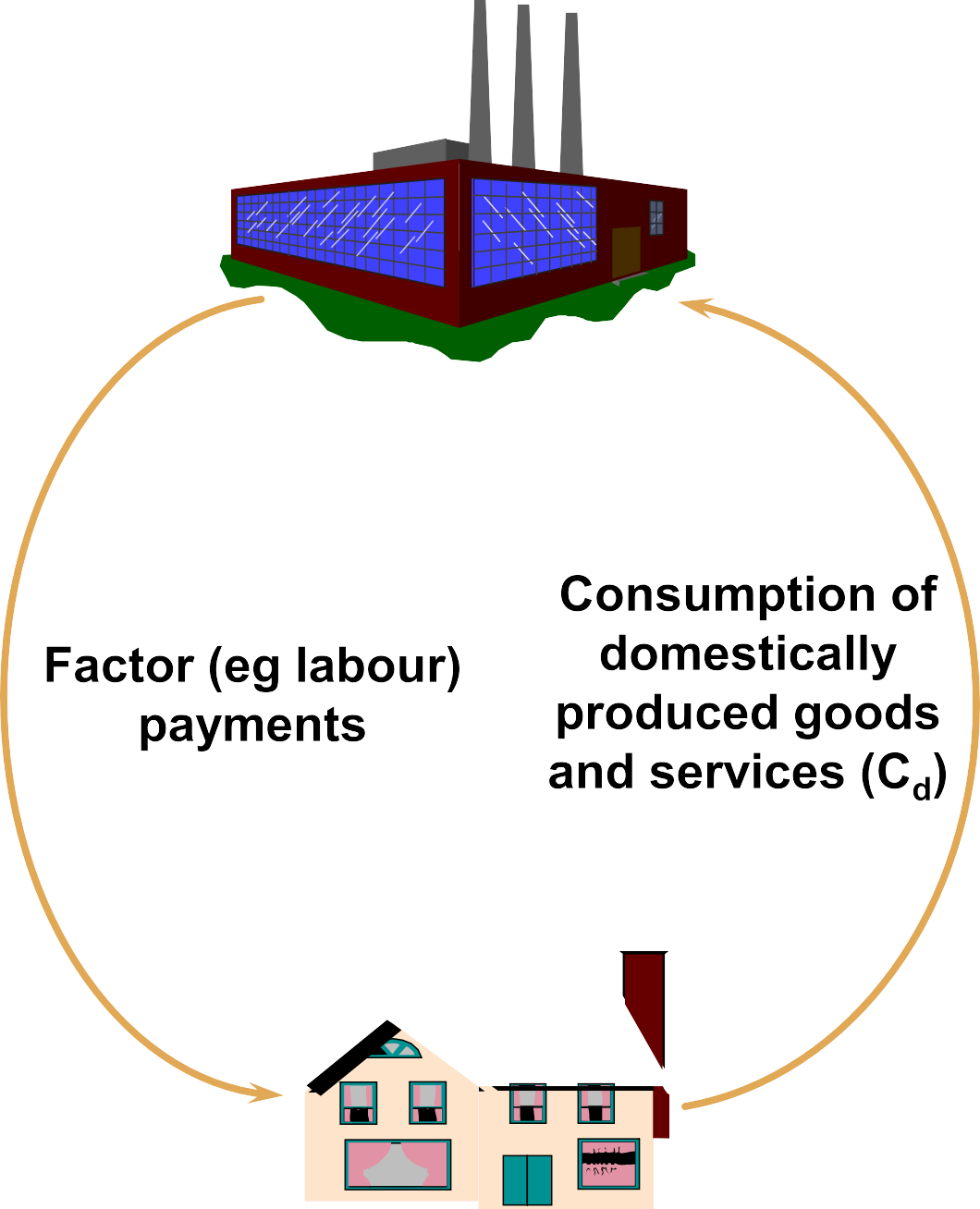



Households
The circular flow of income
Equilibrium: Withdrawals= Injections
Economy
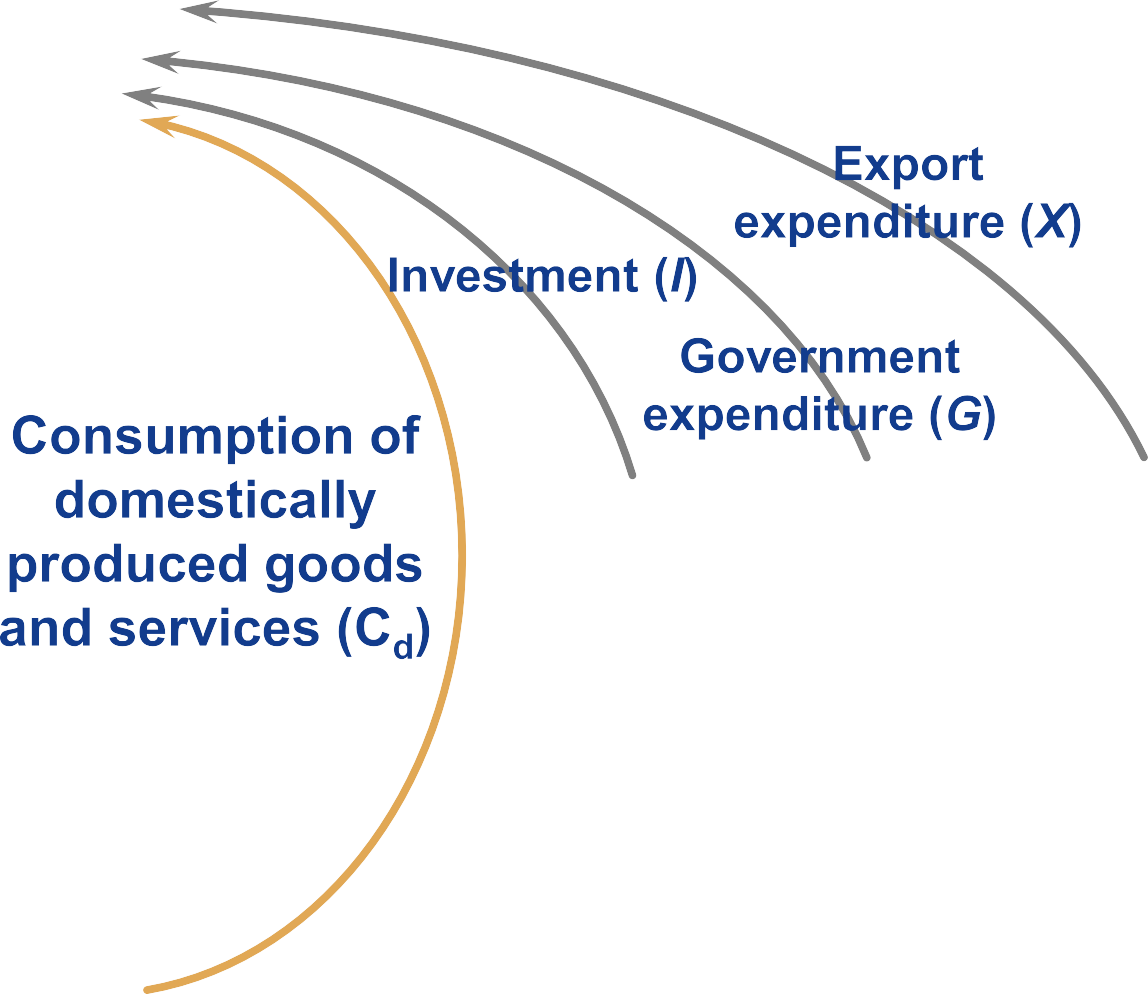
INJECTIONS
BANKS, etc
GOV.
ABROAD
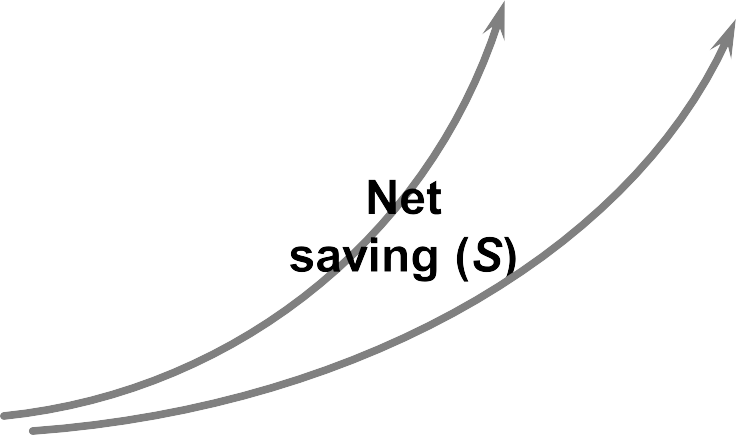
Net saving (S)
Net taxes (T)
Import
expenditure (M)
















WITHDRAWALS




- Withdrawals (W)
Leakage from the circular flow, reducing the funds available for economic activity.
- Net savings (savings minus borrowing) (S)

Saving- deposits in banks or other financial institutions
- Net taxes (taxes minus benefits) (T)

Net Taxes = Taxes on Households - Transfer Payments
Transfer payment-social welfare program from government
- Import expenditure (M)
Money will eventually flow out of the domestic economy to foreign producers as payments for imported goods and services.
- Injections (J)
money entering the circular flow, boosting the economic activity
- Investment (I)
Firm spending on capital goods (e.g. machinery, equipment, buildings, and infrastructure)

- Government expenditure (G)
Government spending on goods and services for public services (e.g. healthcare;
education; defence )
- Export expenditure (X)
Firms also sell goods and services abroad
Withdrawals (W)= Net saving (S) + Net taxes (T) + Import expenditure (M) Injections (J) = Investment (I) +Government purchase (G)+Export expenditure (X)
- The relationship between injections and withdrawals
Equilibrium in the circular flow: Withdrawals (W)=Injections (J)
- If injections (J) > withdrawals(W), more spending, aggregate demand, aggregate supply national income (e.g. payment to households) and economy grows. Then S,T, M will until W=J.
Withdrawals (W)= Net saving (S) + Net taxes (T) + Import expenditure (M) Injections (J) = Investment (I) +Government purchase (G)+Export expenditure (X)
- The relationship between injections and withdrawals
Equilibrium in the circular flow: Withdrawals (W)=Injections (J)
- If Injections (J) < withdrawals (W), less spending , aggregate demand aggregate supply, national income and economy slows, S,T, M will until W=J

Section 1 National Income Determination
The Keynesian Theory of Consumption
10
Recall: Aggregate Demand (AD)
- Total spending on goods and services made within a country Spending by consumers, businesses, the government, and foreign buyers on domestically produced goods and services (export).
- AD = Cd + I + G + X
AD = C − IM + I + G + X AD = C + I + G + X − IM =GDP
- Cdomestic = C − spending on imports (IM)
Keynesian economics
Aggregate demand is the primary driver of economic activity in the short run. It determines the level of production (aggregate supply), which in turn influences national income.
- Aggregate demand, also referred to as aggregate expenditure
AD = Cd + I + G + X= Cd + Injection (I+G+X)
- National income is the total income earned by a nation’s residents in the production
of goods and services.
National income (Y) = money earned = money spent= Cd + Withdrawals (S+T+M)
- In Keynesian model, aggregate demand (AD) = national income (Y)
Injection= withdrawals
Keynesian economics
Keynes suggests:
An increase in your income (∆Y) will typically lead to an increase in your spending.
The relationship between consumption and income: Consumption (C)
The Consumption Function




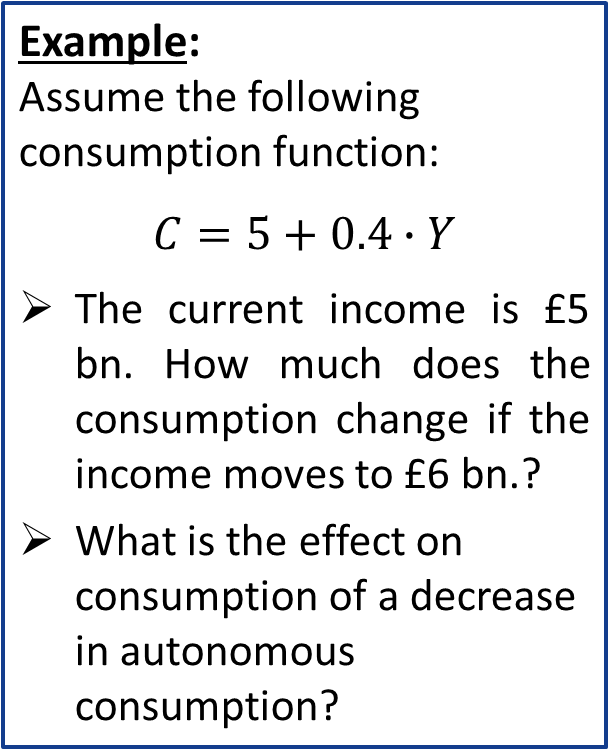
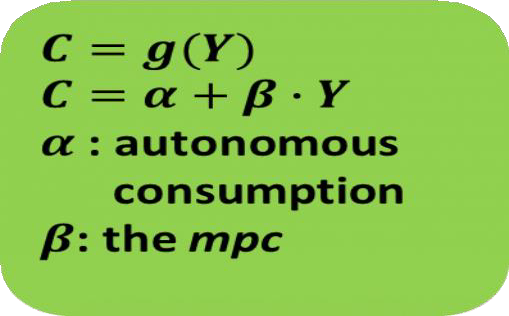
- Consumption (C) is a function of income (C = g(Y))
- Assume that the consumption function is linear:
C = 𝛼 + 𝛽 ∗ Y
- 𝛼 is a constant and represents what people would consume if their disposable income equals zero (autonomous consumption).
- 𝛽 is the marginal propensity to consume (mpc): the fraction of additional current income consumed in current period. (e.g. mpc=0.5: consumption increase by £0.5 for every £1 increase in income)
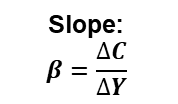
mpc is equal to ΔC/ΔY (i.e., ratio of change in consumption over the change in income), positive, the slope of consumption function
Consumption Function: example
Figure: Consumption and Disposable Income




Income, Y



Consumption, C
42
50
58
66
74
82
90
98
National income
(£bn)
Consumption
(£bn)
0 10
18
34
26
10
20
30
40
50
60
70
80
90
100
110
10 + 0.8 x 60 = 58
National income
(£bn)
Consumption
(£bn)
0 | 10 |
10 | 18 |
20 | 26 |
30 | 34 |
40 | 42 |
50 | 50 |
60 | 58 |
70 | 66 |
80 | 74 |
90 | 82 |
100 | 90 |
110 | 98 |
120
Graphical Illustration
Y= Cd + W
When W=0, Y= Cd
1.The higher the income
Y of country, the more we
expect people to
100
80
Consumption (£bn)
3.The slope of consumption function
tells us how much extra income is spent on extra consumption and this is called marginal propensity to consume(MPC).
45-degree line
C
∆C = 8
∆Y = 10

60
50
40 MPC = ∆C
∆Y
=8/10= 0.8
2. Even income 0,
consumption is positive. WHY?
20
Relationship between Consumption C and domestic Consumption Cd
Y
C
Cd
Cd excludes imports
and indirect taxes.
120
100
80
Consumption (£bn)
60
40
20
Other Determinants of Consumption




- Wealth and consumers’ balance sheet
- Expected future incomes
- Availability of credit
- Consumer sentiment
- Expectations of future prices
- The age of durables
- Taxation

Section 1 National Income Determination
Withdrawals
21
Endogenous vs. Exogenous Variables
- Endogenous variables: variables depend on other variables in the model.
- Exogenous variables: variables not explained within the model but are instead taken as given.
- Withdrawals are endogenously determined
Net savings (S) | Net taxes (T) | Imports (M) | Withdrawals (W) |
Savings function S = f(Y) | Tax function T = f(Y) | Import function T = f(Y) | withdrawals’ function W = f(Y) |
marginal propensity to save: mps = ΔS/ΔY (proportion of income rise that is saved) | marginal tax propensity: mpt= ΔT/ΔY | marginal propensity to import: mpm = ΔM/ΔY | marginal propensity to withdraw: mpw = ΔW/ΔY |
New saving schemes; Determination of consumption | Tax rates | Determination of consumption |
Net savings (S) | Net taxes (T) | Imports (M) | Withdrawals (W) | Consumption (C) |
Savings function S = f(Y) | Tax function T = f(Y) | Import function T = f(Y) | Withdrawals’ function W = f(Y) | Consumption function C = g(Y) |
marginal propensity to save: mps = ΔS/ΔY | marginal tax propensity: mpt= ΔT/ΔY | marginal propensity to import: mpm = ΔM/ΔY | marginal propensity to withdraw: mpw = ΔW/ΔY | marginal propensity to consume: mpc = ΔC/ΔY |
W = S + T + M, hence: mpw = mps + mpt + mpm
Y = Cd + W, hence: mpcd + mpw = 1
The W and Cd Functions
Cd, W


2. When domestic consumption equal to income, withdrawal must be 0, so the slope of the withdrawal functions will be different from the consumption
function.
Cd + W (=Y)
100 Cd
3. Note that given 70
that there
is positive
consumption at 0 W
wealth, there must
been negative withdrawals at 0 wealth.
30
O 100 Y

Section 1 National Income Determination
Injections
26
Injections
- Injections (exogenously determined)
- Unlike withdrawals, Constant in relation to income (not determined by income)
- Investment (I)
- Increased consumer demand
- Expectations
- Credit and interest rates
- Government expenditure (G)
- Determinants: Government objectives (short- and long- run)
- Exports (X)
- Determinants: foreign incomes, exchange
- Cost and efficiency of capital equipment




rates, relative product quality, other

Section 1 National Income Determination
Equilibirum
28
Injections and Withdrawals Functions
Cd, W, J
Equilibrium national income:
W=J
W
J
O Y
Cd, W, J
O


If injections exceed withdrawals,
national income will rise.
J>W, economy will produce more to satisfy
additional expenditure, incomes will rise, more savings, taxes, imports hence W rise (do not forget: W=g(Y))
W
a
J>W
J
b
Y1
Y

Cd, W, J
O


If withdrawals exceed injections,
national income will fall.
J<W, economy will produce less as there is
deficient expenditure, incomes will fall, less
savings, taxes, imports hence W fall
W
c
d
J
J<W
Y2
Y
Cd, W, J
O


Equilibrium national income
is where W = J.
W
x
J
Ye
Y
Cd, W, J


If aggregate expenditure exceeds national income, national income will rise.
Y = Cd + W
E = Cd + J = AD
Cd
J also
above W e
W
f
J
O Y1 Y


If national income exceeds
aggregate expenditure, national income will fall.
Y = Cd + W
g
h
E = Cd + J
Cd
W
J
Y2
Y
J also below W
Cd, W, J
O


Equilibrium national income is
where Y = E (and W = J).
Y = Cd + W
E = Cd + J
Cd
z
W
x
J
Ye
Y
O


Equilibrium National Income




- Equilibrium national income
- Withdrawals equal injections
- Income equals expenditure

Section 2 National Income Determination
The Multiplier
37
Determination of National Income
An increase in the income (∆Y) will typically lead to an increase in consumption (ΔC).
An increase in injection(∆J ) will typically lead to an increase in the income (∆Y).
∆J ∆Y ΔC
Consumption
- The multiplier
The multiplier
function
- The ratio of the change in income relative to the change in injections (i.e.




∆Y/∆J)
Cumulative causation: an initial event can lead to successive changes in other institutions.
The Multiplier: A Shift in Injections (I)
W, J

W
a
J1
Ye
Y
O
W, J
The Multiplier: A Shift in Injections (II)
If gov increase spending, by investing in infrastructure project, this create additional revenue for business. These businesses need to use additional labor. So, therefore, provide additional income to the household. Then, household spends more which leads to additional revenue to the firm. So J increase from J1 to J2.


How much extra income does this processWcreate?
b
J2
a
J
1
O Ye Ye Y
W, J
Multiplier = ΔY / ΔJ
= ΔY / ΔW
= c – a / b – c
- This diagram shows that the
change in J = change in W.




- The withdrawal function is change in W divide by change in Y.
- The multiplier is the inverse of this.
J2
ΔJ a
J1
O Ye
W
b
J2
ΔW
J
c 1
ΔY Ye Y
W, J




Multiplier = ΔY / ΔJ
= ΔY / ΔW
= c – a / b – c
= 1/mpw
b
ΔJ
a
ΔW
c
W
J2
J
1
Ye
ΔY
Ye
Y
J2
1
J
O
Multiplier Formulas




- The multiplier is defined as follows:
k = 1/mpw
- Since: mpw + mpcd = 1 it follows that
k = 1/(1 − mpcd)
- From the above:
- The greater the mpw, the lower the multiplier
- The greater the mpcd, the greater the multiplier
2 80 40
40
4 20 10
10
6 5 2.5
2.5
5 10 5 5
3 40 20 20

Round
ΔJ (£m)
ΔY (£m)
ΔCd (£m)
ΔW (£m)

1
160
160
80
80
4 20 10
10
6 5 2.5
2.5
5 10 5 5
3 40 20 20



Round | ΔJ (£m) | ΔY (£m) | ΔCd (£m) | ΔW (£m) |
1 | 160 | 160 | 80 | 80 |
2 | 80 | 40 | 40 |
Example: The Multiplier
4 20 10
10
6 5 2.5
2.5
5 10 5 5


Round | ΔJ (£m) | ΔY (£m) | ΔCd (£m) | ΔW (£m) |
1 | 160 | 160 | 80 | 80 |
2 | 80 | 40 | 40 | |
3 | 40 | 20 | 20 |
Example: The Multiplier
6 5 2.5
2.5
5 10 5 5



Round | ΔJ (£m) | ΔY (£m) | ΔCd (£m) | ΔW (£m) |
1 | 160 | 160 | 80 | 80 |
2 | 80 | 40 | 40 | |
3 | 40 | 20 | 20 | |
4 | 20 | 10 | 10 |
6 5 2.5
2.5
1
2
160
160
80
80
40
80
40

Round
ΔJ (£m)
ΔY (£m)
ΔCd (£m)
ΔW (£m)
3
4
5
40
20
10
20
10
5
20
10
5
1 320 160
160
1
2
160
160
80
80
40
80
40
3
4
5
40
20
10
20
10
5
20
10
5
Round
ΔJ (£m)
ΔY (£m)
ΔCd (£m)
ΔW (£m)

6
5
2.5
2.5
1
2
160
160
80
80
40
80
40
Round
ΔJ (£m)
ΔY (£m)
ΔCd (£m)
ΔW (£m)
3
4
40
20
20
10
20
10

5
6
10
5
5
2.5
5
2.5
1
320
160
160
W, J
Withdrawals Multiplier
O




A shift in withdrawals
Multiplier = ΔY / ΔW
= c – a / a – b
a
c
W1
W2
J
ΔW
b
Ye1
ΔY
Ye2
Y

Section 3 National Income Determination
The Accelerator
52
Keynesian Analysis of the Business Cycle




- The accelerator
- Instability of investment
- Changes in the national income and induced investment
- The accelerator coefficient (): It = 𝛼 ∆Y
- depends on marginal capital/ output ratio
- Extra investment (I) or change in capital (∆K) to achieve the production of extra output or income ∆Y
Fluctuation in UK Real GDP and Investment
30

GDP
Investment
20
10
Annual % change
0
-10
-20
1960 1965 1970 1975 1980 1985 1990 1995 2000 2005 2010
Source: Based on data in United Kingdom Economic Accounts (National Statistics)
The Accelerator Effect (I)
Year
(extra machines)
0 | 1 | 2 | 3 | 4 | 5 | 6 |
Quantity demanded 1000 by consumers (sales) | 1000 | 2000 | 3000 | 3500 | 3500 | 3400 |
Number of 10 machines required | 10 | 20 | 30 | 35 | 35 | 34 |
Induced investment (Ii) | 0 | 10 | 10 | 5 | 0 | 0 |
The Accelerator Effect (II)
Year
investment (Ir)
0 | 1 | 2 | 3 | 4 | 5 | 6 |
Quantity demanded 1000 by consumers (sales) | 1000 | 2000 | 3000 | 3500 | 3500 | 3400 |
Number of 10 machines required | 10 | 20 | 30 | 35 | 35 | 34 |
Induced investment (Ii) (extra machines) | 0 | 10 | 10 | 5 | 0 | 0 |
Replacement | 1 | 1 | 1 | 1 | 1 | 0 |
The Accelerator Effect (III)
Year
0 | 1 | 2 | 3 | 4 | 5 | 6 |
Quantity demanded 1000 by consumers (sales) | 1000 | 2000 | 3000 | 3500 | 3500 | 3400 |
Number of 10 machines required | 10 | 20 | 30 | 35 | 35 | 34 |
Induced investment (Ii) (extra machines) | 0 | 10 | 10 | 5 | 0 | 0 |
Replacement investment (Ir) | 1 | 1 | 1 | 1 | 1 | 0 |
Total investment (Ii + Ir) | 1 | 11 | 11 | 6 | 1 | 0 |
Period t J Y (Multiplier)
Period t + 1 Y I (Accelerator)
I Y (Multiplier)
Period t + 2 If Yt +1 > Yt then I
If Yt +1 = Yt then I stays the same (Accelerator) If Yt +1 < Yt then I
This in turn will have a multiplied
upward effect, no effect, or a (Multiplier) multiplied downward effect
respectively on national income.
Period t + 3 This will then lead to a further
accelerator effect and so on . . .
Period t
J Y
(Multiplier)
Period t + 1 Y I
I Y
Period t + 2 If Yt +1 > Yt then I
If Yt +1 = Yt then I stays the same (Accelerator) If Yt +1 < Yt then I
This in turn will have a multiplied upward effect, no effect, or a
multiplied downward effect (Multiplier)
respectively on national income.
Period t + 3 This will then lead to a further
accelerator effect and so on . . .
(Accelerator) (Multiplier)
Period t + 1 Y I
I Y
(Accelerator) (Multiplier)
Period t + 2
If Yt +1 > Yt then I
If Yt +1 = Yt then I stays the same If Yt +1 < Yt then I
This in turn will have a multiplied upward effect, no effect, or a multiplied downward effect respectively on national income.
Period t + 3 This will then lead to a further
accelerator effect and so on . . .
(Accelerator)
(Multiplier)
Period t + 1 Y I
I Y
Period t + 2
If Yt +1 > Yt then I
If Yt +1 = Yt then I stays the same
If Yt +1 < Yt then I
(Accelerator)
This in turn will have a multiplied
upward effect, no effect, or a multiplied downward effect respectively on national income.
(Multiplier)
(Accelerator) (Multiplier)
Period t + 3 This will then lead to a further
accelerator effect and so on . . .
Reference




- Sloman, J., Wride, A. and Garratt,D (2018) “Economics” (10th edition)
- Gregory, Mankiw, N. (2017) “Economics” Cengage Textbooks
- Symeonidis, Lazaros (2022) IC103 Introductory Economics for Business and Finance materials