9. Introduction to t-statistics
Introduction to t-statistics, Independent and Related Sample t-test
The t Statistic: An Alternative to z
Z-score: A statistical procedure testing hypotheses about an about an unknown population average/mean using the average/mean from a sample
Basic Concepts:
Sample Mean (M) can be use to determind the approximate of Population Mean (μ).
Standard Error: Measures how well a sample mean approximates the population mean.
Compare sample mean (M) with hypothesized population mean (μ) with z-score calculation.
The Problem with z-Scores
Goal: Determine if the difference between data and hypothesis is significant.
Z-scores require knowledge of the population's standard deviation, which is often unknown.
Using sample standard deviation instead of population standard deviation allows hypothesis testing to proceed
Introduction to t-statistics
Estimated Standard Error (sM): Used as an estimate of the real standard error (σM) when population standard deviation(σ) is unknown, derived from sample variance or standard deviation.
t-statistic Formula
t-statistics/t-value:how far your sample mean is from the population mean, adjusted for the size and variability of your sample.
Usage: Tests hypotheses about an unknown population mean (μ) when population standard deviation(σ) is unknown.
Formula structure is similar to z-score but uses estimated standard error in the denominator.
Types:used in different contexts depending on what you're comparing;
One-sample t-test (comparing a sample mean to a population mean)=
testing a hypothesis about an unknown population mean (μ)
formula:calculate the t-value by comparing the sample mean to the hypothesized population mean, adjusting for the sample size and variability (sample standard deviation)
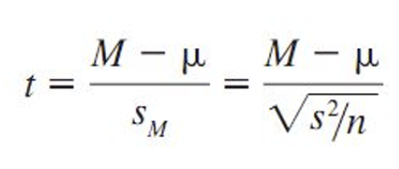
M =sample mean which represents the average of the sample data.
𝜇 =population mean (the hypothesized mean you are testing against)
𝑆 =sample standard deviation, which is used to estimate the population standard deviation.
𝑛 =sample size.
𝑆𝑚 =standard error of the mean, It represents the variability of the sample mean.
*Since you don't know the population's standard deviation, you use the sample's standard deviation to calculate the t-value.
(Two-sample t-test Isn’t in the ppt so it isn’t as important, focus on One-sample t-test)
Two-sample t-test (comparing two sample means)=
comparing means of two samples from different population, often when you want to determine if the two groups come from populations with different means.
formula:measures how far apart the sample means are, adjusted for the variability within each sample and their sizes, difference between the two sample means is statistically significant.
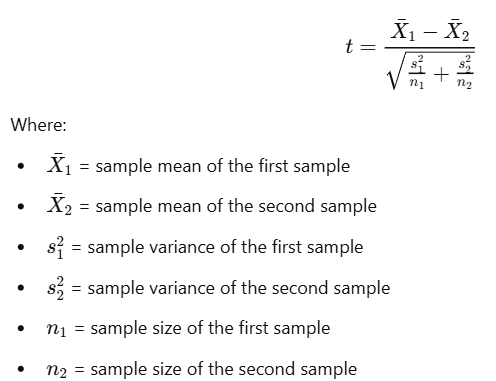
*don't know the population standard deviations, you use the two-sample t-test
Degrees of Freedom (df): counting how many numbers in a set are "free to move" or change without messing up the average
*for sample, not population
first two numbers could vary, but the last number is locked in once the first two are chosen for the average to be the same;
*ex= Imagine you have 3 numbers that must add up to 10. Let’s say:
The first number is 3.
The second number is 4.
Now, the third number must be 3 (because 3+4+3=10)
mean depends on the total. That’s why the formula is:
Degrees of Freedom (df)=n(total number of values in the sample)−1
The t Distributions
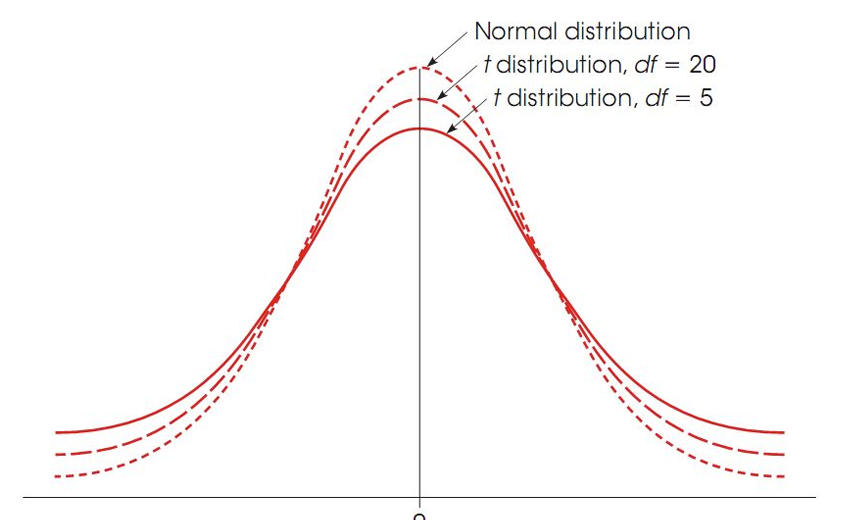
The t distribution=a curve(not a formula) that shows the probability of getting a certain t-value/something more extreme if the null hypothesis is true, based on small samples.
It’s like a normal distribution, but you use it when you don’t know the population standard deviation or working with fewer data points.
t-distribution collects all these t-values to show how they behave for a specific sample size or degrees of freedom
Shape/Curve=
looks like the normal distribution (a bell curve), but it’s a bit wider, especially with smaller sample sizes.
sample size gets bigger, the t-distribution becomes nearly identical to the normal distribution.
Types of Tail:
Proportion in One Tail
A "tail" is the far left or far right end of the curve(probability in one end of the distribution)
probability of tail=
Proportion in one tail = 0.05 or 5% → This is the amount of extreme on one side (0.05 or 5%)
Proportions in Two Tails Combined:
combined probability in both tails(left and right)
*interested in extreme values at both ends of the curve (very low or very high t-values) because either could show that the null hypothesis is unlikely.
probability of tail=
Two tails combined= Left tail + Right tail
proportion of individual tail= Left tail + Right tail
—————————-
2
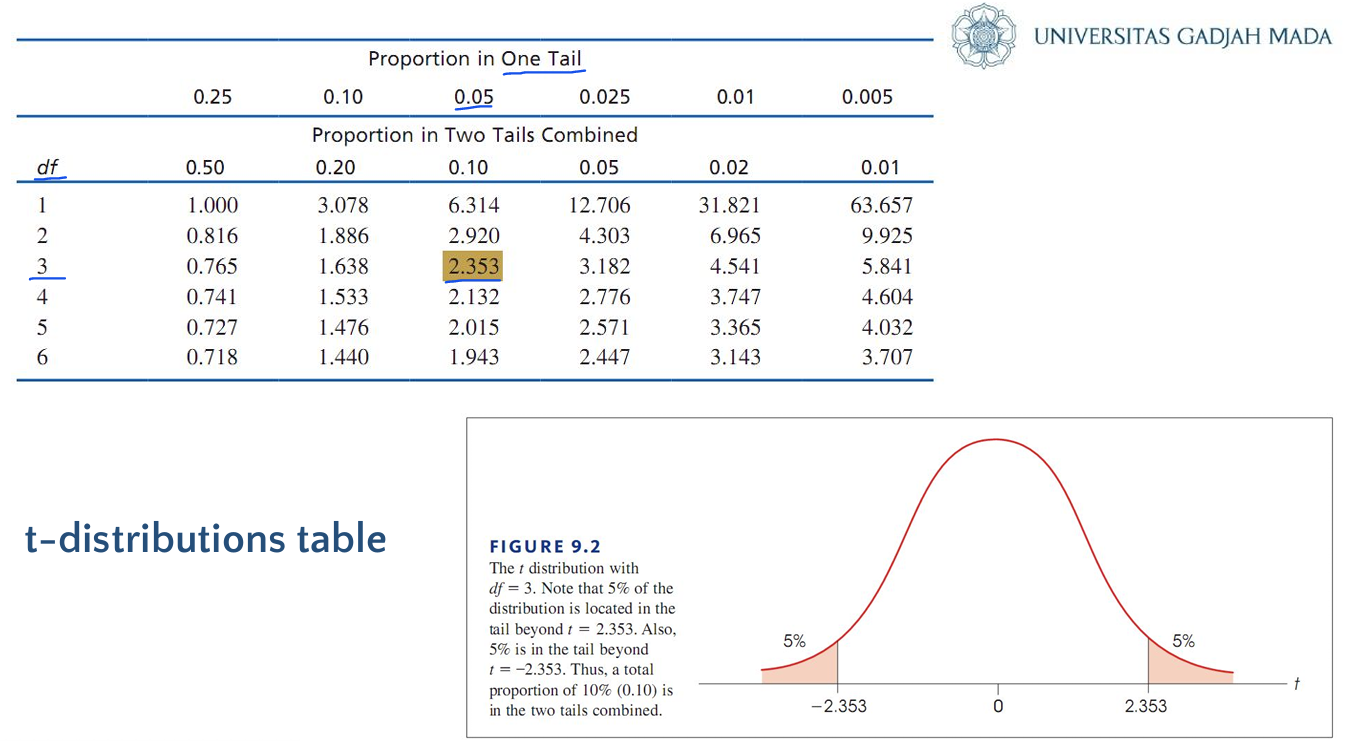
Determining Proportions and Probabilities for t Distributions (t-distributions Table)
Use a t-distribution table to find proportions for t statistics.
t-Distribution Table: A table that give a specific number of;
A t-value if you know the probability.
A probability if you know the t-value.
if the null hypothesis is true, based on small samples
*shortcut for getting t-value/probability
How to read the question:
One tail/two tails combined=
One tail
“tail beyond” refers one end of the distribution, either the far right or far left.
“Tail beyond t = 2.353 occupies 5% of the distribution”
-with the number/probability occupied refers specifically to the area in one tail, not the total area in both tails
(5% one tail)
Two tails combined
"Combined tails beyond” refers to the combined distribution
“Combined tails beyond ±2.353 occupy 5% of the distribution”
-with the number/probability occupied refers to two tails combined (2.5% in each tail)
direction of the tail=
Positive/negative
Right tail(higher values on the curve)
- t-value = positive (e.g.,t=2.353)
Left tail(lower values on the curve)
- t-value = negative (e.g.,t=−2.353)
Key words
Right tail
-question says "beyond" t = 2.353, because it’s looking at values greater than t=2.353
Left tail
-question says "below" or "less than" t = -2.353, because it’s looking at values smaller than t=−2.353
Context of the problem
Right tail
-problem involves testing whether values are greater than the mean
Left tail
-problem involves testing whether values are less than the mean
Problem example:
df = 3(this comes from your sample size minus 1)
Tail beyond t = 2.353 occupies 5% of the distribution
↓ ↓
“Tail beyond”=one tail positive number=right tail
Process:
Step 1: Look up the degrees of freedom (df) in the table (in this case, 3).
Step 2: Find the desired probability (in this case, 0.05, or 5%).
Step 3: The table will show you the t-value that corresponds to that probability. For df = 3 and 5%, the t-value is 2.353.
Independent and Related Measure Designs
Between-Subjects Design(Independent Measures Design):
A research design that uses a separate group of participants for each treatment condition
goal= compare the effects of each conditions on the two groups
The Hypotheses for independent measure=
H0: µ1 − µ2 = 0
H1: µ1 − µ2 ≠ 0
formula=
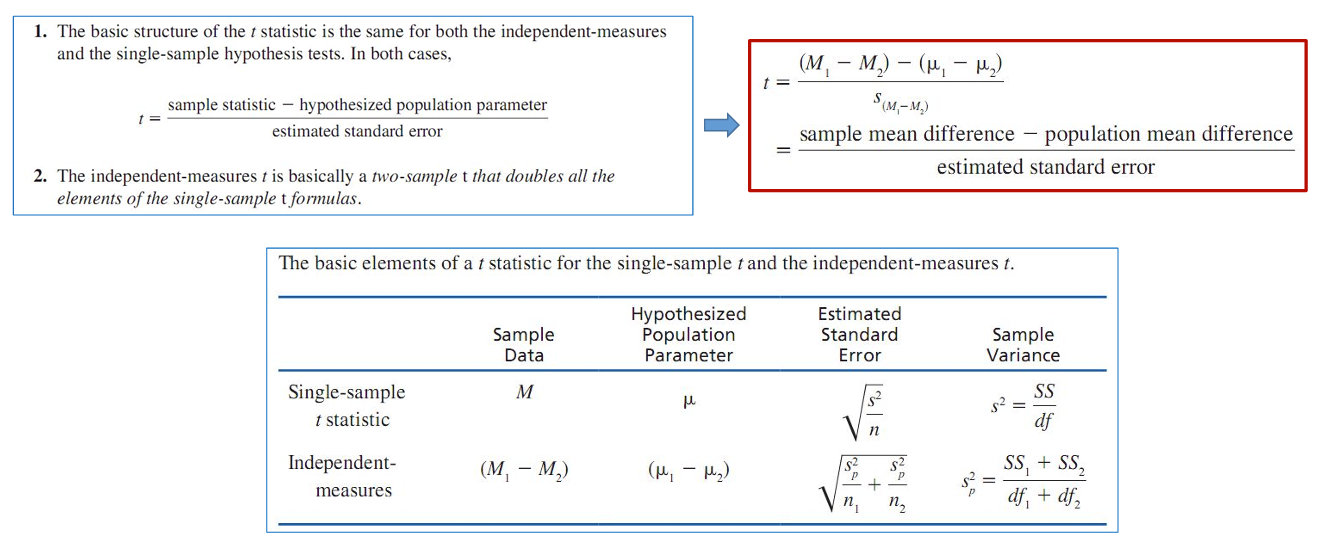
Independent Sample t-test Calculation:
used to compare the averages (means) of two different groups.
steps=
State hypotheses and alpha level:
-Hypotheses=make a claim about Null hypothesis (H₀) & Alternative hypothesis (H₁)
-Alpha level=cut-off value, helps decide if your results are statistically significant
Determine degrees of freedom (df) and critical region using the t-distribution table:
-determine the degrees of freedom (df)
-Critical region=reject the null hypothesis if your t-statistic falls in this region
Compute the test statistic (t-statistic):
-calculate using Two-sample t-test
Compare t-statistic with critical values to make a decision:
-compare t-statistic to the critical t-value you found in the t-table;
If the t-statistic is greater than the critical t-value, you reject the null hypothesis(there is a significant difference between the two groups)
If the t-statistic is smaller, you fail to reject the null hypothesis (there’s no significant difference)
Within-Subjects Design(Related Measures Design):
A research design that uses the same group of participants which experience all treatments.
*test the same individuals more than once, with each person going through every condition or treatment
goal: comparing their performance in two different conditions, but each person is tested with both conditions.
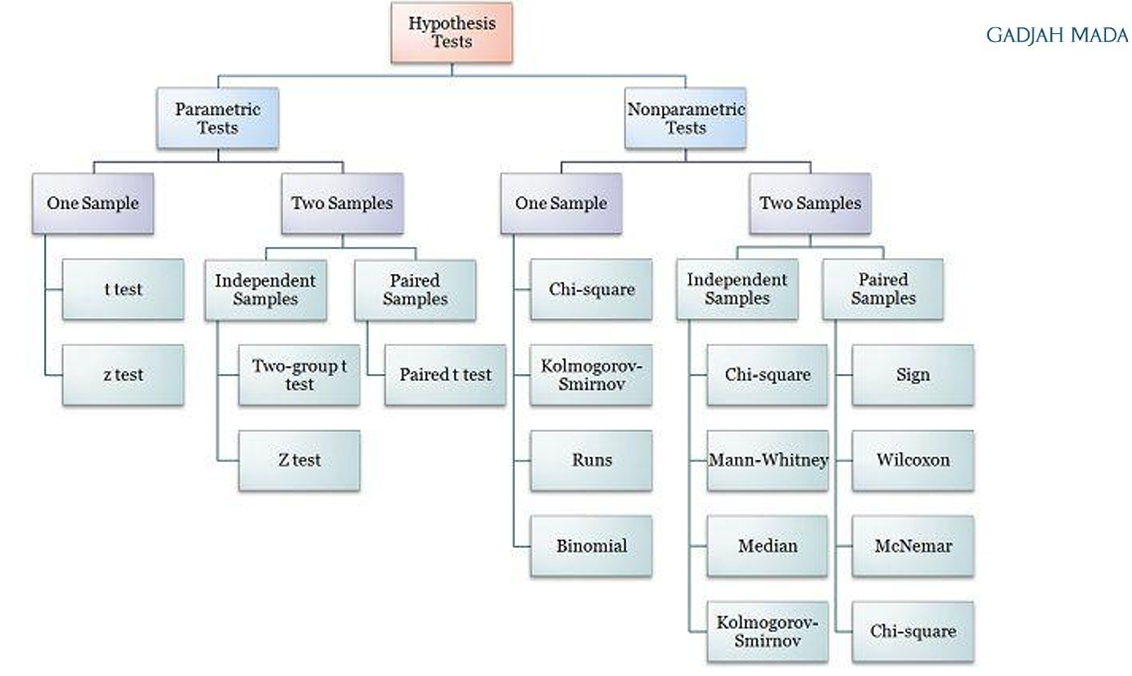
Parametric vs Nonparametric Statistics
Parametric Statistics: way of analyzing data where you make assumptions about how the data behaves in the population;
*such as following a specific pattern or distribution(like assuming it follows a normal distribution; bell-shaped curve)
key assumptions=
Additivity= assumes that the impact of one factor is independent of the impact of the other factors, so you can just sum them up to get the total effect
Normality= data should follow a normal distribution (a bell-shaped curve)
Homogeneity of Variance= The spread or variability of data should be the same across groups.
Independence: Each data point should be independent of the others (one person’s result doesn’t affect another’s)
Nonparametric Statistics: Way of analyzing data with no assumptions about the distribution at all
Hypothesis Tests
Example - Independent Sample t-test
Describes an experiment testing the effect of lighting on puzzle-solving performance and the resulting potential for cheating.
Example Step - Hypothesis and Alpha Level
Alpha level set at 0.05. Directional hypotheses may specify expected outcomes based on environmental conditions.
Example Step - Compute Test Statistic
Analyzed significance of t value (-2.67) indicating a substantial difference in performance based on environmental lighting.
Calculating Effect Size: Cohen’s d
Effect size measurement standardizing mean difference between two groups, reported as Cohen's d.
Repeated Measure Test
Describes within-subject designs measuring dependent variables multiple times.
Matched-Subjects Design: Individuals matched across samples based on specific variables.
Related Sample t-test
t statistic is derived from difference scores rather than raw data, with hypotheses:
H0: µD = 0
H1: µD ≠ 0
Related Sample t-test Visualization
Illustration of how each individual is measured twice with computation of difference scores.
Related Sample t-test Calculation Steps
Similar to independent measures but includes obtaining data from related measurements.
t-test Summary
Comparison of scores between independent and related samples, including considerations for bias and assumptions.