Personality and Social
Term 1
Week 8 - Intro
What is personality psych
Humans are deeply attuned to personality.
Personality - a set of psychological trait and mechanisms within the individual test that refer to differences among individuals in a typical tendency to behave, think or feel in some conceptually related ways across a variety of relevant situations and across some fairly long period of time
Personality psychology seeks to understand why and how people differ and aims to predict both differences and similarities between individuals in various situationsWhat is social psych
Social psych - the study of how an individual's thoughts, feelings, and actions are affected” by other people, whether “actual, imagined, or symbolically represented.”
Difference between this and personality psych is individuals, group and society and how they relate
Strengths and weaknesses of each approach
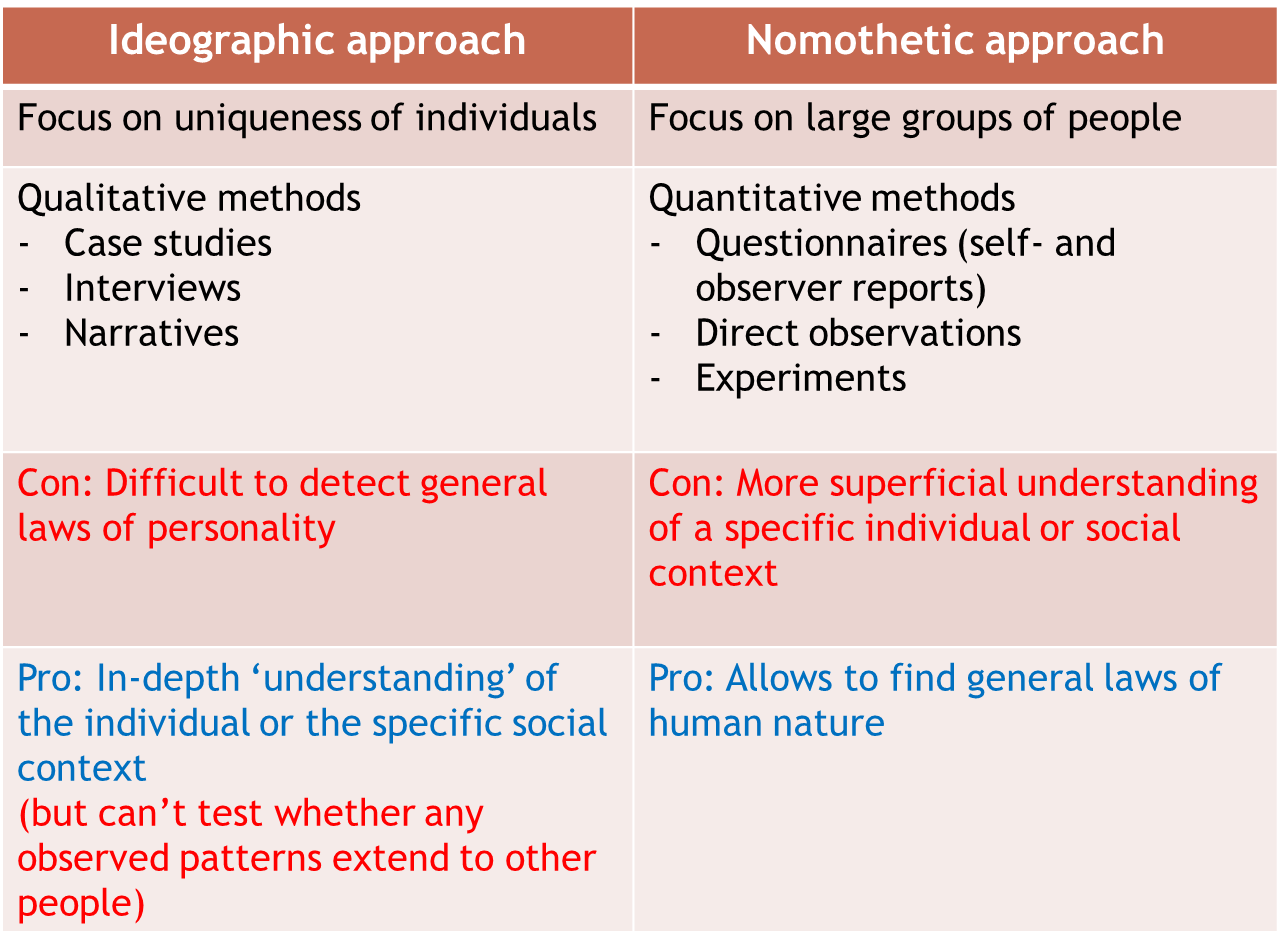
The universal: everyone tends to be similar → Social psychology
The in-between: everyone tends to be similar to some people, yet different from other people → Personality psychology – Nomothetic approach
The unique: every person is different from everyone else → Idiographic approach to personality
Week 9 - Scientific study of Personality and Individual difference
Basic concepts in psychological measurement
Some Simple stats ideas:
Levels of measurement
Nominal - data that an only be categorised
Ordinal - data can be ranked
Interval - data can be ranked and evenly spaced
Ratio - data can be ranked, evenly spaced and have a natural 0
Data from a personality scale is between ordinal and interval
Standard Scores → to make meaningful comparisons between scores, “raw data” are converted to standard scores (eg. by subtracting the mean [M] from the score and then dividing the result by the standard deviation [SD])
Correlation coefficients, r: tell us how strongly 2 variables are related and in which direction (p or n)
Sample representativeness and Sample size:
Sample representativeness → samples should be reasonably representative of the pop that the researching is investigating. Potential problems are all being psych undergrads, WEIRD, show restricted variance
Sample size → correlations from samples of ³ 250 are usually close to the population correlation. The larger the sample the greater the stat power to obtain stats significant results
Assessing quality of measurement: reliability and validity:
Reliability → The extent to which a measure produces consistent results. Does the obtained score represent the “true level” of the construct being measured?
Internal-Consistency Reliability → The extent to which the items of a measure are correlated with one other, Cronbach’s alpha (a); as ≥ .70 are usually considered acceptable
Interrater (Interobserver) Reliability → The extent of consistency between the scores of different raters/observers
Test–Retest Reliability → The extent of consistency between scores across different measurement occasions (eg. now and 1 year later)
Validity → The extent to which a test measures what it claims to measure
Content Validity → The extent to which a measure assesses all relevant features of the construct, and does not assess irrelevant features
Construct Validity: Convergent & Discriminant → The measure assesses the same construct that it is intended to assess
Convergent validity: correspondence with measures assessing similar (positive relations) or opposite (negative relations) characteristics
Discriminant validity: correspondence with measures assessing characteristics unrelated to the one the measure is intended to assess
Criterion Validity → Relations with relevant outcome variables; also called predictive validity
Methods of measurements: self and observer reports, direct observations, biodata
Self-report:
Structured questionnaires: Same questions for all participants with fixed response options.
Common method for measuring personality, often assessing multiple traits.
Reliability: Traits are measured with several items, often including reverse-scored items to reduce bias (acquiescence).
Pros: Efficient, low cost, mostly accurate if people know and are willing to report their behaviors and feelings.
Cons: Can be distorted (e.g., socially desirable responding, especially in job applications).
Overall value: People usually know themselves well, providing unique insights (Baldwin, 2000).
Observer reports:
Similar to self-reports, but someone else (e.g., spouse, friend, colleague) provides information about the target person.
Pros: Can be more objective and less biased ("Others sometimes know us better than we know ourselves" – Vazire & Carlson, 2011).
Cons: Some personality traits may go unobserved, and observations are limited to specific contexts.
Direct observations:
Involves observing a person’s behavior to assess traits through frequency and intensity.
Can occur in natural or artificial settings (e.g., labs).
Pros: Very informative.
Cons: Time-consuming, expensive, and requires aggregation across multiple indicators, times, and situations to capture personality traits effectively.
Biodata (Life Outcome Data):
Records of life events relevant to personality (e.g., phone bills, grades, income, speeding tickets).
Provides objective behavioral indicators, but it’s often unclear which data are accurate or relevant to the specific personality traits being studied.
Personality traits and the Inventories that measure them
The idea of a personality trait
Personality: A trait reflects individual differences in consistent patterns of behavior, thought, or emotion across various situations and over time.
Differences Among Individuals → A personality description is a comparison with other people
Typical Tendency to Behave, Think, or Feel → Likelihood of showing some behaviours or having some thoughts or feelings
In Some Conceptually Related Ways → Traits are expressed by various behaviours, thoughts and feelings that appear to have some common psychological element
Across A Variety of Relevant Situations → Not in just one specific situation, but consistency across a variety of situations and settings that are relevant
Over Some Fairly Long Period of Time → Relatively stable pattern that can be observed over the long run
Personality traits and other psychological characteristics
Mental abilities
Attitudes
Do personalities traits exist
Hartshorne & May (1928)
Investigated 11,000 children for the consistency in their “moral character” (altruism, self-control, honesty)
Observed their behaviour in a variety of situations; eg. donation to charity, cheating on a test
Result: Children displayed little consistency between any two behaviours (rs ≈ .20)
Mischel (1968)
Individual differences in behaviour depend on the specific situation
Also Mischel and Peak (1982): Conscientiousness depends very strongly on the situation
Claim → “Personality traits are of limited value for predicting behaviour”
“Individual differences in behaviour depend on the specific situation” ???
Yes, BUT … Failure to notice the cross-situational consistency when aggregating observations across many situations
Correlations between two sets of several behaviours are much higher (rs > .50) (Jackson & Paunonen, 1985). Personality is reflected in overall, typical behaviour as observed across many different situations. Still very important research, particularly regarding Person-by-Situation Interactions
Structured personality intervories
The California Psychological Inventory (CPI) - Over 400 items; various psychological characteristics, “everyday variables”. Based on The Minnesota Multiphasic Personality Inventory (MMPI) intended to measure mental illnesses
The Eysenck Personality Questionnaire (EPQ) - Three basic dimensions of personality. Biological basis of personality
The Temperament and Character Inventory (TCI) - Developed by Cloninger and colleagues. Basic biological dimensions of temperament and additional character dimensions
The Myers-Briggs Type Indicator - Very popular in business and assessment Centre settings. BUT (–) Very crude measure: assigns people to 1 of 16 personality types instead of providing personality scores. (–) Not a scientifically sound instrument in theory and methods. (–) Very limited reliability and validity – if any
Big Five Framework: 5 major dimensions
The Big Five Inventory (BFI): 44 items. The NEO Five-Factor Inventory (NEO-FFI) and the NEO Personality Inventory Revised (NEO-PI-R): 60 and 240 items
Neuroticism
Extraversion
Openness to Experience
Agreeableness
Conscientiousness
The HEXACO Personality Inventory Revised (HEXACO-PI-R)
Three versions: 200, 100, or 60 items. 6 dimensions
Honesty-Humility
Emotionality
eXtraversion
Agreeableness (vs Anger)
Conscientiousness
Openness to Experience
Strategies of personality inventory construction
Empirical Strategy: Collect a large pool of items that show observable relationships with the trait of interest (e.g., femininity-masculinity) based on empirical evidence.
Factor Analytic Strategy: Gather a large set of items, perform factor analyses to identify groups of items that measure different traits, similar to the approach used to develop the "Big Five" personality traits.
Rational Strategy: Develop items specifically designed to assess each trait based on theoretical and research-based conceptualizations (e.g., the Multidimensional Perfectionism Scale).
Self and observer reports on personality inventory scales
Combined use of self & observer reports:
Obtain self reports from a sample of “target” people as well as observer reports about the same “target persons from others
High agreement between self and observer reports provide support for the construct validity of scale
NEO-PI-R: correlations of about .60 (with spouses as observers) and .40 (with friends or neighbours as observers)
HEXACO-PI-R: correlations from .40 to .60 in a sample of over 600 college students (Lee & Ashton, 2013)
Coveregent validity of the scales or prehaps targets and observers have the same inaccurate opinion about target’s personality traits
Funder et al (1996) → target-oberserver agreement in Big 5 personality traits between Target and Parents/College Friends/Hometown Friends
Inter-observer agreement in Big Five personality traits between: Parents and college friends, Parents and hometown friends, College and hometown friends
Inter-observer agreement in Big Five personality traits between: 2 college friends, Mom and dad , 2 hometown friends
Who knows you best: Kolar et al (1996) - “People know themselves better than anyone else knows them” versus “Others know us better than we know ourselves”
Both self- and observer reports showed validity for predicting behaviour
Single observer reports were slightly better
Accuracy increased when averaging across observers
How could we not know?: Vazire (2010); Vazire and Carlson (2011)
Gaps in our self-knowledge
Blind spots due to lack or overload of information
Biases in self-perception
“Others sometimes know us better than we know ourselves”
Accuracy depends on which types of traits are considered
Self- and observer-reports capture different aspects of personality.
Self-Other Knowledge Asymmetry model (SOKA model)
SOKA Model (Vazire 2010)
Observability
“Internal” traits:low observability primarily thoughts and feelings e.g., anxious, self-esteem
“External” traits: high observability primarily overt behaviour e.g., charming, talkative
Evaluativeness- Highly evaluative traits: more biases in self-reports e.g., intelligent, rude
Low observability, low evaluativeness: better predicted by self-reports
High evaluativeness: better predicted by observer-reports
Conclusion
Self- & observer reports show fairly high levels of agreement
People provide fairly accurate descriptions of their own and others’ personalities
Self- & observer reports can predict behaviour with moderate levels of validity
However, research suggest that self- & observer reports may capture different aspects of personality
→ fairly accurate, not perfectly accurate
LIMITATION of self- & observer reports: BIASES
Socially desirable responses and socially undesirable responses in both self- & observer reports
Not necessarily in the same direction
BUT: the more sources of information, the less bias
Week 10 - Structure, Change and Stability of Personality
Chapter 3: Personality Structure
Traits to Measure:
Aim: Classify traits into broad groups for efficient personality measurement.
Method: Factor Analysis (FA)
Exploratory FA (EFA): Reduces data by identifying underlying factors.
Confirmatory FA (CFA): Tests hypotheses generated by EFA.
Eysenck’s Model (1947)
Early theory with two factors: Extraversion-Introversion and Neuroticism-Stability.
Added a third factor later: Psychoticism.
Big Five/Five-Factor Model (FFM)
Traits: Neuroticism (N), Extraversion (E), Openness (O), Agreeableness (A), Conscientiousness (C).
Provides a framework for classifying personality traits, reducing confusion across models.
The Lexical Hypothesis
Concept: Important personality traits are encoded in language (Galton, 1884).
Early attempts to classify traits: Allport & Odbert (1936): Identified 18,000 English words (4,500 traits).
Cattell’s 16PF Model
Derived from early factor analysis; classified 16 personality factors (Cattell, 1949).
Key Models/Developments
Tupes & Christal (1961): Found 5 factors.
Costa & McCrae (1985): Popularized the Five-Factor Model (FFM).
Chapter 4: Developmental Change and Stability of Personality
Key Concepts
Mean-Level Change: How the average personality trait score changes over time.
Stability: How stable personality traits are across time points (correlations between measurements).
Developmental Changes in Traits
Meta-analysis (Roberts et al., 2006) found significant changes in the Big Five across the life course, particularly during young adulthood (ages 20-40).
Longitudinal vs. Cross-Sectional Studies
Longitudinal: Tracks the same individuals over time (reflects real change but expensive).
Cross-Sectional: Compares different individuals at one point in time (efficient but may be affected by cohort effects).
Five-Factor Theory vs. Social Investment Hypothesis
Five-Factor Theory (McCrae & Costa, 1999): Claims personality changes due to genetic predispositions.
Social Investment Hypothesis (Roberts et al., 2005): Personality changes due to social roles (e.g., job, marriage).
Personality Stability
Costa & McCrae: High stability in adulthood, with correlations of around 0.65-0.80 across different studies and time points.
Stability in Adolescence: Correlations are lower, ranging from 0.40 to 0.60 during adolescence and early adulthood.
The HEXACO Model
Six-Factor Model (Ashton et al., 2004)
Honesty-Humility (H): Added as the 6th factor.
Other Factors: Emotionality (E), Extraversion (X), Agreeableness (A), Conscientiousness (C), and Openness (O).
HEXACO vs. Big Five → Honesty-Humility is absent in the Big Five. Some HEXACO traits differ conceptually (e.g., HEXACO Emotionality ≠ Big Five Neuroticism).
Key Takeaways
Understanding factor analysis, the lexical hypothesis, and personality models (Big Five and HEXACO) is crucial.
Personality traits change across the lifespan, particularly in young adulthood, but there is significant stability across time.
Models like the Big Five and HEXACO provide frameworks to study individual differences and trait stability.
Week 11 - Personality and Life Outcomes
Relationships and marriage
Romantic relationships are obviously an important aspect of many people’s lives, we will consider 2 fundamental questions about personality and relationships:
Do spouses tend to be (dis)similar in their personality characteristics?
In what ways are the personality characteristics of spouses associated with the satisfaction they have with their relationship?
Friendship and other peer relationships
When observing friendships, you may notice that some friends are similar in personality, while others are quite opposite. Researchers have explored whether, across many friendships, there is a general tendency for friends to be similar or opposite in certain personality traits. By averaging across multiple friendships, patterns of similarity or difference in specific traits might emerge.
Lee, Ashton et al (2009): similarity and assumed similarity between well-acquainted students for the HEXACO factors. Results:
High self-observer agreement for all 6 personality factors
For four of the six personality traits (EXAC): no strong tendency to be similar or different
For Honesty-Humility and Openness: friends tend to be similar
No “perceived” (dis)similarity for EXAC dimensions
For Honesty-Humility and Openness: friends tend to perceive their friends as similar and perceive even more similarity than actually exists
WHY is there similarity in H and O but not in E, X, A, C? → H and O are related to people’s values about how to live and relate to other people
Personality and social status - Anderson, John, Keltner and Kring (2001)
Big Five from young adult college students in a fraternity, sorority, and mixed-sex dormitory
Peer ratings of each student’s prominence, influence, and respect
Results:
Extraversion was positively related to social status both for men and women
Emotional stability was positive related to social status among men (or neuroticism was negatively related)
→ Toughness is admired by men more than by women
The other three big five characteristics were unrelated to social status
Generalizability across settings?
Health-related outcomes
Substance use:
Conscientiousness: self-discipline, impulse control resisting temptation?
High Neuroticism: anxiety, moodiness, irritability temptation to use substances to control negative emotions?
Elkins, Kins, McGue, and Iacono (2006): about 1000 17-year-olds. Interviews to determine their tobacco, alcohol and drug use
at age 20: nicotine dependence (30%), alcohol (30%) or drug use disorder (20%)
Results of Elkins et al (2006):
Participants at age 17 with substance use disorder were lower in Conscientiousness-related traits and lower in Emotional stability
These personality traits were also predictive for developing substance use disorders by age 20
Conscientiousness and emotional stability also predict quitting smoking and quitting drinking (Terracciano & Costa, 2004; Bottlender & Soyka, 2004)
Bogg and Roberts (2004): Meta-analysis confirmed the role of conscientiousness
Longevity:
Persons with higher levels of certain personality characteristics may tend to be healthier and may tend to live longer
Longitudinal research design across decades
Archival data
Friedman et al (1993): Does childhood personality predict longevity Personality of gifted children (11 years old) during 1921-1922 . More than 60 years later: records of who was still alive and who had died (N=1200)
Results:
Conscientiousness/social dependability: low (vs high) conscientious persons had about 35% greater chance of dying before the age of 70
Less likely to engage in health-damaging behaviours such as smoking, drinking, overeating?
Low conscientiousness/dependability was related to smoking and drinking but these relations could not explain the link between cons/depend and early death (Friedman et al., 1995)
Alternative explanations: handling stress, better networks of social support, other health-related behaviours
Cheerfulness/optimism: persons high (vs low) in cheerfulness had about a 35% higher chance of dying before the age of 70
Unrelated to smoking and heavy drinking (Martin et al., 2002)
Alternative explanation: overoptimistic about health prospects
More large-scale projects are needed, using representative samples
Academic performances
Cognitive ability - Poropat (2011)
Conscientiousness and grade point average: r = .25
Similar across different levels of education
Self-discipline, organization, and diligence → greater effort, efficiency, and attention to detail in completing course work and examinations
Elementary school level: Also positive associations with Agreeableness, Emotional stability, Extraversion, and Openness to Experience (around .20)
Law-abidigness versus Criminality
Influence of social groups, exposure to temptations or provocations → criminal or unethical behavior
Role of self control:
Gottfredson and Hirschi (1990): Self-control theory of crime - “acts of force or fraud undertaken in pursuit of self-interest”. What differentiates criminals from non-criminals?
Impulsivity, immediate gratification and pleasure despite negative consequences
Failure to inhibit selfish impulses
Motivational factors are the same for criminals and non-criminals
Romero, Gomez-Fraguela, Luengo, and Sobral (2003)
Study among Spanish university students
Personality traits of poor self-control : impulsive risk taking, “preference for simple tasks”, self-centeredness, preference for physical activities, volatile temper
Delinquent or criminal activities: vandalism, theft, aggression, academic dishonesty, illegal drug use,…
Results:
Overall delinquent behaviour was most strongly related to impulsive risk taking (r > .40)
Willingness to take risks and the tendency not to inhibit one’s impulses influence criminal behavior
In line with the self-control theory
Primary and secondary psychopathy:
Some serious offenders / psychopaths are very rational / coolly calculating, others have very poor self-control. Karpman (1948): primary versus secondary psychopaths
Primary: manipulation, deceit, grandiosity, callousness, and selfishness
“For me, what’s right is whatever I can get away with”
“I enjoy manipulating other people’s feelings”
“Success is based on survival of the fittest, I am not concerned about the losers”
Secondary: impulsivity, irresponsibility, lack of planning, and poor self-control
“I don’t plan anything very far in advance”
“I find myself in the same kinds of trouble, time after time”
(items from Levenson, Kiehl, & Fitzpatrick, 1995)
Both primary and secondary psychopathy are positively correlated with delinquent activities. Thefts, vandalism, intoxicated driving, antisocial actions. Lack of self-control and manipulativeness/selfishness
Only moderate correlation between primary and secondary psychopathy. People can score high on both factors, or low on one and high on the other factor
Being exploitative and manipulative of others but with enough self-control to avoid criminal behaviours
Lower on primary psychopathy but high on secondary psychopathy → impulsively committing a crime without deliberate intention to harm others
Dark Triad (Phaulhus and Williams, 2002): Psychopathy, Narcissim, Machiavelinism
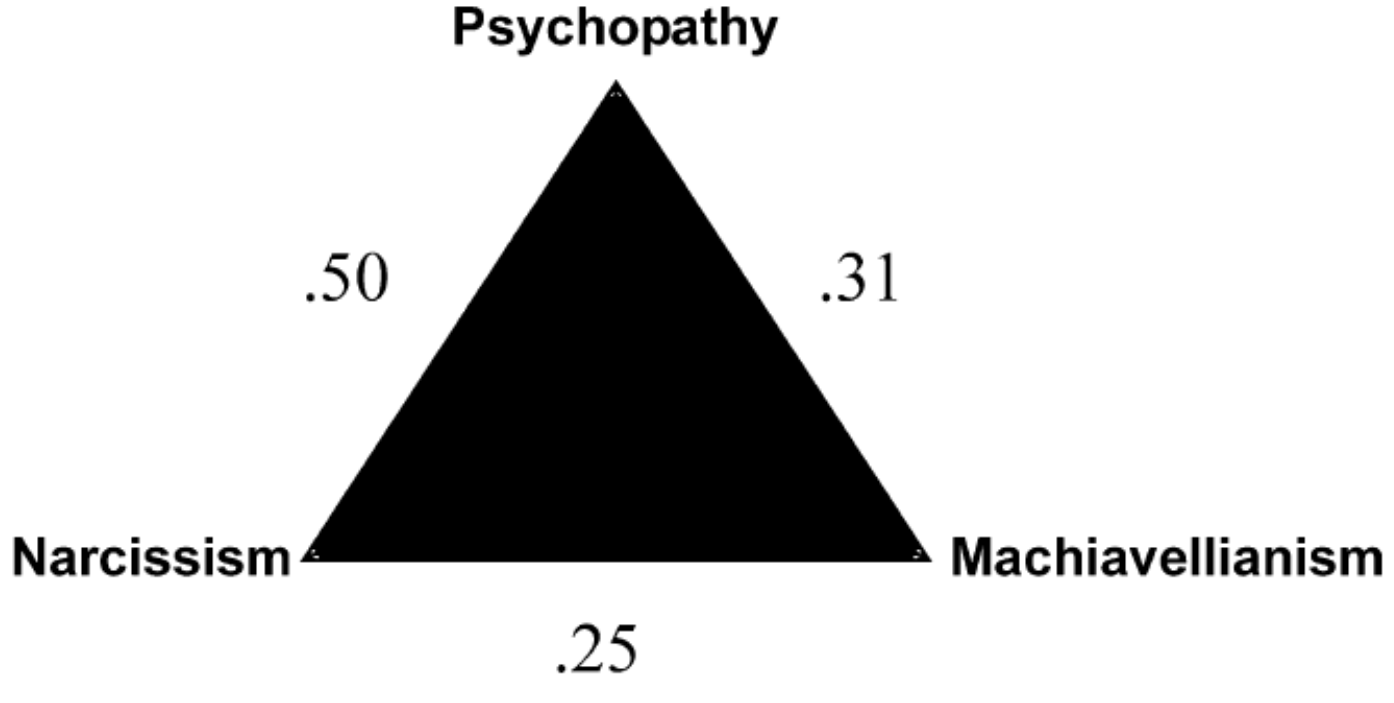
Psychopathy: callous, remorseless manipulation and exploitation → impulsive, callous thrill-seekers
Narcissism: dominance, exhibitionism, exploitation, feelings of superiority and entitlement → grandiose self-promoters who continually crave attention
Machiavellianism: manipulativeness, insincerity, callousness → Master manipulators
Outcomes of Dark Triad (Furnham, Richards, & Paulhus, 2013)
Workplace behaviour: toxic leadership; snakes in suits; bad bosses → Dark triad + high IQ and/or physical attractiveness: adaptive in some context
Educational behaviour: Cheating and essay plagiarism
Mating behaviour → Psychopaths: Short-term impulsive mating strategy, Machiavellians: More strategic and regulated style that maintains the relationships
Intergroup behaviour: prejudice
Antisocial behaviour → Psychopaths: criminality, bullies, aggressors, Machiavellians: less impulsive, corporate / white-collar crimes
Week 12 - Biological, Genetic and Environmental Influences
Introduction to Influences on Personality
Content: The lecture addresses biological, genetic, and environmental factors influencing personality, based on material from Ashton (2018), Chapters 5 and 6, with some additional content.
Note: Recommended to read chapters fully as the lecture does not cover everything.
2. Early Ideas: The Four “Humours” and Personality
Ancient Theory: Greek thinkers Hippocrates and Galen suggested personality was linked to bodily fluids ("humours").
Types of Humours:
Phlegm: calm, phlegmatic
Blood: cheerful, sanguine
Black bile: depressive, melancholic
Yellow bile: angry, choleric
Influence: Though unsupported by evidence, these ideas influenced later theories by Pavlov, Eysenck, and Sheldon.
3. Neurotransmitters and Cloninger’s Theory
Main Neurotransmitters: Dopamine, serotonin, norepinephrine are key in personality traits.
Dopamine & Novelty Seeking: High dopamine linked to excitement-seeking behaviors.
Serotonin & Harm Avoidance: Low serotonin linked to anxiety, pessimism.
Norepinephrine & Reward Dependence: Low norepinephrine linked to sentimental attachments.
Empirical Evidence: Mixed; studies show some support for norepinephrine-reward dependence but limited for serotonin and dopamine relations.
4. Brain Structures
Gray’s Theory (Reinforcement Sensitivity Theory):
BAS: Pursuit of rewards, linked to pleasure and excitement.
BIS: Avoidance of punishment, linked to anxiety.
FFS: Responses to extreme threats, including fight-or-flight.
Eysenck’s Theory: Three superfactors (Extraversion, Neuroticism, Psychoticism) driven by brain arousability.
Empirical Example: Lemon juice test for extraversion; introverts produce more saliva.
5. Hormones
Testosterone: Influences aggression, social behavior, and some aspects of personality.
Examples: Higher testosterone linked to rule-breaking and aggression (Dabbs et al., 1996).
Cortisol: Stress hormone related to emotional reactivity, linked to personality traits in studies of adolescents.
Oxytocin: Bonding hormone associated with trust and emotional attachment, though its role in personality remains unclear.
6. Genetic and Environmental Influences on Personality
Nature vs. Nurture: Examines heredity vs. environment in personality development.
Twin Studies:
Identical twins raised apart vs. fraternal twins provide evidence for genetic influence.
Heritability Findings: Studies show heritability around 0.54 for Big Five traits, with a minimal effect from shared environment.
Behavioral Manifestations: Studies indicate heritable tendencies for smoking and drinking behaviors linked to personality traits.
7. Caveats in Genetic Studies
Potential Bias:
Contrast Effect: Relatives might emphasize differences, inflating or deflating perceived similarity.
Assimilation Effect: Relatives may emphasize similarity, leading to overestimated similarity.
Methods to Mitigate Bias: Use independent observers or direct observation in research.
Assumptions to Question:
Assortative Mating: Parents' similar personalities could inflate fraternal twins’ similarity.
Shared Environment: Twins’ shared early life environment (e.g., womb) complicates attributions solely to genetics.
These notes summarize each topic in the lecture slides. Let me know if you need further details on any specific section!
Week 14 - The Self in Action
Planning, goals and meaning
Planning and Goals: Goals are desired future states linked to personal values. Effective pursuit requires clear planning and an understanding of feasibility and desirability.
Conscious vs. Automatic Systems: Goal-setting often involves conscious decisions, while automatic reminders help maintain focus, such as the Zeigarnik effect (remembering incomplete tasks).
Levels of Meaning: Low-level focuses on operational details, whereas high-level goals tie to broader emotional and moral significance. Shifting between levels aids problem-solving.
Optimism and Fallacies: Planning is subject to biases, such as over-optimism (planning fallacy), which emphasizes the need for realistic and adaptive strategies.
Freedom and Choice
Free Will: The belief in free will encourages prosocial behavior and provides psychological benefits, like stress relief (e.g., the panic button effect).
Choice Paradoxes: While some choice is beneficial, excessive options can lead to anxiety. Decisions are shaped by biases, such as risk aversion, the certainty effect, and temporal discounting.
Influence on Decisions: External factors (e.g., "keeping options open") and psychological tendencies (e.g., status quo bias) play a role in decision-making. Gender-based differences reflect evolutionary theories, like error management theory.
Emotional Decisions: Emotions, particularly in contexts like sex or financial risks, heavily influence choices, often emphasizing immediate over long-term rewards
Self-regulation, Irrationality and Self-destruction
Components of Self-Regulation: Effective self-regulation comprises standards (goals), monitoring (tracking progress), and willpower (capacity to act). It's akin to a muscle that can be strengthened or depleted.
Self-Destructive Behaviors: Actions such as procrastination or impulsive decisions stem from faulty strategies or tradeoffs prioritizing immediate rewards over delayed benefits.
Irrationality: Self-defeating behaviors, such as smoking or binge-eating, highlight conflicts between short-term desires and long-term consequences.
Delay of Gratification: The ability to postpone immediate rewards for future gains is a marker of effective self-regulation, influencing outcomes across health, relationships, and productivity.
Week 15 - Social Cognition
Social cognition
Social cognition - thinking about people, people first and foremost and the inner processes serve interpersonal functions
Social acceptance, relationship formation and maintenance
Competing against others for our goals
Three goals in thinking: Disocver the right answer, confirm the desired answer and reach the answer quickly
Cognitive miser: reluctance to do much extra thinking
Elements of Automatic thinking
Awareness – no awareness needed
Intention – not guided by intention
Control – not subject to deliberate control
Effort – no effort required
Efficiency – highly efficient
Duplex mind
Automatic system: outside of consciousness, simple operations
Conscious system: complex operations
Changing role of consciousness (think of bargh)
Increased focus on role of automatic system (can learn, think, choose and respond)
Consciousness focus on complex thinking and logic
What % during the day are we influenced by automatic processes?
Knowledge Structures (organised packets of info):
Schemas (well informed expectations) → substantial info about a concept, its attributes and its relationship to other concepts
Scripts (informed knowledge about how to act) → schemas about certain events
Priming and Framing:
Priming - activating concept in the mind - influences subsequent thinking, may trigger automatic processes
Framing - presentation as positive or negative
Automaitc influence on: behaviour, thinking (stereotypes), goals and social unconscious (social judgement)
Thoguh suppression and ironic processes:
2 process to suppress though (Automatic – checks for incoming information related to unwanted thought and Controlled – redirects attention away from unwanted thought)
Relax conscious control and mind is flooded with cues from the automtic system
Attributions: Why did that happen?
Casual explanations ‘common sense psych’
internal factors - ability attitude personality mood
external factors - other people, luck environment
Two dimension attrivution theory
internal stable - ability
internal unstable - effort
external stable - difficulty of task
external unstable
Self-servicing bias → success and failure
External - internal attribution, fundamental attribution error and ultimate attribution error
Fundamental attricution error: Four possible explanations
Behavior is more noticeable than situational factors
Insignificant weight is assigned to situational factors (why?)
People are cognitive misers
Richer trait-like language to explain behavior not much situational language
Heurisitics
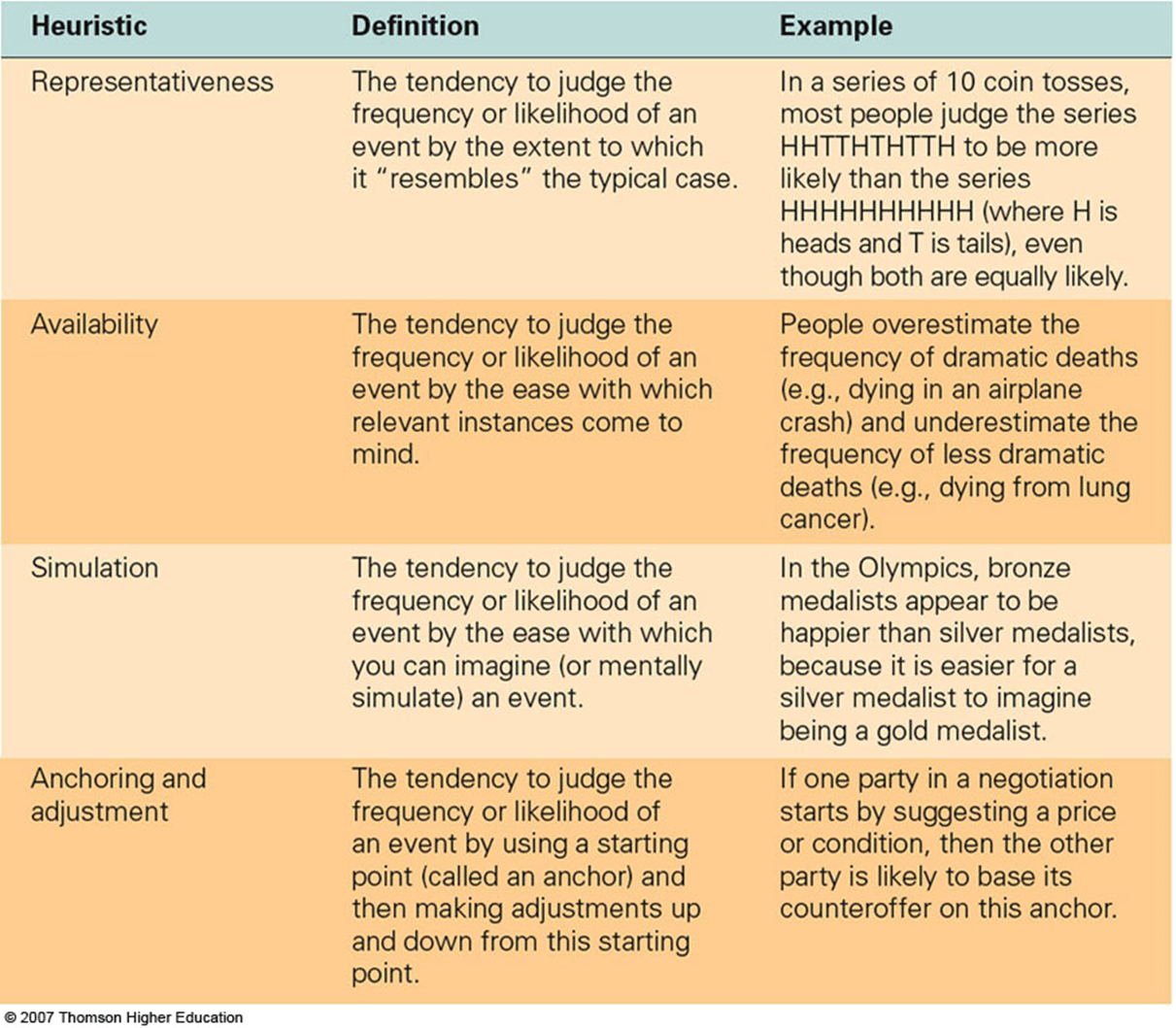
Representativeness heuristic → Judge likelihood by the extent it resembles the typical case
Availability heurisitc → Judge likelihood by ease with which relevant instances come to mind
Cognitive Errors and Biases
Information overload → too much info, contradictions in info and irrelevant info
People access 2 types of info → stats info and case history
People pay closer attetion to case history. Research shows that smoking causes cancer - but most people know someone that has an uncle that is 100 yrs and smokes 33 cigs a day
Conjunction fallacy - tendency to see an event as more likely as it becomes more specific (representation heurisitc)
Base rate fallacy → tendency tomingore base rate info and be influenced by distinctivefeatures of the case
Gambler’s fallacy → tendency to believe that a chance event is affected by previous nevents and will “even out”
False consensus effect (usually when you to something less positive) → tendency to overestimate the number of other people who share one’s opinions
False uniqueness effect (the opposite) → tendency to underestimate the number of other people who share one’s prixed charactertisics or abilities
Statistical regression → stats tendency for extremes to be followed by less extreme or those closer to average
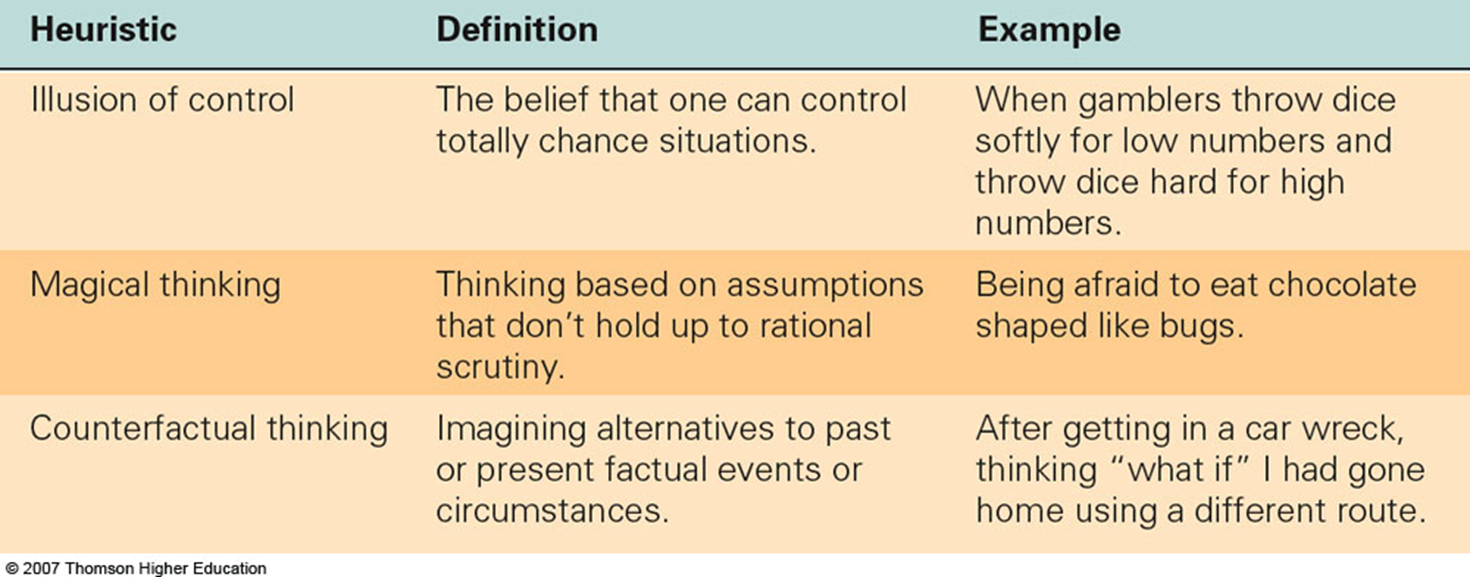
illusion control → false belief that one can influence events
Magical thinking → asumptions that don’t hold up to logical scrutiny
Touching objects pass on properties to each other (contamination) (touching an old or sick person)
Resemblance to something shares basic properties (contamination)
Thoughts can influence physical world (curse)
Imagining alternatives to past or present factual events or circumstances
First instinct fallacy ! What’s your guess? Multiple choice exam
Upward counterfactuals – better positive outcome → Help make future situations better ‘if only we would have had a roof’
Downward counterfactuals – think of a more negative outcome → Comfort it could have been worse ‘happy we still can lay under the bed to shelter for the rain’
Are humans really idiots?
We make predictable errors → cognitive misers and heuristics are short cuts
How serious are the errors → on trivial events (use heurisitics and automatic processing) and important events (use conscious processing and make better decisions)
Debiasing
Consider multiple alternative
Rely less on memory
Use explicit decision rules
Search for disconfirmatory information
Use meta-cognition (analysis of cognitions
Week 16 - Emotion and Affect
Part 1
‘Everyone knows what an emotion is, until asked to give a definition’ Fehr & Russell (1984)
Emotion: A conscious evaluative reaction to some event; Conscious emotion: a powerful and clearly unified feeling state, such as anger or joy
Mood: A feeling state that is not clearly linked to some event
Affect: The automatic response that something is good or bad; Automatic affect: a quick response of liking or disliking toward something (juvaluma)
Emotions have both mental aspects (e.g. subjective feelings and interpretations) and physical aspects (e.g. raising heart beat or tears)
James-Lange theory: proposes the bodily processes of emotion come first and the mind’s perception of these bodily reactions then creates the subjective feeling of emotion.
Researchers have tried to prove this theory but have largely been unsuccessful (why would that be?). However, the JL inspired:
Facial Feedback Hypothesis - Feedback from face muscles evokes or magnifies emotions

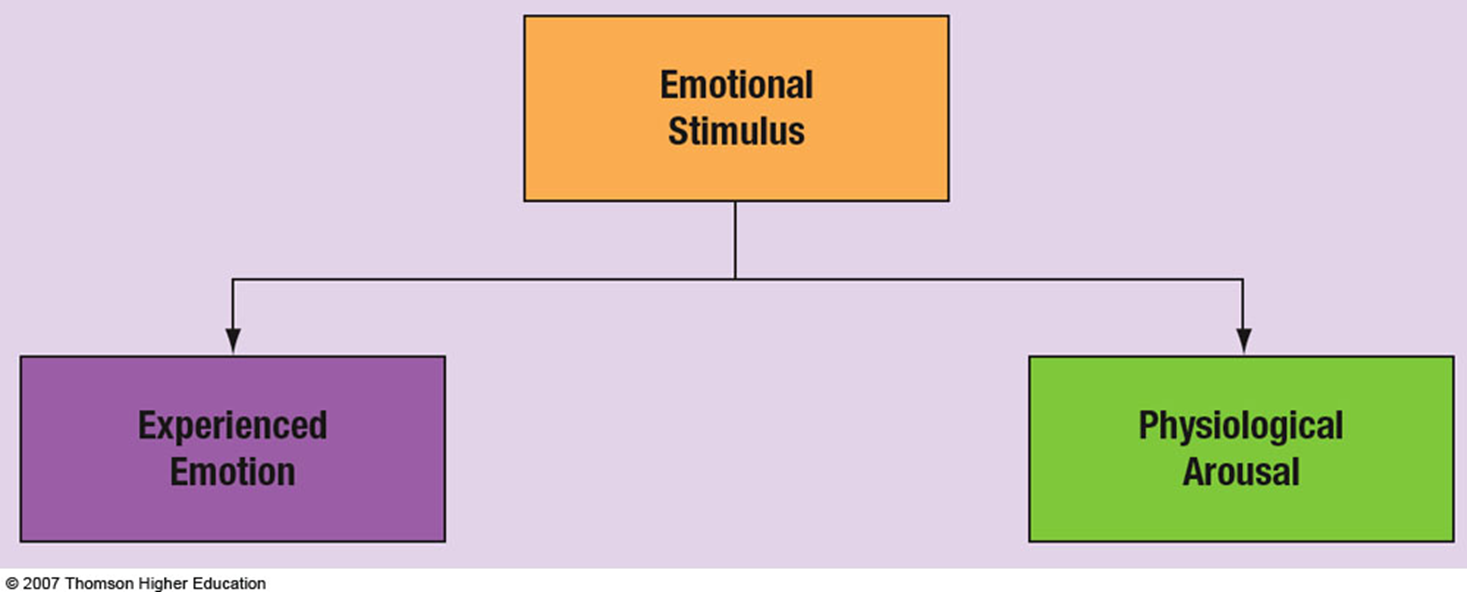
Cannon-Bard Theory - the thalaus (relay station for nerve impulses) will send 2 messages independently at the same time as a reaction to emotional stimuli:
One message that produces the emotional experience
One message that produces an increase in
physiological arousal.
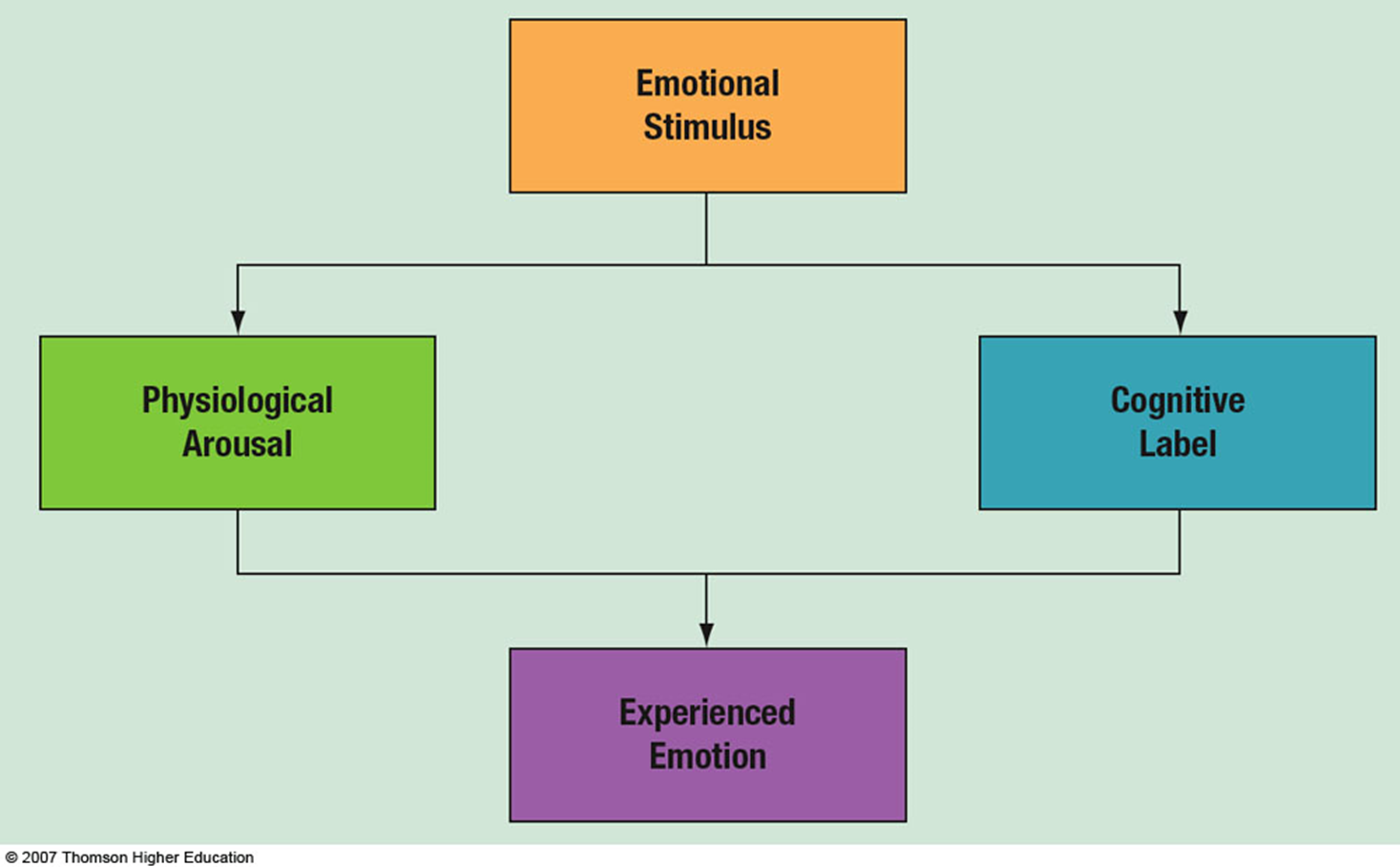
Schacter-Singer theory
Emotion has two components:
Physiological arousal is similar in all emotions (high versus low). Note that research suggests (positive versus negative)
Cognitive label is different for each emotion
Nervousness: Arousal by itself, emotion without the label
Emotion like a TV programme (on/off and volume (arousal) vs. channel switch(label))
Misattribution of arousal
excitation transfer: Arousal from one event can transfer to a later event. Mislabeling and relabeling arousal:
Schachter & Singer (1962): ‘Effects of vitamin
injection on visual skills’ (unrelated to real aim of study)
Adrenaline or placebo
- Adrenaline participants either told or not told about the ‘side effects’
- Exposed to a confederate who was either happy or angry
The strongest emotional response (interaction with confederate) from those who received adrenaline but no info
Physical arousal: Dutton and Aron (1974)
Male participants completed a questionnaire. Asked to cross a shaky or stable bridge experimenter (male vs female). DV – whether the participants called the experimenter with further queries about the study
Excitation transfer: Arousal felt by crossing the shaky bridge was transferred to the female experimenter → more attraction. When the arousal caused by one stimulus is added to the arousal of another. The overall arousal is misattributed to the second stimulus
Happiness:
Affect balance - Frequency of positive minus frequency of negative emotions
Life satisfaction - General evaluation of one’s life and how it compares to some standard
Object roots of happiness:
Objective predictors (money house etc. - cultural valued stuff)– little but some effect, except……. Couples with children are less happy than those without children!
But will say the opposite…. Unhappy couples with kids recent phenomena?
People with strong social connections are happier than those alone
Subject roots of happiness:
Happiness is rooted in one’s outlook and genes – e.g., study (Costa et al., 1987) ten years later best predictor of happiness?
Subjective roots are more significant than objective roots of happiness
Increasing happiness: Focused attention on positive things
Forgiving others, Gratitude for blessings, ,,Practicing religious beliefs, Optimism, General pattern, and can you benefit somehow?
Happiness is linked to good health
Part 2
Anger (internal) = emotional response to real or imagined threat or provocation. Angry people downplay risks and overlook dangers. They become more optimistic and are impuslive and fail to coinsider consequences
Causes = percieved reaction to someone else’s wrongdoing. Greater anger accompanies → more harm the other person does, other’s behaviour viewed as random or arbitrary or other’s behaviour viewed as cruel
Why does it persist (evlutionary thinking) = Motivates person to act aggressively and assertively. previously, anger may have provided needed arousal– prepares the body. But why not go straight to the goal? Act as a warning and allows resolution prior to the aggression? Anger may act as warning signal
Expression of anger = never show anger (stiff upper lip), vent anger, get rid of anger
Guilt → mechanism used to control people. It's an illusion. It's a kind of social control mechanism -- and it's very unhealthy. It does terrible things to our bodies. And there are much better ways to control our behavior than that rather extraordinary use of guilt.“(Ted Bundy)
Guilt and shame (social emotions) → moral emotion, involves feeling bad as guilt focuses on action that is bad or wrong and shame spreads to whole person. Guilt - constructive, shame - destructive
Effects → apology can be motivated by guilt. Conveys implicit agreement that action was wrong, suggests person will try not to do it again if they care about the relationship. Amends can be motivated by guilt - try harder to perform positive actions
Survivor guilt - an interpersonal emotion, people try to make you feel guilty as a manipulation tactice.
Why do we have emotions: promote belongingness:
We feel good emotions when social bonds formed (birth, wedding, new job), negative ones when they are broken (divorce, death, arguments)
Holding hands reduces stress (Coan et al., 2006). Or.. Wisman & Koole, 2003
Emotions (sort of) indirectly cause behaviour
Difference emotion & affect though
Assumption has been that emotion causes behaviour due to arousal ...why does sadness trigger helping?
Why do sad people help others: Study (Manucia, Baumann & Cialdini, 1984)
Conditions: (sad vs. neutral vs. happy)
Pill condition: side effect (freeze emotion 1 hour) versus no side effect
DV: helping
Thus, seems that emotions cause behaviour when person wants to change / escape emotional state (e.g. helping when sad)
Emotions guide thinking and learning
Bad emotions teach people to learn from their mistakes
Good emotions reinforce ‘good’ behaviours
‘Affect-as-information’ hypothesis: people judge something based on how they feel about it > prone to misattributions
Weather experiment (Schwarz & Clore, 1983) DV life satisfaction
Anticipated emotion guides decisions and choices
Affective forecasting
Weighing up how you’d feel in different scenarios will effect decisions > prone to overestimate the bad (focus only one the specific event)!
Emotions help and hurt decision making
Risk-as-feeling hypothesis: How severe the worst
outcome is and how likely is it to happen?
-Strong other emotions can interfere (sexual arousal, depression etc)
Part 3
Six basic emotions → happiness, suprise, fear, anger, sadness and disgust. People in many differnt cultures can identify facial expression of these emotions
Asian Americans place greater emphasis on emotional moderation than European Americans
Collectivist cultural emotion based more on assessment of social worth, outer world, self-other relationships
Cultural difference in amount of concealment of emotion
The beep study (Larson & Pleck (1999) how do you feel right now? Contrary to stereotype, no gender differences exist…if anything….
Men may be slightly more emotional, but women are more willing to report emotions
Men more emotional in:
Love (see next slide) & Work
Anger
Empathy is equal
Lab studies show women express more emotion but physiological measurements show usually more emotions for men
Young boys focus more on controlling emotions
In young children, greater emotionality in boys (anger, outbursts, tantrums)
Men fall in love faster
Women fall out of love faster
Men have more experiences of loving someone who does not reciprocate their love
Women have more experiences of receiving love but not reciprocating it
Men suffer more intense emotional distress after a break up (and die quicker after their spouse dies)
Arousal, attention and performance:
Yerkes-Dodson Law → some arousal is good for performance, too much can hurt
Arousal helps narrow and focus attention → Easterbrook (1959)
Emotional Intelligence (EQ) - Mayer-Salovey-Caruso Emotional Intelligence Test (MSCEIT)
Perceiving Emotion (empathy)
Facilitating Thought (employ emotions)
Understanding Emotion (meta cognition)
Managing Emotions (Affect regulation)
Affect regulation strats: Altering your mood
Do things that produce good feelings
Do something to take your mind off the problem (TV = distraction)
Raise or lower your arousal level (coffee, nap)
Seek social support (talk chat )
Affect regulation strats: Dealing with the problem
Reframe the problem
Use humour
Vent your feelings
Religious activities
Goals of affect regulation: for both positive and negatvie: get into the mood, out of the mood and prolong the mood. Prior to social interactions, tend to neutralize mood (Erber et al., 1994) 2 (sad vs good mood) → new person did they choose a cheerful or depressing reading?
Gender differences in Affect regulation
When distressed, women tend to ruminate; men to distract themselves
When feeling bad, women tend to eat; men turn to alcohol and drugs
Men use more humor to regulate affect; women more likely to shop of turn to friends
Affect regulation – ’’The ability to hang up the phone after getting the message’’!
Week 17 - Close Relationships: Passion, Intimacy and Sexuality
Part 1
Passionate love → strong feelings of longing, desire and excitement towards a specific person. Not a social construct as romantic love is found in most cultures and Attitude, forms and expression vary by culture
Physiological difference (hormones)
Companionate love → mutual understanding and caring
Love across time → passionate love is important for starting relationships. Companionate love is important for making it succeed survive. Over time passion decreases (James, 1981)
However decling of sexual desire is normal and often mistaken for sign to be out of love. For a good sex life should you stay single
Married people have sex more often (note: 8% more than three times a week)
Married people more likely indicate physical or emotional satisfaction from sex
Single people spend more time (more than 60 minutes versus 15) at each sexual episode (and more variation)
Single people (likely) have more sexual partners – also more likely to have none!
Different kinds of relationships:
Exchange → based on reciprocity and fairness, in which people expect something in return; more frequent in broader society, increases societal progress and wealth
Communal → based on mutual love and concern, without expectation or repayment; more frequent in close intimate relationships, more desirable, healthier, mature
Attachment:
Bowlby, influenced by freudian and LT, believed in childhood attachment predicted adlt relationships. Can be falsified?
Shaver, identifed 3 attachment styles to describe adult relatioships (ambivalent, secure, avoidant)
Theory developed along two dimensions (Anxiety and Avoidance)
Four attachment styles (Bartholomew et al., 1991)
Secure attachment - Low anxiety; low avoidance, Positive attitude toward others and self
Dismissing avoidant attachment - Low avoidance; high anxiety, Positive attitude toward others; negative attitude toward self
Fearful avoidant attachment - Low anxiety; High avoidance, Negative attitude toward others; positive toward self
Preoccupied attachment - High anxiety; High avoidance, Low opinions of self and others
Attachment and sex:
Secure - generally good
Preoccupied - may use sex to pull others close to them
Avoidant - have a desire for connection, may avoid sex and resist intimacy
Part 2
Self esteem and love
Popular belief that you need to love yourself efore you can love others (not demonstrated in theory or facts and love comes first them self esteem)
Breaking up and self esteem - Low self-esteem – may feel unlovable,
High self-esteem: may feel more worthy than present partner/ believe they find someone else soon
Narcissists - High self-esteem; strong, stable self-love, Harmful to relationships, Less committed to love relationships
Self-acceptance - More minimal form of self-love, Linked to positive interactions
Maintainng relationships - good relationships tend to stay the same over time, popular myth that they continue to improve and key to maintaining a good relationship is to avoid a downward spiral
Sprecher (1990) report relationship quality year after year – report to do better year after year but if ratings were compared there was no difference
Difference in terms of attribution
Relationship enhancing - Good acts - internal; bad - external factors
Distress-maintaining style - Good acts - external factors; bad – internal
Studies of Gottman & Levenson show → Bad interactions are stronger than good, Positive interactions must occur at least five times as often as negative!, Reciprocity of negative behavior
Optimism in the relationship → happy couples have an idealized version of their relationship
Devaluing alternatives:
People in lasting relationships do not find (attractive & available) others appealing (Johnson & Rusbult, 1989). Those who failed to do so more likely to break up.
Miller (1997) study how long do we look at attractive others? Predicts break up
Simpson et al., 1990 How attractive are others (same sex /opposite sex/ older) when we are committed (versus not)?
Rusbult’s investment model - 3 factors to explain LTR: satisfaction, alternatives and investments (sunk costs). Considered together they predict the likelihood of maintaining the relationship
Swann et al., 1987 support the realistic view. Married people preferred those who see them as they do.
Holmes & Griffin, 1993 the idealization view. Positive idealization couples (see next slide) longest together and happiest. (rel. satisfaction did not predict)
Being yourself: honesty the best policy:
Discrepancy between idealization view and complete honesty → People in passionate love often idealize and overestimate their partners. Relationships thrive when couples retain their best behavior in front of their partner
Part 3
Sexuality → humans form relationships based on 2 separate systes: attachment system and sex drive. Love comes from attachment drive; independent of gender
Theories of sexuality
Social Constructionist Theories (Culture dominant force behind sexual practice)
Evolutionary Theory → Gender differences based in reproductive strategies (Natural selection & sexual selection, and Parental Investment Theory)
Social Exchange Theory (Economics of sex)
Myths:
Men want more sex✔
Men separate love and sex more ✘
Women's sexuality is more natural ✘
Women serve as gatekeepers
Men have a stronger sex drive than women? Coolidge effect - sexual arousal of a new partner
And men: initiate sex more, pay more…, take more risk, like their own (and their partner) genitals better, find it harder to live without sex (think of religious communities), Report a greater sex drive
People eat sparingly in the presence of attractive person of the opposite sex. Reduced eating correlated with desire for social acceptance (the femininity feedback experiment)
Restraining food intake may be more important to women seeking to make a good impression than to men -women ate less in front of attractive (not committed) – men ate less regardless commitment
Homosexuality challenges theories of sexuality. Most cultures condemn it and natural selection doesn’t support it. Erotic becomes exotic (Bem 1998) → Explains sexual arousal is labeled (excitation transfer) from the emotional nervousness resulting from exposure to exotic. Difficult to test and verify this theory
Extradyadic sex
Most reliable data suggests infidelity is rare in modern Western marriages
Tolerance for extramarital sex is fairly low
Extramarital sex is a risk factor for break ups
Can not demonstrate causality
¼ men vs. 1/9 women in the cause of a year 90 % stays faithful
However DNA test shows that 5-15 % (some recent study estimates it is 3.7%) of kids has a father that is not the biological father
Reasons for staying
Men desire novelty → Sometimes engage in extramarital sex without complaint about their marriage
Women’s infidelity characterized by emotional attachment to lover → Usually dissatisfied with current partner
Part 4
Cultural theory of jealousy: Product of social roles and expectations, Margaret Meads (1928) study in Samoa
However…sexual jealousy found in every culture: 92 different societies and cultures Hopka, 1981 and Forms, expressions, and rules may vary
Society can modify jealousy but can not eliminate it
Evolutionary theory of jealousy
Men – ensure they were not supporting someone else’s child
Women –if husband becomes emotionally involved with another, may withhold resources
Buss et al 1992 → what do you prefer your partner has
A one night stand
A stable intimate relatiohsip with someone of the opposite gender
60% men objected more strongles to sexual infedility and 17% women
Jealousy can focus on either sexual or emotional connections with another. Men may focus more strongly on sexual aspects than women
Causes of jealousy: product of both person and situation → many suspicions of jealousy are accurate, paranoid jealousy is fairly rate (10%)
The less of a threat from the other person, the less jealousy - Jealousy depends on how their traits compare to the third party
Both men and women are more jealous if the third party is a man rather than a woman
Social reality:
Social reality (who knows about it) →Public awareness of some event, Important role in jealousy
High social reality = High jealousy - The more other people know about your partner’s infidelity, the more jealousy
Culture and Double standard:
Double standard - Supported more by women than men, Is premarital sex amoral for a women 42% of men agreed and % of women agree
Weaker than usually assumed
Reverse double standard? Sprecher (1989) - Thought experiment – think of novel/movie where the main character is cheating and still a hero – is this a men or a women? Or dating a much younger partner and still cultural acceptable? Why?
Week 18 - Mental abilities
Part 1
Differences between personality and mental ability:
Personality: Differences among individuals in their typical style of behaving, thinking, and feeling across situations and across time
Mental Ability: Differences among people in their maximum performance in producing correct answers to various problems and questions → “Intelligence”
Assessment of mental ability:
Task difficulty due to demands on mental processes such as reasoning, understanding, imagining, and remembering
Not due to demands on physical skills or sensory abilities
Demand skills are roughly equally familiar to all persons
The passage is asking if people who do well in one type of task (like verbal ability or math) also do well in other tasks (like social skills or spatial reasoning).
It offers two possible ideas:
General mental ability: This idea suggests that people who are good at one thing tend to be good at other things as well.
Independent abilities: This idea suggests that each ability is separate, so doing well in one area doesn't necessarily mean you'll do well in others.
History of Intelligence
Francis Galton (1822-1911): First psychologist to study individual differences. Believed intelligence was mainly determined by genetics. He used a statistical approach but focused on physical and sensory abilities (e.g., reaction time, sensory discrimination) rather than mental abilities.
James McKeen Cattell (1860-1920): Defined intelligence as 10 basic psychological functions (e.g., tactile discrimination, hearing). Developed mental tests to measure individual differences, but focused on performance, not mental abilities.
Alfre Biner (1857 - 1911): set the foundai=tion of modern intelligence testing. He developed a variety of tasks to measure mental abilities to identify children with lower relative to higher mental abilities. Pragmatic approach and first intelliegence test, didn’t investigate the nature of mental abilities
Spearman’g G factor
Spearman showed that school grades in different subjects were correlated, suggesting this reflected general intelligence (g factor), rather than just motivation. Later research confirmed that scores on various mental ability tasks were also correlated. Some tasks were strongly related to g, while others were less so.
Spearman introduced two concepts:
1. The principle of the indifference of the indicator: Tasks that are highly related to g can have different content.
2. The eduction of relations and correlates: Tasks with high g-loadings require reasoning and the ability to identify and relate patterns.
Thurstone’s primary factors: Louis Thurstone (1887 - 1955)
g factor doesn’t explain the relations among various kinds of mental abilities. Intelligence should be conceptualised at the primart level. 7 primary ablities:
Verbal fluency
Verbal comprehension
Numerical facility
Spatial visualisation
Memory
Perceptual speed
Reasoning
Part 2
Developmental changes in mean levels of intelligence
Absolute levels of g: Rapid increase during childhood, continue to increase into late adolescence, decrease during old age
What happens in between earlt and late life stages: Differences between subtests (Wisdom, Mignogna, & Collins, 2012):
- verbal ability somewhat higher for 40s-60s
- spatial ability and perceptual speed highest for young adults
Possible “cohort” effects, Lack of longitudinal research, but also possible practice effects or history effects
Stability of Intelligence acroos the life span: Are individual differences in mental abilities stable across the life span despite mean level changes → rank order stability
Relative levels of mental ability show high levels of stablity (Deary, Whiteman, Starr, Whalley, and Fox (2004))
Brain size → too obvious, modest positive correlation with external head size, brain volume (measured with MRI scan) shows an average correlation of .33 with intelligence (McDaniel 2005). Some regions of the brain might be the crucial “intelligent” regions
Genetic influences
Twins and siblings as valuable source of info to estimate genetic effects and effects of shared and unique environment. MZ twins ahring 100% DZ only 50%
Fetal alcohol poisoning, lead poisoning, severe malnutrition → lower IQ
Breastfeeding → children of breastfeeding mothers have higher IQ scores (6 IQ points in some studies, Mortensen et al, 2002). Causality problem! Der et al. (2006) found no difference between breastfed children and their non-breastfed siblings
Part 3
Academic performance:
IQ scores are strongly correlated with school grades
elementary school children: .50 or .60
school grades also depend on motivation, participation, teacher’s perceptions of attitude and effort = underestimation of link between IQ and academic achievement
Link between IQ and tests of academic achievement?
Deary, Strand, Smith, and Fernandes (2007): 5-year prospective, longitudinal study of 70,000+ English children. Correlation between g at age 11 and academic achievement in 25 subjects at age 16
- Is there a difference between IQ tests and tests of academic achievement? IQ tests: problem solving and information of a general nature; does not focus on specific skills from school curriculums
but still, both types of tests involve working with numbers and words. Indeed, highest correlations with mathematics and English; However, correlations are high across all subjects; Also non-verbal IQ tests (spatial or picture arrangements) show high correlations with achievement
Correlations become weaker, but are still strong in secondary school (.50) and in college/university (.40). IQ in elementary school also strongly related to high school drop-out
Job perfromance, occupational status and income
Personality traits: Disciplined, organised, diligent, honest and trustworthy workers. Not easy to measure job perforance objectively. Index of productivity? Self-reports? Supervisor’s reports? Hunter & Hunter (1984): meta analysis → smarter workers are better workers
correlation between mental ability and occupational status: .50, income: .40
might be due to social class? Socioeconomic status (SES) relates to education, better jobs = educational and environmental advantages. SES relates to IQ
Correlations are somewhat weaker, but still moderately strong tendency for smarter people to gain higher-status jobs and income (about .40) after controlling for SES
Longevity and health
Whalley and Deary (2001): IQ and survival - Data from Scottish mental survey conducted in 1932, 2,792 Scottish children from Aberdeen, Searched in the Register of Deaths from 1932 to 19977
Children with higher IQs tend to live longer than children with lower IQs
Why do children with higher IQs tend to live longer than children with lower IQs? low IQ at age 11 might reflect:
an “archaeological record” of prior health-related problems during childhood or before birth
a record of bodily system integrity (body and brain are not functioning very well)
a predictor of unhealthy behaviour (e.g., Physical fitness, Low-sugar diet, low-fat diet, alcoholism, smoking, obesity) a predictor of “health literacy”, understanding of health information and health risks
a predictor of entry into unhealthy environments (e.g. stressful occupations)
Criminality - Whp os more likely to commit crimes? Clear association between crime and iq
Moffit & Silva (1988) compared three groups of youths
group 1: delinquents who had been in contact with the police
group 2: delinquents who had avoided contact with the police
group 3: youths with no police contact and no delinquency
group 3 scored higher on an intelligence test than groups 1 and 2 → no difference between groups 1 and 2
Same association when considering only people growing up in households with equal SES. Some indication that when high IQs commit crime the payoffs are higher and probability of arrest is lower
Marriage: assortative mating. Similarity between spouses in verbal ability (vocabulary): r =.45 More rewarding conversations?
Very weak correlation between spouses’ mathematical reasoning ability: r = .10 → Less important for relationship quality
Noit all g-loaded tasks are the same
Theory of fluid and crystallised intelligence: Raymond Cattell (1905-98). Factor analyses of the structure of and relationship between diff types of ability tests: 2 factors → novel vs familiar tasks
Fluid intelligence (Gf) → the ability to learn new things and solve novel problems, irrespctive of previous knowledge (‘hardware’). Tasks that measure a culture-free element of cognitive perfromance requiring a flexible response (e.g. reasoning ability)
Crystallised intelligence (Gc) → The ability to do well on tasks that require previous knowledge and is dependent on experience and education within a culture. Tasks requires the use of well-learned skills
The flynn effect: People today score substantially higher on intelligence tests than people did a few generations ago = generational increases in IQ scores across nations e.g. - 18 year olds in 2000 score 1 SD higher (15 IQ points) than 18 year olds in 1950 when both groups take the same test
If we scored people a century ago against modern norms, they would have an IQ of 7 → MASSIVE increase. stronger for fluid intelligence than for crystallized intelligence
Education and test familiarity? Education should mainly influence verbal tests and crystallized intelligence ←→ Flynn effect
Nutrition? Cannot account for the entire effect
Societal change? Technological and cultural changes: cognitively complex, more visual (TV, internet). Parenting: creating more stimulating environments
New habits of mind, we train and use our brains differently → Hypothetical reasoning, abstract thinking
Cause of the Flynn effect is unclear
Multiple factors likely play a role
Week 19 - Social Identity
What is a group
Aggregrate → a whole formed by combining several separate elements.
Common fate – e.g., Jewish people in Nazi Germany (Brown, 2000). Defined and accepted social structure including status hierarchies and social roles (e.g., Sherif & Sherif 1969). Face to face interaction (e.g., Bales, 1950). BUT People do not need to be in the presence of others from the group to be influenced by it.
Group exists when "two or more individuals …...perceive themselves to be members of the same social category." (Turner, 1982, pg.15
Social Identity Theory
Social identity theory - The “WE” in “I”. Group membership → personal identity becomes collective identity. I vs We.
Personal Identity: Unique info about self
Collective identity: Info about groups we belong to
individuals experience collective identity based on their membership in a group, such as racial/ethnic and gender identities.
3 stages of S.I.T. - "There is a tendency to define one's own group positively in order to evaluate oneself positively." (Turner, 1984)
Categorization - we find it useful to put people, including ourselves, into categories.
Social Identification – we associate ourselves with certain groups (ingroups)
Social comparison –We compare our groups with other groups (outgroups) with a favorable bias toward our own group.
Why categirse: inherent tendency to categorise the world, reduce cognitive load, gives world meaning and order, reduces undertainty and maintains seld-esteem
Self-Enhancement: Groups strive to differentiate themselves positively to achieve positive distinctiveness. This fosters a positive social identity for members, contributing to their self-esteem.
Subjective Uncertainty Reduction: People seek to reduce uncertainty about how to relate to others and predict behaviors. Group identification helps make life more predictable and addresses these concerns.
Positive distinctiveness: group and self - self concept largely defined by social identities → self esteem associated with social identity. The greater the group status and positive distinctiveness, the better for self-esteem. In-group bias/favouritsm
Subjective uncertainty reduction → lack of clear and certain social identity → associated with stress, anxiety, depression and disorganised behaviour (Burke & Reitzes, 1991)
Self catergorisation → social identification → group membership-based behaviours. Creation of in-group / out-group prototypes creates less complex ways to navigate the world. Validates one’s self-concept
Self categorisation theory = associating groups with sets of norms. Prototype is not a stereotype. Group Prototype = Norms that positively distinguish in-group
When do we use each identity? Depends on identity salience → Salience= importance, How salient a particular identity is to the self. Identities can be:
Chronically accessible: valued, important and frequently used aspects of self-concept
Situationally accessible : Aspects that are self-evident and perceptually obvious in the immediate situation
When group indentification goes too far
Minmial groups paradigm: (Tajfel et al (1971)
School boys asked to evaluate paintings (r.a.) = minimal groups
Told to partcipate in decision-making task: Klee vs Kandinsky
Asked to assign points others in group and outgroup
What does minimal groups research tell us:
Contrary to Sherif’s Robbers Cave findings - (intergroup conflict occurs when two groups are in competition for limited resources)
Key findings: In-group favouritism occurs in minimal groups (challenges idea that competition is needed). Categorization into groups is a sufficient condition for intergroup conflict
S.I.T. and Intragroup processes
Social Identity and prejudice in children
Term 2
Week 24 - Political Cognition
Rational Vs Irrational Voters
“Rational Voter” models of political behaviour - one leading perspective on how people make political decisions. In brief, these models contend that: people are self-interested actors that try to achieve positive outcomes for themselves and choose the politicians and policies that bring positive outcomes.
Two principle tenets (Wolfers, 2002):
Rational voters will try to re-elect politicians who deliver favorable outcomes. In other words, voters should reward COMPETENCE.
Rational voters will NOT support a politician because of favorably outcomes NOT related to a politician's actions. In other words, they should NOT reward LUCK
Assessing tenet #1: Voters should reward competence
Rational Choice Theory:
Rooted in economic models of behavior; voters are assumed to be utility maximizers.
Decisions are made based on cost-benefit analysis, weighing policies and outcomes.
Anthony Downs' Economic Theory of Democracy (1957) suggests voters act to maximize expected utility.
Assumes perfect or near-perfect information and consistency in preferences.
Challenges to Rationality:
Voter behavior often deviates from these rational assumptions:
Limited political knowledge.
Cognitive biases (e.g., confirmation bias, motivated reasoning).
Heuristics and shortcuts like party affiliation, charisma, or single issues.
Converse (1964): Many voters have unstable and inconsistent attitudes over time.
Lupia (1994): Demonstrated that uninformed voters can still make “rational” choices using cues and heuristics.
Irrational Voter Models
Affective and identity-based voting: Emotions and group affiliations often override policy considerations.
Motivated reasoning: Voters seek information that confirms prior beliefs, dismissing contradictory evidence.
Backfire effect: Correcting misinformation can entrench false beliefs further (though more recent studies challenge this as rare).
Ideological Symmetry Vs Asymmetry
Ideological Symmetry:
The idea that liberals and conservatives are equally prone to cognitive biases, misinformation, and motivated reasoning.
Studies like Taber & Lodge (2006) show both sides engage in motivated reasoning similarly.
Suggests that bias is a universal psychological tendency, not an ideological trait.
Ideological Asymmetry
Alternative view: certain ideological orientations (typically conservative) are more susceptible to:
Epistemic closure (resistance to updating beliefs).
Authoritarian tendencies.
Cognitive rigidity, need for order and structure.
Supported by work from Jost et al. (2003, 2007): conservatives show greater need for certainty and threat sensitivity.
Conservatives may also show greater ingroup loyalty and dislike of complexity.
Controversies and Nuances
Some argue asymmetry findings reflect measurement bias or politically loaded operational definitions.
Asymmetries may also depend on contextual variables, like political dominance or societal threats.
Research on fake news and misinformation often shows asymmetry (e.g., right-leaning individuals more likely to share false news), but not universally.
Reducing polarisation: What works?
Interventions and Debiasing Techniques
Accuracy nudges: Encouraging individuals to think about truthfulness before engaging with political content can reduce misinformation sharing.
Cognitive inoculation: Exposing individuals to weakened forms of misinformation and refutations strengthens resistance.
Motivational reasoning interventions: Framing facts in ideologically congruent ways increases acceptance.
Deliberation and Dialogue
Structured intergroup dialogue (e.g., deliberative polling) can reduce animosity.
Perspective-taking: Empathy-driven exercises reduce affective polarisation but results are mixed and often short-lived.
Contact theory: Positive interactions with outgroup members under cooperative conditions reduce prejudice and polarisation.
Social and Structural Solutions
Reforming social media algorithms to reduce echo chambers and exposure to extreme content.
Institutional trust-building: Restoring faith in media, elections, and democratic institutions counters polarising narratives.
Media literacy education: Empowers individuals to critically assess sources and claims.
Limitations and Risks
Backfire and boomerang effects: Some interventions may increase polarisation when poorly framed.
Identity threat: Political beliefs are tied to self-concept; direct challenges can provoke defensiveness.
One-size-fits-all interventions fail: Tailoring strategies to ideological and psychological profiles is more effective.
Week 25 - Gender and Sexism
Gender
For decades, psychological scientists assumed a strict gender binary, categorizing people as either male or female based on biological factors, with stable, distinct brain features, hormones, and psychological traits. This binary was seen as natural, fixed, and beneficial. However, emerging research and societal shifts challenge this view, revealing that the gender binary may misrepresent human biology and psychology. Growing recognition of gender diversity is reflected in increased visibility and support for transgender and nonbinary individuals, gender-inclusive language, and policy changes, such as Germany recognizing a third gender and the election of transgender officials in the U.S.
Cohen’s d - If there’s a group difference, this does not mean that everyone in group a is lower on the trait (e.g., intelligence) than everyone in group b – overlap between the distributions. Within the overlap, people from group A are as intelligent or more intelligent than people from group B
The paradox of sexism
Predjudice = negative or hostile, “Women are wonderful” effect → women are generally seen as kinder, nicer, more moral and more human than men
Popular music video content grew more sexualised between 1995-2016; sexual objectification remained constant. Sexual objectification of women (but not men) causes them to be dehumanised and seen as less competent
Half of all women killed in homicide globally (2012) were killed by partners or family members (6%). <200 mill women and girls alive today have undergone female genital mutilation. Underreoresented in parliament
The paradox of gener relations (glick 2013): 2 main forces co-exist that represent gneder relations:
Male dominance → competitive gender roles
Intimate interdependence on women → cooperative gender roles
The ambivalence of sexism
Hostile sexism (misogyny) → negative, resentful feelings about women’s abiltities, values and abilitiey to challenge men’s power
See women as seeking to gain power over men through sexuality or feminist ideology
“Feminists are making unreasonable demands of men.”
“Women exaggerate problems they have at work.”
Derogatory, punitive attitudes to bad women
Proclivity to commit
Denial minisation of male → female stalking
Opposition to gender equality
Longidudinal, country-level effects → average views in a country similar to hostile sexism predict gender inequality in the coming years
Benevolent sexism, good, bad, con job
Benevolent sexism - affectionate, chivalrous, but potentially patronising feelings of women needing and deserving protection. Women are necessary for men’s fulfilment and happiness
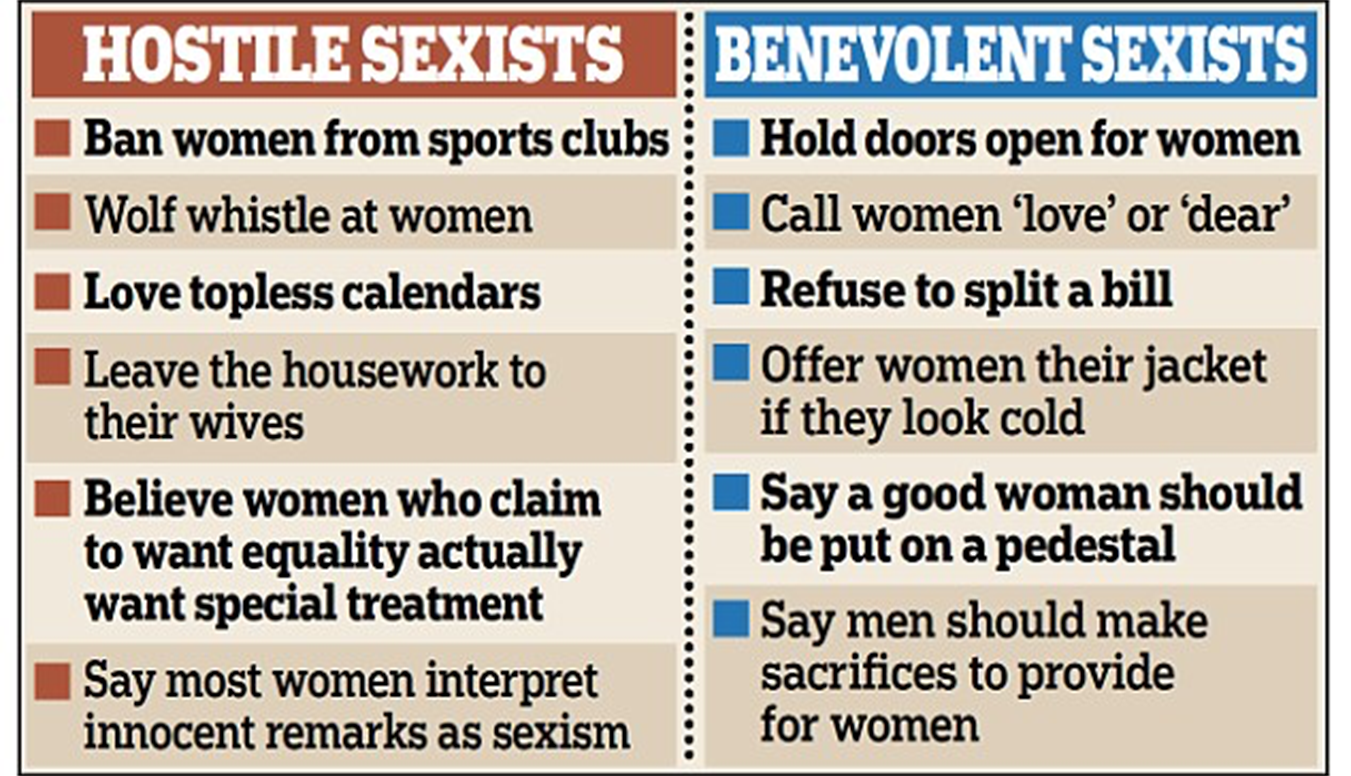
The model posits that two forms of sexism jointly sustain gender inequality by rewarding women who adhere to traditional roles with positive evaluations while penalizing those who deviate with negative judgments. This dynamic pressures women to accept, rather than challenge, power imbalances between the sexes.
“Benevolent” sexism:
Blame of rape surivors who “break the rules” (Abrams et al., 2002)
Acceptance of violence by men against their partners (but not strangers) (Sengupta et al., 2024)
Women accepting husbands giving them orders like “don’t drive” (Moya et al., 2007)
Acceptance of gender inequality -> appearance concern and body modification (Calogero & Jost, 2011)
Reduced cognitive performance among women (Dardenne et al., 2007)
Abrams et al (2003) → BS but no participant gender, predicted victim blame
Sengupta et al (2024) → Results with around 100,000 participants showed that BS predicted greater acceptance of spousal (but not stranger) violence against women
Calogero and Jost (2011) → Experimentally primed sexism with 200 Kent students. “We are constructing a new questionnaire. Please help us by proofreading these statements.”
BS: “Women, compared to men, tend to have a superior moral sensibility”
HS: “Most women do not appreciate all that men do for them”
Control: “Women, compared to men, tend to be more realistic”
Priming BS resulted in more self-objectification (seeing one’s appearance rather than health attributes as more important in determining how happy you are with your body), more self-surveillance (being concerned with what you look like to others), and body shame (being ashamed of the way you look).
Do women want benevolent sexism?:
Mixed findings - some evifence that men displaying BS can be well-recieved by women generally
Seems to be dependent on the way that different types of sexism has presented by researchers
Gul & Kupfer (2018): straight women preferred men high in BS to those low (but men low in BS were described very coldly e.g., ‘he does not think women should be protected’)
Flattering to deieve? Why people misunderstand BS:
Long assumed the niceness of BS makes it (& wider gender system) palatable.
Is this a knowing bargain – do people accept it as one of the “benefits of being a woman” (Becker & Wright, 2011), compensating and legitimizing gender inequality?
Or a deception – an “insidious” ideology that “continues to hide under the veil of chivalry” (Rudman & Fetterolf, 2014)
Role of warmth
Warmth is a cardinal trait in person perception and organizing principle in social cognition (Asch, 1948; Heider, 1954)
The very niceness of benevolent sexism may disguise its anti-egalitarian functions
If it’s nice, it can’t be nasty. And it can’t go together with hostile sexism, which is obviously not-nice
Benevolent sexism doesn’t look so much like a consenting bargain for women, but a con-job, in that people don’t understand what BS really is or what it does. And they aren’t presented with palatable alternatives
Sexism, men, boys
Sexism affects both → Traditionally, women do less well in math and science. They do worse whem reminded of their gender or compared to men (stereotype threat)
Gender role strain → stress associated with any conflcit between your personal identity and the expectation associated with gender role. Most research has focused on men. Strain includes fear of: physical inadequancy, emotional expresiveness, suordination to women, ittelectual inferiority and performance failure
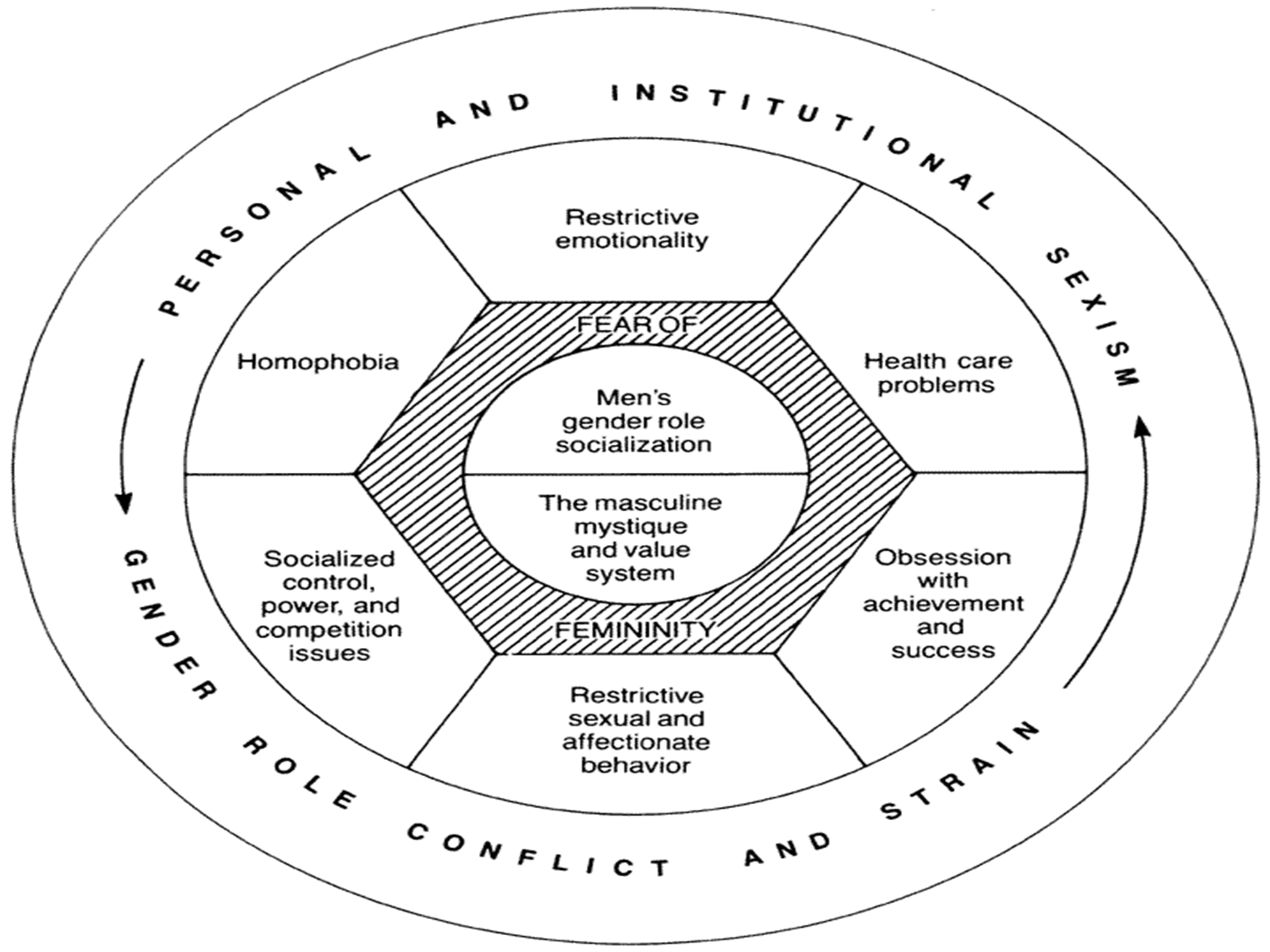
Manhood is a precarious status – hard won and easily lost. This uncertainty is threatening and produces anxiety. Threats to manhood linked to more displays of aggression. Threats to manhood:
Losing in a sports competition
Having your lover say that she/he is not sexually satisfied.
Telling someone that you feel hurt by what she/he said.
Admitting that you are afraid of something.
Having a female boss.
Being married to someone who makes more money than you.
Having people say that you are indecisive.
Working with people who seem more ambitious than you.
Being unable to become sexually aroused when you want.
Not making enough money.
Feminism and men
Paradox: despite all the gains won by feminism for women, it is spurned, even by women. Only a minority identify as feminists. Some even sympathise with feminist ideas but refuse the label. At the heart of this rejection is the misandry myth: stereotype that feminists harbor antipathy toward men.
Extreme anti0feminist sentiment is common; South Korea people are being fired from their jobs if suspected
Misandry → dislike of, contempt for or ingrained prejudice against men
Misandry myth research → Published November 2023. First attempt to examine whether and why feminists dislike men, and are seen to dislike them. Six studies: 9,799 participants across 9 countries in Europe, Asia, the US
Were feminists’ attitudes negative in absolute terms? No: Across feeling thermometer, liking and trust, and emotional reactions measures, feminists scored above midpoint, d = 0.73 [0.58, 0.89], p < .001
Were feminists relatively less positive about men? A: NO.
Feminists v. nonfeminists: d = -0.07 [-0.17, 0.04], p = .204
Strength of identification, d = -0.04 [-0.11, 0.02], p = .199
No robust non-linear relationship, χ2 = 1.29, p = .255
Indeed, feminists’ attitudes to men were arithmetically (but ns) more positive than men’s, d = 0.19 [-0.10, 0.49], p = .194
(If we call feminists misandrists, what do we call men?)
Week 26 - Racism and Diversity
Race Disparity Audit: Racial disparities in health, educational attainment employment
Lammy Review: Racial disparities in the criminal justice system
McGregor-Smith Review: Racial discrimination in the workplace
Windrush Review: “Institutional ignorance and thoughtlessness on the issue of race”
Racism and Racial inquality: Racial attitudes are the strongest predictor of opposition to policies that promote equality. Not personal economic anxiety, not princiled conservatism
A bit of hope - BLM movement has become more popular with the American pulic and awareness raising helps
Here are detailed and structured notes based on the presentation “Racism” (PSYC6392) by Dr. Nikhil Sengupta, incorporating all key theoretical points, studies, and discussion prompts from the slides:
I. Racial Inequality in the UK
Systemic Disparities:
UK government-commissioned reports reveal enduring structural inequalities:
Race Disparity Audit – Disparities in health, education, and employment.
Lammy Review – Overrepresentation of Black and minority ethnic individuals in the criminal justice system.
McGregor-Smith Review – Racial discrimination in workplaces, especially in career progression.
Windrush Review – Institutional failures linked to ignorance and neglect on race.
Implication: These findings point to institutional racism — systemic policies and practices that disadvantage racial minorities even without explicit intent
II. Racial Superiority Beliefs
Historical Foundations:
The White Man’s Burden (Kipling, 1899): Colonial justification framing non-White people as inferior and in need of control.
Abraham Lincoln (1858): Despite progressive reputation, Lincoln expressed belief in White superiority and opposition to racial integration.
Psychological Studies:
Kteily et al. (2015):
Introduced the “Ascent of Man” scale to measure blatant dehumanization.
Some participants rate racial outgroups as less evolved — a modern expression of biological racism
III. Racism Over Time
Shift in Expression:
Racism has evolved from open expressions of biological inferiority to subtler, more “modern” forms:
Symbolic/modern racism: Expressed through opposition to racial equality policies and through “principled objections.”
Kinder & Drake (2009): Document how racist beliefs remain persistent beneath changing cultural norms.
IV. Racial Attitudes and Policy Opposition
Core Finding:
Racial attitudes are the strongest predictor of opposition to policies like affirmative action — stronger than:
Personal economic insecurity
Political conservatism
Supporting Studies:
Blatz & Ross (2009): Racists mask opposition to race-based justice as principled ideology.
Federico & Sidanius (2002): So-called “principled objections” often function as rationalizations for racial bias.
V. The Myth of Racial Progress
Misperceptions of Equality:
Kraus et al. (2019): Most Americans vastly underestimate the degree of racial economic inequality.
People believe progress has been rapid and substantial.
In reality, wealth, education, and employment gaps remain persistent or have worsened.
Consequences:
These misperceptions:
Reduce support for redistributive policies.
Foster complacency.
Sustain systemic inequality by making it invisible.
VI. A Bit of Hope: Black Lives Matter (BLM)
Changing Perceptions:
The BLM movement has grown in popularity, especially after high-profile police killings and mass protests (Rickards, 2020).
Increased awareness appears to have shifted public discourse — at least temporarily — toward acknowledging systemic racism.
Summary of Key Concepts and Studies
Concept | Key Point | Supporting Evidence |
|---|---|---|
Institutional Racism | Systemic disadvantage not dependent on individual prejudice | Lammy, McGregor-Smith, Windrush Reviews |
Blatant Dehumanization | Seeing other races as less evolved or human | Kteily et al. (2015) |
Modern Racism | Masked in appeals to fairness or meritocracy | Blatz & Ross (2009); Federico & Sidanius (2002) |
Myth of Progress | Perceived progress does not match reality | Kraus et al. (2019) |
Hope Through Awareness | BLM has increased visibility of systemic issues | Rickards (2020) |
Week 27 - Improving Intergroup Relations
People think they are less prejudiced in current day, but prejudice remains. Crucially real inequality and disadvantages persists. In the UK too. Ageism is another very important type of prejudice and discrimination and has negative effects like racism.
So, we have work to do solve 3 specific and overlapping problems:
Stereoypes - beliefs about a group and its members (intelligent/stupid, (un)friendly)
Prejudice - attitudes - typically negative (hating, disliking, indifference)
Discrimination - giving different outcomes (treatment) to a group and its members (wealth, law, policy, employment, health prevention and treatment)
And have taken different (overlapping) approaches to solving them:
Addressing the cognitive, identity bases of prejudice and stereotyping
Intergroup contact and reconciliation (also aimed mostly at prejudice)
Changing material circumstances of groups (aimed mostly at discrimination
Cognition and identity
Categorisation-based approaches
Recategorisation - Common ingroup identity model → suggests that if members of opposing groups recategorise themselves as members of the same group, attitudes improve. 2 mechanisms: Salience of superordinate identities and common goals
Recategorisation can backfire among “high identifiers” - Crisp, Stone and Hall (2006) told british students in the “superordinate” condition that Britain was joining a (USE) and that “British” was old-fashioned
Changing categories changes predjudice; de-categorisation, superordinate identification, but may backfrie if people feel they will lose their identities
Reconciliation
Intergroup apology → when a member trangresses, an apology is often expected, allows perpetrator and victim groups to reconcile
Apologies → some elements present in all governmental apologies, people feel insulted by apoigies with reparations but no expression of guilt. Apologies tend to hae little impact on forgiveness, memory for apology is poor. After apologising, the perpetrator group shifts obligation to the victim group. Feels that they, not we, should take responsibility for intergroup relations
Contact hypothesis - contact between members of diff social groups, under approriate conditions, can lead to reductions in intergroup bias. Among most enduring and studied theory and technique. Direct positive contact is associated with reduced prejudice
(Allport, 1954; Amir, 1969) → Equal status, Common goals, Cooperation, Support from authorities and social norms
Borne out by Pettigrew and Tropp’s (2006) meta-analysis of 515 articles. They don’t have to be present (not necessary), but they help. They work together rather than separately
How does contact work - most effectively by changing how we feel about the other group and its members
Reducing negative feelings - intergroup anxiety, negative intergroup emotions
Promoting positive feelings - Encouraging empathy + perspective taking, Promoting mutual sharing of personal information, Positive intergroup emotions
Intergroup anxiety - “The anxiety that an individual may feel when anticipating or experiencing contact with someone from another group” (Greenland & Brown, 1999)
Largely investigated for its negative outcomes in contact situations. Derives from previous experiences with the outgroup and beliefs regarding the interaction
Minorities: anxious about negative evaluation/identity stigma
Majorities: anxious about seeing prejudices/discriminating
Positive previous contact makes people more optimistic about futue contact
Empathy - capacity to know the other person’s state of mind and adapt
Batson et al (‘97) - 1st empathise with individuals who are suffering, 2nd people realise the importance of the wellbeing of the individual, 3rd generalise to the whole group that the person belongs to
Perspective-taking
Empathy is closely associated with perspective-taking, ability to understand the internal state of another (Underwood & Moore, 1982)
Cotact with outgroup friends is positively associated with perspective-taking, among the strongest positive predictors of forgiveness (Hewstone et al., 2006)
Work via categorisation, increased overlap etween self and target group (Galinsky & Moskowitz, 2000), Common humanity and common destiny (Stephan & Finlay, 1999)
Decategoristion (brewer & miller, ‘88) → frequent contact should lead to more personalised (or individuated) perception of the outgroup as a whole. Move from the Intergroup to the interpersonal end of the continuim.
When can contact worl? Contact requires… to engage in meaningful interaction with the outgroup
the opportunity
the inclincation
A reality check for contact theory?
Dixon et al. (2009, on moodle, in critical focus section of textbook, Chapter 12)
Critique of contact: too many conditions, not realistic in many situations, people avoid contact or find it highly stigmatizing (Lee, 2003)
A verdict on contact is much researched technique. That can backfire (sometimes negative/numbing) and sometimes unrealistic outside carefully controlled situations
Addressing the reality
Collective action - sometimes intergroup relations are marked by inequality. Dealing with it sometimes requires coordinated actions of disadv group members to change iintergroup relations. Often taken on behalf of the wider cause of justice and needs of other groups (Thomas & McGarty, 2009)
BUT most likely to do so on behalf of one’s own group
Three interrelated variable (Van Zomeren et al 2008)
High identification with group
Perceived justice
Percieved efficacy of the group to change its stituation
BUT can be very costly for minority groups
Physically - time, energy, threat of repression
Psychologically - system justification
Needs the buy-in majority of majority groups - difficult to get
Conclusions
Social Psychology has researched why people are prejudiced towards outgroups. Using this knowledge, it has tried to apply solutions to ‘disrupt’ the causes of prejudice:
Categorization (us vs them thinking) – solution: recategorization
Anxiety, lack of empathy, segregation – solution: contact
Inequality – solution: collective action
But all of these approaches have pitfalls and complications. There are also significant gaps in the research (e.g., causal evidence). More research needed (especially longitudinaly; Cohen-Eick et al., 2022).
Week 28 - Social cure: Benefits and costs of group membership
Benefits of belonging to group
Interdependence - state of being dependent on one another. People can often achieve more in groups than alone → defining feature of groups
Affiliation = act of associating or interacting with 1+ other people. Can be or bad, short or long encounters. People seek to be in company/interact with other people. Being with or interacting with other people is fundamental social behaviour. Social inclusion is beneficial for self-esteem
Affiliation, similarity and support - grouping together with people who have the same attitudes. Opinion-based groups: groups formed around shared opinion
Group memberships can provide social support → perception or experience that one is loved and cared for, esteemed and valued, and part of a social netwoek of mutual assisitance and obligatins
Grouping together with people with similar problems.
People experience need to affiliate when they are sad (Gray et al., 2011)
Even seeking other sad people and sad music (Hunter et al., 2011)
Appears to help because people feel “understood”, “befriended”, and ”less alone” (van den Tol & Edwards, 2015)
Terror management theory (Pyszczynski et al., 1999; Solomo et al., 1991):
Most profound human anxiety stems from knowledge that we will die one day
Much of human behaviour is motivated by escaping this death anxiety
Mortality salience = Awareness of one’s own inevitable death
People look for structure in their lives to confront the inevitability of their death. Group norms, identities, values provide this as does sheer human company
Optimal distinctiveness - People have 2 competing fundamental needs:
Inclusion - like to affiliate
Differentiation - like to distinguish themselves
Optimal distinctiveness theory → group memberships allow for both needs to be met
Leonardelli et al. (2010):
Context-specific – Context affects both the activation of motives or needs and the relative distinctiveness of specific social categories
Dynamic equilibrium – Optimality is not necessarily fixed because inclusion and differentiation motives are also subject to temporal influences and change over time
Identity motives vary across situation, culture, and individuals – Inclusion and differentiation motives vary as a function of current levels of satiation or deprivation
Benefits of activism on behalf of group: Klar and Kasser (2009)
Activism Orientation Scale (AOS; Corning & Myers 2002)
Conventional activism: “Being an activist is central to who I am”
High-risk activism: “I would engage in a political activity in which I knew I would be arrested”
Other activism measures, Wellbeing measures
Results: Activism associated with higher psychological well-being. Again, exception of high-risk activism
Social cure hypothesis → based on social identity = aspect of our self that is determined by our group memberships. Social identity theory (Tajfel & Turner ‘79) theory of group membership and intergroup relations. Argues that personal identites and group membership complete people’s sense of self
Social cure = Idea that social groups have positive impact on individuals because processes of social identification make them meaningful and psychologically valuable (Jetten et al., 2012)
Social cure in medicine → people often lose group memberships in major life events and traumas. Loss of group memberships negatively predicts well-being over time. This can be counteracted by joining new groups
Boden-Albala et al. (2005)
Method: 655 stroke patients followed for 5 years.
Findings: Socially isolated patients were twice as likely to have another stroke. Social ties were a stronger predictor of health than coronary artery disease.
Haslam et al. (2008)
Method: Examined stroke patients’ pre- and post-stroke group memberships.
Findings: Maintaining group memberships post-stroke was associated with better well-being.
Williams et al. (2020)
Method: Interviewed members of a creative writing group and a choir with chronic mental health conditions.
Findings: Group participation met psychological needs like belonging and purpose.
Uhlmann & Wegge (2023)
Method: Surveyed 2062 older adults during COVID-19 on multiple group memberships (MGM).
Findings: MGM was linked to higher well-being, but didn’t buffer pandemic-induced fear.
Cognitive route
Self-continuity - When I, or my circumstances, change, my group provides a stable identity
Self-esteem – When I am proud of my group, I feel better about myself because I associate myself with it
Jones & Jetten (2011) – Study 1
Method: Field study with 12 RAF athletes in winter sports training.
Findings: Greater group membership was linked to faster heart rate recovery, showing physiological benefits of belonging.
Jones & Jetten (2011) – Study 2
Method: Experimental study using a cold-pressor task (hand in ice water) with participants identifying with 1, 3, or 5 groups.
Findings: Those who identified with more groups endured the cold longer, suggesting group membership boosts resilience.
Greenaway et al. (2015) – Study 1
Method: 62,000 participants across 47 countries measured for group identification, personal control, and well-being.
Findings: Identifying with groups increased perceived personal control, which improved well-being.
Greenaway et al. (2015) – Study 4
Method: American participants manipulated to feel high vs. low identification with the USA.
Findings: Higher identification increased personal control and well-being.
Downsides of belonging to groups
Black sheep effect - tendency to evaluate disreputable/disliked individuals more negatively when they are a member of one’s in-group rather than of another group
Reactions to deviants
Deviants (or marginal group members) = People who deviate too far from prototypical group members and group norms
Deviants threaten the positive image of the group or perception of ingroup superiority (Marques et al., 2001)
People want to evaluate their groups positively
Imposters = individuals posing as legitimate group members when they are not
Marginalisation: Marginalising racism (Platow et al., 2014) = Form of prejudice whereby ingroup members claim that specific individuals belong to their group, but also exclude them by not granting them all of the privileges of a full ingroup member. Held to account by group standards (as if “in”), but not fully granted respect, privileges of group membership (as if “out”)
One manifestation: zero-sum membership – you cannot be “fully Iraqi” and “fully Australian” at the same time (Smithson et al., 2015)
Social ostracism - being excluded from a group by the consensus of the group.
Ostracism and social inclusion → people feel sad, angry and psychologically distressed. It even hurts when we do not want to be part of the group (Gonsalkorale & Williams, 2007). Resembles physical pain (Eisenberger et al., 2003). Hurts the ostraciser too (Nezlek et al., 2015)
Functions of ostracism → get rid of burdensome group members and their delaying effect on group goals (Wesselman et al 2013). Motivates group members to follow group norms (Ouwerkerk et al., 2005). Deters other group members from following the example of people who “defect” – help themselves at group’s expense (Kerr et al., 2009)
Marques & Yzerbyt (1988)
Method: Evaluated reactions to bad speeches from in-group vs. out-group members.
Findings: Bad speeches were rated more harshly when delivered by an in-group member (black sheep effect).
Jetten et al. (2005)
Method: Looked at reactions to “meat-eating vegetarians.”
Findings: These imposters were derogated more by their in-group than by outsiders.
Schoemann & Branscombe (2011)
Method: Studied reactions to an older person dressing young.
Findings: Those trying to “pass” as young were seen as deceitful and less likable.
Boden-Albala et al. (2005)
Method: Social isolation and stroke outcomes study.
Findings: Social isolation doubled the risk of a second stroke.
Nezlek et al. (2015)
Method: Studied the impact of ostracism.
Findings: Ostracism causes distress, even when people don’t want to be in the group.
Staunton et al. (2014)
Method: Looked at messaging about healthy eating among students.
Findings: Messages suggesting a norm of unhealthy eating led to lower intentions to eat healthily.
Howell et al. (2014)
Method: Study of PhD students at a summer school.
Findings: Those who were central in social networks had better mental health but worse physical health.
When groups are bad for you
Stigmatised identities → these can lower well being, but in part people expect to be stigmatised (O’Donnell et al 2015)
When identities are stigmatised, Woodhams et al. (2014):
Workers who identify with more than one stigmatized group (e.g., race, sexuality) get paid less
Unhealthy group norms → when a group adopts these, the norms can undermine healthy behaviour, especially through attitudes and subjective norms (e.g. Louis et al ‘97). Sujective norms → Person’s perception of social expectations to adopt a particular behaviour
Staunton et al. (2014):
Participants exposed (or not) to positive injunctive norm that fellow students approve of eating healthily
Also exposed (or not) to descriptive norm that fellow students do not eat healthily
Results:
When exposed to negative descriptive norm is made salient, those exposed to the injunctive norm report lower intentions to healthily
No descriptive norm – no effect of exposure to positive injunctive norm
Health cost of fitting in, Howell et al 2014:
Study of PhD students on a 2-week long European summer school (Greece). Network analysis established who was central and who was peripheral in the emerging social network
More central people reported better mental health, but worse physical health
Physiological reactions to a hard maths task are pictured to the right
“Fitting in” was associated with binge drinking and ill health
This is not a study of identification
Social cure or curse? → Ingroup processes can also be detrimental for well-being. Groups can become burden rather than resource, negatively affecting stress appraisal (Kellezi & Reicher, 2012)
When it’s complicated
Escartín et al. (2013)
Method: Studied workplace bullying across 19 Spanish organizations.
Findings: Higher identification with a workplace reduced bullying.
Branscombe et al. (1999) – Rejection-Identification Model
Method: Studied how discrimination affects group identification.
Findings: Perceived discrimination led to stronger group identification, which improved well-being.
Giamo et al. (2012)
Method: Surveyed 252 multiracial individuals on discrimination, group identification, and well-being.
Findings: Discrimination reduced life satisfaction, but identifying with multiracial groups helped mitigate the negative effects.
Bogart et al. (2018)
Method: Studied 710 people with disabilities, measuring disability pride and self-esteem.
Findings: Viewing disability positively improved self-esteem and helped combat stigma.
Kellezi & Reicher (2012)
Method: Interviewed detainees in UK immigration removal centers.
Findings: Some avoided social support to protect loved ones, increasing distress.
Week 30 - Dual Systems and Nudge Psych
Old view: people are rational agents. People have control over (importnant aspects of) their own thinking. They are utility maximisers that follow reason/logic
Daniel Kahneman (born ‘34), was an israeli-american psychologist
Now many aspects of cognition are beyond our awareness and control. People rely on uncoscious biases and rules of thumb to navigate the world (for better and worse)
Irrationality in action: Anchoring (Tversky and Kahneman ‘74)
Spun a wheel of fortune with numbers raging 0 -100
Asked Ps whether number of African nations in UN was < or > than number
Asked Ps to estimate actual number
Estimations were significantly related to number spun on wheel
Irrationality in action: Expectancies
Group A → regular price → workout intensity higher
Group B → discounted → workout intensity lower
Dual system theory:
System 1 (right), the fast thinker: intuitive, automatic, little effort, no voluntary control, multitasker, impulsive, always at work
System 2 (left), slow thinker: rational, deliberate, effortful, allocates attention, hierarchial, cautious, can be lazy
Has been explored in many domains
Persuasion (elaboration likelihood model)
Stereotyping and prejudice
Learning theory (implicit and explicit learning)
Moral psychology
Automatic behavior
Terror managament
Economic behavior
Memory (e.g., fuzzy trace theory)
Applications of dual process models: Persuasion
Peripheral route (system 1) → Source Effects: We trust speakers who are attractive, credible, authorities. We like products associated with positive stimuli. Social Proof: We buy / do / think whatever everyone else does
Central Route (System 2) → BUT these effects are reduced when we are highly motivated to reach the “correct” response, in which case we engage in deliberative thought
Caveats and Open questions: Challenging common assumptions of DS theories
System 1 and 2 have distinctive characteristics, but they have more shared characteristics than we think
System 2 leads to better decisions, but there are many exceptions as well
System 1 and 2 are separable; operate one at a time, but they also interact, and can operate simultaneously
Attention is a limited reasource, Shared by S1 and S2, both systems disrupted when attention is drawn away to something else
System 2 can also fail → motivated cognition (people want to perserve a positive self-image amd will bend over backwards to do so
Motivated percetption → Took photos of Ps and asked them to recognize their own photograph from array of photos. Photos were manipulated to be more/less attractive. Ps selected more attractive photo (especially high self-esteem)
Motivated skepticism → Ps given favourable vs. unfavourable medical test results (random). Ps In unfavourable condition: took longer to decide result was complete, more likely to retest result, rated test accuracy as lower
Humans love to think in binaries. Behaviours can be both uncoscious (obstensibly s1) and intentional (ostensibly s2). Behaviours can be unitentional and controllable. Although separat, the 2 systems interact. S1 can override S2 and vice-versa
Nudging
Cass Sunstein, a Harvard Law professor, is a leading expert in behavioral economics and law, and a Holberg Prize recipient.
Richard Thaler, a Chicago Booth professor, won the Nobel Prize in Economic Sciences for his work in behavioral economics and helped found the Behavioural Insights Team.
Choice architecture → envrio in which we choose *unavoidable
Usually (not always) s1 is easier and quicker to change behaviour at scale
Default - habitual behaviour
Nudge, enviro cue or incentive to change behaviour: subtle, small, salient, attractive, easy, can opt out
NOT a nudge: Financial incentive, Financial deterrent (E.g., fine), Punishment, Coercion, Forcing choice, Removing alternative (cannot opt out)
Criticisms:
Nudges teach us little about “mechanism” – that is, WHY do nudges work
Nudges are sometimes drawn from psychological theory, but they rarely shed light on process.
E.g., because of simple design (usually a comparison between Condition A and Condition B)
And lack of psychological measures
Perhaps as a result, nudges often don’t work – and sometimes backfire
Moreover, they don’t tell us anything about what’s happening in people’s heads! (And isn’t this the point of psychology?)
Week 31 - Group Decision Making
Does Interaction with groups intensify our decisions?
Group polarisation - tendency to group discussions to produce more extreme group decisions than individal members pre-discussion or the direction favoured by the mean
Group shift toward risk → Stoner (‘61): Individuals marked their answers first while alone, and then again after discussing their opinions with a group. Groups made riskier decision than individuals.
Risky Shift: finding that the group consensus seems to be “riskier” than the average decision made by individuals prior to a group discussion.
Beyond the risky shift: the “risky shift” is not about risk at all. Moscovici & Zavalloni (1969) re-conceptualized the risky shift as a more general phenomenon related to the group’s initial leanings.
Group Polarization: A group discussion strengthens the average inclination of group members.
Moscovici & Zavalloni (1969)
Examined French student’s attitudes toward Americans (initially negative) and toward de Gaulle (initially positive)
Moscovici examined French student’s attitudes toward Americans (initially negative) and toward de Gaulle (initially positive).
Attitudes toward Americans became MORE negative after the discussion than before the discussion.
Attitudes toward de Gaulle became MORE positive after the discussion than before the discussion.
Brauer, Judd & Jacquelin (2001): mutual dislike for peers was increased when shared with other students.
Group polarisation: how does it happen
Normative influence → social comparison, People seek public approval and conform to group norms. Leads to extreme shifts in opinions to align with the majority
Informational influence → persuasive argument, Expressing support for dominant opinions reinforces belief. Hearing new arguments in favor of the majority view strengthens polarization
Self-categorisation theory → Identifying yourself as a member of a group means you take on the identity of intergroup behaviours.
Are groups always risky? → not always, e.g. when alcohol is involved. Abrams, Hopthrow, Hulbert and Frings (2006). Risk orientation in groups vs alone and after consuming alcohol vs. Placebo.
Findings
Main effect of alcohol/placebo. Alcohol> Placebo
No main effect of group/indi, Significant interaction effect
Supports the idea of group monitoring when the group has been drinking
Groups make decisions as a collective knowledge that they all share, but we all also have unique knowledge that each individual could bring to the table
Does unique knowledge get considered when making group decisions?
Stasser and Titus (1985,1987):
YES….. “Unique and novel arguments would be the most persuasive in decision making groups”
NO….. groups generally focus on information that is shared among all members rather than on information that is uniquely held by different individuals (Stasser & Titus, 1985,1987,2003). = the hidden profile problem
Hidden profile problem:
Groups over focus common information/ insights and do not discuss information unique to one individual or small minority (Strasser, 1992; Strasser & Stewart, 1992).
Even when bits of unique information are shared there is a general tendency to fail to hear, understand or integrate them. (Dennis, 1996; Kerr and Tindal, 2004; Larson et al, 1994)
Why hidden profile is a problem
Failure to disclose and attend to hidden profile information typically results in poorer quality decisions (Dennise, 1996; Stasser & Titus, 1985).
Why the hidden profile occurs
Time – Time pressure increases urgency for closure making participants less receptive to diverging or disconfirming perspectives (Kruglanski & Webster, 1991; Kerr &Tindale, 2004)…… though ironically more focused on the task (Karau & Kelly, 1992).
Group size - larger group greater the chances of worthy individual ideas and insights being overlooked (Steiner ‘72). Three person group everyone has 33% chance to recall & contribute their unique information to the group. Four person group 25% chance
Large group diversity - The greater the diversity of group membership the more likely that intergroup stereotypes and conflicts will compromise the full utilisation of member resources (Caruso & Wolley, 2008).
Shift in group composition - The more frequently group composition changes, the harder it is for members to keep track of which members have what task relevant information or expertise (Lewis, et al, 2007).
Groups geographically dispersed and replying on electronic technologies - The more dispersed group relies on electronic technologies for communication, the more challenging it will be for members to get a good “take” on who knows what (Nemiro et al, 2008).
Social costs & Status – higher status members of medical teams such as resident physicians are more likely to discuss unique information in group discussions than lower status members (e.g. interns & students; Larson, Christensen, Abbott, & Franz, 1996). Risky for low status members to share unique information credibility concerns (Stewart & Strasser, 1995)
How groups can overcome the hidden profile problem
The group must recognise that certain members do have special info/expertise relevant to the group’s work → group must value what those indi contribute → group must be sufficiently motivated and coordinated to actually use memers reasources
Equal status of members (Hollingshead, 1996), Compare each decision alternative on common dimensions (Reimer, et al, 2007). For example, members rank decisions rather than choose one outright (Hollingshead, 1996; Reimer, et al, 2007)
Brainstorming
Diehl and Stroebe (1987) suggest there is little evidence that individuals brainstorming in groups are more creative than when on their own.
But…. Eyewitness testimony is more accurate when a group account is given (vs. individual report; Warnick & Saunders, 1980). When group’s work together and critique each other’s ideas produce better quality ideas (McGlynn et al., 2004)
This may be due to 4 factors (Paulus et al (‘93)
Evaluation apprehension
Social loafing and free riding
Production matching
Production Blocking
Overcome brainstorming draw backs
Combine individual & group brainstorming (Brown & Paulus, 2002)
Have groups communicate in writing (Mullen, Johnson & Salas, 1991)
Electronic brainstorming: groups that brain storm via computer produce more ideas (Gallupe et al, 1994)
Heterogeneous groups: members with diverse types of knowledge and background may create a stimulating environment (Stroebe and Diehl, 1994)
But why do people believe brainstorming in groups work?
Illusion of group effect (Diehl and Stroebe, 1991): Experience based belief – we produce more ideas as a group than alone
Although… Equal number of individuals working alone produce more ideas than those in a group …..Groups generate more ideas than any single individual
→ Illusion groups are better
Group memory
Clark and Stephenson (1989,1995) groups remember more information than individuals
Lorge and Solomon (1995) groups recall more because individuals communicate unshared information and because their group recognised true information when they hear it. But depends on the memory task
Steiner (1976): compared to individuals, groups remember more on simplistic artificial tasks (e.g. nonsensical words) than on complex realistic tasks (e.g. a story)
Week 32 - Groups and Leadership in Ors
Key Concepts
Prosocial Behaviour: Actions that benefit others.
Altruism: Helping others without benefit or at a cost to oneself.
Not all prosocial acts are altruistic, and vice versa.
Penner et al. (2005) Multi-Level Model
Micro: Evolutionary and individual bases (kin selection, reciprocity, reputation).
Meso: Contextual interactions (bystander intervention, intergroup dynamics).
Macro: Group/organizational level (volunteering, cooperation in dilemmas).
Bystander Intervention
Darley & Latané (1968): As bystanders increase, help decreases (diffusion of responsibility, pluralistic ignorance).
Kitty Genovese case: Media misrepresented the event, becoming a cautionary tale.
Group Size and Helping
Levine & Crowther (2008): Group of friends or ingroup can enhance helping.
Harari et al. (1985): Male intervention increased with male group presence.
Economic Games
Dictator Game: Measures altruism without consequences.
Ultimatum Game: Includes fairness considerations.
Trust Game: Captures reciprocity and trust.
Social Dilemmas
Cooperation increases when:
Individuals value collective good.
Group identity is strong.
Communication is possible.
Norms of cooperation are established.
Communication in Dilemmas
Promotes cooperation especially when:
Ground rules are set.
Discussions are constructive.
Moral commitments are publicly made.
Evolutionary Perspectives
Kin Selection: Preference for helping relatives (Hamilton, 1964).
Reciprocal Altruism: Mutual long-term benefit (Trivers, 1981).
Indirect Reciprocity: Reputation-based cooperation (Nowak & Sigmund, 2005).
Ingroup Favouritism
Parochial Altruism: More prosocial towards ingroup (Fehr et al., 2008).
Mechanisms: “Ingroup Love” (preference) vs. “Bounded Generalized Reciprocity” (expectation-based).
Week 33 - Morality and Justice
Moral Development Theories
Durkheim (1925): Morality as external, social obedience.
Piaget (1932/1965): Heteronomous vs. autonomous morality.
Kohlberg (1981): Stages of moral development:
Preconventional: Obedience, self-interest.
Conventional: Conformity, law/order.
Postconventional: Social contract, universal ethics.
Critiques and Advances
Gilligan (1982): Care vs. justice ethics; Kohlberg was androcentric.
Bloom (1959): Cultural and class bias in Piaget's methods.
Research Evidence
Colby et al. (1983): Longitudinal validation of Kohlberg’s stages.
Walker (1983): Moral conflict exposure boosts development.
Mammen et al. (2019): Peer discussions trigger deeper moral reasoning.
Moral Intuition and Emotion
Haidt (2001): Social Intuitionist Model—intuition first, reasoning post-hoc.
Graham et al. (2009): Moral Foundations Theory (harm, fairness, loyalty, authority, purity).
Haidt et al. (2000): “Moral dumbfounding” – intuition overrides reason.
Emotion and Judgement
Wheatley & Haidt (2005): Hypnotic disgust alters moral judgement.
Schnall et al. (2008): Disgust amplifies harshness in judgement.
Landy & Goodwin (2015): Meta-analysis finds publication bias in disgust studies.
Week 34 - Pro-social Behaviour
Organizational Identity
Group membership influences behavior via Social Identity Theory (Tajfel & Turner, 1979).
Identity nested in organization → division → team → role.
Turnover and Satisfaction
Organizational Identity → Job Satisfaction → Turnover Intention
Model 2 (ID → satisfaction → turnover) better supported (Randsley de Moura et al., 2009).
Organizational Citizenship Behaviour (OCB)
OCB-I: Helping colleagues.
OCB-O: Supporting the organization.
Smith et al. (1983): Altruism and compliance scale.
Leadership as Social Influence
Hogg (2001): Leadership emerges from social identity processes.
Effective leaders are prototypical: embody group norms and identity.
Steffens et al. (2021): Meta-analysis supports effect of leader prototypicality.
Attributions and Evaluation
Internal vs. External Attribution: Influences how behavior is explained.
Leader effectiveness perceived higher when prototypical of the group.
Definitions
Altruism: Helping others without benefit (or at a cost) to oneself.
Prosocial Behaviour: Actions that benefit others.
Not all prosocial behaviour is altruistic.
Altruism does not always lead to prosocial acts.
Distinction from economic/behavioural economist definitions.
Methods in Prosocial Behaviour Research
Sociological approaches
Field experiments
Lab experiments
Economic games (e.g., Dictator Game, Ultimatum Game)
Penner et al. (2005) – Multi-Level Model
Micro: Evolutionary origins (kin selection, reciprocity, individual differences)
Meso: Situational dyads (e.g., bystander intervention, intergroup context)
Macro: Group-level prosociality (e.g., volunteering, cooperation)
Bystander Intervention → Study: Darley & Latané (1968)
Simulated emergency (seizure via intercom)
More bystanders = less help
↓ Noticing the event
↓ Interpreting it as an emergency
↓ Assuming responsibility
Key Concepts: Diffusion of responsibility and Pluralistic ignorance
Reanalysis: Manning et al. (2007)
Questioned Kitty Genovese narrative
Few likely saw full incident
Media created a “modern parable” – dangers of group inaction
When Groups Increase Helping
Levine & Crowther (2008) → More help in groups of friends, More help to ingroup members
Harari et al. (1985) → Male bystanders more likely to intervene in presence of other men
Rhetorical Psychology (Billig, 1987)
Psychology should consider counter-arguments
Group size doesn’t always reduce helping—may increase it under certain conditions
Economic Games & Social Dilemmas
Types:
Dictator Game (DG): One person unilaterally allocates money
Ultimatum Game (UG): Second person can reject the offer
Trust Game (TG)
Social Dilemmas:
Best for individuals to defect
Best for society if all cooperate
Communication Helps:
Dawes et al. (1977): Communication about cooperation increases group cooperation
Stech & McClintock (1981): Constructive discussion boosts cooperation
Promises and norm-setting are powerful motivators
Evolutionary Theories
Kin Selection (Hamilton, 1964) → Help kin to spread shared genes. Evidence: Help increases with genetic relatedness
Reciprocal Altruism (Trivers, 1981) → Help non-kin with expectation of future return. Direct & Indirect reciprocity
Indirect Reciprocity → Wedekind & Milinski (2000): Good reputations = more likely to receive help. Semmann et al. (2004): Anonymity reduces prosociality. Haley & Fessler (2005): Eye images increase giving
Ingroup Favouritism
Behavioural Evidence → Kids and adults show more generosity to ingroup Fehr et al. (2008); Jordan et al. (2014)
Primate & Neuroscience Evidence:
Macaques, capuchins prefer ingroup (Mahajan et al., 2011; de Waal et al., 2008)
fMRI: Greater empathy for ingroup pain (Xu et al., 2009; Mathur et al., 2010)
Field & Minimal Group Studies:
Ingroup bias seen in real-world and artificial groups
Tajfel (1970); Ahmed (2007); Whitt & Wilson (2007)
Theories of Ingroup Favouritism
Preference-Based (Ingroup Love) → People want to help ingroup more due to alignment with self-identity: Tajfel & Turner (1979); Brewer & Kramer (1986)
Expectation-Based (Bounded Generalized Reciprocity – BGR)
Help to build a reputation with ingroup
Driven by strategic beliefs about reciprocity
Yamagishi & Kiyonari (2000); Mifune et al. (2010)