310 Final Exam.docx
Exam Date: Monday 12/9 10:30 - 12:30
What to study:
Equations and units
Define the units if there are similarities
If there is math associated it will appear in that section
Lighting, turbines, PV cells
Types
Which to use if there are varieties/options
How they work
The parts that make it up
Advantages and Disadvantages
Understand and explain scientific concepts
Sections and possible points
1. Heat Pumps (20 points) (needs to be finished)
A heat pump function:
Summer: pumps heat from inside to outside
Winter: pumps heat from outside to inside, heat is extracted from the air outside
Energy Balance:
Qh = WNET + Qc
∴WNET = Qh - Qc
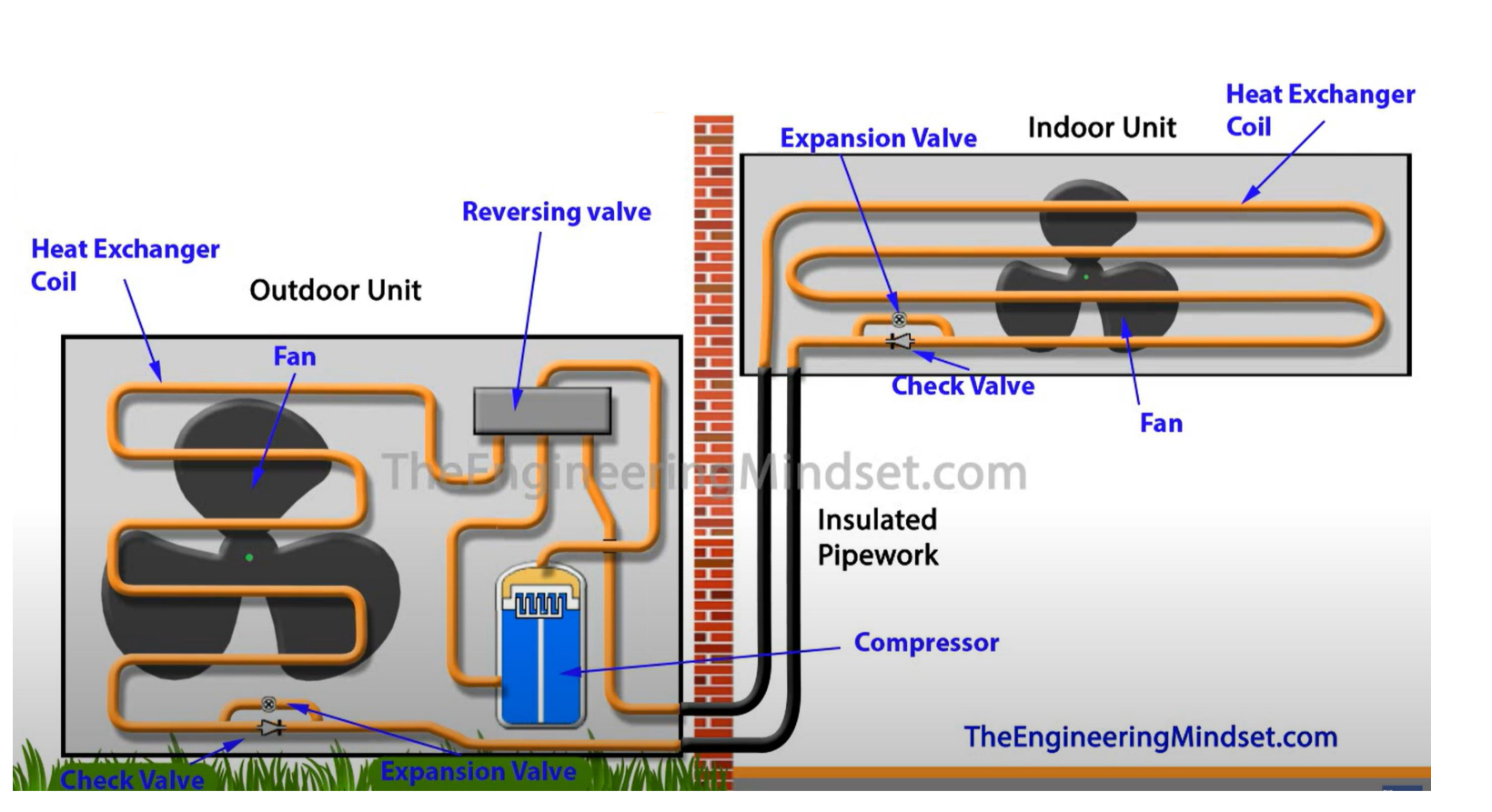
Key Components of a heat pump system
Compressor: Compresses refrigerant to raise temp and pressure
Reversing valve: Directs refrigerant flow to indoor or outdoor unit for depending if heating or cooling mode in use
Indoor heat exchanger: Transfer heat between refrigerant and indoor air
Outdoor heat exchanger: Transfer heat between refrigerant and outdoor air
Expansion valves: Control refrigerant flow and reduces temp and pressure
Check valves aka non-return valves: prevent reverse flow of refrigerant
Filter Drier: removes moisture and contaminants form refrigerant
Sight glass: allows for visual inspection
Temperature and pressure sensors: monitor system operation
Refrigeration cycle basics:
Evaporation: Refrigerant absorbs heat and turns into gas
Compression: Refrigerant pressure is increased therefore increasing temperature
Condensation: Refrigerant releases heat and condenses back to liquid
Expansion: refrigerant passes through expansion valve to reduce pressure and temp
Heating mode process:
Refrigerant compression
Starts as low pressure and temp vapor
Refrigerant compress to be high temp high pressure vapor
Flow directed by reverse valve
Reversing valve directs hot refrigerant to indoor heat exchanger
Heat transfer to indoor air
At indoor heat exchanger fan blows cool air over coil
Heat from refrigerant transfer to indoor air
Refrigerant cools and compresses
Flow through expansion valve
Flow to expansion valve, in heating process by passes this first valve to bypass and non-return valve
Passes through filter drier and sight glass
Expansion and cooling
Pressure and temperature is reduced making a mix of liquid and vapor in second expansion valve
Heat absorption in outdoor heat expansion
Cold refrigerant flow to outdoor heat exchanger
Fan blows outdoor air over coil transferring thermal energy to refrigerant
Refrigerant absorbs heat and evaporates
Cycle repeats
Warmed vapor returns to reversing valve and goes back to compressor
Cooling mode process:
Switch to cooling mode
Reverse valve changes position direction vapor to outdoor heat exchangers
Heat transfer to outdoor air
Outdoor exchanger blow cooler air over coil, carrying heat away from refrigerant and it cools and condenses
Flow through expansion valve
Refrigerant flows toward the second expansion valve, the first one is closed so it passes through the non-return valve and goes through the filter drier and sight glass
Cooling process
Goes through a second expansion valve where it expands and lowers pressure and temperature
Heat absorption in indoor heat exchanger
Cooled refrigerant flows into indoor heat exchanger
Fan blows warm hard over coil and transfers heat from air to refrigerant cooling the space
Refrigerant absorbs heat and evaporates becoming a low-pressure, low temperature vapor
Cycle repeats
Cooled vapor flows back into reserve valve which directs to compressor and continues the cycle
2. Compressors (15 points) (done)
Convert mechanical power into fluid air power
Compressed air produced can be stored
Critical components in industries and systems that rely on pneumatic tools, air-driven machinery, and industrial air systems
2 major designs
Positive displacement
Pressure is increased by decreasing volume
Types:
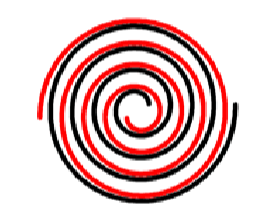
Rotary:
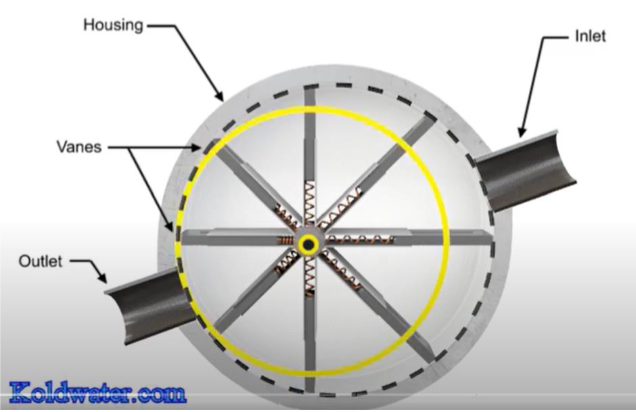
Vane: cylindrical housing with an off-center drive shaft and adjustable vanes
Smooth and free of vibrations
Screw: ambient air intake -> cleans the air
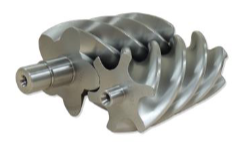
Scroll: used in refrigeration
Reciprocal
Cylindrical housing with piston connected to crankshaft
Piston moves up and down
Single stage: air becomes hot and makes compressor less efficient
Multi-stage: avoids overheating and increases pressure
Dynamic compressor
Use rotating elements to accelerate the gas by diffusing action, velocity is converted into static pressure
Total energy in flowing gas is constant
Entering an enlarged section, flow speed is reduced and some velocity turns into pressure energy -> static pressure is higher in enlarged section
Centrifugal compressor
Converts kinetic energy into potential energy
Bernoulli’s principle
Radial acceleration
Efficiency and safety concerns:
Heat can reduce efficiency or even blow up
Cooling system is essential
Air or water cooled
Applications:
Industrial and commercial
Pneumatic tools, air systems in factories, transportation
Chemical manufacturing, HVAC, and energy production
Displacement -> quiet and smooth
Reciprocating -> high compression ratios
3. Chillers (15 points) (done)
Used to generate cool water for AC
Normally on roof or basement
Closed-loop system
Remove heat from building
Can come from: people, lighting, plug loads, solar radiation
Basic operation:
Chilled water circuit: water leaves evaporator, circulates through the building, and absorbs heat
Heat rejection: heat is transferred from chilled water to refrigerant
Key components:
Evaporator: cools water
Compressor: drives refrigerant through system
Condenser: transfer heat from refrigerant to condenser water loop
Expansion valve: expands refrigerant, lowering pressure and temp
Cycles:
1. Refrigeration circuit: transfers heat from evaporator to condenser
Loop: evaporator -> compressor -> condenser -> expansion valve -> evaporator
2. Chilled water circuit: absorbed heat from building via AHU (air handling unit)
Loop: AHUs -> evaporator -> AHUs
3. Condenser water circuit: rejects heat to cooling tower
Loop: condenser -> cooling tower -> condenser
Step-by-step process
1. Evaporator: starting point where chilled water is produced
chilled water circulates through the building, absorbing heat and returning to the evaporator for heat transfer
refrigerant within the evaporator absorbs this heat, causing it to vaporize
evaporator is insulated to minimize energy losses and maintain efficiency
2. Compressor: refrigerant, now a low-pressure, low-temperature vapor, enters the compressor through suction line
the refrigerant is compressed, increasing its pressure and temperature
process transforms the refrigerant into a high-pressure, high-temperature superheated vapor
compressor is the driving force of the system
3. Condenser: from the compressor, the refrigerant flows into the condenser
it releases the heat absorbed in the evaporator
Cooling water from the cooling tower circulates through the condenser, removing this heat
water always inside the pipe, refrigerant and water ever actually meet
refrigerant condenses into a high-pressure liquid
4. Expansion valve: high-pressure liquid refrigerant moves to the expansion valve, where it experiences a dramatic pressure drop
process causes a portion of the refrigerant to vaporize, creating a low-pressure, low-temperature liquid-vapor mixture
expansion valve regulates the flow of refrigerant into the evaporator, ensuring efficient operation
Prepares refrigerant to re-enter evaporator for heat absorption
Chiller load:
= water flow rate
= water density
= water specific heat capacity
Types:
Water-cooled: use a water loop and cooling towers
Advantages: efficiency, temp stability, scalability
Disadvantages: high initial costs, maintenance requirement, water dependency
Installation considerations: installed on roof or ground level -> structural requirement; maintenance
Air-cooled: use fans to dissipate heat directly into the air
Advantages: ease of installation, lower maintenance, suitable for dry climates
Disadvantages: low efficiency, affected by ambient air, noise levels
Installation considerations: pipe routing, aesthetics, space
Applications:
Commercial and institutional: buildings and data centers
Industrial: manufacturing, power generation
4. Resistive Heat and Boilers (6 points) (done)
Resistive heat (joule heating) is when an electric current passes through a conductor and encounters resistance. Converts electrical energy into heat
Equations
P = I2R
Q = Pt
R =
Types
Direct: the material to be heated carried the current and heat is developed within material. Basically the heat goes straight to workpiece
Ex. electric kettle: heating element is in contact with water
Others: toasters and electric underfloor heating
Indirect: heat is developed in separate conductor or heating element and the workpiece receives energy by a combination of conduction, convection, and radiation. Basically there is a middle man to get the heat to workpiece
Ex. ovens: resistive heat element heats the air and then the air cooks the food
Others: boilers and furnaces
Heat distribution can be enhanced with fans as it forces air over the element. It can also push heat further into a room
Safety: enclosed elements and design
Materials used:
Nichrome: combo of nickel and chromium. Most common due to high resistivity and melting point of 1400 C
Kanthal: used in high temperature applications
Ceramic: used in some space heaters
Boilers: A closed vessel or system of vessels and tubs where steam or hot water is generated by applying heat to water
Convert energy stored in fuels to generate heat
How it works:
Fuel combustion: burns fuels like natural gas, oil, or biomass in the combustion chamber. Fuel reacts with oxygen to make heat
Heat transfer to water or steam: heat is transferred to water through heat exchanger which raises temp
Circulation: heated water circulates through a network of pipes. In a steam boiler steam is transported to required areas
Exhaust: by produced such as CO2 and water vapor are expelled through pipe or flue
Steam contains significant energy and is high efficient at powering turbines
Heating boilers (hot water boilers) used for heating in domestic or commercial purposes and provide steam or hot water
Power boilers (steam boilers) used for power plants or industrial application by generating steam or high temp hot water
Types:
Fire-tube: hot combustion gas pass through tubes surrounded by water, used in low-pressure applications
Operation: furnace heats tubes, transfers heat to water in tank, steam is generated and sent downstream for use
Advantages: cheap and simple to construct
Disadvantages: limited to lower pressures
Water-tube: water flows through tubes surrounded by combustion gases, used in high pressure applications
Operation: fuel source burns in furnace heart water in tubes, when boiling point is reached steam is produced and moved downstream
Advantages: higher thermal efficiency
Disadvantages: more complex and require better water quality
Sectional
Water in sections and fire around them
Boilers classified by: size, fuel type, steam vs water
Boiler efficiency:
Combustion: how efficiently fuel is burned
Heat transfer: How well heat is transferred from gasses to water or steam
AFUE: Condensing have ratings of 90% and up, older boilers have as low as 70%
Boiler safety:
Pressure relief valves
Temperature control
Ventilation
Routine maintenance
Condensing boilers: higher efficiency by condensing water vapor
9-% of energy is converted into sensible heat and 10% is converted into latent heat
Average efficiency is about 80% and can be increase to 86% and 98% when condensing water
Equations:
Energy input = V x energy content of NG
Boiler efficiency = energy output / energy input
Energy required from fuel = energy required to produce / efficiency
Volume of gas required = energy required from fuel / energy content of NG
Q = mcT
Energy output = energy input x efficiency
5. Energy Storage (4 points) (done)
Capture, store, and release energy back to the grid
Pumped hydro storage is 95% of global storage capacity
Pumped hydro for long term and battery storage for day to day
Applications:
Grid stabilization
Frequency regulation
Backup power
Types:
Pumped Hydro Storage: pumps water to an elevated reservoir and releases it to generate energy as needed
Lithium-ion batteries: store energy chemically and widely used in the grid
Compressed air energy: compressed air stored in underground caverns for later use
Flywheels: store kinetic energy and can provide fast-response power
Flow batteries: use liquid electrolytes to store energy and can scale up
Thermal energy storage: stores energy as heat for later use
How each type works:
Pumped storage:
Use water falling to produce energy, after water falls through turbine it is collected in lower reservoir
A reverse turbine can pump the water back up to upper reservoir when energy demand is low
Lithium ion battery:
Anode and cathode store lithium
Electrolyte carry positive charge lithium ions from anode to cathode and vice versa through separator
The movement creates free elections in anode which makes a charge at positive current collector
Electrical current flows from collector through device being powered to negative current collector
Separator blocks flow of electrons inside battery
Characterized by:
Power vs energy: power is rate of discharge, energy is total amount stored
Cycle life: how many charge and discharge cycles a system can endure before degrading
Efficiency: how much energy can be extracted compare to how much is put in
Footprint: the physical space required for installation
6. PV and Fuel Cell (6 points) (done)
When a photon enter a PV cell it can be reflected, absorbed, or transmitted
If photon energy is smaller than the band gap it will not be able to jump into the conduction band. Excess energy is converted into KE so energy is lost as heat
Ep = hc / or Ep = 1239.8 (nm. eV) / (nm)
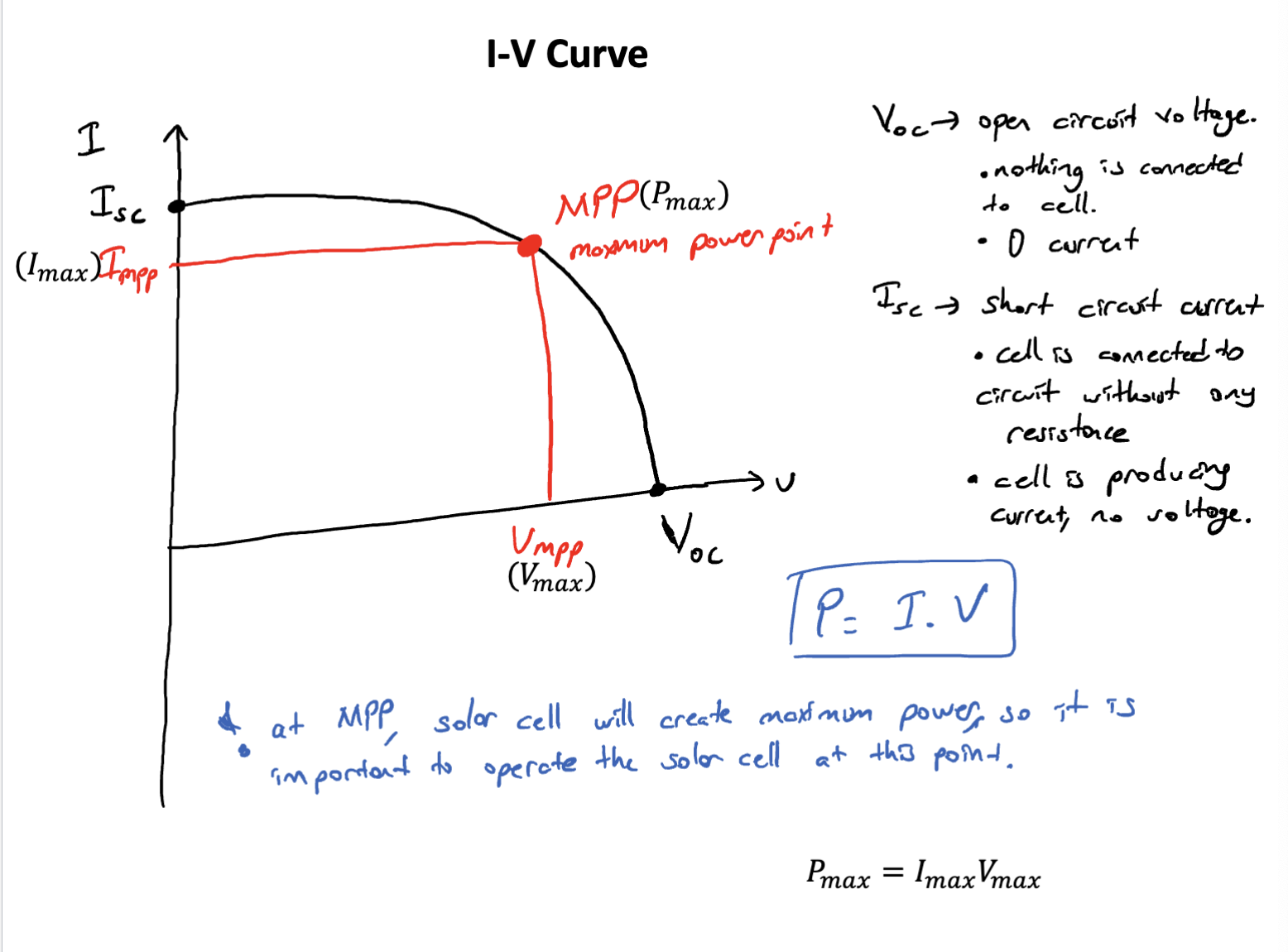
= Pmax / Pin = ImaxVmax / AIinsolation
Fuel Cell: Electrochemical device that converts chemical energy from fuel into electricity through chemical reactions
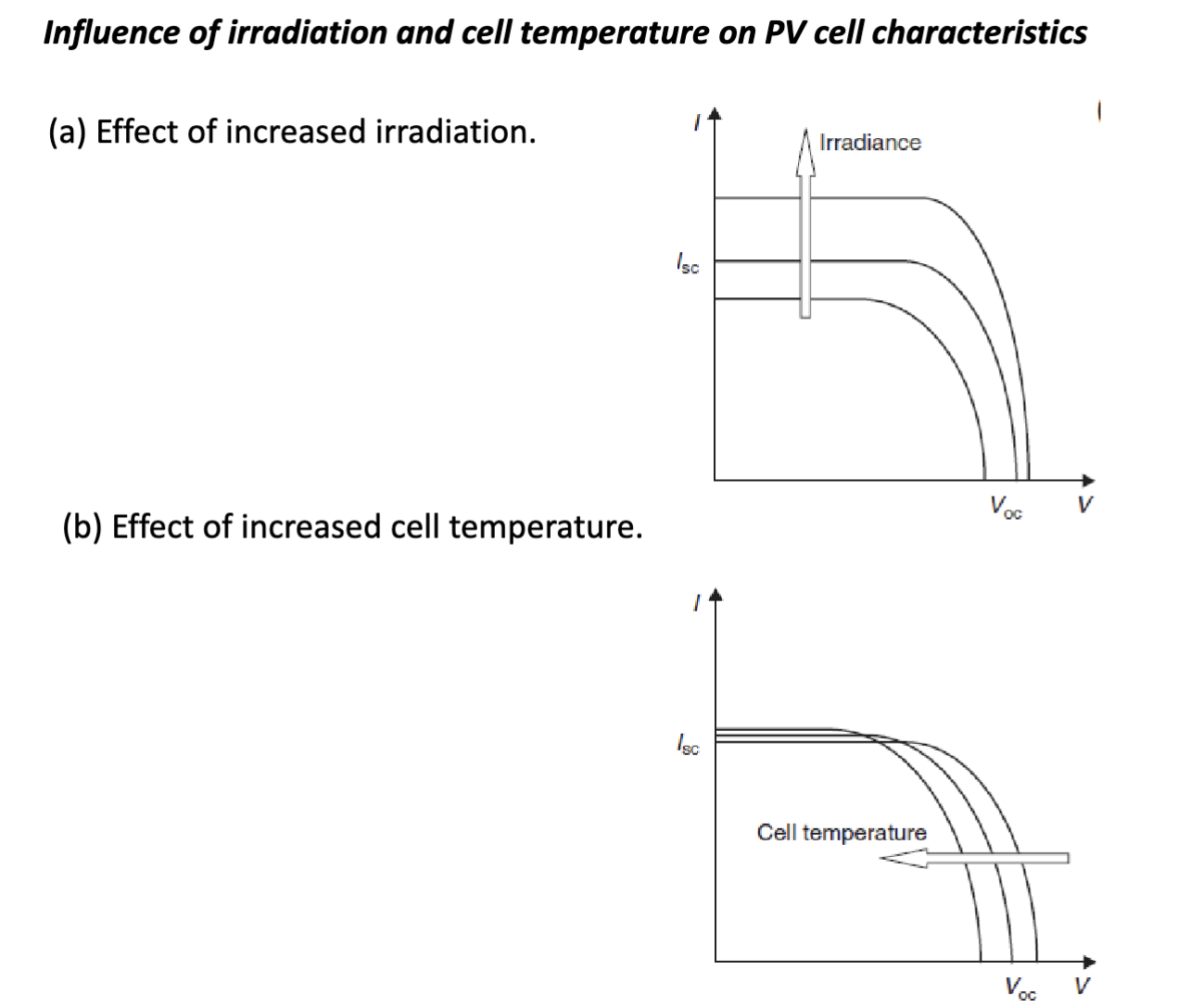
Hydrogen-Oxygen Fuel cell:
Key components:
Electrolyte: ions pass through potassium hydroxide solution
Electrodes: sites of chemical reactions
Negative anode: on left, hydrogen is oxidized
Positive cathode: on right, oxygen is reduced
Wire connects anode to allow electron flow
How it works:
Hydrogen gas enters cell at anode and get oxidized
Electrons from oxidation process move through wire to cathode which generates energy
Oxygen enters cathode and reacts with hydrogen and electrons to make water
Equations:
Pcell = VcellIcell for a single cell
Vstack = NVcell for a stack of cells
Pstack = VstackIstack = N VcellIcell
Pactual = Ptheoretical
Advantages:
Abundant fuel sources: only needs hydrogen and oxygen
No pollution: water only byproduct
Durability: last longer than batteries and simpler disposal
Environmental benefits: cleaner energy alternative
Scalability: can be scaled up or down
Quiet operation: no moving parts
Disadvantages:
Cost: Expensive catalyst and components
Hydrogen supply: Hydrogen takes up more space in gas form than batteries and other fuels. It is also explosive when mixed with air
Energy-intensive fuel production: requires energy to produce
Durability: Membranes and catalysts degrade over time
7. Generators and Power (8 points) (done)
Faraday’s Law: States voltage induced in the loop is directly proportional to the change in time of the flux
In simple terms: Over time a voltage will produce a field and when that field changes in a circuit a force is produced that is flux. The voltage is proportional to that of the rate of change for the flux
Generator: How it works
A coil is (the rotor) rotated inside a field. The magnetic flux changes and induces a field (emf) that produces energy. The rotor's mechanical movement is driven by an energy source. The stator (stationary coil) produces a magnetic field and the rotor spins through it to generate a current.
Key components of generator:
Rotor: Moving part in generator
Stator: Stationary part in generator
AC Generator: Current changes direction
Slip rings: Wire connected to this and brush make contact with it
Brushes: Connect current to slip rings for continuous flow of current
How it works:
Turbine spins a coil inside a magnetic field. The coil rotates and the wires inside move through the field causing an induced current. The current reserves every half turn. Think flips
AC generators can be 3 phase, 3 alternating current, to provide a more stable, smoother, and efficient power supply. This means at any given point there is some level of power provided. There is not one peak time and one low time, there is variation.
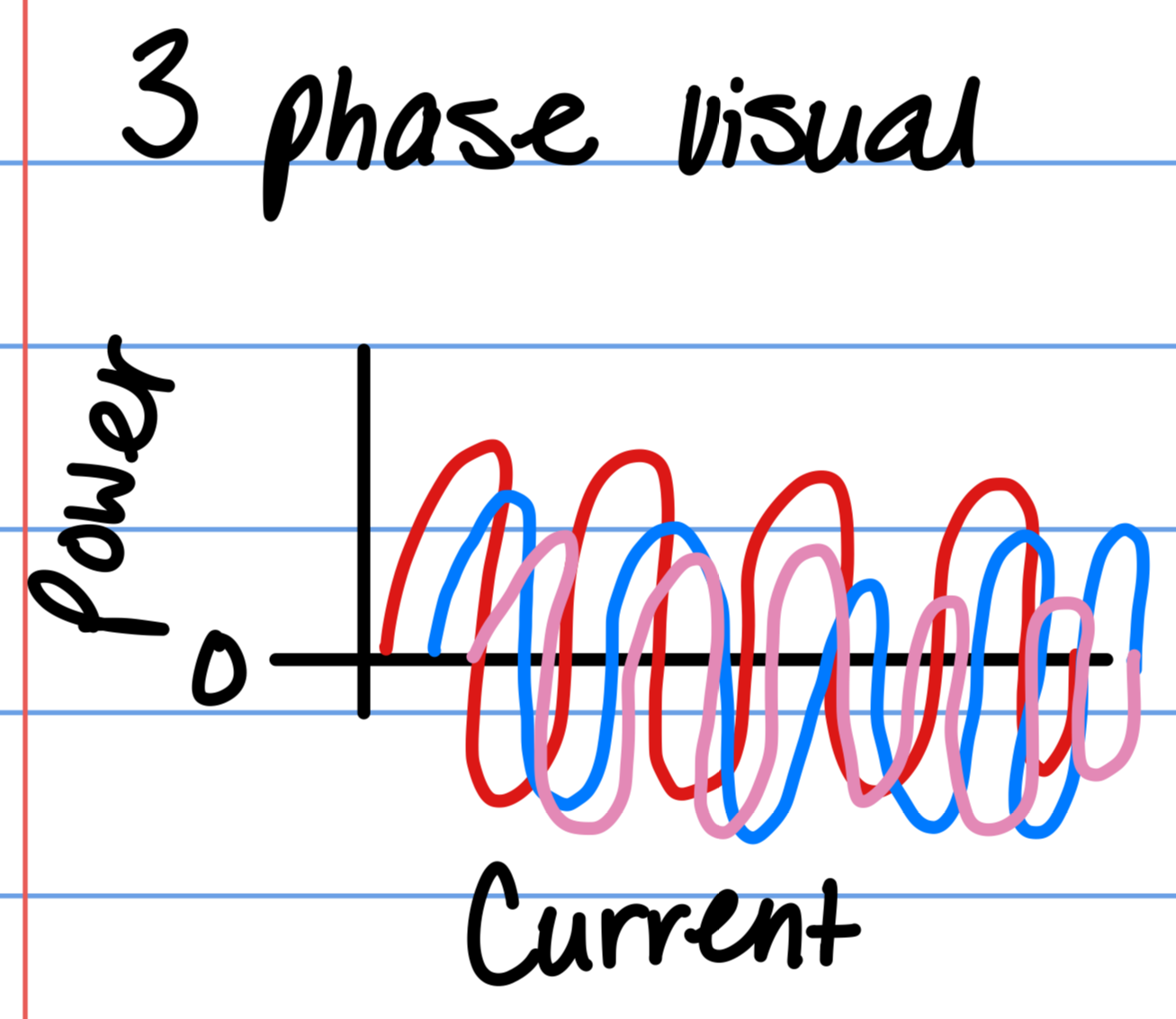
Great for long distance transmission
DC Generator: Current direction remains the same
Commuter (split rings): rotates with coil to keep flow of current in one direction
Brushes: connect current to commuter
How it works:
Similar to ac generator but the current only flows in one direction. Think a turn
Equations
P =
P = power output in watts
= emf or voltage in volts
I = current amps
P = Vrms x Irms x pf
Pf = power factor between 0 and 1 and accounts for the phase change difference as there is energy lost
Pout = Pmechanical
= a decimal between 0 and 1
Key components
8. ICE (4 points) (done)
Convert chemical fuel into mechanical work
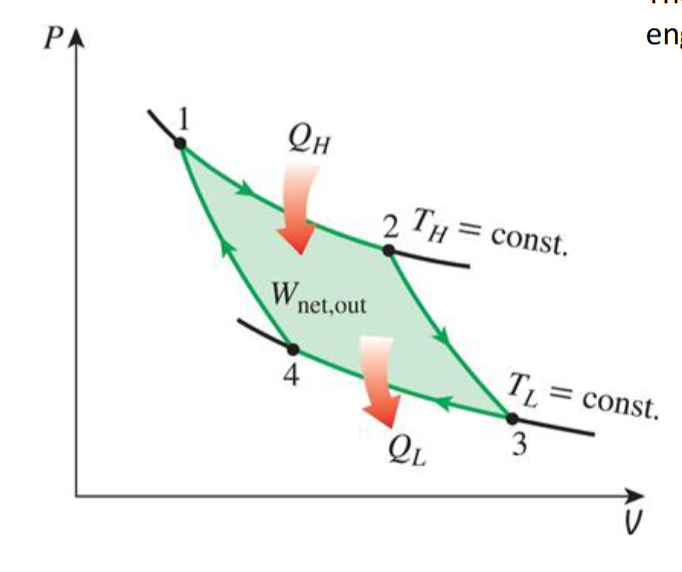
Carnot cycle: most efficient
Applications:
Transportation: cars, trucks, motorcycles, and airplanes
Industrial machines: generators, pumps
Marine engine: boats and ships used diesel-based ICEs
Steps of 4 cycle (in own words):
1. air/fuel mixture gets injected
2. air/fuel mixture gets compressed
3. air/fuel mixture gets ignited, pushing the piston down
4. Piston moves up to push exhaust out
Otto cycle: ideal cycle for spark-ignition engines
Diesel cycle: ideal cycle for compression-ignition engines
V is engine displacement
B is bore
L is stroke length
N is number of cylinders
9. Motors (4 points) (done)
Electric motors
Convert electrical energy into mechanical motion
Electromagnetic induction: moving magnet creates an electric field
Application: spinning motion for fans
AC motor: alternating current, changes direction periodically
AC vs DC: AC is more efficient, smoother, and easier to maintain. DC is simplier
10. Turbines (10 points) (done)
Kinetic energy from moving fluid into mechanical energy
Types: hydraulic, steam, gas, and wind
Bernoulli’s Principle: At points along a horizontal streamline, higher pressure regions have lower fluid speed and lower pressure regions have higher fluid speed.
In own words: pressure differences cause the blade to spin to try and even it out
Hydraulic turbine
Impulse turbine: only kinetic energy; blades in air
Reaction turbine: kinetic and pressure energy; blades fully submerged
Gas turbine: basically an ICE, but continuous
Open-cycle: air is exhausted
Closed-cycle: exhaust is used again and again
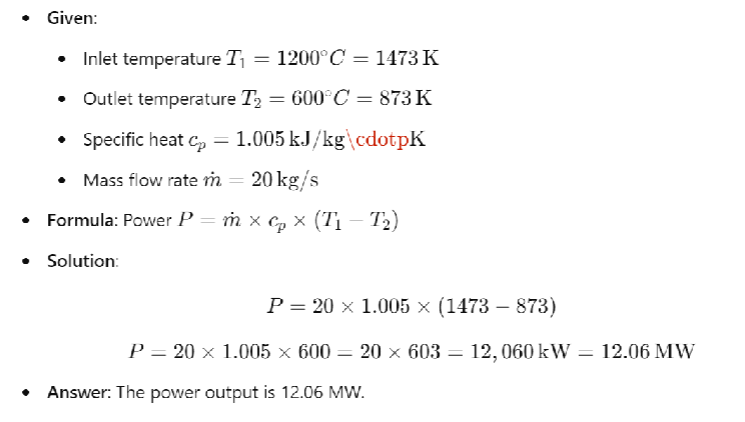
Power output = mass flow rate of a liquid x specific heat capacity of a gas x (initial temp - final temp) x efficiency
ṁ
Steam turbine: thermal energy into mechanical energy
Rotors and stators
Energy forms in steam: kinetic, pressure, and thermal
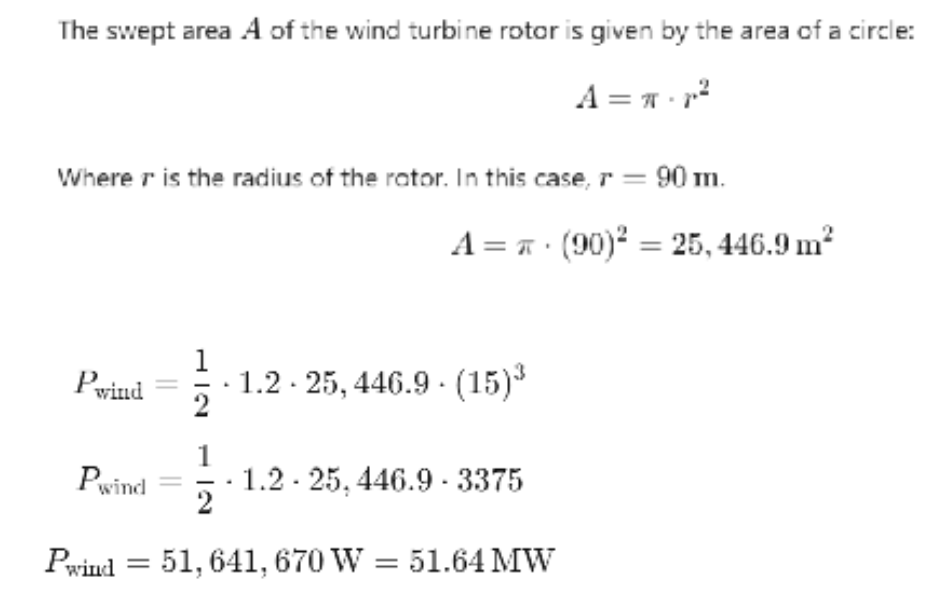
Power from wind: A= area, v = velocity, = air density
Betz limit: 16/27, actual power
EXAMPLES:
A gas turbine operates with an inlet temperature of 1200°C and an outlet temperature of 600°C. If the specific heat capacity of the gas is 1.005 kJ/kg·K and the mass flow rate is 20 kg/s, calculate the power output of the turbine. Assume no mechanical losses
A wind turbine with a rotor radius of 90 m operates in an area with an air density of 1.2 kg/m3 and a wind speed of 15 m/s. Calculate:
a. The total power in the wind approaching the turbine.
b. The theoretical maximum power that the wind turbine can extract from the wind.

A steam turbine operates with an inlet steam temperature of 500°C and an exhaust steam temperature of 100°C. Using Carnot's theorem, calculate the maximum possible efficiency of the turbine

11. Lighting (8 points) (done)
Lumen: light output
Efficacy =
Incandescent:
Electricity heats a filament, which produces light
Advantages: high CRI values (excellent color rendering), cheap, and available in different sizes
Disadvantages: waste energy by consuming the same amount of energy for less lighting and making the cooling system work harder to off-put the heat; limited operation life; tungsten deposits reduce aesthetics and brightness
Fluorescent
Glass tube with inert gas and electrodes that light up
High efficacies
Long lifetime
Emit more UV light than incandescent
LED lamps
Semiconductor diodes emit light
Any range of colors
N-type: doped to have more electrons
P-type: doped to have more holes
Most energy efficient
Long life
High intensity discharge
Similar to fluorescent
High power output
Advantages: long life, high lumen output, small
Disadvantages: require time to warm up
EXAMPLES:
Given the list of materials and their bandgaps below, determine whether each material can be used for LEDs. If applicable, specify the color of light produced by each material
Bandgap of 2.9 eV
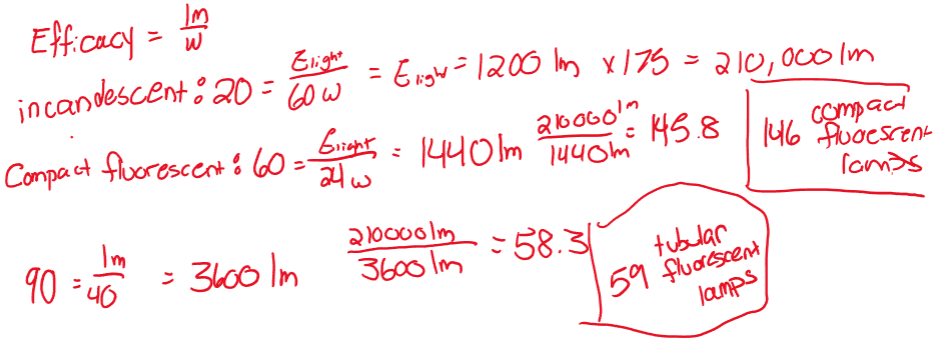
A large space is currently illuminated by 175 incandescent lamps, each with a rating of 60 W. How many (a) 24-W fluorescent lamps or (b) 40-W tubular fluorescent lamps are needed to supply the same level of lighting to the space? The efficacies of incandescent, compact fluorescent, and tubular fluorescent lamps are 20, 60, and 90 lm/W, respectively. Please neglect the power consumed by ballasts in fluorescent lamps