Government Unit 1 Notes
Article 1 Section 1 & 8
Enumerated (Expressed) Powers (Section 8)
federal government
ex - coining money, declaring war, regulating interstate commerce.
Implied Powers
derived from Necessary & Proper Clause
federal government
ex - creating a national bank, creating an airforce
Reserved Powers
derived from 10th Amendment
states
ex - regulating education (schools), conducting elections, managing local law enforcement, marriage laws.
Concurrent Powers
shared simultaneously by federal and state governments
ex - power to tax, borrow money, create lower courts, define crimes, building roads.
Limited Government Through Lawmaking
Enumerated Powers - lists specific limited powers granted to Congress - prevents the federal government from exercising “plenary” (unlimited) authority.
Bicameralism - by vesting legislative power into two houses (House and Senate), the Constitution ensures that no single group can pass laws impulsively.
Mechanism Against Arbitrary Rule - requiring a transparent, multi-step process for all laws prevents “legislative tyranny” and ensures that the executive cannot simply create rules by decree
Article 1 Section 9
Suspension Clause - prohibits the federal government from suspending the privilege of the writ of habeus corpus (the right to challenge unlawful detention) except during rebellion or invasion when public safety requires it.
allows for temporary detention without trial during emergencies.
Habeas Corpus Protection
the clause ensures that individuals can challenge the legality of their detention in court - serving as a primary safeguard for personal liberty.
Crisis Balancing
suspension is permitted only during “Rebellion or Invasion” when “public safety may require it.” - this creates a strict constitutional threshold for prioritizing national security over individual rights.
Implications
while suspension gives the executive broad discretion during emergencies, it is intended to be a temporary and extreme measure to prevent the “hallmark of tyranny” - unchecked detentions
Due Process & Rights of the Accused
5th & 14th Amendments
Fair Procedures (Procedural Due Process)
these clauses mandate that the government must follow fair legal steps (notice. hearing, neutral judge) before depriving anyone of “life, liberty, or property”
Protecting Fundamental Rights (Substantive Due Process)
they protect essential liberties that are “implicit in the concept of ordered liberty.” - preventing the government from enforcing laws that are fundamentally unjust or vague.
Balance of Power
these amendments serve as a check on law enforcement - ensuring that the pursuit of justice does not “run "roughshod” over the constitutional rights of individuals.
Senate Structure & Elite Democracy
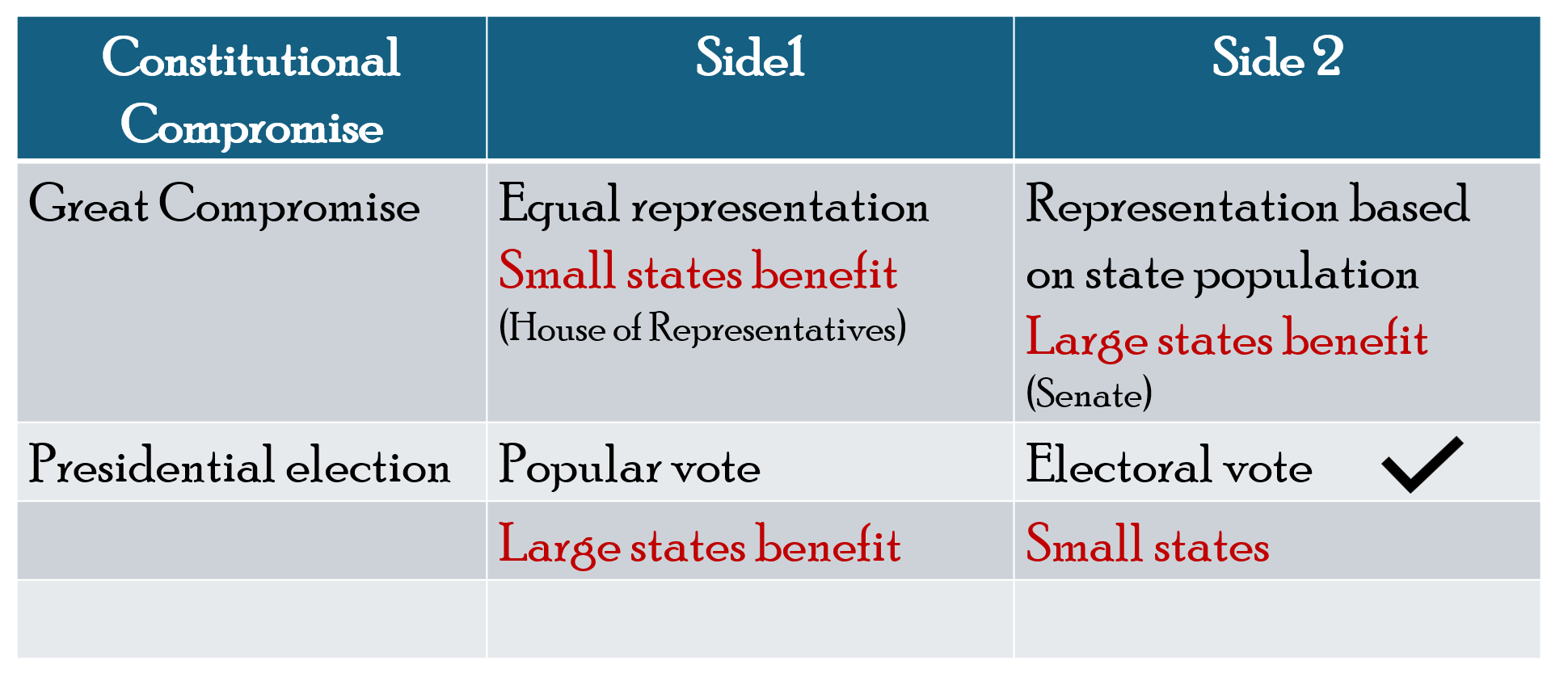
The Great Compromise
Purpose
designed to break the deadlock between the Virginia Plan (proportional representation favored by large states) and the New Jersey Plan (equal representation favored by small states.)
The Structure
House of Representatives - seats are based on state population, addressing large state concerns
Senate - each state has two seats, ensuring equal representation for smaller states
Impact
adopted on July 16,1787, by a narrow margin, this agreement saved the Convention from failure and created the foundational structure for the U.S. Congress.
Equal Representation
each state receives two senators regardless of population, a result of the Great Compromise.
Reinforcing Elite Elements
this structure can lead to “malapportionment” where a minority of the national population (concentrated in smaller states) can control a majority of Senate seats.
Limiting Populated States
highly populated states have the same voting power as a low-population state which can skew federal legislation, spending and judicial confirmations toward the interests of smaller-state elites.
House (Participatory) vs. Senate (Elite)
House of Representatives (Participatory)
designed as the “peoples house” with members directly elected by the populations for short two-year terms to ensure they remain responsive to the public will.
U.S. Senate (Elite)
originally selected by state legislatures (until the 17th Amendment), the Senate was intended to be a more deliberative, “select body” that could act as a “cooling saucer
for the more impulsive House.
Founders Intent
The House represents a direct link to the citizenry, while the Senate’s longer six-year terms and equal state representation were meant to provide stability and protect the interests of the states as sovereign entities.
Connection to the Electoral College
PACs, Super PACs, and the Elite Democracy Model
Elite Theory Foundations - this model suggests that a small, wealthy group of individuals and corporations hold disproportionate power over government.
Unlimited Fundraising - unlike traditional PACs, which have strict donor limits ($5000/year), Super PACs can accept unlimited contributions from corporations, unions, and billionaires.
Narrow Donor Pool - campaign finance is increasingly dominated by a small group of ultra-wealthy donors, reinforcing the elite model by ensuring that only those with massive capital can significantly influence national elections.
Disproportionate Influence - critics argue that because candidates rely on the massive advertising spending of Super PACs, elected officials are more responsive to these “big spenders” than to the general public.
Corporate Influence on Regulatory Agencies
Pluralist Appearance
on the surface, the system appears pluralist because any group can lobby or participate in public commentary during the regulatory process.
Resource Disparity
in reality, “biased pluralism” exists because major corporations have the financial resources to hire full-time lobbyists and legal experts, while average citizens lack comparable organization.
Regulatory Capture
this occurs when agencies, intended to protect the public, instead act as a pro-corporate instruments due to intense industry pressure and the “revolving door” between government and business.
Elite Outcomes
while many groups can compete, the results consistently favor elite interests, leading to an “unheavenly chorus” where the loudest voices have an upper-class accent
Federalist No.10 Factions and Models of Democracy
Control of Factions
James Madison argued in Federalist No. 10 that the causes of factions are natural and cannot be removed, so their effects must be controlled.
Pluralist/Representative Model
Madison favored a large republic where many different factions (interests) would compete, preventing any single group from forming a tyrannical majority.
Rejection of Participatory Democracy
The founders feared '“pure” or participatory democracy because small, direct systems are more susceptible to the “mischiefs of faction” and “mob rule”
The “republican remedy”
by using representatives to “refine and enlarge” public views, the system filters passion through a deliberate process, creating a pluralist landscape of negotiation rather than direct, volatile action.
Hyper-Pluralism and Policy Effectiveness
Concept of Hyper-Pluralism
an extreme “perverted” form of pluralism where so many groups are so powerful that the government is pulled in too many directions at once.
Gridlock and Paralysis
unlike pluralism, which emphasizes compromise, hyper pluralism leads to political gridlock because the government tries to appease every interest and ends up accomplishing nothing.
Contradictory Policy
to satisfy competing groups, the government may pass confusing or contradictory laws (subsidizing a crop while simultaneously funding anti-use campaigns for that same crop.)