Practice Tests
Test No. 1
a) Identify 2 features of the ‘book of the dead (2 marks)
A funerary text containing spells to guide the deceased through the afterlife, including the “Weighing of the Heart” ritual (Source 45). This also depicts the “Fields of Yaru”, a paradise where the justified dead could enjoy eternal life. ✅✅
b) Outline key characteristics of the ‘valley of the kings’ in this period (3 marks)
It was the royal necropolis where New Kingdom pharaohs, such as Amenhotep II, were buried in rock-cut tombs with bent axes, pillared halls, and burial chambers (Source 46). It offered seclusion for tombs dedicated to Amun, “the hidden one,” and was guarded to protect against robbers. Decorative Amduat texts painted on walls illustrated the pharaoh’s journey through the underworld. ✅✅ It is located in the mountains on the west bank of the Nile, this overlooks a mountain called ‘The Peak’ and its shape is reminiscent of the pyramids.
c) What is known about food and clothing in this period? (5 marks)
Food in New Kingdom Egypt relied on the Nile’s fertility, with staples like bread, beer and fish. The wealthy enjoyed meat, and imported wines, while peasants ate vegetables like onions, lentils, and dates. Food was only available at the time of harvest, as most of these foods were perishable. The Hyksos introduced pomegranates and olives, and robust humpbacked cattle. Poorer Egyptians used blood from animals to thicken their vegetable stews for protein.
Clothing indicated social status: elites wore fine linen, pleated garments, and wigs (Source 62), while workers wore simple loincloths. Tomb scenes (eg. Source 52) show banquets with elaborate dishes, reflecting dietary variety. Men wore a calf-length kilt, belted at the waist, while women wore a dress with one or two straps. Women are also depicted with a wax cone on their heads, which was perfumed and would release scent as it melted throughout the day. The Hyksos introduced new technology which improved Egyptian textiles. However, there is little evidence to show how it was worn.
✅✅
d) What does evidence reveal about social structure in this period? In your answer refer to source 57, other sources and your own knowledge (15 marks)
New Kingdom Egypt had a rigid (set) social hierarchy, with the pharaoh at the apex as both divine ruler and administrator (Source 10). The vizier, as the king’s deputy (Source 14), oversaw taxation, law, and infrastructure, highlighting the bureaucracy’s importance. Source 57 (“Be a Scribe”) reinforces scribe’s elite status, describing their privileges, access to granaries, fine clothes, and horses, thus contrasting with labourers’ toil.
Religious and military elites held significant power. The Amun priesthood controlled vast temple estates, while generals like Ahmose (Source 15) gained status through conquest. Women’s roles were gendered: royal women like Tiye (Source 18) wielded political influence, while non-royal women managed households.
Lower classes included artisans (Source 20), farmers (Source 48), and slaves. Tomb scenes (eg. Source 22) depict labourers taxed by scribes, revealing economic stratification. The Instruction of Ani (Source 58) advises humility, reflecting societal expectations for non-elites.
Therefore, sources illustrate a pyramid-like structure: the pharaoh and elites dominated politics and religion, while the majority worked in agriculture or crafts, their lives documented largely through elite perspectives.
provides a response using some historical terms and concepts appropriately
12/15 — use historical terms and concepts appropriately
Glossary terms to use:
Test No. 2
a) Outline the range of crafts and industry in this period (4 marks)
i forgot EVERYTHING lol
b) What do human remains reveal about the health of Egyptians in this period? (6 marks)
The health of Egyptians in this period were held to high standards. Because their diet consisted of plenty of fruits, vegetables, wheat-kind foods, meats (only for those who were wealthy) and water. They maintained a balanced diet whilst also keeping their physique in great shape. This was also because the Egyptians were hardworking people, they spent most of their time outside taking in the vitamin D from the sun. Although most had a healthy diet, there were also many underlying issues and diseases caused from insects and such. This included; dental issues, parasites, arthritis, malaria, and obesity too. This can all be seen in the remains of Hatshepsut, the royal wife of Thutmose II whilst also being coming from regency into assuming the throne (becoming Pharaoh). She was the sixth ruler in the Eighteenth Dynasty.
c) Explain how funerary customs and rituals help us to understand Egyptian society in this period. Support your response using evidence from source e) and other relevant sources. (15 marks)
Mummification:
The mummification process started with the salting of bodies within natrum (salt) for about 70 days before continuing on with the certain rituals and procedures required to fully complete this process. Once this was completed, they would place the internal organs of the deceased person into jars, which were then inserted inside a canopic chest (a wooden case). The internal organs were the, lungs, livers, intestines and stomach. They would use unguents (oils and ointments) to cover the body with. Whilst this process was being held, there was much work to be done on the deceased person’s mummiform coffin. This was a coffin that had a human-shaped body with a face resembling the deceased person contained within. Those of high status would also have a mortuary temple; a place dedicated to the funerary cult of that deceased person. Once this whole process was finished they were then placed in a necropolis (from Greek; literally meaning, ‘city of the dead’)
Tomb construction & decoration:
Burial goods:
Funerary procession:
Opening of the Mouth:
Beautiful Feast of the Valley:
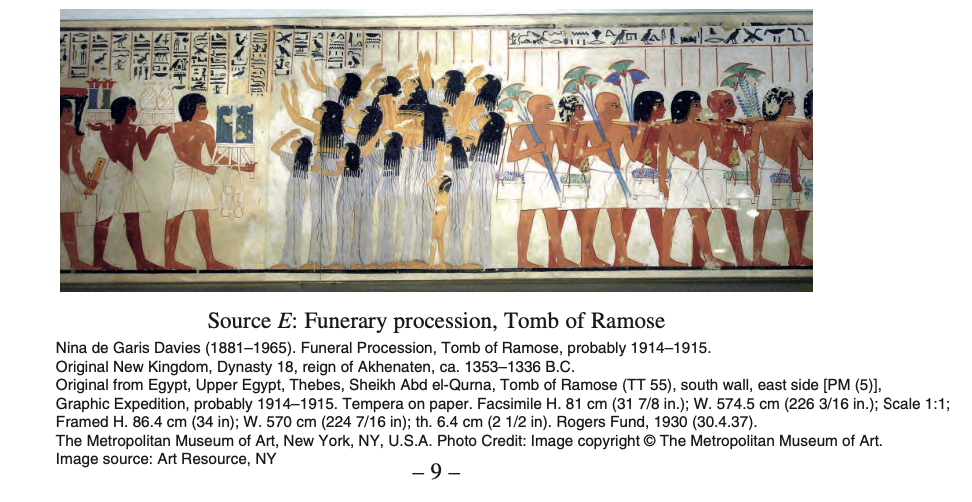
Source E:
Source E reveals to us the Funerary procession occurring in Tomb of Ramose. On the left hand side there are some men who are carrying what it seems to be funerary goods. These would be items placed in a section of the tomb that Ramose would take with him into the afterlife to use. Then as we approach the middle of the source, there are some ladies decorating the tomb with many different hieroglyphs, this adds a decorative essence, giving the tomb some life without it being empty and almost naked. The men on the far right are in the last process of this funerary procession, they are each holding the same things, some sort of plant whilst carrying a bag filled with funerary goods.
Weighing of the heart ceremony:
Test No. 3
a) Name TWO New Kingdom sites
The Valley of the Kings, Malkata
b) What was the significance of ma’at to the pharaoh?
Ma’at was an ancient Egyptian concept that included truth, order, harmony, and justice. The pharaoh was known as a god to all men because he upheld these values. Without it, the people of Egypt would not take the pharaoh seriously and truly believe in his abilities to oversee the political and spiritual affairs of their country.
c) Describe the main features of trade during this period.
Trade became an imminent part of Egypt during the New Kingdom period. With materials and resources received by its neighbouring countries. This included; timber from Byblos as timber was scarce in Egypt. Pottery, jewellery and copper ingots from Crete and Aegean. Gold, ebony, myrrh, precious stones and ostrich feathers from Nubia. Lapis lazuli from Afghanistan and myrrh trees, precious stones, panther skins and exotic animals from Punt. All of these resources assisted Egypt in building their empire, moreover growing into becoming one of the most influential and vital part of Ancient History. There were also trade slaves which accommodated for this growing city as population grew there were more people for the working class in industries such as agriculture, farming, and mining.
d) What does evidence reveal about religious festivals in this period? In your answer, use Source K, other sources, and your own knowledge.
Test No. 4
a) Describe the role of the Egyptian army in this period
The main part of the Egyptian army was called the infantry, this consisted of foot soldiers and archers. The officials would help assist by selecting parts of the army to protect the pharaoh. There were 5 main sections of an army. A squad, which consisted of 10 people, platoon which had 50 people, company which had 250 people, host which had 500 people and division which involved a whopping 5000 people. The Egyptian army had many types of weapons to assist them during war, long-range and short-range. Those on chariots with horses would use the short-range weapons fighting in battle such as the foot soldiers whilst those archers represented those using long-range weapons, standing from afar. These archers had perfect precision, justified by the many battles won by the Egyptian army during the New Kingdom period, expanding into Palestine and Syria. In the middle kingdom, there were new beginnings as to whether or not the Egyptian army should be a professional fight force with a distinct hierarchy, now in the New Kingdom they sought to these ideas creating a professional army with well-trained soldiers.
b) What do temples reveal about religion in Egypt in this period?
Temples reveal many aspects about religion during the New Kingdom period. In the eastern bank of Thebes there were two great temples dedication to the main god at the time, Amun-Re (creator god and god of the sun). These were located in Karnak and Luxor (private chamber in the south). The temple in Karnak was mostly used for the Opet festival (assured stability and prosperity in the land for another year). The Luxor temple was the mainstay of the Beautiful Feast of the Valley temples where people would visit their loved ones’ tombs and give food and drink as sustenance for their afterlife, specifically the spiritual element Ka.