Structure and Composition of the Jovian Planets (Part 1)
The Outer Planets
Jupiter’s outer layer is a dynamic area of storms and turbulent gases
Jupiter is permanently covered with clouds and rotates approximately once every hours, which is the fastest of any planet.
Its clouds are in perpetual motion, confined to narrow latitude bands, forming:
Belts: Dark, reddish bands.
Zones: Light-colored bands, white due to ammonia vapor at their tops.
These belts and zones represent gases flowing eastward or westward, known as zonal flow, with typical wind speeds between km/h ( mi/h) and km/h ( mi/h).
The belt and zone regions do not extend to the planet’s poles.
Jupiter's Storms
Jupiter's atmosphere contains turbulent swirling cloud patterns and rotating storms.
White ovals: Cool clouds located higher in the atmosphere.
Brown ovals: Warmer, lower clouds visible through holes in the cloud layer. These storms can last from hours to centuries and extend down km below the visible surface.
Great Red Spot: Jupiter's most striking feature, a massive hurricanelike storm observed since .
It changes dimensions; it was large enough to fit three Earths in the late th century, shrinking to slightly larger than Earth's diameter by .
Extends at least km ( mi) below the surface, sustained by heat from Jupiter's interior.
Red Spot Jr. (Oval BA): Formed between and from the merger of three smaller white storms, becoming red in .
Similar to, but smaller than, the Great Red Spot and at a similar latitude.
A third red storm appeared in . The cause of the red color in these newer storms is still under investigation.
Great Cold Spot: Observed in at Jupiter’s north pole, approximately °C ( °F) cooler than surrounding gases.
Similar in size to the Great Red Spot and has existed for at least years.
Its cooling may be linked to interactions with the planet’s magnetic field and aurora.
Differential Rotation and Oblate Shape
In , Giovanni Cassini noted differential rotation: Jupiter's cloud speeds vary with latitude.
Near the poles, the rotation period ( h min s) is min longer than at the equator.
Clouds at different latitudes circulate in opposite directions, creating swirling patterns and contributing to storm stability.
Jupiter's rapid rotation causes it to be oblate, meaning its equatorial radius is larger than its polar radius by km ( mi).
Chemical Composition and Cloud Layers
Jupiter’s average density of kg/m indicates it's primarily composed of hydrogen and helium, classifying it as a gas giant.
Its interior is believed to contain a central volume of water, metal, and rock, but no solid surface continents or water oceans.
Atmospheric composition (by atoms): \% hydrogen, \% helium, and \% molecular compounds like methane (), ammonia (), and water vapor ().
(By mass): \% hydrogen, \% helium, and \% other substances in the atmosphere.
(Overall mass distribution, including interior): \% hydrogen, \% helium, and \% heavier elements.
Jupiter has three major cloud layers:
Uppermost: Crystals of frozen ammonia (white).
Middle: Primarily ammonium hydrosulfide.
Bottom: Mostly composed of water vapor.
The exact chemicals causing the brown, red, and orange tones, possibly sulfur or phosphorus compounds, are still unknown.
The Galileo probe (1995) unexpectedly found high wind speeds (up to km/h, mi/h), higher-than-expected air density and temperature, and lower-than-expected concentrations of water, helium, neon, carbon, oxygen, and sulfur in a region likely identified as a
Jupiter: Vital Statistics
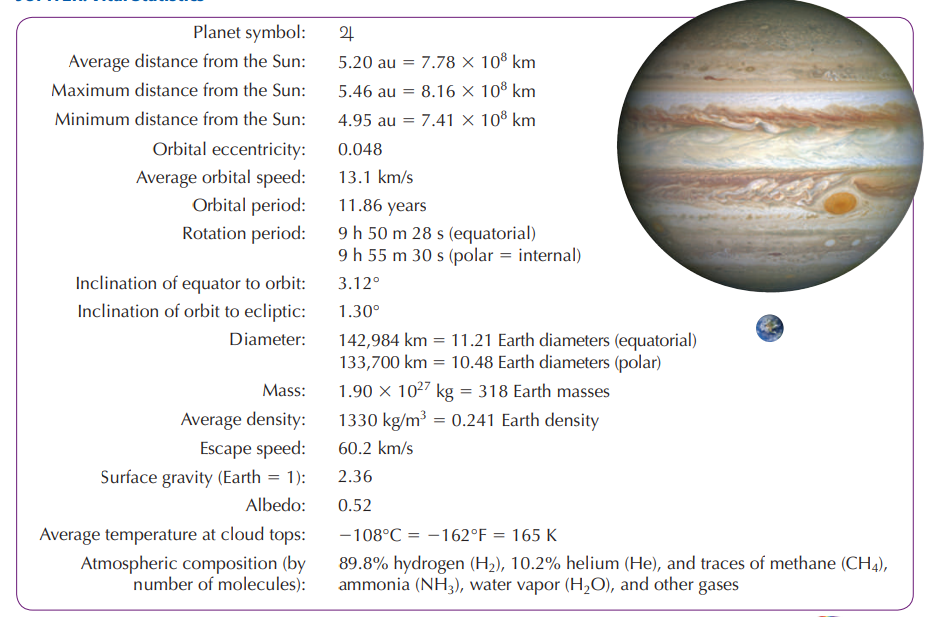
Our understanding of Jupiter’s interior is in flux
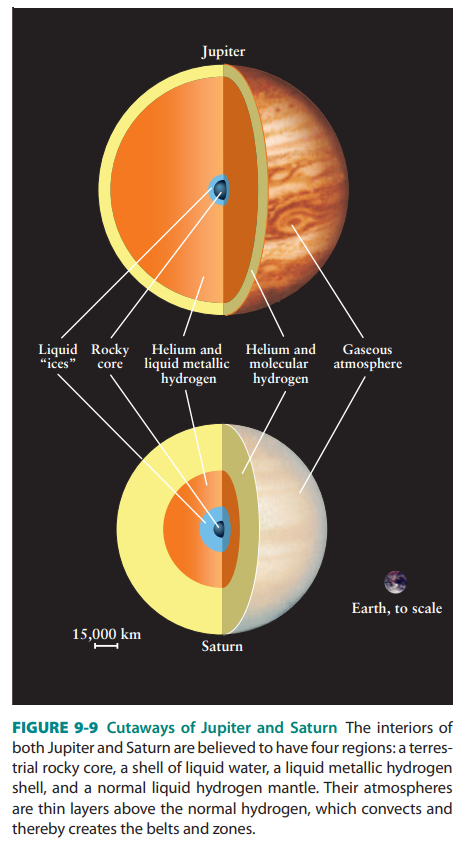
Internal Structure
Below Jupiter's clouds, the interior starts with liquid molecular hydrogen and helium.
Pressure increases significantly with depth, reaching million atmospheres ( atm) at km ( mi) below the cloud tops.
At these depths, hydrogen transforms into liquid metallic hydrogen, which conducts electricity and heat like a metal.
Magnetic Field and Magnetosphere
Electric currents within the rotating liquid metallic hydrogen generate a powerful planetary magnetic field, times stronger than Earth's strongest.
Jupiter's magnetosphere spans nearly million km, enveloping the orbits of many of its moons.
If visible from Earth, it would cover an area times larger than the Moon.
At Jupiter's cloud level, the magnetic field is times stronger per square meter than Earth's field at our planet's surface.
The magnetosphere includes regions for storing charged particles (similar to Earth's Van Allen belts) and a magnetotail that extends over million km as far as Saturn.
Early evidence for the magnetosphere came from a periodic hiss of radio static, reflecting Jupiter's internal rotation rate of h min s.
Permanent aurorae surround Jupiter’s poles, forming distinct ring shapes due to trapped glowing gases.
In , the Juno spacecraft detected beams of electrons shooting out of Jupiter's atmosphere near the aurorae, a phenomenon not observed on Earth.
Jupiter’s Formation and Core
According to the Nice theory, Jupiter formed from a terrestrial (rock, metal, and water) protoplanet beyond the snow line, which now constitutes Jupiter's core.
This core then attracted hydrogen and helium to form the planet's outer layers, though the state of the core is still under investigation.
Core Composition and Pre-Juno vs. Juno Data
Prior to July 2018 (Pre-Juno data):
The core was believed to be a solid body, comprising up to \% of Jupiter’s mass (nearly times the mass of Earth).
It was thought to be compressed by the weight of the planet (equal to Earths' mass) into a sphere with a km radius.
The central pressure was calculated to be about million atm, with a temperature of approximately K (nearly times hotter than the Sun's surface).
Juno Mission Data (since July 2018):
Suggests the core is physically much larger, potentially extending to half of Jupiter's radius, but with a significantly lower density than previously theorized.
Interpretation of Juno data is still ongoing.
Other Interior Components and Energy Emission
"Ice" in astronomical terms refers to compounds like water, carbon dioxide, methane, and ammonia, which likely existed in Jupiter's terrestrial protoplanet.
Water is believed to form a layer around the core, but Juno data now suggests much of it may be incorporated into the core itself.
Ammonia from the interior has been detected in Jupiter’s atmosphere, thought to emerge through storm centers like the Great Red Spot.
Jupiter emits about twice as much energy as it receives from the Sun, causing it to cool slightly and contract by about cm per decade.
This cooling and contracting process is known as the Kelvin–Helmholtz mechanism, proposed by Lord Kelvin and Hermann von Helmholtz.
Impacts provide probes into Jupiter’s atmosphere
Shoemaker-Levy 9 Comet Impact (1994)
On July , , a comet nucleus (a clump of rock and ice, a few kilometers across) was ripped into at least pieces by Jupiter's gravitational tidal force.
The debris, named Shoemaker-Levy (after its discoverers Gene and Carolyn Shoemaker and David Levy in March ), was unusual because it orbited Jupiter rather than the Sun.
Calculations predicted the pieces would strike Jupiter between July and July , , generating excitement in the astronomical community to study the planet's atmosphere, interior, and the comet's properties.
The impacts occurred as predicted, observed by major Earth telescopes and spacecraft.
At least fragments struck Jupiter, with leaving detectable impact sites.
Impacts caused fireballs approximately km in diameter with temperatures of K, hotter than the Sun's surface.
The largest fragment released energy equivalent to million megatons of TNT.
Impacts were followed by crescent-shaped ejecta containing various chemical compounds.
Ripples or waves spread from the impact sites through Jupiter’s clouds, lasting for months.
Observations suggested the comet pieces did not penetrate very far into Jupiter's upper cloud layer, indicating they were not much larger than km in diameter.
Dark plumes, likely from vaporized carbon compounds, rose high into Jupiter’s atmosphere from each impact.
Detected substances from the comet collisions included water, sulfur compounds, silicon, magnesium, and iron.
Asteroid Impact (2009)
On July , , an amateur astronomer discovered a new dark patch near Jupiter’s south pole, caused by an impact that occurred about hours prior.
This collision involved a small asteroid, approximately km in diameter and composed of rock and metal.
Astronomers distinguished this asteroid impact from the comet impact because the asteroid lacked the surrounding gas and dust that created halos around the comet's impact sites.
Impact Frequency
Based on the and impacts, Jupiter appears to be struck by pieces of debris to km in diameter every to years.
Section 9.4 - 9.8
See the Jupiter section from Unit 5 .
Saturn’s atmosphere, surface, and interior are similar to those of Jupiter
Saturn's Atmosphere and Dynamics
Saturn’s clouds are thick and hazy, lacking the colorful contrast of Jupiter's, but exhibit faint stripes similar to Jupiter’s belts and zones.
The presence of these stripes indicates internal heat driving convection in the cloud gases.
Saturn displays differential rotation, with rotation periods varying from approximately hours and minutes at the equator to hours and minutes at higher latitudes.
Like Jupiter, some belts and zones move eastward, others westward. However, Saturn’s belts and zones extend from the equator to the poles, unlike Jupiter's.
Polar Features
In , the Cassini spacecraft discovered a stationary hexagonal boundary around Saturn’s north pole.
Belts, zones, and large storms flow within this hexagon, which rotates at approximately the same rate as the planet.
This feature is linked to Saturn's jet stream, a high-altitude, high-speed wind system.
Both of Saturn's poles feature persistent vortices or cyclones with steep walls, similar to hurricanes on Earth.
Jupiter does not have such polar vortices.
Saturn's Storms
Saturn experiences storms, although it lacks a long-lived feature like Jupiter’s Great Red Spot.
In , a pair of storms was observed merging.
Saturn also has large hurricane-like storms known as Great White Spots (or Great White Ovals), which are not perfectly round.
One of the most powerful storms in decades occurred in , encircling much of Saturn’s northern hemisphere.
This storm caused local atmospheric temperatures to soar K ( °F) above normal and led to the emission of a large quantity of ethylene (a colorless, odorless gas) whose source is currently unknown.
Great White Spot storms occur roughly every years, with the first observed in .
Computer simulations suggest these storms result from extreme periods of convection in the gases below.
Atmospheric Composition and Winds
Saturn’s atmosphere (by mass) is about \% hydrogen and \% helium, differing from Jupiter's (\% hydrogen and \% helium).
Due to its smaller mass, Saturn’s gravitational force on its atmosphere is less, resulting in a more spread-out atmosphere compared to Jupiter.
Saturn experiences impressive surface winds; equatorial storms have been clocked at speeds of km/h ( mi/h), which is times faster than Earth’s jet streams and times faster than Jupiter’s fastest winds.
The reason for these extremely high wind speeds is still under investigation.
In , the Cassini spacecraft detected lightning in Saturn’s atmosphere.
Energy Emission and Helium Rain
Saturn emits about times as much energy as it receives from the Sun.
Unlike Jupiter, where extra energy primarily comes from the Kelvin–Helmholtz mechanism, much of Saturn’s excess energy is believed to be generated by helium rain.
This mechanism involves helium condensing into liquid droplets due to Saturn's cooler atmosphere (being smaller and farther from the Sun).
These liquid helium droplets descend deep into the planet, and their energy helps heat the interior, which then radiates this energy.
Seasons
Saturn’s rotation axis is tilted by ° relative to its orbital plane, similar to Earth’s tilt, causing seasons.
The Cassini spacecraft confirmed the existence of seasons over one Saturnian year.
Saturn’s upper atmosphere is about °C (°F) warmer in summer than in winter.
The color of each hemisphere changes seasonally, from yellow-orange (ochre) in summer to bluish hues in winter.
This color change results from varying combinations and dissociations of atoms, creating different molecules that scatter sunlight differently.
Interior Structure and Density
Saturn's interior structure is inferred to resemble Jupiter's, consisting of a layer of molecular hydrogen below the clouds, surrounding a layer of liquid metallic hydrogen and a rock, metal, and water core.
Due to its smaller mass, Saturn’s interior is less compressed than Jupiter’s, meaning there's insufficient pressure to convert as much hydrogen into liquid metal.
Saturn's rocky core is approximately km in radius, and its liquid metallic hydrogen layer is km thick.
At kg/m ( lb/yd), Saturn is, on average, the least dense body in the entire solar system; an object with this density would float on water on Earth.
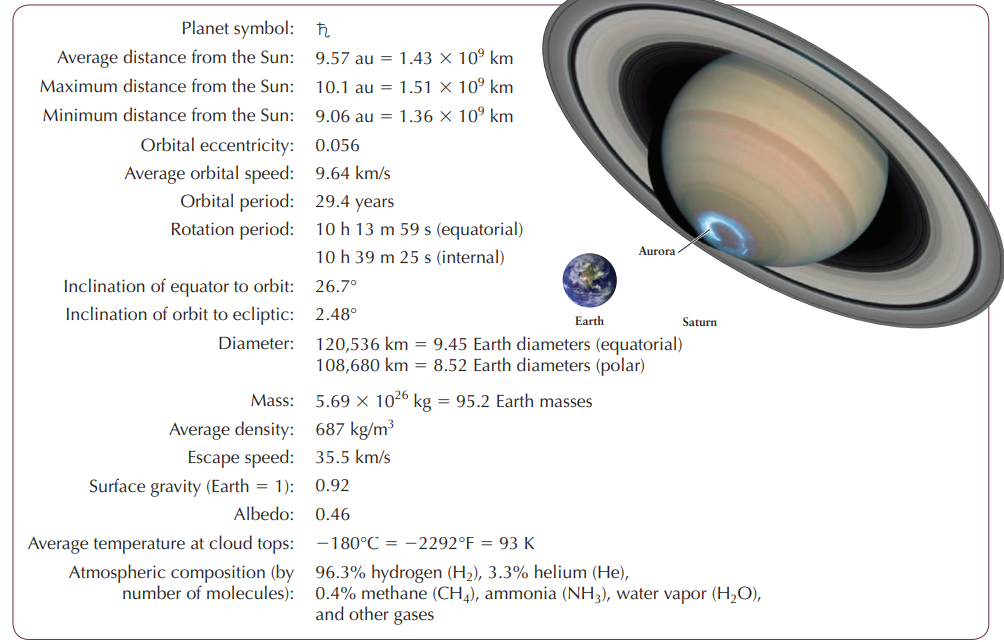
Saturn: Vital Statistics
Uranus sports a hazy atmosphere and clouds
Early observations (pre-1996 and Voyager 2) showed few features in the visible spectrum.
The Hubble Space Telescope's infrared camera revealed a system of belts and zones.
Its hydrogen atmosphere contains traces of methane and a high-altitude haze.
Below the haze are clear air and dynamic methane clouds, typically as large as Europe.
Clouds and atmosphere rotate approximately once every hours, with variations due to differential rotation.
Physical Characteristics
Uranus is times more massive than Earth and times larger in diameter.
Its outer layers are predominantly composed of gaseous hydrogen and helium.
Cloud Composition and Color
The upper atmosphere's low temperature (around K or °F) causes methane and water to condense into ice crystal clouds.
Methane forms higher clouds than water vapor due to its lower freezing temperature.
Methane absorbs red light and scatters blue and green, giving Uranus its characteristic blue-green color.
A layer of hydrogen sulfide gas (smelling like rotten eggs on Earth) is at the very top of Uranus’s clouds.
Axial Tilt, Rotation, and Seasons
Uranus’s rotation axis is highly inclined, ° from perpendicular to its orbital plane, meaning it lies nearly in the plane of its orbit.
It exhibits retrograde rotation, with its north pole pointing below the orbital plane (Venus is the only other planet with retrograde rotation).
This extreme tilt causes exaggerated seasons, where poles alternately point almost directly toward or away from the Sun for many Earth years.
Moons and Formation
Planetary scientists suggest each of the five largest Uranian moons has experienced at least one shattering impact.
A catastrophic collision with an Earth-sized object may have knocked Uranus onto its side.
Interior Structure
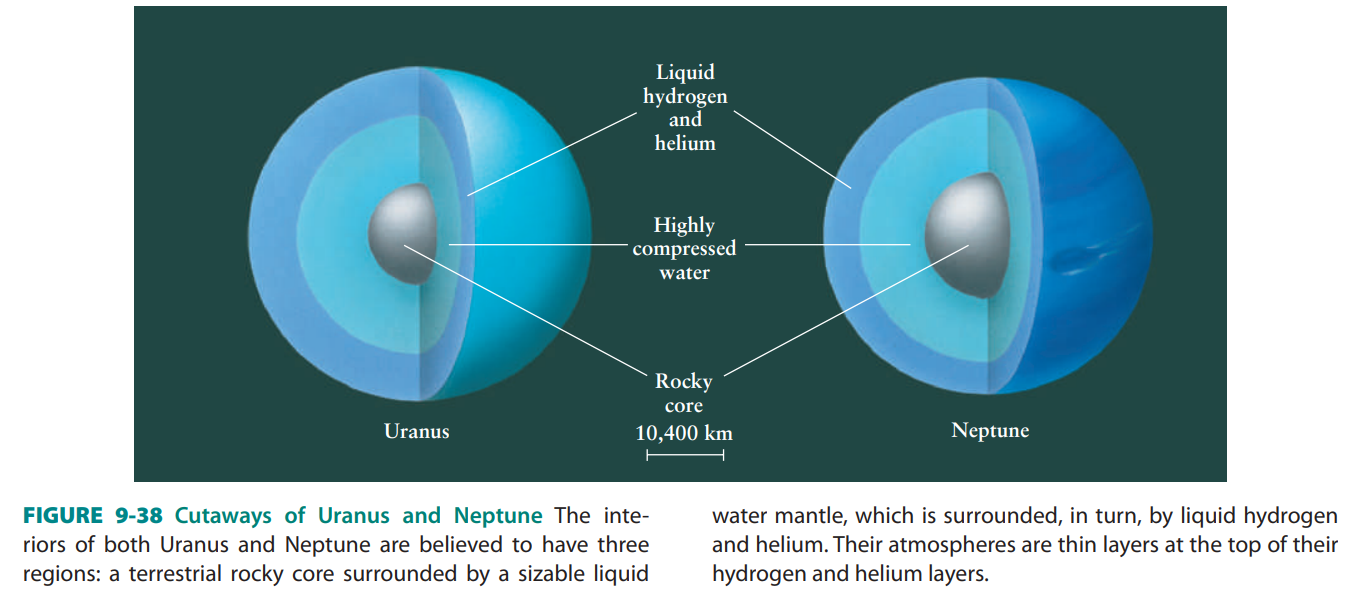
Based on its mass and density ( kg/m), Uranus's interior has three layers:
Outer \%: Liquid hydrogen and helium.
Middle \%: Highly compressed liquid water (with some methane and ammonia).
Inner \%: A rocky core.
The scarcity of ammonia in the atmosphere may be explained by its dissolution in a large internal water ocean.
Like Jupiter and Saturn, Uranus (and Neptune) lack a well-defined liquid surface, with no phase transition between atmosphere and liquid layers.
Uranus and Neptune are classified as "ice giants" due to their rich water content.
Magnetic Field and Magnetosphere
Uranus's surface magnetic field is about three-quarters the strength of Earth's.
The magnetic field is remarkably tilted (° from its rotation axis) and its axis does not pass through the planet's center.
The magnetosphere wobbles significantly due to the large angle between the magnetic field and rotation axis.
This rapidly changing magnetic field provides clues for other astronomical phenomena, like pulsars.
Rotation Rates
Astronomers use the magnetosphere’s wobble to determine that the planet’s interior rotates once every hours minutes.
This interior rotation rate is considerably slower than the hour rotation rate of its surface clouds.
Uranus: Vital Statistics
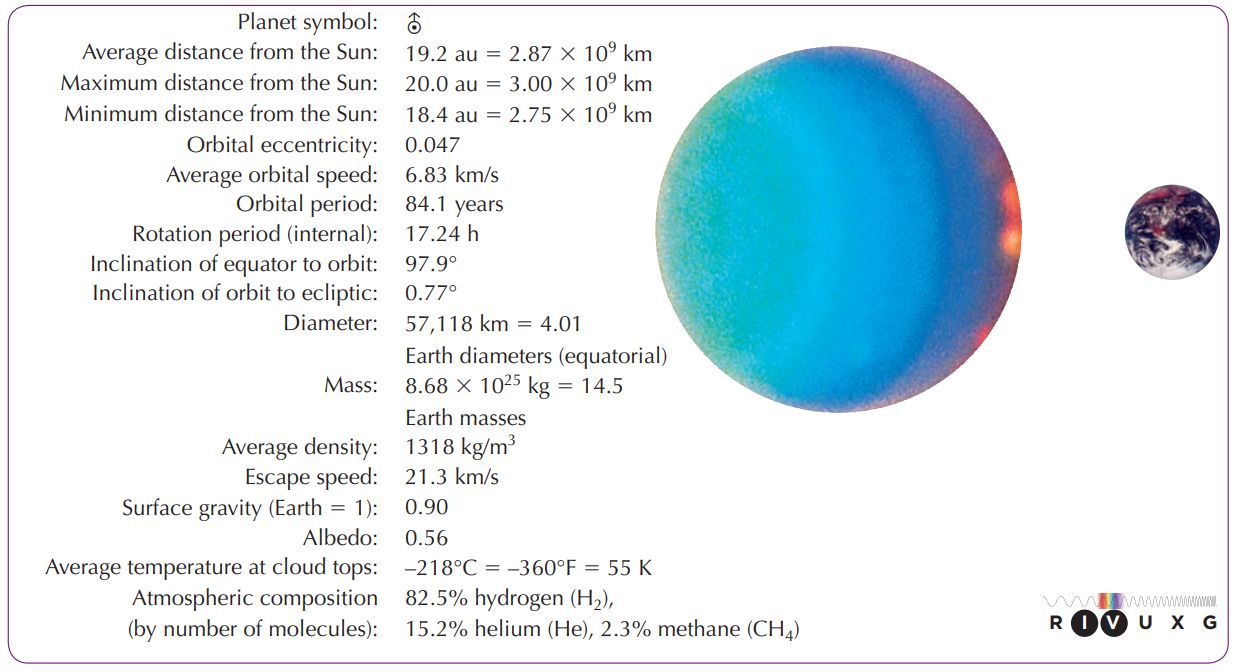
Neptune: Vital Statistics
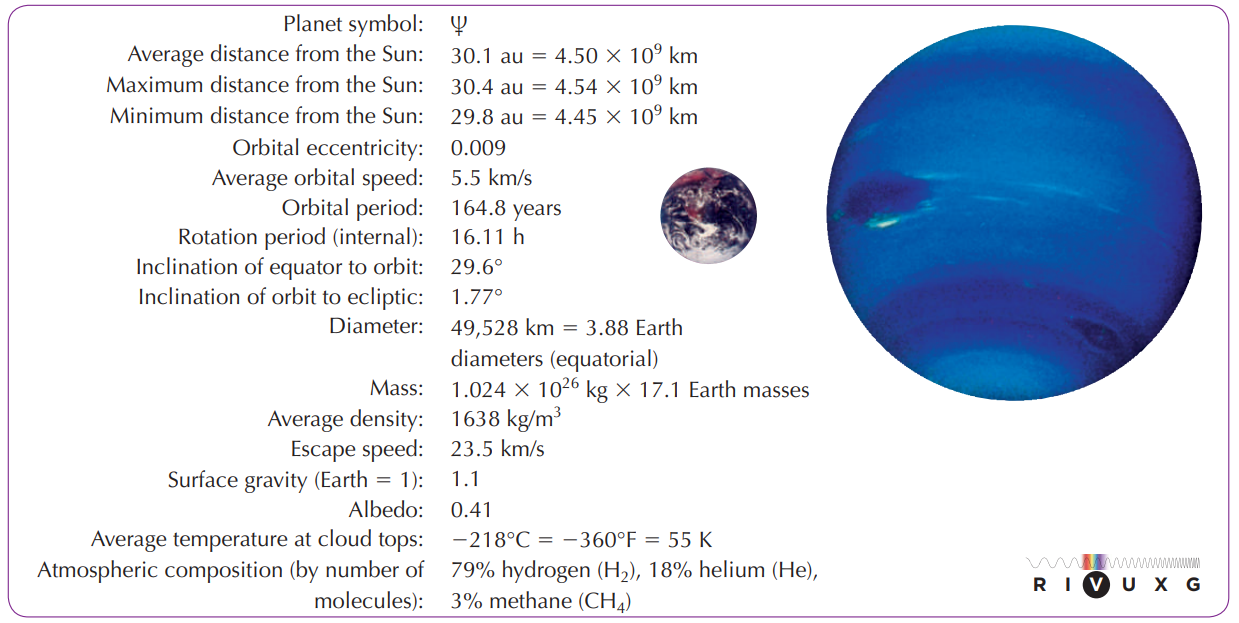
Neptune was discovered because it had to be there
Neptune was discovered because it had to be there
Neptune’s discovery is a classic example of scientific prediction leading to confirmed observation.
Discovery
In , William Herschel discovered Uranus.
By the s, Uranus's orbit deviated from predictions based on Newton's and Kepler's laws, even accounting for known gravitational influences.
This discrepancy suggested either the existing laws were flawed or an undiscovered body was gravitationally affecting Uranus.
Independently, John Couch Adams (English mathematician) and Urbain Leverrier (French astronomer) calculated the same predicted location for this unknown planet.
In , German astronomer Johann Galle located Neptune within a degree or two of the predicted position, confirming its existence and influence on Uranus.
Voyager 2 Mission
In August , nearly years after its discovery, Voyager 2 arrived at Neptune.
The spacecraft provided detailed, close-up pictures and a wealth of data about the planet.
Neptune's Storms
During Voyager 2's flyby, a giant storm, the Great Dark Spot, raged in Neptune’s atmosphere.
It was about half the size of Jupiter’s Great Red Spot at that time and occupied a similar proportional area at a similar latitude.
Despite these similarities suggesting common formation mechanisms, the Hubble Space Telescope observed the Great Dark Spot had disappeared by .
In April , another spot developed in the opposite hemisphere.
Interior Structure
Neptune’s interior structure is believed to be very similar to Uranus's.
It consists of a rocky core surrounded by ammonia- and methane-laden water.
Magnetic Field
Neptune’s surface magnetic field is approximately \% the strength of Earth's.
Similar to Uranus, Neptune’s magnetic axis (connecting its north and south magnetic poles) is sharply tilted at ° relative to its rotation axis.
Also like Uranus, the magnetic axis does not pass through the center of the planet.
Unlike Jupiter and Saturn, which generate magnetic fields from liquid metallic hydrogen, Uranus and Neptune lack this material.
Their magnetic fields are thought to arise from ionized molecules (like ammonia) dissolved in their rotating, fluid water layers, creating a dynamo effect.
Neptune has rings and captured moons
See Comparative Planetology of Outer Planets in Jupiter.