Jupiter (Part 2)
Jupiter’s Moons and Rings
Jupiter’s Moon System:
Total Moons: At least 79
Four largest Moons: Io, Europa, Ganymede, and Callisto - possibly formed from similar debris as Jupiter.
Other moons likely captured planetesimals.
Discovery by Galileo:
First observed four major moons in 1610, referred to as Medicean stars, influencing Copernican cosmology at the time.
Galilean Moons Overview:
Distinct from terrestrial planets and hydrogen-rich Jupiter.
Names derived from Zeus's companions and lovers in mythology.
Extensive imaging conducted by Voyager, Galileo, and Juno missions.
Comparative Anatomy of Galilean Moons
Physical Characteristics:
Io and Europa: Comparable to the Moon in diameter and density, majorly composed of rock.
Ganymede and Callisto: Roughly the size of Mercury.
Figures for Planetary Features:
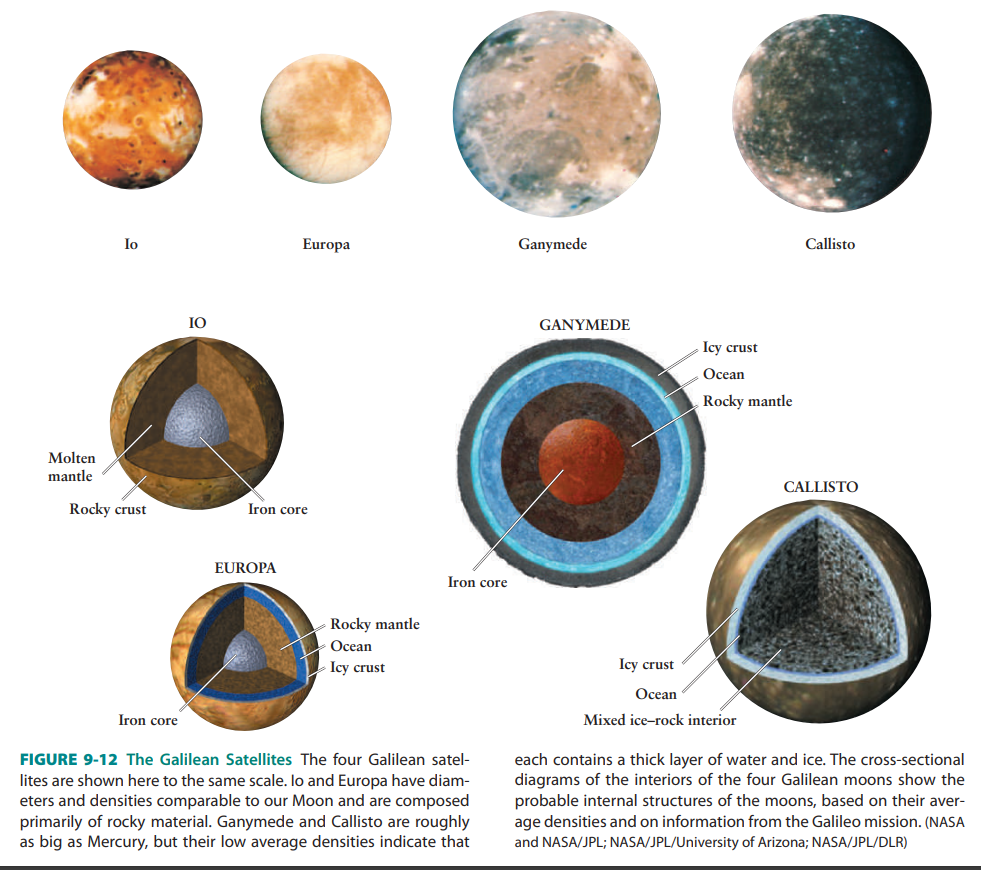
Figure 9-12 show comparative characteristics and interiors of these moons.
Insight Into Science:
Common misconceptions about moons based on their names; many are geologically active or have subsurface water unlike Earth’s Moon.
Io: A Volcanic World
Overview of Io:
Density: , indicating its composition is intermediate between terrestrial and Jovian planets.
Chemical Composition:
Mostly rock and iron because of lower compression due to its small mass compared to Earth and larger planets.
Orbital Period:
Completes its orbit around Jupiter every 1.8 days.
Synchronous Rotation:
Similar to our Moon, it always shows the same face to Jupiter.
Surface Features:
Active volcanoes (Number): Approximately 400
Ejections: Plumes and lava geysers, comparable to Old Faithful.
Lava amounts: 10 trillion tons annually in plumes up to 400 km high.
This is 100 times the total lava emitted by all of Earth's volcanoes, capable of resurfacing Io to a depth of 1 m each century.
Example Eruption in 2002:
Area covered: Size of London, 1600 sq km (620 sq mi).
Largest eruption observed in 2014:
Emission of energy: watts.
Comparison: Typical light bulbs emit less than 100 W.
Lava Composition: Basaltic lava rich in magnesium and iron.
Geological Features:
Surface dots indicating dormant volcanic vents with old lava flows covering 5% of Io’s surface, typically 10 to 50 km in diameter.
Tidal Heating of Io
Heat Source:
Gravitational forces from nearby moons cause tidal heating, generating sufficient energy akin to that from detonating 2400 tons of TNT every second.
Impact on Geology:
Leads to a molten layer ranging from 30 to 50 km beneath the surface, resulting in volcanic activity.
Volcanic Emissions:
Sulfur and Composition: Gaseous emissions reveal sulfur dioxide () and colors based on sulfur molecules adjusted by temperature.
Vital Statistics of the Galilean Moons, Mercury, and Earth’s Moon
| Sidereal period (day) | Diameter (km) | Mass (kg) | Mass (Moon = 1) | Mean density (kg/m³) | |
|---|---|---|---|---|---|---|
Io | 421,600 | 1.77 | 3643 | ___________ | 1.22 | 3528 |
Europa | 670,900 | 3.55 | 3122 | 0.65 | 3013 | |
Ganymede | 1,070,000 | 7.16 | 5262 | 2.01 | 1942 | |
Callisto | 1,883,000 | 16.69 | 4820 | 1.47 | 1834 | |
Mercury | — | — | 4878 | 4.49 | 5430 | |
Moon | — | — | 3476 | 1.00 | 3340 |
Europa: Liquid Water Potential
Overview:
Orbits Jupiter every days and is in synchronous rotation, similar to Io.
Average density: 2970 kg/m³ (lower than Io's), with approximately a quarter of its mass potentially being water.
Possesses a metallic core of much higher density and a weak magnetic field.
Surface Features:
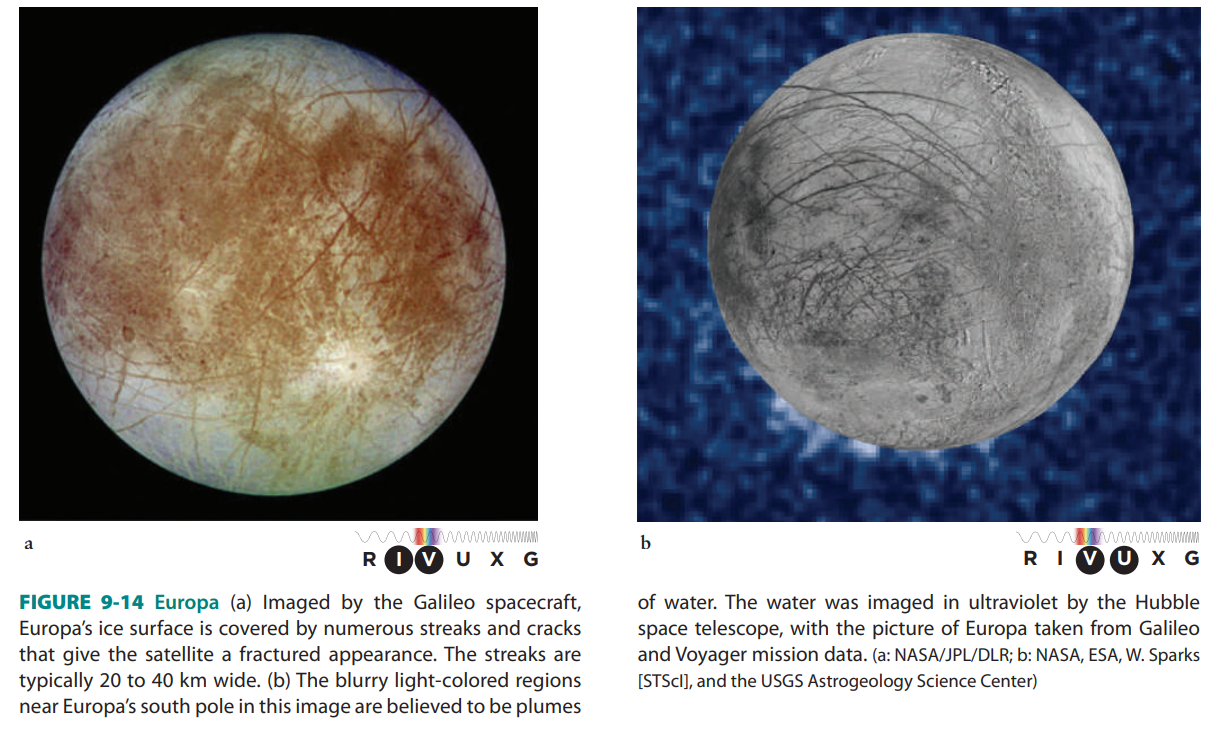
Images from Voyager 2, Galileo, Juno, and New Horizons reveal an ice and rock surface with numerous cracks and fractures.
Tectonic Processes:
The changing gravitational tug from Io creates stress similar to that on Io, leading to these cracks and fractures.
In 2014, astronomers identified signatures of tectonic plate motion, where one plate glides under another.
This surface motion helps generate heat internally, keeping water in a liquid state just a few kilometers below the ice and rock surface.
Evidence of Subsurface Water:
Similar dynamics to Earth’s Arctic region, where the movement of surface features creates ice floes, swirls, strips, and ridges, driven by circulating water underneath.
The reddish color of the moon may be due to salt deposits left after liquid water rose to the surface and evaporated.
The chaotic surface observed by satellites is interpreted as resulting from water volcanism on Europa, indicating a persistent liquid water layer.
The replenishment of the surface by tectonic plate motion explains the scarcity of large impact craters.
Observations of Plumes and Lenticulae:
The Hubble Space Telescope observed what appear to be plumes of water above the moon’s south polar region in December 2012 and early 2014, with variations suggesting episodic emission from an underground ocean.
Galileo discovered red and white domes called lenticulae (typically 100 m high and 10 km wide), thought to be rising warmed ice mixed with other material, possibly organic matter.
These lenticulae behave like blobs in lava lamps, although calculated to take 100,000 years to reach the surface from the liquid ocean.
Atmosphere:
In 1995, astronomers discovered an extremely thin atmosphere containing molecular oxygen, about times as dense as Earth's air.
This oxygen may originate from water molecules on the moon's surface broken up by ultraviolet radiation from the Sun.
The Potential for Life
Arguments for Liquid Water:
The existence of liquid water beneath the icy surface supports the possibility of extraterrestrial life, similar to environments found in Earth's oceans.
The underground ocean is of significant interest to scientists due to the prevalence of life in liquid water on Earth.
Contamination Concerns:
If life exists and evolved differently from Earth's, Earth-based life forms could contaminate or wipe it out.
To prevent potential contamination, NASA intentionally directed the Galileo spacecraft into Jupiter's thick atmosphere, where it was vaporized.
Ganymede: Largest Moon Features
Geology:
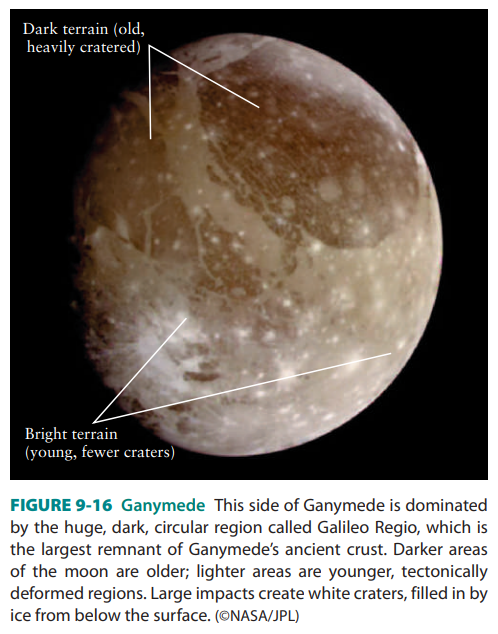
Largest satellite surpassing Mercury's diameter (Figure 9-16) but significantly less dense (1940 kg/m³).
Orbits Jupiter in synchronous rotation once every 7.2 days.
Internal structure includes an iron-rich core, a rocky mantle, an icy mantle, a salty underground liquid water ocean, a covering of dirty ice, and a thin atmosphere.
Magnetic Fields and Internal Ocean Evidence:
Has a permanent magnetic field (twice as strong as Mercury's).
Also possesses a continually varying second magnetic field generated by Jupiter’s magnetic field.
Jupiter's powerful magnetic field creates an electric current inside Ganymede, which causes this varying magnetic field as the moon rotates and revolves.
The flow of current inside Ganymede is best explained by the presence of liquid saltwater, which is a good electrical conductor, implying a liquid ocean.
Salts have been observed on Ganymede’s surface, deposited as water leaked out and froze.
The presence of liquid water supports the potential for life, similar to Europa.
Surface Terrain:
Features two different kinds of terrain (Figure 9-16, Figure 9-17):
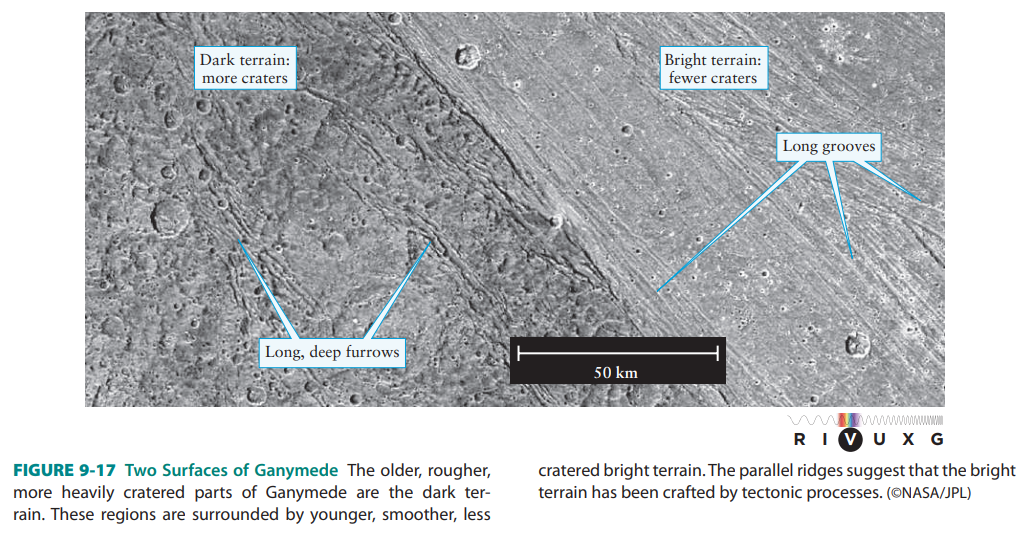
Dark, polygon-shaped regions: Oldest surface features, identified by numerous craters.
Light-colored, heavily grooved terrain: Found between the dark, angular islands, much less cratered, indicating younger age.
Grooved terrain consists of parallel mountain ridges up to 1 km high and spaced 10 to 15 km apart.
These features suggest plate tectonics may have dominated Ganymede’s early history, ceasing 3 billion years ago when the crust froze solid.
Water expansion upon freezing likely helped create large-scale features:
Water seeping through cracks in the original crust and solidifying may have forced apart crust fragments, producing jagged, dark islands of old crust separated by bands of younger, light-colored, heavily grooved ice.
Atmosphere:
Thin atmosphere containing oxygen, and possibly other gases.
Auroras, observed in 1998, are created as oxygen in the atmosphere is bombarded by electrons trapped by Jupiter’s magnetic field.
Callisto: Ancient Impact Survivors
Geological Characteristics:
Jupiter’s outermost Galilean moon, orbiting in 16.7 days.
Synchronous rotation, similar to other Galilean moons.
91% as big and 96% as dense as Ganymede.
Thin atmosphere composed of hydrogen and carbon dioxide.
Dark, cratered terrain, showcasing ancient impacts but lacking tectonic activity, highlighting its frozen state.
Contains a substantial liquid water ocean, inferred by a changing magnetic field.
Heat for the liquid ocean likely comes from radioactive decay inside the moon.
Numerous large impact craters are scattered over its ancient, icy crust, but very few are smaller than 100 m across, possibly due to disintegration.
Unlike Ganymede and Europa, it lacks younger, grooved terrain, suggesting tectonic activity never began, likely due to rapid freezing.
Callisto's Unique Geography
Valhalla Impact Basin:
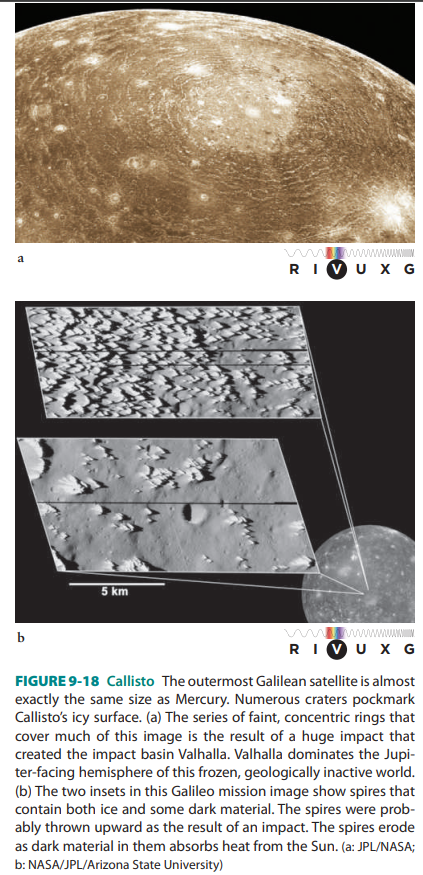
Large impact basin, located on Callisto’s Jupiter-facing hemisphere, created by an asteroid-sized object.
Features reminiscent of rippled patterns that ran out from the impact site, cracking the surface and freezing into place.
Largest remnant rings surrounding the impact crater have diameters of 3000km.
In 2001, the Galileo spacecraft revealed spires 80–100 m high, also believed to be impact-created.
Notably lacks jumbled terrain on the side opposite Valhalla Basin, unlike other large impact sites such as on Mercury and our Moon.
The smoothness is explained by a liquid water interior dampening impact shock, preventing disturbance on the opposite side, supporting the presence of internal liquid water.
Temperature ranges from 155 K during the day to 80 K at night (-180°F to -315°F).
Remaining Aspects of the Jovian System
Other Moons and Ringlets:
Over 65 smaller moons with irregular shapes, most under km in diameter.
Four of these moons are inside Io’s orbit; all other known moons are outside Callisto’s orbit.
The inner moon Amalthea is red-colored, has about the same density as water, and is apparently made of pieces of rock and ice barely held together by gravity.
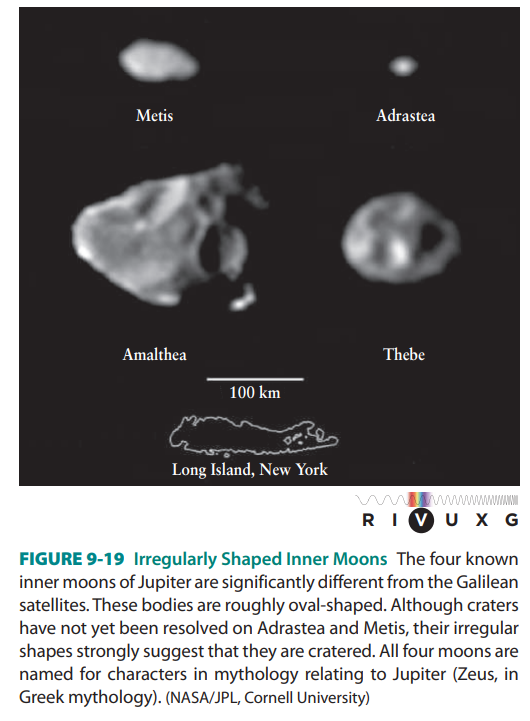
The Galilean moons, along with the smaller moons closer to Jupiter and six of the outer moons, orbit in the same direction that Jupiter rotates (prograde orbits).
The remaining outer moons revolve in the opposite direction (retrograde orbits).
The outer moons appear to be individual captured planetesimals, while the inner ones are probably smaller pieces broken off a single larger body.
Jupiter's Rings:
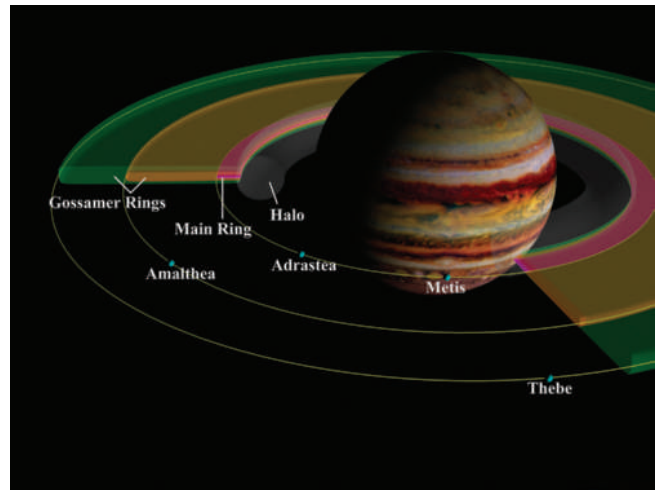
Jupiter is the first of four planets with rings.
Composed primarily of dust and finer particles blasted off moons such as Adrastea and Metis for the main ring.
The main ring's outer edge has three well-defined ringlets of debris ranging from gravel to small boulders.
The rest of the main ring, extending about km inward, is composed of dust-sized particles and is less than km thick.
Smallest particles leak inward, creating the halo ring.
Debris ejected from the moons Amalthea and Thebe creates thicker rings of very tiny dust particles called the gossamer rings.
All rings are actively replenished by impacts freeing regolith from the moons, continuously replacing material ejected by collisions and solar radiation.
Tori of Electromagnetically Charged Gases:
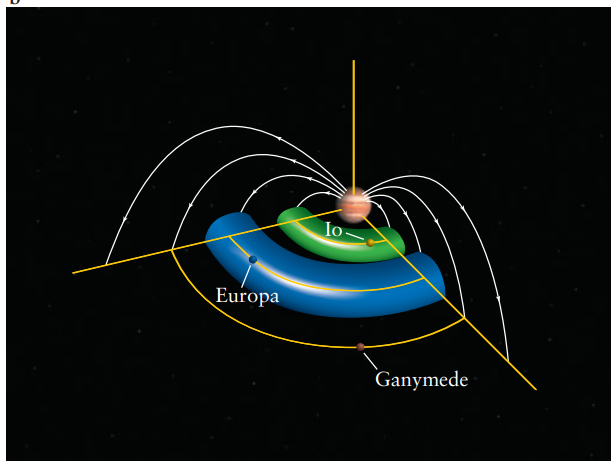
Two significant doughnut-shaped regions (or tori) of electrically charged gas particles, called plasmas, orbit Jupiter.
One torus is in the same orbit as Io (Io torus), consisting of sulfur and oxygen ions along with free electrons, ejected by Io’s geysers.
These particles are held in orbit by Jupiter’s strong magnetic field; some spiral in toward Jupiter, creating auroras and contributing to Jupiter’s coloration.
The other torus is in Europa’s orbit, consisting of hydrogen and oxygen ions and electrons created from water molecules kicked off Europa’s surface by radiation from Jupiter.
The mass of Europa's gas ring is calculated to be about kg.