Neptune (Part 5)
Neptune's Rings and Moons
Like Uranus, Neptune possesses a system of thin, dark rings.
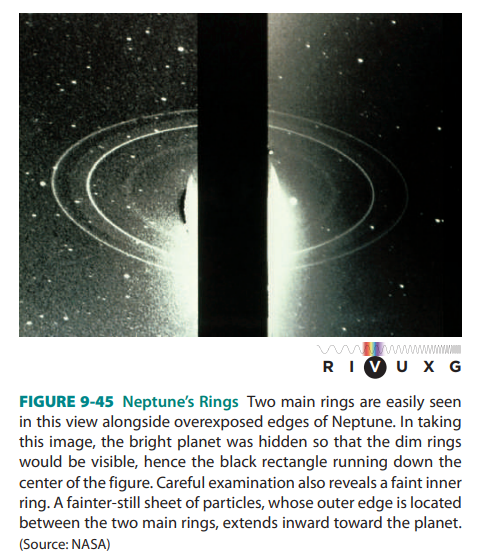
Ring particles are composed of methane ice, which radiation damage has converted into darkish carbon compounds, resulting in low reflectivity.
Neptune has 14 known moons:
Thirteen are irregularly shaped with highly elliptical orbits, suggesting they were captured.
Triton, discovered in 1846, is spherical and has a nearly circular, retrograde orbit.
Scientists speculate Triton was captured 3 to 4 billion years ago, with tidal forces subsequently circularizing its orbit.
Triton: Neptune's Unique Moon
Composition and Atmosphere:
Average density of approximately , indicating an equal mix of rock and ice.
Has a thin atmosphere composed of nitrogen, methane, and carbon dioxide, with density varying seasonally.
Surface and Geologic Activity:
Early tidal forces from Neptune caused internal heating, melting its interior and obliterating original surface features like craters.
Its current surface is estimated to be only about 100 million years old, with few visible craters due to ongoing resurfacing.
Exhibits features similar to other icy worlds, such as long cracks (like on Europa and Ganymede).
Unique features include wrinkled terrain resembling a cantaloupe's skin and frozen lakes, possibly calderas of extinct cryovolcanoes formed from a mixture of methane, ammonia, and water.
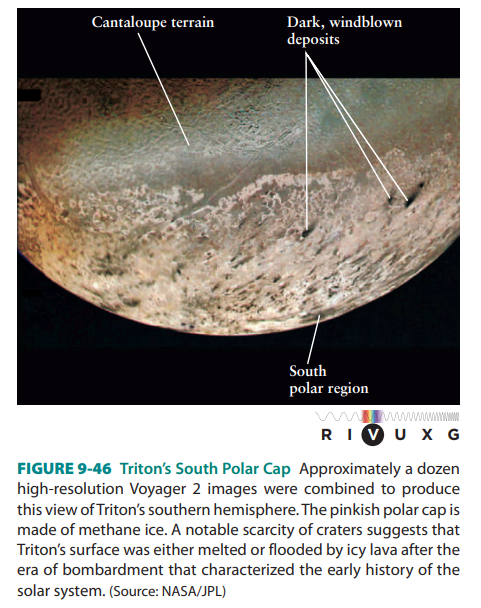
Surface temperature measured by Voyager was ( ).
Voyager observed two nitrogen gas plumes, extending up to above the surface, likely warmed by interior radioactive decay and escaping through vents.
Future of Triton:
Triton's retrograde orbit causes tides on Neptune, which in turn cause Triton to spiral inward.
Within the next 250 million years, Triton will reach the Roche limit and be demolished, forming a new, more substantial ring system around Neptune.
Comparative Planetology of Outer Planets
Size and Mass
The four giant planets (Jupiter, Saturn, Uranus, Neptune) are all significantly larger ( to times Earth's diameter) and more massive ( to times Earth's mass) than Earth.
Atmospheres and Rotations
All four have thick, hydrogen- and helium-rich atmospheres completely covered with clouds.
They rotate rapidly (sidereal rates from about to hours), causing their clouds to form parallel bands (belts and zones).
Interiors
All possess terrestrial cores.
Jupiter and Saturn:
Cores are surrounded by thick liquid metallic hydrogen layers, then normal hydrogen and helium layers.
Jupiter’s core may be dissolving due to interaction with liquid metallic hydrogen.
Uranus and Neptune:
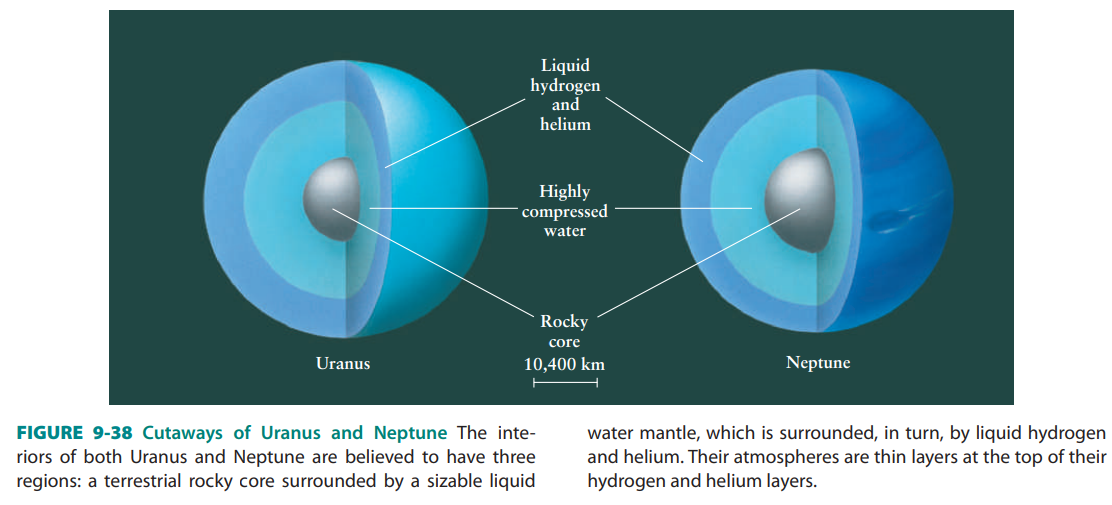
Terrestrial cores are surrounded by large amounts of water, then liquid hydrogen and helium (no liquid metallic hydrogen).
Magnetic Fields and Rings
All four giant planets have magnetic fields that trap solar wind particles, similar to Earth’s Van Allen belts.
Magnetic fields of Jupiter, Uranus, and Neptune are tilted relative to their rotation axes; Saturn's is aligned with its rotation axis.
All four have ring systems:
Saturn's rings are the most massive and distinctive.
Followed by those of Uranus, Jupiter, and Neptune in terms of distinctiveness/mass.
Moons
Collectively, the giant planets have at least 172 moons.
Each giant planet has a few spherical moons, along with many smaller, irregularly shaped moons, which are likely captured space debris.
Unlike Earth's Moon, the satellites of the giants are orders of magnitude less massive relative to their planets (millions or billions of times less massive, compared to Earth's Moon being only times less massive than Earth).