Module 4 ExReading Notes
Jørgensen & Bozeman (2007) - Public Values (An Inventory)
Abstract: Exploring boundaries and meanings of public value, the authors seek to identify some of the impediments to progress in the study of public values. The study of public values is often hamstrung by more general problems in the study of values. The authors begin by identifying analytical problems in the study of values and public values. Then they take stock of the public values universe. To identify public value concepts, relevant literature is reviewed and interpreted. Finally, the analytical questions posed in the first section are addressed, focusing specifically on issues related to the hierarchy, causality, and proximity of public values.
Despite the importance of public values, the study of them has not progressed much
This article is concerned with the study of public values being complicated by problems in the study of values
1st section: identifies analytical problems in the study of values and public values
2nd section: ‘take stock’ of the public values universe
Inventory guiding questions: (1) When researchers write about public values, to which values do they refer? (2) After sorting through the thicket of public values concepts to develop a research program on public values, what issues must one address?
Core Questions for a Public Values Research Agenda (ANSWER THESE AT END FOR REVIEW)
The researchers look at several questions that are key to the progress of public value analysis
“What is the origin of public values, and what does the “public” mean in public values? Do public values attach to political action, to public authority, or to more deeply seated prerogatives of the governed?
“Is there a hierarchy of public values? What are the implications of hierarchy?”
“What are the possibilities for assessing public values?”
How do public values fit together? How does one handle conflicts in values?
Does the attainment of some values cause the attainment of others, or are they preconditions for the attainment of others? Are there constellations of public values? Most important, if public values conflict, how does (or should) this affect governance?
A Preliminary Inventory of Public Values
Most of this study pulled from research with intersections between public policy and administration, and also at general political science research at a lesser scale. Also, most of the literature is journal articles
Also pulled public admin periodicals in—the US, UK, and Scandinavian countries. These nations represent the author’s national origins and also represent most writings on public value
The literature for this study is recent, so the study itself might understate historic state traditions/political cultures as they are taken for granted
Only a fraction of the literature is referenced so the loss of context has three downsides
Values are removed of specific meaning
Historical background and specific political cultures are lost
Values are removed from intellectual context/relationship to the history of ideas
Advantages of their employed method: gives overall impression of the scope of public values (unlike researchers who only mention a small number of values), taking values out of context allows room for contemplation, and makes it possible to identify closely related values and exempt synonyms
Unfolding the Values Universe
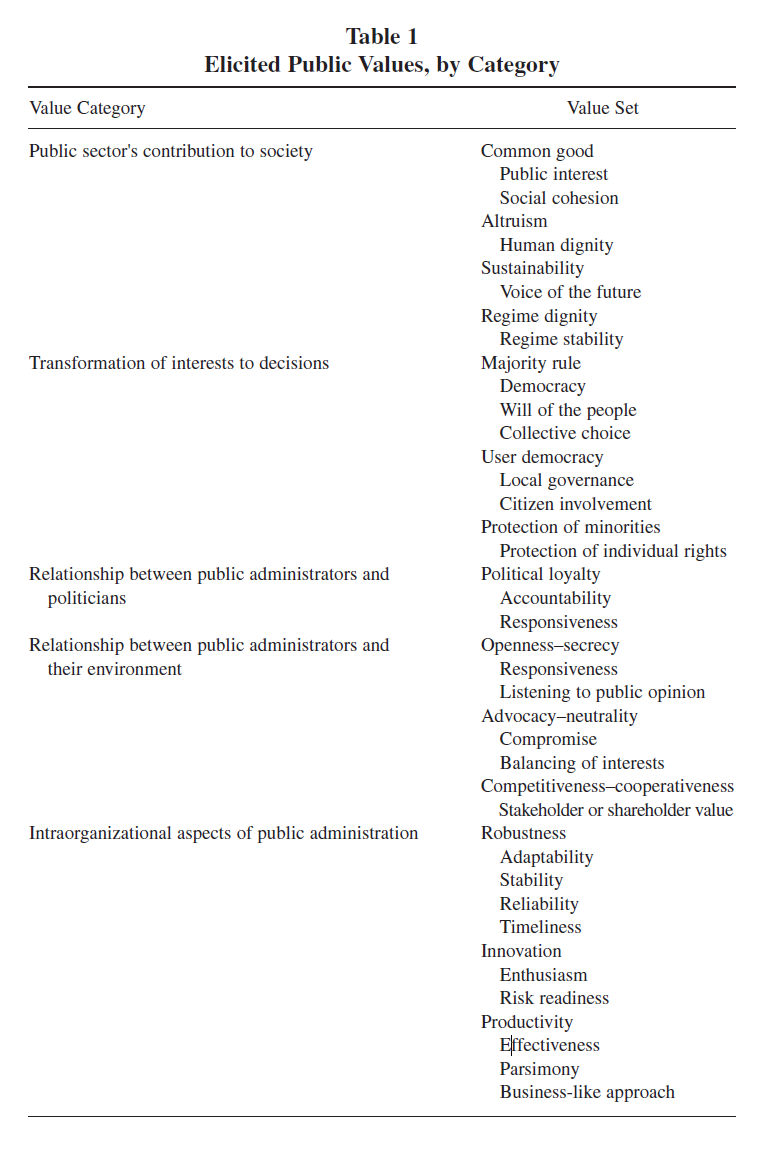
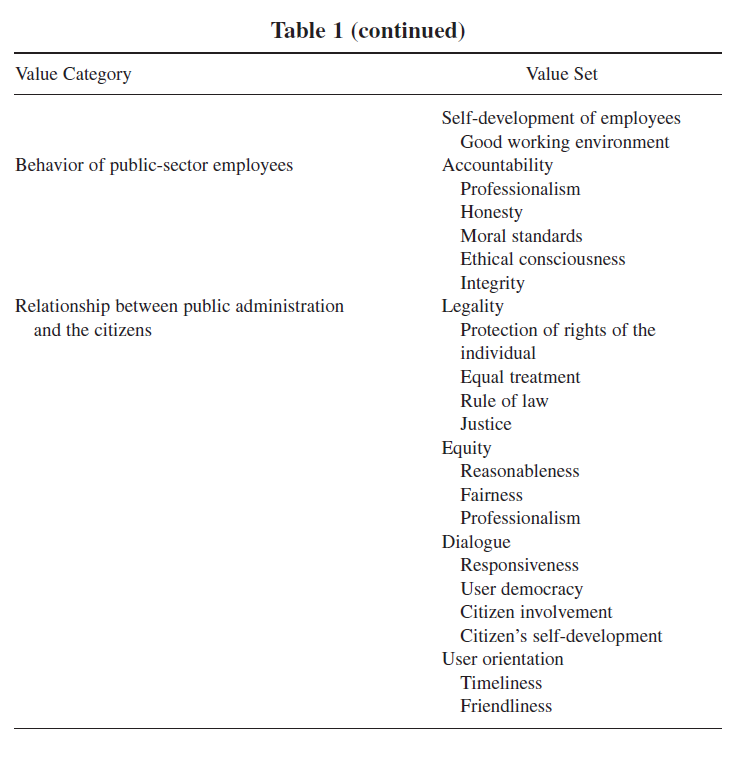
The survey of public values resulted in 72 registered values.
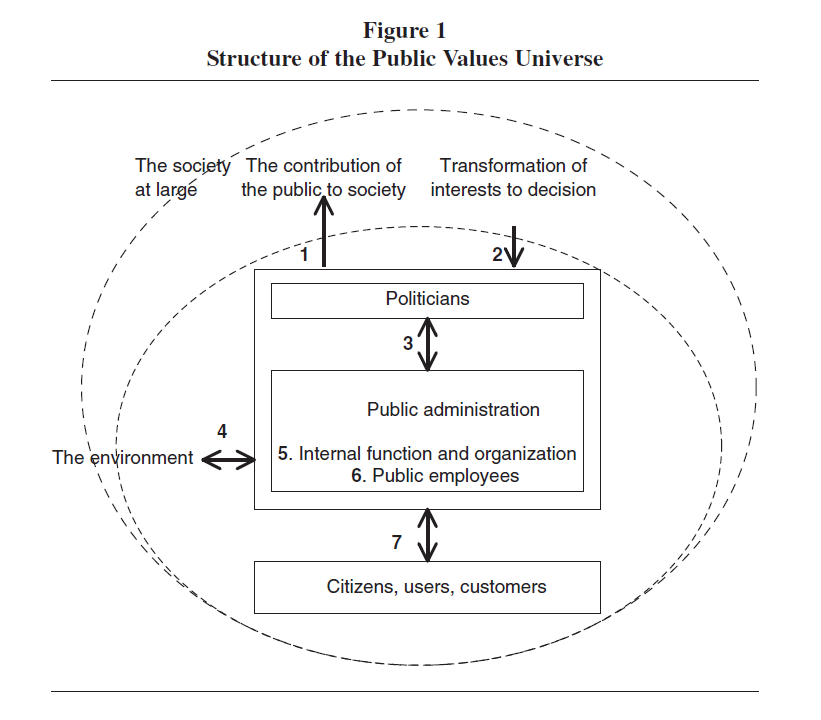
Constellation 1: Values Associated With the Public Sector’s Contribution to Society
Table 1 illustrates the large number of values, with four different types of values. This constellation focuses on the 1st
First value type
Public Sector’s contribution to society (idea that the public sector should create or contribute to the common good and to the public interest)
Critics say that the terms common good and public interest are worthless concepts—the article ignores this b/c even if the concepts are broad, they have certain characteristic expectations SUCH AS:
The public sector is there for everybody, not special interests of certain groups. Related values: the will of the people, loyalty to society, altruism, and solidarity.
Social cohesion fits into this group as it fits the idea that society is not divided up into mutually conflict factions and that we are all united by certain bonds
Altruism subgroup value explanations
Related to values of humanity (moral standards, justice) and influence (democracy, citizen involvement.
Human dignity subgroup
acting according to principles, bearing others’ burdens, protecting others.
Related values: citizen involvement, protecting individual rights, justice, equity
Sustainability subgroup
Creating a clean environment, giving resources to descendants and not destroying Earth. Is a more generalized value as it can adhere to groups that don’t wear out resources, which is a simplified application.
Related values: stability, common good, moral standards
Voice of the future
Democracy is flawed b/c it is impossible to represent future generations thru political assembly —> other ways must be found to address the imbalance between present and future
1st subgroup (common good/public interest) implies respect for a society —> 2nd subgroup implies respect for the individual —> 3rd subgroup extends those values to future
4th subgroup: Regime dignity and regime stability
Regimes must act in a manner that commands respect as they are a public power
Related values: rule of law, equity
It is the big values that are launched in this group, that is, public interest values. Underscored by fear that executive power can be misused, and that present conflicts will lead to resource destruction
Constellation 2: Values Associated With Transformation of Interests to Decisions
2nd value group concerned with how opinions should be channeled from society to the public sector. All subgroups are related and have a core element of people having a right to exert influence as a result of being affected by decisions.
1st subgroup: will of the majority/democracy/will of the people/collective choice
Democracy is a value that includes various forms and is broader in scope compared to related values in this group
Will of the majority does not have to be based on the people just as the will of the people isn’t always the electoral majority. Ex: Hitler claimed to represent all of the people.
Collective choice is choice for a majority without necessarily being through voting
2nd subgroup: user democracy, local governance, citizen involvement. Common denominator: individuals should be involved in local matters
User democracy: prevalent in small local institutions such as schools and day care centers
Citizen involvement: local planning hearings where local governance concerns their autonomy related to the state. Is a value that is broader & includes many forms: related values include the will of the people, listening to public opinion, responsiveness, dialogue, balance of interests, and self-fulfillment
3rd subgroup: protection of minorities and rights of the individual—counterbalances first group
Minority groups need protection from majority groups. Related values: fairness, justice, balance of interests, and human dignity
Related values to protection of individual rights: legalistic values such as equal treatment and the rule of law.
Constellation 3: Values Associated With the Relationship Between the Public Administration and Politicians
Three important values: accountability, responsiveness, political loyalty. Stress that politicians make decisions and provide funding while administrators act in accordance with those politicians
Accountability/Responsiveness: ‘rubber value’ as a person can be responsible for many people.
Political loyalty: stronger value as disloyalty insinuates active subordination, where the other two values above may be due to carelessness
Related values: accountability, stability, neutrality, the will of the people, and public interest.
Constellation 4: Values Associated With the Relationship Between Public Administration and Its Environment
Three subgroups: public insight, advocacy vs. neutrality, shareholder value and competitiveness
Public insight (scale of openness to secrecy)
Openness: admin can be open in a way that they publish and speak to public, on the other hand they can be more active and comply with public demands. Has many related values: accountability, rule of law, dialogue, democracy, collective choice, the will of the people
Secrecy: In a brutal sense, police state that is secretive to increase power. Less brutal sense, covers confidential info when dealing with foreign conflict, or keeping information about citizens private as a means of protection. Related to values of stability, continuity, rule of law, protection of individual rights, productivity, effectiveness
Advocacy vs. neutrality
Advocacy: when public orgs champion certain POVs or keep a problem on agenda as a means of advocating for the people. Example: EPA expected to protect environment. Related to enthusiasm (for issue) and professionalism (interpreting client issues within professional code)
Neutrality/impartiality: administrators do not have personal feelings/interests involved. Relates professionalism due to this definition.
Between these two values is compromise (value), not letting strong dominate weak and finding a satisfactory solution for the parties involved. Related values: reasonableness, fairness, and dialogue.
Shareholder value/competitiveness (new-er values)
Shareholder value: parsimony, productivity, and effectiveness
Competitiveness: can mean market success, or (broad sense) ability to win contracts. Related to values: businesslike approach, risk readiness, responsiveness, and effectiveness.
Constellation 5: Values Associated With Intraorganizational Aspects of Public Administration
Organizational values. Four subgroups that are all opposites.
Subgroup 1: The (reliable) Machine Metaphor
Values: robustness, adaptability, stability, reliability, and timeliness. Robustness is flowing with tide/being adaptable. Adaptability relates to flexibility, stability to continuity and legality. Reliability adds dimension with relations to timeliness. Timeliness relates to values such as parsimony, effectiveness
Subgroup 2: Innovation, enthusiasm, risk readiness. Contrasts with Machine.
Organizations with these values are not worried about future, are about the here and now. Innovation, relates to risk readiness and enthusiasm.
Risk readiness: taking chances. related to flexibility
Subgroup 3: typical new public management values: productivity, effectiveness, parsimony, a businesslike approach, and timeliness. Also contrasts with Machine.
Associated as well with economic thinking, downsizing.
Subgroup 4: organization or the public administration as a workplace.
Values: self-development of employees (relates to professionalism), good working environment (associated with enthusiasm, innovation, productivity)
Constellation 6: Values Associated With the Behavior of Public-Sector Employees
This section concerns the values relevant to public sector employees because organizational values b/c it gives a nuanced view of personal and system values combined
Subgroup 1: Accountability and Professionalism
Public employee works in a serious, reflective, competent manner.
Subgroup 2: Honesty, moral standards, ethical consciousness (individual values)
Subgroup 3: integrity
Employees are unmoved by personal motive/interests, bribery, and has a backbone to stick to a certain POV or principle. Relates to the value of Loyalty the most as this employee respects the system they adhere to
Constellation 7: Values Associated With the Relationship Between Public Administration and the Citizens
Four distinct subgroups
1st subgroup: legal status of citizen related to public admin
Related: legality (relationship should be regulated by law), protection of the rights of the individual, equal treatment, and the rule of law (superior value as it is only achieved if the other values are present). Justice occurs here as it is a result of each of these values
2nd subgroup: laws, if applied rigidly and insensitively, result in justice not
being served
equity, reasonableness, and fair treatment. Common theme is that circumstances must be taken into consideration when decisions are made on their lives.
3rd subgroup: the citizen learns and develops through contact with the public sector.
dialogue, responsiveness, user democracy, citizen involvement, and the citizen’s self-development. These stem from the tradition of participatory democracy. Admins with these values accept responsibility for citizen development, and cares for democratic input
4th subgroup: new public management version of the relationship
Citizens are seen as customers, meaning public services are designed with a primary focus on the needs and preferences of the user
Constructions on the Basis of the Values: Proximity, Hierarchy, and Causality
Values in this section are considered on proximity, hierarchy, and causality.
Proximity: explains closeness of related values
Hierarchy: some values take more importance for certain individuals/groups
Causality: refers to how certain values can influence or lead to the emergence of others, establishing a framework for understanding relationships between them
Proximity of Values
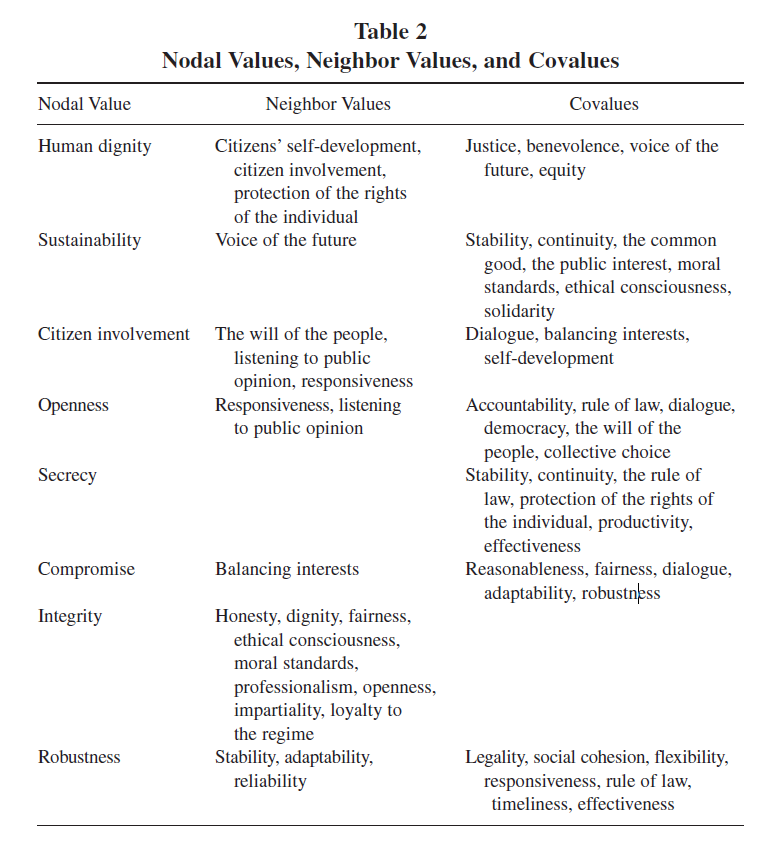
Neighbor values: closely related, but not synonyms. Are important in two ways
Identifying neighbors helps define ‘starting point’ values
Number of neighbors shows importance of value—more neighbors means a richly faceted starting point and higher significance
Values might also have positive effects on each other, or might be a precondition for the other (rule of law is promoted by openness). these are Co-values.
Values w/ many related values are NODAL VALUES—occupying a central position in a value network. Their exact meanings are open to discussion.
there are four groups of values that are mutually interrelated: robustness, innovation, optimal performance, and a good workplace. Four value clusters in the relationship between administration and citizen: the rule of law, professional discretion, citizen involvement, and customer orientation
Value clusters and nodal values indicate important organizational
design problems in the public sector—the question is how to balance these values
Values Hierarchy and Causality
The issue of relationships and hierarchies among values is particularly challenging when it comes to public values
Hierarchy of values and their causality is considered due to their inseparability
Prime values: a thing valued for itself and Instrumental value: valued for its ability to achieve other values
Van Dyke (1962) describes instrumental values as the conditions needed to achieve goals, while prime values are the ultimate outcomes or consequences that are valued for their own sake.
Conclusion
Public Value Is Not Governmental
Government has a special role as a safe guarder and promoter of public values, but it is not exclusive to them; institutions and private actors may also have obligations related to public values.
Public value obligations follow the ‘lines’ set down by political authorities
Implication: obligations pertaining to public value are related to public and civil law in some ways. This means that if one accepts that private actors are obligated to public values, then they must have more strict rules for compliance
So, public values are rooted in society, culture, individuals, and groups. Private citizens and institutions have obligations toward public values in the same way that the government does, even if they don’t universally agree to each value.
For some governments, their ‘bedrock for governance’ is common law (which is similar to unwritten social covenants formed off of society’s core public values)
Many Public Values Are Prime Values But Cannot Be Distinguished on That Basis Alone
Prime values are ends in themselves rather than a means to achieve other goals
Example: Declaration of Independence highlighting public values such as life, liberty, and the pursuit of happiness
These values are fundamental to legitimate governments, but even these values are up for interpretation and debate
Example: in the 18th century, ‘the people’ was White male property owners, and the rights of rebellion were contested
These values serve as a starting point for the understanding of public values but offer little clarity on their hierarchy
Public Values Analysis Is Both Causal Inquiry (Instrumental Values) and Philosophical and Moral Inquiry (Prime Values)
Analyzing public values requires two approaches: moral reasoning and causal reasoning, which can be confused
Prime values (end goals like improving quality of life) are hard to measure empirically b/c they are subjective.
Instrumental values (means to achieve goals, like training programs) can be tested empirically as causal hypotheses.
Ex: government program providing job training can be seen as instrumental values supporting the prime value of job security
Values Relationships Are Many and Unwieldy But Must Be Sorted Out
Analysis of public values is challenging due to ambiguous and complex value relationships
Public values, like common law, are inherently ambiguous but can still serve as useful criteria for action and accountability
Key Assumptions/Arguments/Conclusions
Assumptions
Public Values Are Complex: Public values are ambiguous, interconnected, and often conflicting, making their study inherently challenging.
Public Values Are Not Exclusive to Government: Public values are rooted in society and culture, not solely in government institutions. Private actors also have public value obligations.
Prime vs. Instrumental Values: Public values can be categorized as prime values (ends in themselves) or instrumental values (means to achieve other values), but this distinction is not always clear-cut.
No Universal Agreement on Values: Public values are not universally agreed upon or codified, and their interpretation evolves over time.
Arguments
Need for Systematic Study: Progress in understanding public values requires addressing analytical problems, such as hierarchy, causality, and proximity of values.
Value Relationships Are Critical: Sorting out relationships among values (e.g., clusters, nodal values, hierarchy) is essential for meaningful analysis and practical application.
Public Values Are Broader Than Government: Governments play a special role as guarantors of public values, but societal norms and expectations also shape public value obligations for private actors.
Instrumental Values Are Empirically Testable: While prime values are philosophical, instrumental values can be analyzed empirically to assess their effectiveness in achieving public goals.
Conclusions
Public Values Are Multifaceted: Public values are interconnected, with some acting as nodal values that influence others. Understanding these relationships is crucial for governance and public administration.
Public Values Are Not Fixed: They evolve based on societal norms, culture, and historical context, much like common law.
Analysis Requires Dual Approaches: Studying public values involves both moral reasoning (philosophical inquiry into prime values) and causal reasoning (empirical testing of instrumental values).
Future Research Needs: A more focused and systematic approach is required to analyze fewer values in greater depth, identify their network properties, and balance conflicting values in governance.