Energy
Energy is the ability to do work or produce change, existing in various forms such as kinetic, potential, thermal, chemical, and nuclear energy. It cannot be created or destroyed, only transferred or transformed.
Key Concepts of Energy
A fundamental part of the universe; something everything is made of.
Stored in the bonds of molecules, released during chemical reactions, powering processes that sustain life.
Kinetic Energy
Associated with the motion of an object; directly proportional to mass and the square of velocity.
Forms:
Mechanical kinetic — moving objects (cars, balls).
Thermal — movement of particles.
Sound — vibrations through air.
Electrical — moving electrons.
Potential Energy
Stored energy due to position or condition; can convert to kinetic energy.
Forms:
Gravitational — due to height.
Elastic — stretched/compressed objects.
Chemical — in food, fuel, batteries.
Nuclear — within atoms.
Energy Transfer & Transformation
Transfer: Moves from one object to another without changing form.
Transformation: One form changes into another.
Practical Applications
Humans transform chemical energy from food into kinetic and thermal energy.
Sports activities transfer kinetic energy (e.g., kicking a ball).
Electronic devices transform electrical energy into other forms, affecting efficiency.
Scientific Method
Observation: Measurable statement using senses.
Inference: Likely explanation of an observation.
Hypothesis: Predicted outcome from changing an independent variable (IV).
IV: What you change.
DV: What you measure.
Controlled Variables: Kept constant to ensure fairness.
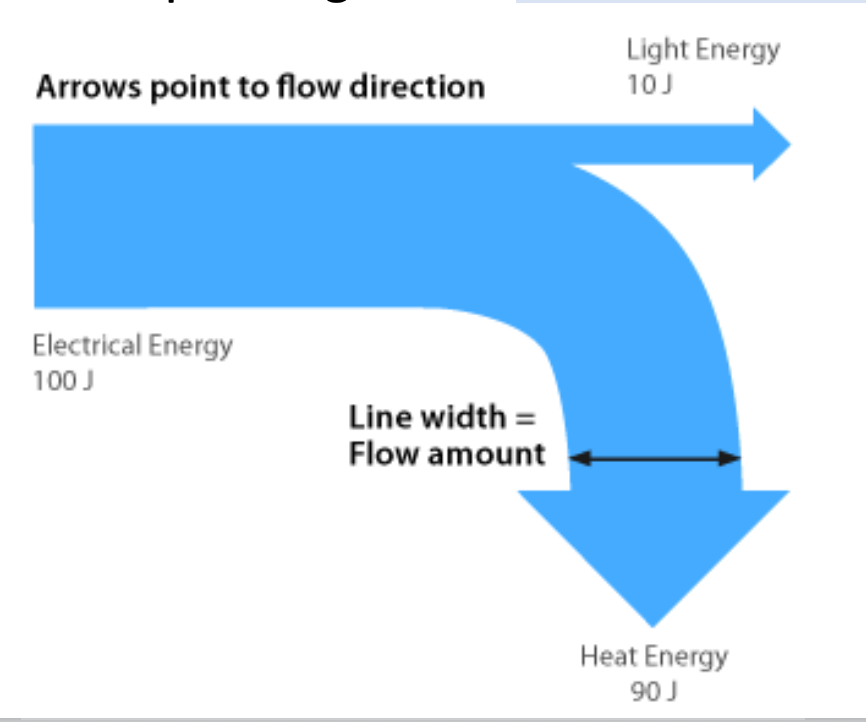
Sankey Diagrams
Visual representation showing input energy, useful output, and wasted energy.
Rules:
Arrow thickness proportional to energy amount.
Total input equals total output.
Law of Conservation of Energy
Energy cannot be created or destroyed, only transferred or transformed.
Thermal Energy & Heat Transfer
Thermal Equilibrium: Two objects at the same temperature due to heat flow.
Heat Transfer Methods:
Conduction — direct contact.
Convection — through moving fluids.
Radiation — electromagnetic waves.
Energy Efficiency
Efficiency = (Useful energy output / Total energy input) × 100
Interpretation of Energy Flow
Energy flow diagrams illustrate paths from one form to another (e.g., Chemical → Electrical → Light).
Useful vs. wasted energy as it outlines efficiency and conversions in practical applications be it engines, appliances, or biological systems.