complete-preliminary-cafs-syllabus-notes-64a2213e0410e.docx
Preliminary Exam study notes
Resource Management:
Fundamental Concepts of resource management
Wellbeing (SEPECS):
Wellbeing is the degree of satisfaction that an individual or group experiences when needs are met. Wellbeing is therefore dynamic and isn’t the same all the time. It depends in a variety of factors:
Social
Emotional
Physical
Economic
Cultural
Spiritual
Social | Social well-being refers to social interaction with other people, friendship and companionship. It enables opportunities for leisure, relaxation and recreation with family and without. It allows individuals to belong to a variety of groups to meet social needs. Being wanted positively impacts on wellbeing. |
|---|---|
Emotional | Emotional well-being refers to our feelings. Emotional needs include love, attachment, security, encouragement, independence, self expression and creativity. When emotional needs are met, individuals are better able to cope with stress. |
Physical | Refers to our physical health and safety. This includes food, water, physical activity, sleep and access to health care. Physical well-being affects other factors of SEPECS and stress levels. |
Economic | Economic well-being refers to finances. Money doesn’t always buy happiness but it can increase an individual's level of well-being to a certain extent. This can be achieved through employment, job security, budgeting and centrelink payments. Money can satisfy many needs and wants. |
Cultural | Cultural well-being refers to customs, beliefs, values and traditions. This can contribute to an individual's sense of identity. A sense of belonging provides emotional security. |
Spiritual | Refers to an individual sense of purpose in life. It also means knowing right from wrong and may sometimes refer to religious beliefs. |
Preliminary Exam study notes
Individual and Group Well-being:
A person's well-being can affect the well-being of others in a group. This can both have a positive and negative effect. For example those in a sporting group where one player has poorer levels of well-being can influence the performance of others in the same group. → Since there are 6 different areas of wellbeing, an individual can LOOK like they have a high level of overall well-being and vice versa.
Needs and Wants:
Needs are defined as things that are required to survive and to be physically and mentally healthy (eg. food, water, safety, love and acceptance).
Wants are preferences or desires that we crave. We would like to have them but do not essentially need them to survive and maintain positive levels of health (eg. cars, phones or jewellery).
There are 6 specific needs among the course:
Safety and Security
Health
Education
Employment
Sense of Identity
Adequate Standard of Living
Safety and Security | Safety and security is feeling safe and protected from threats. These threats can be the weather or potential theft, burglary or harm. Eg. Installing barson windows for an elderly relative on their home |
|---|---|
Health | Health is a holistic concept and is related to a person’s perception of well-being therefore making it critical. Health can be divided into physical, social, mental, emotional and spiritual sectors. |
Education | Education is a need as it involves learning and acquiring knowledge and skills. Education may be formal or informal. Those with higher education have higher levels of economic resources, housing and healthcare, therefore improving their wellbeing. |
Employment | Employment involves devoting time and energy towards a goal for payment or profit. It can help us meet many needs that require costs. Employment also gives us money to meet basic needs alongside a sense of belonging and |
Preliminary Exam study notes
purpose. | |
|---|---|
Sense of Identity | Sense of identity is an individual's idea of who they are, their confidence and it affects their self-esteem. Sense of I.D. changes over time and is influenced by roles, responsibilities and life events. |
Adequate Standard of Living | Adequate standard of living includes primary needs like food, water, shelter and clothing. Some members of the community need help accessing basic needs to achieve an ASL. They may rely on charities, Centrelink or family to provide this. |
Maslow’s Hierarchy:
Maslow's hierarchy of needs is a theory of motivation which states that five categories of human needs dictate an individual's behaviour.
The hierarchy of needs works from the bottom → upwards. Needs lower down on the hierarchy must be satisfied before individuals can attend to needs that are higher up. You ‘technically cannot be higher in the hierarchy before bottom needs are met’.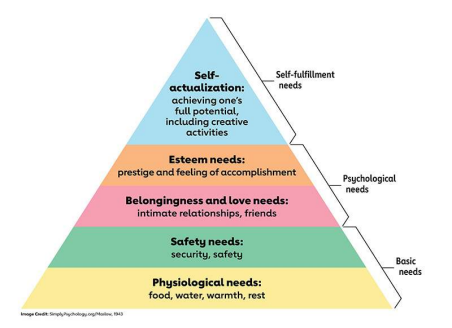
Preliminary Exam study notes
Satisfaction of Needs and Wants - Goal Setting:
Both individuals and groups set goals to satisfy both their needs and wants. Goals should be prioritised in order of importance or when they should be achieved by. Resources, values and motivation influence how, when and what goals can be achieved. Goals can be classified as short term, medium term and long term.
The SMART goal setting technique can be used to reach desirable goals: Specific
Measurable
Attainable
Relevant
Time-based
Resources
Things that are used to achieve goals can be defined as the term resources. Resources and generally limited, hence why individuals must manage the resources available to them carefully. Well-being is enhanced when resources are managed successfully.
Specific resources:
Human Resources | Are the skills, abilities and talents of people: Eg. energy, knowledge, language, skills + abilities, initiative, compassion, cooperation, creativity |
|---|---|
Non-human Resources | Are tangible and touchable items/objects: Eg. money, food, clothing, shelter, cars, tech devices, musical instruments, electricity |
Interchangeability of Resources:
As resources have a variety of uses, individuals should decide how to use them best. The term Interchangeability of resources is when one resource is swapped out for another. This is commonly done with money (for example tutoring, skills and knowledge are swapped for money). Other examples include taking the neighbours bins out to borrow their lawnmower.
Resource Sustainability (to conserve a resource):
Individuals are resource users or consumers.
Some non-human resources can be consumed partially or wholly. Resources are unable to be renewed when they are fully consumed (eg water, petrol, coal).
Effective resource management relies on individuals and governments to decide in how and at what rate that resources should be used. This therefore ensures that particular resources are used sustainably and can be used for longer.
Preliminary Exam study notes
Influences on resource management
Factors Affecting Resource Management
Personal values and past experiences:
Values and qualities that an individual or family believes to be desirable or important in life. They influence how we act in our environment, but also determine what we feel we need to do in certain situations, hence how they can be shaped by past experiences. Values are the core driver of our actions.
Factors influencing availability of and access to resources:
The availability and access to resources varies between groups and individuals. The GASCD acronym can be used to remember it:
Gender
Age
Socioeconomic status
Culture
Disability
Gender | Men and women are provided equal access to resources through law. Despite so, men are quite often less likely to go and seek resources such as medical attention or centrelink where it is needed |
|---|---|
Age | Age restricts access to resources as certain resources can only be obtained through the access of age requirements. Eg. The pension cannot be accessed until 65 and aged care is only available for free to certain individuals. Alcohol is also a resource restricted to 18 years, similar to a unrestricted driver's licence (approx 20 years) |
Socioeconomic status | SES refers to the employment, income and education of an individual or family. This influences the availability of resources as certain resources must be paid for and others not, therefore limiting some individuals from it. Eg those who cannot afford a car do not have access to the resource which can prevent them from accessing other resources. |
Culture | As culture is strongly linked to language it can influence how resources are accessed; many resources can be unknown to individuals due to language barriers. Cultural beliefs can also become barriers by varying values. Eg. Medical decisions in cultures vary such as certain resuscitation beliefs. |
Preliminary Exam study notes
Disability | Individuals with disabilities can have trouble accessing specific resources like transport, however they also may have greater access and entitlement to resources due to their disability. Eg. government payments or being entitled to payments |
|---|
Access to Support:
As individuals rely on themselves, each other, the community and greater society to satisfy their needs and wants and to promote wellbeing, it is impossible for it to all be provided hence why support networks (formal and informal) are available.
Informal support does not require any sort of formal paperwork to be filed and can be issued by relatives, friends and neighbours. Informal support may be looking after children, providing transport, teaching the aged computer skills.
Formal support on the other hand does require formal paperwork to be lodged and is done by government agencies and community organisations. Formal support could be childcare, disability services, sporting services, employment opportunities etc.
Personal Management Skills
Personal management skills are concerned with an individual's ability to exercise control over their attitudes, behaviours and motivations. Those practising better skills show better well-being and positive attitudes/behaviours.
Planning and Organisation:
Planning | Planning enables the process of achieving or doing something |
|---|---|
Organisation | The process/quality of being efficient, systematic, logical and orderly is termed being organised. Organisation is key in being able to achieve goals. |
Communication:
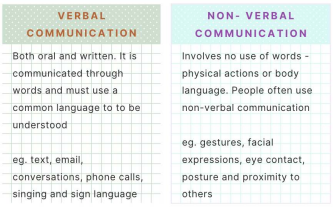
Communication is how people share ideas, information, opinions and feelings. Communication has 4 components:
1 The Sender - the source of the communication
2 The Receiver - the recipient of the message
3 The Message - the meaning of what is being communicated
4 The Medium - the way the message is being transmitted eg text, voicemail, face to face etc
Preliminary Exam study notes
Assertive | When a person expresses their feelings in a positive, non-threatening manner that doesn’t offend or hurt the feelings of others. Assertive communication involves individuals standing up for their own rights whilst respecting other people's opinions - they are ready to listen to others and show respect |
|---|---|
Aggressive | Aggressive communication involves sharing opinions and feelings in an intimidating way with no respect for other people’s opinions. It can result in arguments. Hostility can arise with conflict - respect is lost. |
Passive | When people want to be polite, do not communicate their opinions and let others ‘walk all over them’ they are showing passive communication. This can avoid conflict but it may arise later in time. |
Preliminary Exam study notes
Decision Making:
Decision making involves making choices or reaching conclusions based upon all options available.
Some of these decisions are quick and easy and are therefore made quickly in everyday life and others are difficult and have a long term impact on those around them and themselves.
Decision making styles: | |
|---|---|
Impulsive | Is a decision made quickly that doesn’t consider alternatives or consequences Eg. Buying an expensive hot tub online |
Intuitive | Is a decision making style based on a gut feeling or an instinct. A lot of thoughts may not be put into the decision, but they do consider their values and standards. Eg. Picking an answer of multiple choice based on gut feeling |
Hesitant | Is a decision made with caution. The person may have trouble making the decision and may lack confidence. May be fearful of the outcome or consequence of the decision Eg. Skipping class |
Confident | Decisions are made with certainty and trust. They have looked at all the alternatives and possible outcomes. Eg. Buying a computer |
Rational | Logical and sensible decision making. The individual uses common sense and gathers relevant information, looks at all alternatives, considers all consequences before making a final decision. Eg. Booking a hotel |
Factors Influencing Decision Making:
1. Access to resources - access to time, energy and money will impact decisions to be made. Lack of knowledge and resources will limit alternatives
2. Complexity of the Problem - complex decisions generally require greater resources. More complex problems = greater consequences
3. Past experiences and personal problems - decisions are often influenced by previous choices and consequences. This can be positive (do again) and negative (do it differently) decisions from the past.
4. Attitudes to change - Some people are more open to change in their life whilst others crave familiarity.
5. Sociocultural factors - Some cultures value some things more than others.
Preliminary Exam study notes
Problem Solving:
Problem solving is a method for analysing a situation, generating possible solutions and evaluating the options.
Steps:
1. Identify the problem
2. Explore the alternatives and their consequences
3. Select an option
4. Implement the solution
5. Evaluate the solution
Effective Resource Management
Strategies for Effective Resource Management:
Using Interchangeable Resources:
Different people use resources differently - Individuals need to make decisions about the best use of resources.
Adopting Sustainable Behaviours:
Certain non-human resources and non-renewable - Managing and sustaining resources for the future is crucial.
Accessing Support:
Formal support is provided by government agencies and community support Informal support comes from friends and family
Through free resources individuals or groups can ensure resources are used effectively
Developing Personal Management Skills:
Resources can be managed through planning, organising, decision making, problem solving and communication skills.
Engaging in Education and Training:
Better paying jobs and futures for all are ensured through education. Money can mean better access to support and resources.
Preliminary Exam study notes
Interviews as a Primary Research Method:
Interviews = conversation between 2 or more people to collect information or opinions.
Constructing, Conducting and Recording Responses:
→ Interviews ideally should contain a mixture of questions:
Introductory Questions | Aim to put interview at ease and are general in nature |
|---|---|
Focus Questions | Enable interviewee to give certain information and can account for further probing on a particular issue |
Open Questions | Allow reasons, thoughts and opinions to be provided by the interviewee |
Closed Questions | Result in brief answers |
Structured and Unstructured Interviews:
Structured Interviews - planned interview with a set of predetermined questions from researcher
Unstructured Interviews - discussion-like interview with researcher planning areas for discussion without developing the actual questions
Structured Interviews | |
|---|---|
Advantages: | - Q’s are planned to focus on an area - Responses are consistent due to format - Time length can be specified and limited |
Disadvantages: | - Formal structure may affect responses from interviewees - Limited flexibility |
Unstructured Interviews | |
Advantages: | - More relaxed atmosphere - Greater flexibility as issues can be identified in importance during interview |
Disadvantages: | - Interviewer needs to be incontrol and knowledge to achieve success - Q’s may become irrelevant/unrelated and waste time - Time length required is unknown - Wide variety of responses may be hard to collect and combine |
Preliminary Exam study notes
Individuals and Groups:
Groups in the Community
Types of Groups:
Family and Friend groups | Family groups formed through blood or marriage, and spend much time together Friendship groups know each other well but may be short term (e.g. school friends split up) |
|---|---|
Sporting and Leisure groups | Maybe short term or long term. Aim is to participate in physical activity or to get fit. Motivation stems from group members. Can also be creative means (photography etc) |
Study and Work groups | Study and work groups ↑ wellbeing. |
Religious groups | Formed around common belief or faith - promote spiritual growth and a sense of community. |
Cultural groups | Cultural and ethic groups are based on the country of origin. Many re-settle in Australia in similar areas to those of the same culture - enabling familiarity with family groups and support. |
Other specific groups in the community | These groups form from need - generally minority groups. Health, financial status, age, education, gender and class may form the basis of these groups. |
Reasons for Group Formation:
Locality/Geography:
Group formation is due to individuals living in a certain area/region.
Gender:
Intentional or incidental group formation based upon gender may occur. Some friendship groups develop because of division in common interests.
Shared Interest/Common Goal:
Individuals like to seek those who have similar interests/values/goals.
Security:
The need for security and safety can influence group formation.
Sexuality:
LGBTIQ+ form social groups based on their own beliefs and experiences.
Preliminary Exam study notes
Specific Needs:
Groups can form due to diverse needs. These groups adhere to both the individual, their family and the wider community.
Social Interaction:
Formation reason is for ‘catch up’ or for social meetings
Culture:
Cultural groups rely on each other for assistance and hence stick together. Food and cultural dance can be shared.
Religion:
These groups are influenced by values, beliefs and religious affiliations. Sub-groups also form within religious groups.
Roles Individuals Adopt Within Groups:
Specific Roles of Individuals -
Specific Roles Adopted by Individuals in groups:
Groups often have different members who have different agendas. Due to this different individuals play different roles within groups and it affects the distribution of status and power within a group.
There are 3 different roles individuals can adopt
1. Task-oriented
Concerned with getting job done within time frame, hence are goal oriented 2. Socio-emotional
This person is worried about the wellbeing of the group and its members, therefore knows the group well and caters to its needs. They focus on group cohesion 3. Destructive
This person gets distracted and ensures that the goal is not achieved or if achieved is done at a poor level. They generally have poor judgement and make silly decisions.
Norms:
Standards or patterns of behaviour that are considered to be normal in a particular society.
Conformity:
Standards, rules or expected behaviours within a group or society.
Cohesiveness:
Act of being united and acting as one with a group.
Preliminary Exam study notes
Factors that Contribute to the Role they Adopt within Groups:
Personal Factors | |
|---|---|
Self-esteem | Those with high self-esteem are more likely to contribute to a group compared to those with low self-esteem |
Self-confidence | Closely linked to self-esteem. Those with self-confidence take on more challenges. Leaders are generally self-confident. |
Sense of Belonging | An individual who fits in is more likely to contribute. Those who feel excluded do not take on leadership. |
Education | Leaders are generally more educated. Education (knowledge) is highly valuable. |
Hereditary | Temperament is hereditary. This is the major contributing factor towards how one acts in a group. |
Previous Experience | Previous experience in a role means that leadership roles are more likely to become adopted again. Past experiences always shape how future tasks are approached. |
Culture | If culture is understood, people are more likely to fit in and contribute. |
Social Factors | |
Relationship with Group Members | High group cohesion leads to high levels of trust. Disharmony and low effectiveness are results of fractured relationships. |
Attitudes of Group Members | Acceptance = higher self-esteem, therefore influencing group effectiveness. Group cohesion is increased when group members' attitudes are acknowledged. |
Gender Expectations | It is expected within groups that males will be dominant and females will take more submissive roles. This is stemmed from historical bias. |
Media | Media strongly influences groups and their members and can therefore create conflict among members. Media refers to information and opinions being given on a large scale to the public. |
Preliminary Exam study notes
Observation as a Primary Research Method:
→ Observations require researcher to watch and record the actions and conversations of the participants
→ Audio/video recordings and taking notes requires the permission of the participant. Parental permission is required to participants who are under the age of 16
Types of Observations | |
|---|---|
Participant Observation: | Researcher participates among subjects in the activity |
Non-Participant Observation: | Researcher does not participate in observations - recording and taking notes |
Types of Data | |
Quantitative: | Generally involves numbers, stats, percentages, ratios |
Qualitative: | Involves people's feelings, opinions, thoughts + interactions |
Observation is mostly a qualitative form of research, numerical data can be obtained from observation however.
Conducting and Recording Observations:
→ Researchers can observe actions like interaction patterns, group dynamics, body language, time taken to achieve tasks etc.
→ They are open to bias (negative) - what the researcher sees and what they don’t. Recording must be diligent to avoid researcher bias.
Sociograms:
Sociograms are helpful when recording data from an observation. - They allow the researcher to record interrelationships in the groups.
Power Within Groups:
Power is the ability of an individual or group to bring change - creates strength, control, domination or influence
Power Bases are the position, area, groups or individuals that provide the foundation of somebodies power of support - describes origin of power
Power Bases
Legitimate | Power comes from position. Usually voted upon by community members of the governing body - held in high-esteem because of their position E.g. school captains, prime ministers, the Queen |
|---|
Preliminary Exam study notes
Reward | Refers to leaders ability to reward those under them E.g. teachers ability to provide merit awards, boss giving pay rise |
|---|---|
Coercive | Originates from leaders ability to give or take away rights/privileges and influence groups behaviour - used in a +/- way E.g. parent grounding child, police issuing loss of licence |
Referent | Individuals look or ability to influence others - can be celebrities/influencers E.g. Anna Paul, David Beckham, Paris Hilton |
Expert | Originates from leaders knowledge, skills and abilities in a group - group members may look up to them and rely on them E.g. Uni professor has great knowledge than first year students |
Leadership -
In a group setting, the person who has the power is known as the leader and impacts the whole group
Leaders are generally a characterised by being; motivating, inclusive, approachable, communicating, knowledge, organised
Self-Leadership:
Self-leadership is those who are sure of who they are, their abilities, knowledge and where they want to go (clear goals in mind). Above characteristics are used effectively to ensure the best outcome is obtained - influenced by their own values and standards. They have lots of enthusiasm for their group (eg Trump, Nelson Mandela)
Leadership Styles:
Autocratic | Maintains their own leadership - does not involve others. They determine how things are done and are often impatient, hence are demanding. | |
|---|---|---|
Advantages: + Quick decision-making + Effective in small teams + Secrets kept + High pressure | Disadvantages: - Morale impairment - Discouragement of group - Forcefulness - Dependence on leader | |
Democratic | Leader is willing to share leadership and lets others have a say. They believe that the people and the tasks are equally as important. | |
Advantages: + Improves communication + Encourages innovation + Balanced decision making | Disadvantages: - Delay in decisions - Being unheard causes dissatisfaction | |
Laissez Faire | Leader has minimal input and avoids making decisions. Leadership is | |
Preliminary Exam study notes
not task oriented and group members decide on processes. | ||
|---|---|---|
Advantages: + Greater job satisfaction + Positive motivation + Utilisation of employees + Increased scope for development of employees | Disadvantages: - Low productivity - Lack of cohesion - Potential ignorance of leader - Lack of guidance | |
Transformational | Leader is inspirational and has a vision. They are stimulating and encourage their group members - provide rewards and praise. Coach members to take on further responsibility. | |
Advantages: + Excellent communication + Good balancing of short term vision and long term goals + Mutual trust + Better emotional intelligence | Disadvantages: - Manipulation by leaders - Need for existing structure to fix - Initially ineffective - Bad fit in bureaucratic structures | |
Factors Influencing Resources:
Type of task:
Task oriented leaders may adopt an autocratic style for giving instructions in an emergency. Tasks may be regular up to urgent/emergency. Leadership in crisis’ differs from regular leadership.
Knowledge and Skills within the group:
Depends on the group. Larger groups have varying skill sets. Leaders may need to be more direct and provide clear communication and guidelines to ensure everyone achieves goals. If the team is more skilled, then they may need to be more democratic and consultative.
Attitudes of Individuals within the group:
A leader's attitude is derived from their self-concept. Individuals in the group also have their own attitudes and self-concepts. A group leader's attitude influences the group members' attitudes significantly. (Infectious)
Relationship between group members:
The relationship between group members and the leader is highly significant. A democratic leader may believe strongly in teamwork + contribution, a transformational leader may encourage members to self-manage - creates a competitive environment. This can also allow members to share leadership.
Preliminary Exam study notes
Conflict Within Groups:
Case Study as a Secondary Research Method:
Collecting and Recording Data;
Case studies involve data being collected raw by researchers and not used by another party or person. Allows researchers to focus on a particular aspect of their topic. Case studies are usually rich in detail and contain deep insights into the topic.
As case studies are very time consuming, it is of utmost importance to select what is wanted to study carefully - ensuring data is relevant and useful. Case studies only collect data about a particular group and hence does not apply to the rest of the population. Case studies need to be used in conjunction with other research methods like surveys and interviews.
Advantages | + Lots of detail + General predictions can be made + Behaviour is described as occurs + Researcher controls the situation |
|---|---|
Disadvantages | - Data not valid for entire population - Data bias from one person collecting it - Hard to draw conclusions from one case - Time consuming |
Causes of Conflict:
Conflict is normal in life - occurs between individuals and groups. It has a +/- impact therefore being constructive and destructive. Conflict usually arises due to differences and generally has a negative impact on well-being.
Internal conflict - conflict within the individual
External conflict - conflict with another individual or group
There are 6 causes of conflict:
Incompatible Goals | When two parties end goals differ. Usually die to values or beliefs Eg. A husband might want to purchase a new car when the wife wants to go on a holiday |
|---|---|
Individual differences / personality | Conflict generated from who individuals are, and their personalities Eg. A loud person may cause a quiet and shy person to feel threatened |
Limited resources | Inability for individual or group to satisfy needs or to do what they need or want to do can cause conflict Eg. A family who are on low income may fight due to not being able to meet their basic needs |
Preliminary Exam study notes
Ineffective communication | Inability to communicate due to language barrier, misunderstanding, ignorance or failing to understand can all cause conflict Eg. A person playing on their phone rather than listening to their partner causes conflict |
|---|---|
Varying values | Those with varying values from their family/friends may have arguments and conflict Eg. Teenagers will feel isolated when grounded whilst being away from their friends and phone |
Multiple role expectations | Those with too many tasks to complete in their daily life may feel resentful/overwhelmed, hence conflict may arise. Eg. A working mother may feel internal conflict over whether to prioritise her work or children |
Conflict Resolution:
Conflict resolution is about implementing strategies that allow both parties to cope with the conflict so that they are both suited.
Process:
1. Negotiation - Process of discussion b/n 2 parties to find a solution 2. Agreement - The positive outcome of mediation - assisted by an unbiased individual 3. Resolution - Needs of both disputing parties have been resolved.
Role of Support Advocates:
Advocates speak in favour of a disputing individual or group and support their ideas. Advocates make recommendations and provide strategies to resolve problems whilst discussing arisen consequences. They support individuals or groups that cannot speak for themselves.
Outcomes of Conflict Resolution:
1. Win-Win - Goals of both parties are met as the problem is confronted. Communication is open and direct
2. Win-Lose - Most common outcome as parties are greedy and aggressive. Usually met by judges, votes or leaders and can involve threats or bribes. Can cause intergroup conflict
3. Lose-Lose -Where disagreement is inevitable it is smoothed over and neither party gets what is wanted - no party is satisfied.
Preliminary Exam study notes
Families and Communities:
Families
Family:
A family is a group of two or more persons where one is at least 15 years of age, who are related by blood, marriage (registered or de facto), adoption, step or fostering; and who are usually resident in the same household. Each separately identified couple relationship, lone-parent-child relationship or other blood relationships forms the basis of a family. Some households contain more than one family.
Family Structures:
Adoptive | Legal transfer of rights from birth to adoptive parents. Permanent car is provided for the children who cannot live with their birth families. |
|---|---|
Blended | Contains both a biological parent and a step parent. At least one child has to be the biological child of a parent, and at least one step-child of either parent. |
Childless | A couple with no children (of any age) in the present that is childless. This can arise from death, age, medically unable to etc. |
Communal | A family that is a group of families either related or unrelated. They live and share resources together. (Food, child bearing, social life etc) |
De Facto | A couple live in the same household but aren’t legally married. They are romantically linked as partners and must be living together greater than 12 months. |
Extended | One core family plus at least one other relative living in the same house. |
Foster | Children and young people that cannot live with their parents and families - it is not their fault. Foster parents do not have legal rights and children can be placed in any family structure |
Nuclear | Heterosexual couple and their children |
Same Sex Couple | Two individuals of the same sex in a sexul relationship lving together with or without children. |
Sole Parent | Consists of a lone parent with minimum one dependent or non-independent child regardless of their age. |
Kinship | Australian Aboriginal kinship care is provided by a person who is a relative or considered to be family/close friend/community member |
Preliminary Exam study notes
Roles Individuals Adopt Within Families:
- Satisfying specific needs; family members need to understand resources they have available to them. Larger families may have more resources available or those with more members working may have a larger income.
- Building relationships; By parents modelling good relationships for their children, it enables them to form quality relationships and their own families in the future. - Promoting Well-being; Healthy well-being is achieved when needs are satisfied and positive relationships are maintained. During times of crisis, well-being is difficult to maintain.
Communities
Community:
A group of people within society who have a common background or shared interests and who may live in a similar area.
Reason for Community Formation:
Communities can be formed due to culture, politics, business, sport, leisure, recreation, music, craft or friendship. In a community each member feels like they belong and have a part to play.
Questionnaire As a Primary Research Method:
Questionnaires (or surveys) consist of set questions that seek info about a person's knowledge, beliefs, feelings and opinions. A questionnaire is filled in by the respondent, whereas a survey is filled in by the researcher after asking the respondent questions.
Developing Reliable Questions:
1 - Closed Questions: only allowing a certain range of responses
2 - Open Questions: Allowing the respondent to write what they want without limitation
Collecting and Recording Data:
Quantitative data can be presented as tables or graphs
There are different types of graphs;
Column | Bar | Doughnut | Line | Pie |
|---|


Advantages:
+ Questions can collect both quantitative and qualitative data
+ Quick to distribute
+ Removes interviewer bias
+ Respondents can compare in private
Preliminary Exam study notes
+ Easy to access data
+ Presents closed questions easily
+ Quantitative data is easily interpreted
Disadvantages:
- Questions may be misinterpreted
- Respondents need basic literacy skills
- Information collected may be limited
- Can be too many questions
- Must wait for responses
- Possible low response rate
- Qualitative data is difficult to complete
Levels of Community Organisation:
Local: Manage laws for that area
State: Manage a certain state
Federal: Make laws and decision making for a country
Global: Manage all countries and international problems
Managing Change in Families and Communities:
Internal | Change that happens within the group. It may change in size, structure or role |
|---|---|
External | Change in a wider community that has influenced the functioning of a family |
Planned | Change that occurs with prior knowledge. Decisions that have been made prior knowledge. Decisions have been made prior to the implement of change |
|---|---|
Unplanned | Is unexpected and individuals aren’t prepared. |
Temporary | Lasts for an unspecified time period - lasts for a few days up to years |
|---|---|
Permanent | Change that lasts forever |
Socialisation of Individuals within Families and Communities
Socialisation:
Lifelong process by which individuals learn and recognise patterns of behaviour that are expected of them by society.
Preliminary Exam study notes
Stages of the Life Span:
Infancy → 0-4
Childhood → 5-12
Adolescence → 13-18
Adulthood → 19-64
The Aged → 65+
Literature Reviews as a Secondary Research Method:
A literature review involves a search and evaluation of existing knowledge for a chosen topic area.
Lit. reviews can be sourced from the internet, textbooks, statistical reports, pamphlets or magazines. They can be utilised to allow for the correct amount of data needed.
Advantages | + Can be conducted for any topic and provides in-depth info + Researcher carried background reading + Inexpensive and efficient + Research already done + Plenty of information + Thorough + Easy to Access + Exposed to new ideas |
|---|---|
Disadvantages | - Requires high skill - Needs to write meaningful summary of information - Limited to collecting into about past experiences/behaviours - Takes time - Can be hard to access - Cannot access government reports - Misleading |
Influences on Socialisation:
Relatives:
Shape who we are today. Help us fit into society and adapt to social norms. Usually share the same culture, values and upbringing.
Peers:
Generally the same age and have the same interests. Peers help the socialisation process by accepting others, developing communication and problem solving skills. They also show empathy and sympathy.
Preliminary Exam study notes
Paid Carer:
Paid to care for young people - can be nannies, day care staff, babysitters, staff. They teach socialisation by setting rules, encouraging communication, providing opportunities for independence and applying discipline.
Health Professionals:
Can include doctors, nurses, dentists, physios and counsellors. They aid the socialisation process by checking children’s developmental milestones, providing confidential information about sensitive topics and providing counselling.
Online Networks:
Enable young people to make social connections digitally. Aid the socialisation process by connecting those with similar interests, giving a sense of belonging and providing instant gratification (both +/-) through ‘likes’ etc.
Media:
Young people are exposed to the media from a young age. It creates and breaks down stereotypes, creates awareness of global issues, creates an understanding of others or breaking down gender roles.
Print or Digital Information:
Similar to the media but can provide current data and help mould young people's behaviours.