The Enlightenment and the great Awakening
🧠 The Enlightenment — AP Study Notes
Definition
The Enlightenment was an intellectual movement that began in Europe and spread to America during the 18th century.
Core Beliefs
Emphasized reason and logic over tradition and unquestioned authority.
Sought to understand the natural laws governing the world.
Rejected the idea that knowledge must be explained solely through religion.
View of Humanity
Believed humans are capable of progress.
Argued that education and freedom of thought allow individuals and societies to improve.
Saw human reason as a tool to improve government, society, and moral life.
Key Ideas to Remember (AP Focus)
Reason > tradition
Science and logic as tools for understanding the world
Progress is possible through education
Separation of religion from scientific and philosophical inquiry
🧠 Enlightenment in America — AP Study Notes
Spread to the Colonies
Enlightenment ideas spread from Europe to America in the 18th century.
Many educated colonists were inspired by European Enlightenment thinkers.
American Enlightenment thinkers were not atheists, but they:
Questioned religious dogma
Evaluated beliefs using science and reason
Religion and Reason
Enlightenment ideas encouraged people to:
Examine religious teachings through scientific knowledge
Separate faith from empirical evidence
Religion was not rejected, but blind acceptance was challenged.
🔑 Key Enlightenment Thinkers Influencing the Colonies
Isaac Newton
Contribution: Science
Developed laws explaining the natural universe
Showed the universe operates according to natural laws
Reinforced the idea that the world can be understood through observation and mathematics
John Locke
Contribution: Political philosophy
Applied reason to government and politics
Influenced ideas about:
Natural rights
Government based on consent
Major influence on American political thought
Influence of Copernicus
Copernicus (1500s) proposed the heliocentric model
Earth revolves around the Sun
Challenged the church-supported geocentric view
Influenced later Enlightenment thinkers like:
Newton
Locke
Helped shift thinking away from church authority toward scientific inquiry
🧩 Big Picture (AP Focus)
Enlightenment thinkers:
Challenged church-centered explanations
Promoted reason, science, and logic
Their ideas:
Undermined traditional authority
Encouraged intellectual independence
Helped shape American political and scientific thought
🧠 Isaac Newton — AP Enlightenment Study Notes
Influence on the Enlightenment
Isaac Newton strongly influenced American and European Enlightenment thinkers.
His work showed that the universe operates according to rational, balanced natural laws.
Helped shift thinking toward reason and science as ways to understand the world.
Scientific Contributions
Developed the theory of gravity.
Explained motion and forces using mathematical and measurable laws.
Demonstrated that natural phenomena could be understood without relying on religious explanations.
Religion and Beliefs
Newton considered himself a Christian.
Studied the Bible extensively.
Disagreed with certain doctrines of the Church of England.
Did not believe in the divinity of Jesus.
Believed in one God who created an orderly universe.
Mechanistic View of the Universe
Newton believed the universe functioned like a machine.
After creation, the universe operated according to:
Gravity
Motion
Natural laws
God did not need to intervene constantly.
This view separated science from religion, a key Enlightenment idea.
The Royal Society (1672)
Newton became a member of the Royal Society of London in 1672.
The Society was dedicated to science (natural philosophy).
Goals:
Question ancient Greek scientific theories
Test ideas through experimentation
Separate scientific inquiry from religious belief
Helped promote the scientific method.
🔑 Key Enlightenment Themes Represented by Newton
Reason over tradition
Science based on observation and experimentation
Separation of religion and science
Belief in an orderly, rational universe
One-Sentence AP Summary
Isaac Newton’s scientific discoveries and mechanistic view of the universe reinforced Enlightenment beliefs in reason, natural laws, and the separation of science from religion.
🧠 John Locke — AP Enlightenment Study Notes
Background
John Locke was a British philosopher educated at Oxford University.
Contemporary of Isaac Newton.
Member of the Royal Society.
One of the most influential Enlightenment thinkers, especially in political philosophy.
Religious and Philosophical Beliefs
Believed in pantheism:
God exists in nature, not separate from it.
Supported religious freedom.
Rejected:
Absolute authority of the church
The divine right of kings
Opposed nonrepresentative and auth0 ritarian governments.
Emphasis on Reason and Individualism
Encouraged freethinking and individualism.
Urged people to abandon superstition.
Believed truth should be discovered through reason, not imposed authority.
Supported democracy and political participation.
📘 Major Works and Ideas
An Essay Concerning Human Understanding
Proposed the idea of tabula rasa (blank slate):
Humans are born without innate ideas
Knowledge comes from experience and environment
Enlightenment thinkers interpreted this to mean:
Humans are born equal
Values and beliefs are shaped by life experiences
Two Treatises of Government
Argued that:
Government exists to protect natural rights
Natural rights include:
Life
Liberty
Property
Government must have the consent of the governed.
People have the right to overthrow a government that abuses natural rights.
🇺🇸 Influence on American Thought
Locke’s ideas heavily influenced:
American Enlightenment thinkers
The Declaration of Independence
His political philosophy shaped:
Democratic ideals
Concepts of limited government
His emphasis on education influenced the American education system.
🔑 Key Enlightenment Themes Represented by Locke
Reason over superstition
Individual rights and equality
Government by consent
Religious tolerance
Education as a foundation for society
One-Sentence AP Summary
John Locke’s ideas on natural rights, government by consent, and the equality of individuals profoundly influenced Enlightenment thought and the foundations of American democracy.
🧠 Education in the Colonies — AP Study Notes
Literacy Rates
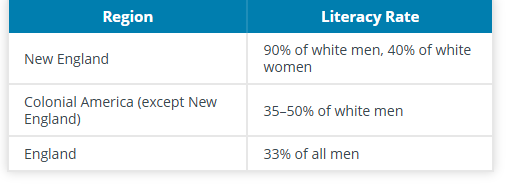
In the 18th century, literacy rates in the New England colonies were higher than in England.
New England had:
Higher literacy than the Middle Colonies
Much higher literacy than the Southern Colonies
High literacy helped spread Enlightenment ideas in colonial America.
Education and the Enlightenment
Education played a major role in the spread of Enlightenment thought from Europe to America.
Literate colonists could:
Read European Enlightenment works
Exchange ideas with thinkers across the Atlantic
This intellectual exchange strengthened Enlightenment influence in the colonies.
Who Was Educated?
Literacy was highest among white male colonists.
However:
A significant number of colonial women could read and write well enough to sign documents.
In the 18th century:
Being able to sign one’s name was considered literacy, unlike today’s standards.
Impact on Colonial Thinking
Educated colonists began to:
Question religious superstition
Challenge irrational traditions
This questioning mindset aligned with Enlightenment values of:
Reason
Logic
Critical thinking
Key Figure: Benjamin Franklin
Benjamin Franklin was a leading colonial supporter of Enlightenment ideas.
Promoted:
Education
Scientific inquiry
Reason over superstition
Served as a bridge between European Enlightenment thought and American society.
🔑 Big Picture (AP Focus)
High literacy → spread of Enlightenment ideas
Education enabled:
Political questioning
Religious tolerance
Intellectual independence
Enlightenment thought helped shape American identity before independence.
One-Sentence AP Summary
High literacy rates, especially in New England, allowed educated colonists such as Benjamin Franklin to engage with Enlightenment ideas, helping spread reason, science, and critical thinking throughout colonial America.
🧠 Benjamin Franklin — AP Enlightenment Study Notes
Role in the Enlightenment
Benjamin Franklin is often called the “spirit of the Enlightenment in America.”
One of the first Americans to:
Question irrational religious dogma
Promote scientific inquiry
Apply reason to improve everyday life
Believed knowledge should be useful and benefit society.
Early Life and Intellectual Growth
Born in Boston.
Moved to Philadelphia as a teenager.
Philadelphia’s rapid growth provided opportunities for:
Intellectual exchange
Social mobility
Sharing Enlightenment ideas
Intellectual Societies
Founded the Junto:
A discussion group for like-minded thinkers
Focused on ideas, self-improvement, and civic responsibility
Helped organize the American Philosophical Society in 1743:
Brought together leading colonial intellectuals
Focused on science, philosophy, and natural phenomena
Modeled after and communicated with the Royal Society in London
Poor Richard’s Almanack (1732)
Popular publication including:
Weather forecasts
Moon phases
Practical advice
Aphorisms (short sayings)
Made Franklin famous and financially successful.
Allowed him to devote his life to:
Public service
Scientific research
Science and Public Service
Franklin believed science and public service were connected.
Used scientific knowledge to:
Improve daily life
Increase comfort and efficiency
Embodied Enlightenment belief that reason can improve society.
Political Beliefs
Opposed:
Religious authoritarianism
Absolute monarchy
Supported:
Democratic institutions
Protection of natural rights
Strongly influenced by John Locke’s ideas.
Religious Beliefs (Deism)
Franklin identified as a deist.
Deism:
God created the universe
Universe operates according to natural laws
God does not actively intervene
Believed:
Morality comes from good works, not rituals
Faith and virtue are not dependent on organized religion
Deism gained support among several Founding Fathers.
🔑 Key Enlightenment Themes Represented by Franklin
Reason over superstition
Science for human benefit
Religious tolerance
Opposition to authoritarian power
Civic responsibility
.
🧠 Deism — AP Enlightenment Study Notes
Origins
Deism emerged during the Scientific Revolution (17th century).
Influenced heavily by Isaac Newton’s idea of an ordered, mechanistic universe.
Newton’s view suggested:
God created the universe
The universe operates according to natural laws
This led thinkers to seek a rational religion based on reason and observation.
Core Beliefs of Deism
God created the universe but does not actively intervene in it.
The universe functions according to natural laws.
God can be understood through:
Reason
Nature
Religion should emphasize:
Ethical living
Rational thought
Moral behavior
Relationship to Christianity
Deists were often culturally Christian, but:
Rejected orthodox doctrines
Questioned miracles and divine intervention
Believed God is rational, because He created a rational universe.
Understanding nature helps humans understand God’s design.
Enlightenment View of Religion
Just as reason explains physical laws, it can explain religious principles.
Faith should be guided by:
Logic
Evidence
Moral reasoning
Rejected blind acceptance of church authority.
Impact on the 18th Century
Deism challenged traditional religious beliefs.
Many Christians continued to follow orthodox Christianity.
Religious tension increased as Enlightenment ideas spread.
Connection to the Great Awakening
The Great Awakening emerged partly as a reaction to Enlightenment and Deist ideas.
Emphasized:
Emotional religious experience
Personal faith
Revival-style preaching
Reflected a pushback against overly rational approaches to religion.
🔑 Big Picture (AP Focus)
Deism represents the Enlightenment attempt to:
Reconcile religion with science
Separate faith from superstition
The Enlightenment and the Great Awakening developed simultaneously, shaping American religious and intellectual life.
One-Sentence AP Summary
Deism, influenced by Newtonian science, promoted a rational view of God as the creator of a universe governed by natural laws, challenging traditional religious doctrines and contributing to religious change during the Enlightenment.
🧠 The Great Awakening — AP Study Notes
Definition & Time Period
The Great Awakening was a Protestant religious revival.
Took place in the late 1720s–1730s.
Spread across Europe and colonial America.
Emerged partly as a reaction against Enlightenment rationalism.
Core Beliefs
Emphasized human sinfulness.
Stressed the need for:
Penance
Repentance
Salvation through faith
Believed salvation required:
Personal conversion
A direct relationship with God
Emotion vs. Reason (Key AP Contrast)
Great Awakening:
Appealed to emotion and feeling
Focused on spiritual rebirth
Enlightenment:
Appealed to reason and logic
Emphasized human improvement through education
The two movements represented opposing views of:
Human nature
Religion
The universe
Evangelicalism
The Great Awakening revived evangelical Christianity.
Evangelicals believed:
The Bible is the ultimate authority
Scripture is infallible
Faith must be personal and emotional
Rooted in the Protestant Reformation.
Salvation came through:
Personal faith
Acceptance of the Gospel
Spread and Social Impact
Strongest impact in New England.
Spread to:
Middle Colonies
Southern Colonies
Included:
Men and women
People from all social classes
Some African Americans and American Indians
Helped break down traditional religious hierarchies.
Preaching Style
Introduced a new, animated style of preaching.
Ministers were:
Charismatic
Emotional
Dramatic
Sermons emphasized:
Human sinfulness
Fear of damnation
Need for repentance
Preachers often:
Shouted
Wept
Used intense emotion to move audiences
Key Figures
George Whitefield (England)
Famous itinerant preacher
Jonathan Edwards (American colonies)
Known for sermons emphasizing sin and salvation
🔑 Big Picture (AP Focus)
The Great Awakening:
Challenged traditional church authority
Encouraged personal religious experience
Increased religious diversity
Alongside the Enlightenment, it shaped:
American views on faith
Individualism
Authority
One-Sentence AP Summary
The Great Awakening was an emotional Protestant revival that emphasized human sinfulness, personal conversion, and evangelical faith, standing in contrast to the Enlightenment’s focus on reason and rationality.
🧠 Jonathan Edwards — AP Great Awakening Study Notes
Background
Jonathan Edwards was a leading evangelical preacher in colonial America.
Educated at Yale.
Lived and preached in Massachusetts.
Credited with igniting the Great Awakening in the American colonies.
Core Beliefs
Salvation comes only through complete dependence on God’s grace.
Rejected the idea that:
Good deeds alone
Prayer alone
could lead to salvation.
Emphasized true conversion and total faith in God.
Famous Sermon
“Sinners in the Hands of an Angry God”
One of the most famous sermons in American history.
Warned sinners of God’s wrath and the dangers of damnation.
Famous imagery includes:
Sinners compared to a spider dangling over a fire
Humans described as:
“dry stubble before devouring flames”
“light chaff before the whirlwind”
Purpose:
Instill fear of damnation
Encourage repentance and conversion
Use of Imagery
Edwards used vivid, frightening imagery to:
Emphasize human sinfulness
Show the fragility of human life
Imagery made sermons:
Emotionally powerful
Memorable
Persuasive
Audience Reaction
Sermons caused intense emotional responses, including:
Shouting
Crying
Barking
Rolling on the floor
Reflected the emotional nature of the Great Awakening.
Preaching Style
Despite emotional content:
Edwards himself spoke calmly and quietly
Contrasted with George Whitefield, who preached in a loud, dramatic style.
Showed that emotional impact came from ideas and imagery, not volume.
🔑 Key Great Awakening Themes Represented by Edwards
Human sinfulness
Fear of damnation
Necessity of repentance
Emotional religious experience
Personal conversion
🧠 George Whitefield — AP Great Awakening Study Notes
Background
George Whitefield was a British revivalist preacher.
Toured the American colonies from 1739 to 1741.
One of the most influential evangelists of the Great Awakening.
Preaching Style
Known for an emotional, dramatic, and theatrical preaching style.
His sermons often:
Reduced audiences to tears
Led listeners to confess their sins publicly
Even Jonathan Edwards is known to have wept during Whitefield’s sermons.
Inspired many American ministers to:
Imitate his dramatic delivery
Use emotional and confrontational techniques
Core Religious Beliefs
Taught that salvation comes through:
God’s grace
Emotional conversion
Believed true salvation required being emotionally moved during conversion.
Emphasized:
Love for Jesus
Hope and redemption
Proclaimed that all who truly loved Jesus would enter the kingdom of God.
Impact on Colonial America
Drew thousands of colonists to revival meetings.
Led to dramatic increases in church membership:
In Connecticut, membership increased to 3,217 (fivefold growth).
Helped spread the Great Awakening across regional boundaries.
Influence Beyond Religion
Whitefield’s preaching affected even Enlightenment thinkers.
Benjamin Franklin, though a rationalist, was deeply moved by Whitefield:
Donated money spontaneously after a sermon in Philadelphia (1740).
Demonstrates how emotional revivalism could transcend intellectual divides.
🔑 Key Great Awakening Themes Represented by Whitefield
Emotional religious experience
Evangelical preaching
Personal conversion
Religious inclusivity
Mass religious participation
One-Sentence AP Summary
George Whitefield was a charismatic revivalist whose emotional preaching during the Great Awakening inspired mass conversions, increased church membership, and influenced colonists across social and intellectual boundaries.
🧠 Enlightenment vs. Great Awakening — AP Study Notes
Reaction to the Enlightenment
The Enlightenment introduced new ideas about:
Religion
Morality
Reason and rational thought
Not all people accepted these rational ideas.
For some, Enlightenment thinking created a spiritual void.
Rise of Revivalism
The spiritual void was filled by Great Awakening revivalists.
Revivalists used:
Emotional sermons
Religious theatrics
Focused on personal religious experience.
Core Revivalist Beliefs
Salvation could be achieved through:
Personal conversion
Repentance
Emphasized individual responsibility for faith.
Appeal of the Great Awakening
The promise of salvation was especially appealing to:
Ordinary colonists
People facing hardship and survival struggles
Offered:
Hope
Emotional comfort
A sense of spiritual meaning
🔑 Big Picture (AP Focus)
The Enlightenment and Great Awakening developed side by side.
Represented different responses to religion:
Enlightenment → reason and logic
Great Awakening → emotion and faith
Both shaped colonial American identity.
One-Sentence AP Summary
As Enlightenment rationalism challenged traditional religion, the Great Awakening emerged to fill a spiritual void by emphasizing emotional conversion, repentance, and personal salvation.
🧠 Old Lights vs. New Lights — APUSH Study Notes
Division Caused by the Great Awakening
The Great Awakening split American Protestants into two groups:
New Lights
Old Lights
This division reshaped religious life in the colonies during the 1740s.
🔹 Old Lights
Opposed the Great Awakening
Supported:
Traditional, established forms of worship
Rational, orderly religion
Believed revivalist emotion was:
Excessive
Dangerous
Irrational
Often part of the religious elite
Key figure:
Charles Chauncy (Boston)
Criticized revivalist theatrics
Warned against mistaking emotional excitement for divine grace
🔹 New Lights
Supported the Great Awakening
Emphasized:
Emotional preaching
Personal conversion
Religious enthusiasm
Welcomed:
All social classes
All races
Criticized Old Lights as:
Elitist
Spiritually empty
Key figures:
Gilbert Tennent
James Davenport
Gained support among:
Poor
Oppressed
Ordinary colonists
🔹 Colonial Religious Landscape (Before the Awakening)
Anglican Church:
Delaware, Maryland, Virginia, Carolinas
Congregationalists:
New England
Dutch Reformed & Anglican:
New York
Quakers:
Pennsylvania
🔹 Conflict and Consequences
Deep divisions within Protestant churches
Formation of rival religious groups
In 1741, Presbyterians split into two factions
Reunited in 1758 with acceptance of New Light ideas
Old Light churches:
Lost members to New Lights
Tried to block new churches legally
In some colonies (e.g., Connecticut):
Revivalists were barred from preaching
Old Lights controlled church taxes
🔹 Long-Term Impact
New Lights continued to grow despite resistance
Conversions peaked by 1755
Encouraged:
Religious pluralism
Challenges to authority
Individual choice in religion
Helped shape American values of independence and equality
🔑 Big Picture (AP Focus)
Old Lights vs. New Lights reflects:
Emotion vs. reason
Tradition vs. change
Authority vs. individual experience
Set a precedent for questioning established authority in America
One-Sentence AP Summary
The Great Awakening divided colonial Protestants into Old Lights, who favored traditional rational religion, and New Lights, who embraced emotional revivalism and personal conversion, reshaping American religious life.
🧠 Education and the Great Awakening — APUSH Study Notes
Educational Impact of the Great Awakening
The Great Awakening sparked not only religious revival but also an educational revival.
Education already thrived in New England, especially for boys.
Religious divisions between Old Lights and New Lights increased the demand for separate institutions of higher learning.
Religion and Higher Education
In the 18th century, colleges focused primarily on:
Religious studies
Training ministers
Different denominations wanted colleges that reflected their own beliefs.
This led to the founding of several new colleges in the colonies.
🏫 Colleges Founded During the Great Awakening
New Light–Associated Colleges
College of New Jersey (1746) → Princeton University
Founded by New Lights
College of Rhode Island (1764) → Brown University
Founded by Baptists
Queen’s College (1766) → Rutgers University
Founded by the Dutch Reformed Church
Other Denominational Colleges
King’s College (1754) → Columbia University
Founded by Presbyterians
Harvard College (1636)
Supported by Old Lights
Yale College (1701)
Supported by Old Lights
Founded by Puritan sects
Purpose of Colonial Colleges
Primary goal:
Training ministers
Secondary effects:
Spread of literacy
Growth of educated leadership
Expansion of intellectual life in the colonies
🔑 Big Picture (AP Focus)
The Great Awakening:
Increased religious diversity
Encouraged educational expansion
Colleges reflected:
Religious competition
Growing importance of education
These institutions later became major centers of American higher education.
One-Sentence AP Summary
The Great Awakening encouraged the growth of colonial higher education as competing religious groups founded colleges to train ministers and promote their own beliefs.
🧠 Social Impact of the Great Awakening — APUSH Study Notes
Impact Beyond Religion
The Great Awakening affected not only churches but also:
African Americans
American Indians
Women
It expanded participation in religious life beyond white male elites.
🔹 African Americans
Both free and enslaved African Americans converted to Protestant Christianity.
Many joined white churches during the revival.
Christianity offered:
Spiritual hope
A sense of community
Despite religious participation:
African Americans continued to face social and religious discrimination.
🔹 American Indians
Some American Indians converted to Christianity.
Samson Occom:
A Mohegan Indian
Converted to Christianity
Became a preacher
Taught Christian principles to other American Indians
Conversion did not eliminate discrimination or unequal treatment.
🔹 Women
The Great Awakening expanded women’s roles in religious life.
Women:
Participated more actively in church affairs
Could vote in certain church meetings
Some women moved beyond private prayer groups:
Spoke publicly in meetings
Led mixed-gender religious gatherings
Example
Sarah Osborn (Rhode Island):
Founded a prayer society in her home
Included:
Men and women
Enslaved African Americans who converted to Christianity
🔑 Limits of Change
Despite increased participation:
Women, African Americans, and American Indians still faced:
Social inequality
Legal restrictions
Discrimination
The Great Awakening offered spiritual inclusion, not full equality.
🔑 Big Picture (AP Focus)
The Great Awakening:
Encouraged broader participation in religion
Challenged traditional social hierarchies
Reinforced ideas of individual spiritual worth
Helped plant early ideas about equality and inclusion, even if imperfectly realized.
One-Sentence AP Summary
The Great Awakening expanded religious participation among African Americans, American Indians, and women, increasing their roles in spiritual life while leaving broader social inequalities largely intact.