week 5 flashcards
Theory of Mind
The ability to reason about others' mental states and recognize that these states can differ from one's own.
Autism
Characterized by challenges with social interaction.
Affects about 1% of the population.
A lifelong neurodevelopmental condition.
Some individuals may have learning difficulties, but around 40% possess average to above-average IQ.
Difficulties in understanding others' thoughts and feelings.
Typical Development of Theory of Mind
Typically developing infants show an innate preference for social stimuli.
The earliest indication of Theory of Mind (ToM) appears as 'joint attention' around 18 months.
Development of Theory of Mind
By ages 6-7, neurotypical children begin to understand humor and when someone is joking.
By ages 9-10, they can interpret mental states by analyzing others' eyes.
Those with autism often experience challenges in these areas.
Types of Theory of Mind (Baron-Cohen, 2009)
Cognitive ToM: The ability to recognize another person’s mental states.
Affective ToM: The capacity to have appropriate emotional reactions to others' thoughts and feelings (empathy).
Theories of Theory of Mind
Modularity Theory: Suggests that ToM is driven by innate neural mechanisms present from birth that develop through childhood.
Simulation Theory: Involves placing ourselves in others' 'mental shoes' and responding to those experiences.
Neural Basis of Theory of Mind
Superior Temporal Sulcus (STS): Plays a vital role in detecting biological motion, including eye gaze direction.
Medial Prefrontal Cortex (MPFC): Involved in reasoning about others' mental states in relation to oneself.
Superior Temporal Sulcus and Eye Gaze
STS is activated by observing gaze shifts in all participants (both autistic and non-autistic).
Non-autistic individuals show greater activation during incongruent trials, whereas autistic individuals show no difference between trials.
Summary of STS
Activated by biological motion and eye gaze direction.
Interprets gaze stimuli concerning whether it is goal-oriented or non-goal-oriented. In individuals with autism, while the STS still responds to gaze cues, it does not differentiate between the types of goal orientation.
Medial Prefrontal Cortex (MPFC)
Subdivided into dorsal MPFC and ventral MPFC.
Evidence from studies indicates it is activated when reasoning about others' mental states in relation to oneself.
MPFC - Mental State Attribution
Research (Mitchell et al., 2004) shows MPFC activation when forming impressions about others, based on personality judgment or recalling the presentation of statements.
Autism and Self vs. Other Thinking
ToM requires shifting perspectives from self to others.
Autistic individuals do not show the same differential activation in the vMPFC between self-oriented and other-oriented judgments as neurotypical participants.
Summary of MPFC
Involved in reasoning about others in relation to oneself more broadly, supporting aspects of simulation theory. In autism, the MPFC may not differentiate self from other perspectives to the same extent, and stimulating this area may improve ToM in autistic childre
Four domains of impairment:
Emotional
Behavioural
Cognitive
Interpersonal
What causes BPD?
Heritability of 42-67%
Very high comorbidity with other disorders, e.g. depression, anxiety (around 80%)
Environment is important
Early trauma very common in BPD
Genetic and environmental influences interact
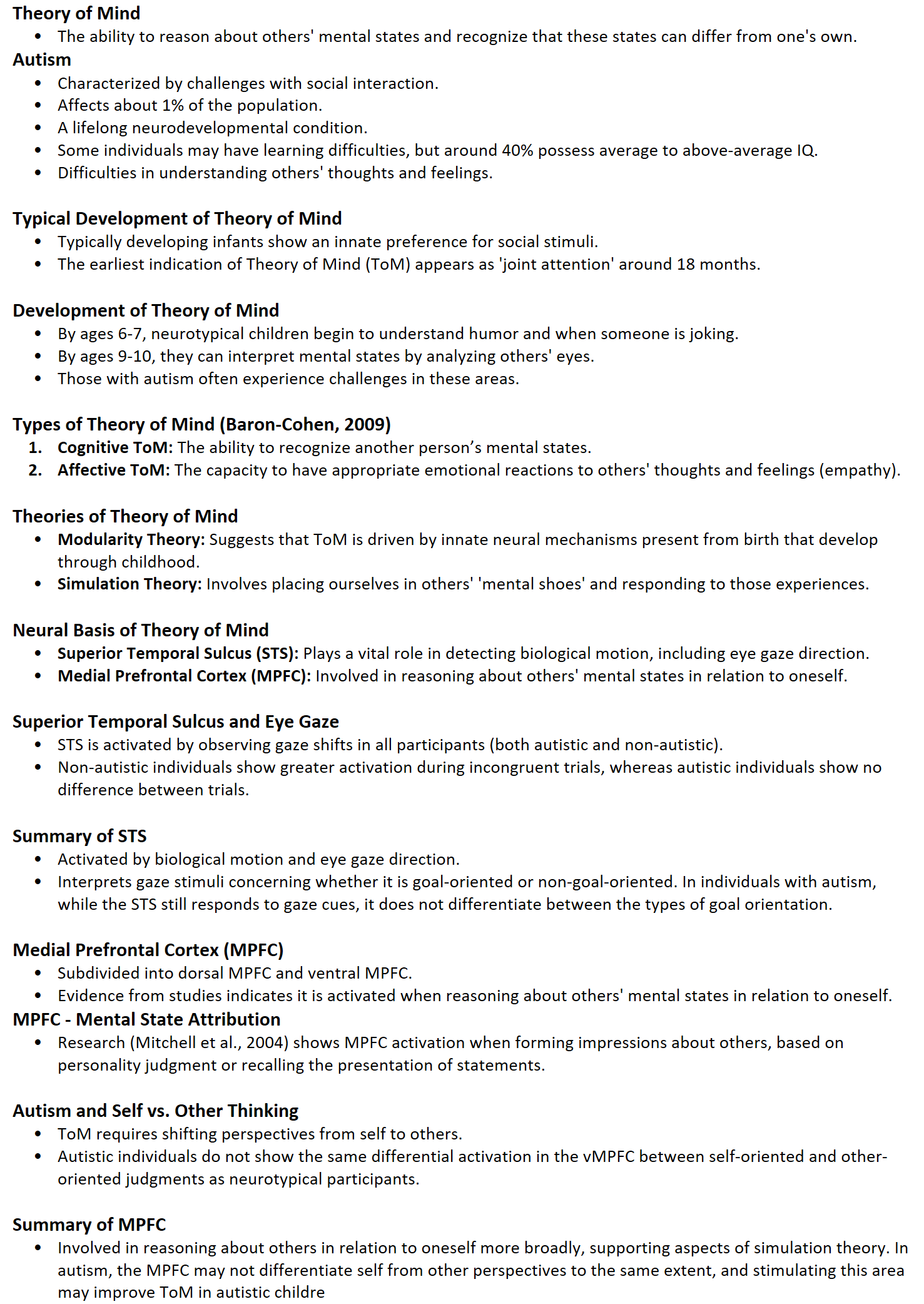
Biosocial Model
Acknowledges biological predispositions and interactions with developmental environment in bringing about BPD
Neural Regions and BPD
3 structures involved in the symptoms of emotional sensitivity and impaired ToM in BPD:
Amygdala
Insula
Superior temporal sulcus
Amygdala
Key to emotional functioning
Part of limbic system
Highly interconnected with sensory, motor, association and cortical areas
STS and Insula
Involved in emotional processing, located under the lateral sulcus, below the STS
Amygdala Hyperactivity in RMTE task
Reading the mind in the eyes task- ToM/emotion recognition
Compared behavioural and neural responses using fMRI between BPD patients and controls (HCs)
Compared accuracy, reaction time and BOLD signals using fMRI between negative, neutral and positive images, between groups
Role of arousal and ecological validity
In BPD there was emotional sensitivity and increased accuracy in some mentalizing and emotional recognition tasks
Studies which tested mentalizing under high ecological V have shown hypementalizing responses, a form of ToM impairment
SUMMARY + CONCLUSIONS
BPD is associated with emotional sensitivity and interpersonal dysfunction.
Hypermentalizing is a form of cognitive impairment seen in BPD where people incorrectly interpret the actions of others with a negative bias (sometimes called excessive ToM)
Studies show in BPD there is an increased activity in “limbic” structures– the amygdala and the insula in response to tasks involving thinking about the emotions of others
And differences in activity in key ToM structure, the STS, during empathy tasks
Excessive emotional sensitivity and reduced accuracy in ToM is suggested to contribute to the interpersonal difficulties in BPD,