Microbe-Host Interactions Study Guide
1. Explain the difference between contamination, infection, and disease. Describe a scenario
for all three terms.
Contamination: Pathogens are introduced to your body but are not replicating ( Ex: Your friend coughs on you while you are talking to them)
Infection: Pathogens are replicating on/inside your body (Ex: Bacteria from respiratory droplets gets in your mouth and begin to replicate)
Disease: The body deviates from what is normal ( Ex: In two days you wake up with a sore throat)
2. Explain how we acquire our normal microbiota along with its benefits and potential
disadvantages.
Resident: Part of our normal microbiota (In respiratory, GI, genitourinary tracts)-they help us by preventing growth of harmful organisms via microbial antagonism
Transient: These microbes get on body surfaces through daily behaviors (Organisms you touch while you work, tough countertops or restroom doors)
3. Explain what is meant by “opportunistic pathogens” and how a normally harmless
organism can become problematic.
These are microbes that are normally harmless but can cause chaos if the opportunity arises (S. aureus, E. coli, C. albicans)
4. Define pathogenicity and virulence. Why should these terms not be used
interchangeably?
Pathogenicity: Can/Does the organism cause disease? (Yes or No)
Virulence: The degree to which an organism causes disease Spectrum of pathogenicity
Just because something can cause disease doesn’t mean its virulent
5. What is a virulence factor? Give examples of some common virulence factors used by
bacteria and viruses.
Virulence factors are molecules that help it takeover and multiply within a host
(Ex: Exotoxin)
6. List and describe the steps a microbe must progress through to cause disease in a host.
a. What are the portals of entry? Which is most common?
Most common portals of entry are skin, GI tract, Urogenital tract, respiratory tract, and parenteral
b. List and describe the different modes of transmission. Give examples of each.
Indirect: Through a fomite (Kleenex) or Vehicle (Soil, water, air, food)
Direct: Through Respiratory (coughing), horizontal or direct contact (kissing), and vertical. Vertical transmission can be prenatal (crosses placenta such as with Zika) or perinatal (through birth canal such as with an STI)
Vector: Through Biological (mosquito) or mechanical (fly) means
Parenteral: Through a needle/nail, has to penetrate the skin.
c. What are the different ways bacteria and viruses can attach and invade a host? of attachment?
Bacteria
Adhesins such as capsules, pili, and fimbriae
Virus
Docking proteins (Capsid and envelopes)
d. What strategies do microbes use to cause disease?
They can use enzymes
They can enter & multiply within cells

They can enter under what is known as a “Trojan horse” where they enter a cell via a phagosome and before being degraded by the lysosome they escape within the cell
e. What are some strategies bacteria use to get past the host’s defenses?
They can use antigenic variation which changes the surface molecules of the bacteria to evade recognition
They can use exoenzymes such as Protease, Leukocidins, Hemolysins, coagulase, Hyaluronidase, and Kinase
They can inhibit the complement system, preventing opsonization and lysis of bacterial cells
They can use sticky capsules which makes it harder for immunes system to get rid of bacteria
They can survive inside of phagocytes by breaking free from them as well as prevent phagolysosome formation
They can form biofilm which provides protection for the bacteria
They can use their flagella to outrun phagocytes
f. How do microbes exit the body?
They can exit through the Respiratory tract (cough or sneeze)
They can exit through the Genitourniary tract (STI/STD)
They can exit through the Gastrointestinal tract (anus/defecation)
They can exit through the skin (open lesions)
They can exit through the blood (vectors or direct contact).
7. Compare and contrast endotoxins and exotoxins.
Exotoxins | Characteristics | Endotoxins |
Low | LD50 | High |
Varies | Effects on the body | Fever, malaise |
Proteins | Chemical composition | Lipopolysaccharides (LPS) |
Yes | Heat denaturation | No |
Yes | Toxoid formation | No |
Yes | Immune response | No |
No | Fever stimulation | Yes |
Secreted | Manner of release | None (lyses) |
G(+) & some G(-) | Typical sources | G(-) |
8. List and describe examples of exoenzymes used by bacteria to weaken a host.
Coagulase: An enzymes that induces coagulation which the bacteria can use to protect themselves from phagocytes
Protease: They destroy proteins
Leukocidins: They target and damage white blood cells
Hyaluronidase: This breaks down hyaluronic acid which is the “glue” that holds the cells together
Streptokinase: Can break down clots after the bacteria is done hiding within the clot
Hemolysins: Destroy red blood cells (RBC)
9. Describe the various ways we can classify infections
Localized: Microbe is confined to one location upon entering the body
Systemic: Infection spreads to several sites and tissue fluids, usually in the bloodstream
Focal: Infection agents breaks loose from local infection & is carried to other tissue
Mixed infection: Several agents establish themselves simultaneously at the infection site (at the same time)

Primary & Secondary infections: The initial infection (Primary infection). A secondary infection occurs when a primary infection is complicated by another infection caused by a different microbe. These are one after the other and do not occur at the same time.

Acute infections: Come on rapidly and goes away quickly
Chronic infections: Progress and persists over a long period of time
Latent Infection: Characterized by a period of inactivity
10. Explain the difference between a sign and a symptom. Give common examples of signs
Sign: Any objective evidence of disease as noted by an observer (Fever, septicemia, chest sounds, skin eruptions)
Symptoms: Subjective evidence of disease as sensed by the patient (Chills, pain, malaise, fatigue, itching)
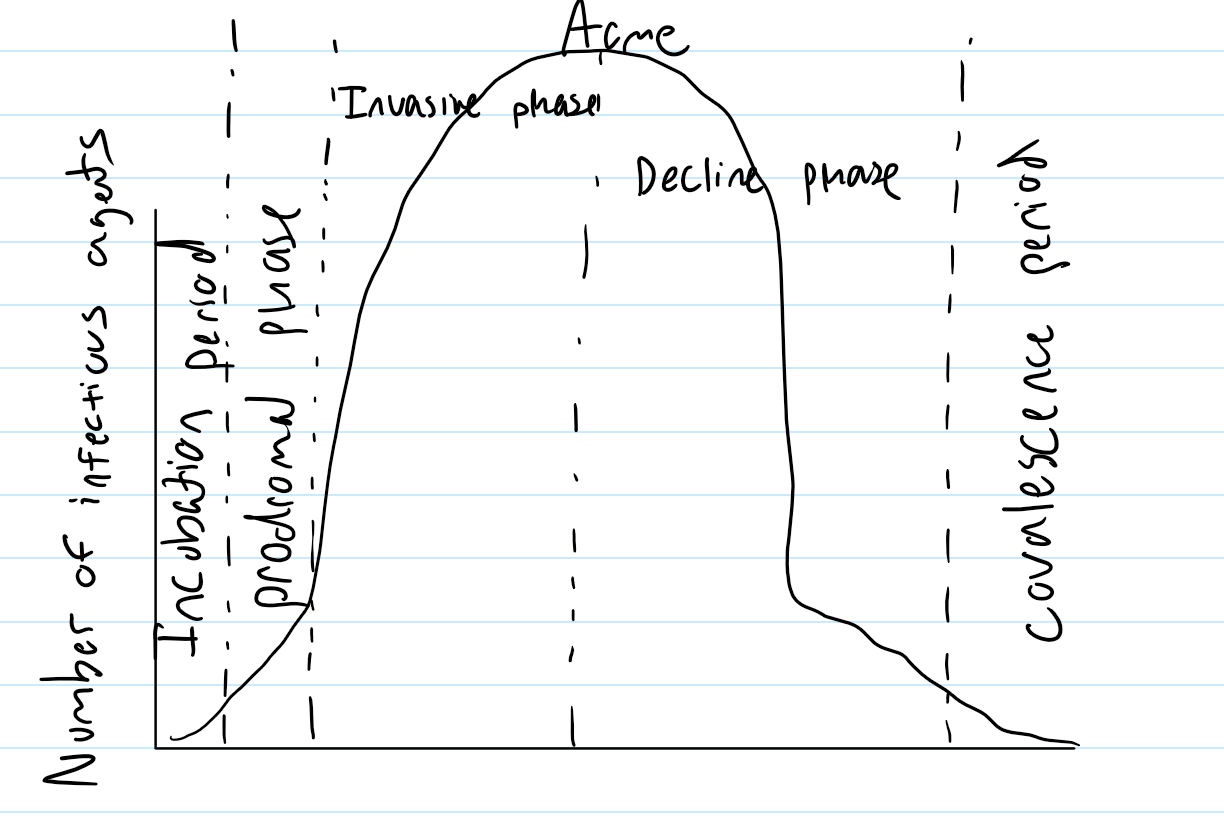
11. Describe the phases of an infection. Be able to sketch this information too.
Incubation period: The time from initial contact with the infectious agent to the appearance of first symptoms
Prodromal phase: When the earliest notable symptoms of infection appear (feeling off)
Invasive phase: Infectious agent multiplies at high levels & exhibits its greatest virulence (Most severe signs and symptoms)
Acme: The stage at which the disease reaches its peak intensity
Decline phase: Signs and symptoms begin to subside & number of pathogens decrease
Convalescent phase: Patient responds to infection and symptoms decline.