RTVF Mid-term
Complex Technology:
-Film is heavily reliant on complex technology. Without machines, moving pictures would not exist.
-Film making is a collaborative process involving many participants working within established routines.
The Socio-economic context of film:
-Film is deeply intertwined with it’s social and economic context. The distribution of films are for audiences are driven by financial considerations at every stage. The business side of cinema significantly shapes and sustains film as an art.
Films impact of viewers:
-Films are offering unique experiences for viewers
-These experiences are carefully designed to evoke specific emotions and responses.
Series of choices:
-Film making is a series of choices. so many decisions to make when filming a movie.
Evolution of film making:
-Movie pictures emerged in the late 19th century as a popular form of entertainment.
Form in film:
-Film is not a random collection of elements, but a carefully constructed pattern designed to engaged the audience.
Deliberate Form:
-Film makers design their works to create a structured experience for the audience.
-This involves establishing patterns, setting up expectations, and using various cinematic techniques to guide the viewers attention and emotion.
Form Defined:
-The overall sets of relationships among a films parts.
Content VRS Form:
-All elements, including subject matter and abstract ideas function as part of the overall formal pattern.
Expectations:
-Exceptions play a crucial role in how viewers engage with a film.
Prior Experience:
-Viewers draw on their prior experience, including knowledge of conventions, to understand and interpret a film.
Emotional response:
-Form shapes the spectators emotional response. Film makers can appeal to ready-made emotional responses or create new responses by manipulating formal patterns.
Meaning in film:
-1: “Referential meaning” refers to tangible things or places already invested with significance in the real world.
-2: “Explicit Meaning” an openly asserted meaning or point that the film seems to be trying to get across.
-3: “Implicit meaning” a suggested meaning that is not stated directly but can be inferred from the films overall form.
-4: '“Symptomatic meaning” reveals a set of social values or ideology characters of a particular society.
Principles of films form:
-1 “Function” every element in a film fulfills specific purposes within the larger whole.
-2 “Similarity and repetition” the repetition of elements such as motifs, patterns, and satisfies formal expectations.
-3 “Deference and variation” changes variations in elements, creates contrast, and maintains viewers interest.
-4 “development” principles of development play similar and different elements within a patter of change.
-5 “Unity and disunity” unity refers to the coherence and interwoveness of all relationships within a film while disunity refers to elements that seem superfluous or unexplained.
~Mise-en-scene~
-Of all film techniques, mise-en-scene is one that viewers notice most.
-Many of our most vivid memories of movies stem from mise-en-scene.
-It’s those smart artistic elements in a film setting, lighting, costume, make-up, staging, and performance.
-Film makers can use mise-en-scene to achieve realism giving settings an authentic look or letting actors perform as naturally as possible.
-Elements of Mise-en-scene fulfill a purpose.
Some general areas of mise-en-scene:
-Setting
-Costumes
-Make-up
-Lighting
-Staging
-Acting/movement in the shot
-Shadowing
-Highlights
-Costumes
-Color
-Props
-The arrangement of scenery and stage properties in a play
Blocking
-Setting
note: color is important to setting.
Motifs:
-A specific person, place, or thing that’s a main thing that pops up regularly in a film.
~Three-Point Lighting~
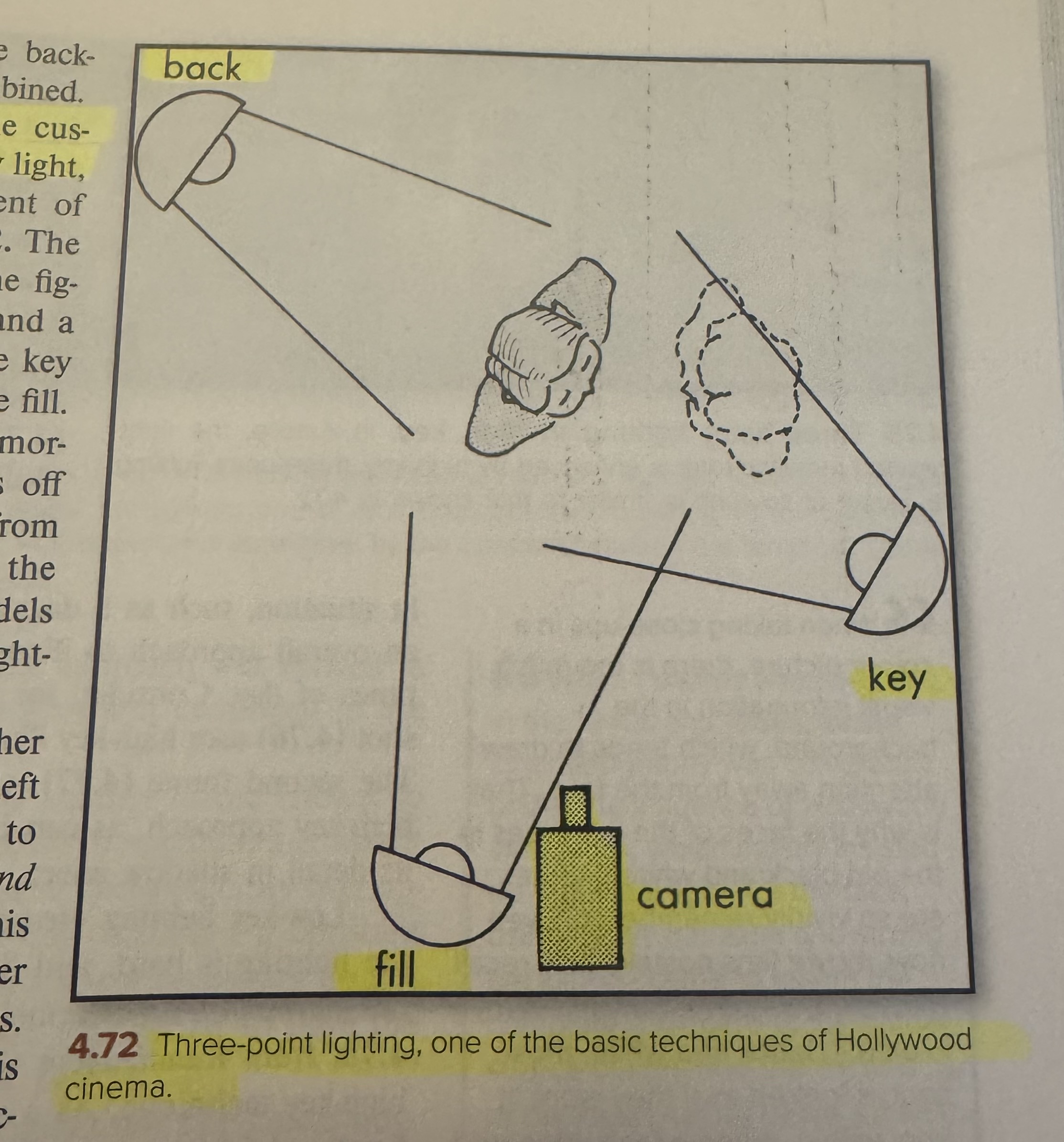
-Classical Hollywood filmmaking developed the custom of using at least three light sources per shot: Key Light, Fill Light, and Back Light.
-Common lighting technique that uses three sources of lighting:
key lighting (to illuminate an object), backlighting (to pick out the object from the background), and fill lighting (to minimize shadows).
Highkey Lighting:
-Using Fill light, and Back Light to create relatively low contrast between bright and darker areas. (Natural Day time lighting)
Low key Lighting:
-Creates stronger contrasts and sharper darker shadows. (More shadowy)
Lighting Note:
-Surprisingly often Directors decide to maintain a constant lighting on the actors as they walk, even though that’s not quite realistic.
~Actors are a huge part of Mise-en-scene~
-Because the performance an actor creates is part of the overall mise-en-scene, films contain a wide variety of acting styles.
-In terms of mise-en-scene, the actor’s are always part of the overall visual design.
-Actors have to pay attention to the tiniest things in their acting performances. To eye contact, face twitch, blinking, body posture. Down to every detail of how that character would act.
Size Diminution:
-Figures and objects farther away from us are seen to get proportionally smaller.
Shallow Space Composition:
-The closest and most distant planes seem only slightly separated.
Deep Space Composition:
-Making the foreground plane quite larger and the background plane distant.
Understanding the Impact of Social Media on Political Polarization
Social media platforms have become integral to modern political discourse, but their influence on political polarization is a complex and debated topic. This summary explores the main arguments and key findings regarding this relationship, aiming to provide a balanced educational overview.
The Role of Echo Chambers and Filter Bubbles
echo chambers and filter bubbles: These occur when algorithms prioritize content that aligns with a user's existing beliefs, limiting exposure to diverse perspectives.
- Echo chambers: Reinforce pre-existing biases by creating environments where individuals primarily encounter information confirming their viewpoints.
- Filter bubbles: Isolate users from opposing viewpoints through algorithmic curation, potentially leading to increased polarization.
This selective exposure can lead to a distorted perception of the political landscape, making individuals believe their views are more widely shared than they actually are, and intensifying their commitment to those beliefs.
The Spread of Misinformation and Disinformation
Social media's ease of sharing and rapid dissemination also contributes to the spread of misinformation and disinformation.
- Misinformation: Inaccurate information shared unintentionally, often due to a lack of fact-checking.
- Disinformation: Deliberately false or misleading information intended to deceive or manipulate public opinion.
The viral nature of social media allows false narratives to spread quickly and widely, potentially influencing political attitudes and behaviors. This can exacerbate existing divisions and create new sources of conflict.
The Impact of Online Anonymity and Incivility
The relative anonymity afforded by some social media platforms can lead to increased incivility and aggression in political discussions.
- Anonymity: Reduces accountability for online behavior, leading to more hostile and polarized interactions.
- Incivility: Discourages constructive dialogue and reinforces negative perceptions of opposing viewpoints.
This toxic online environment can further alienate individuals from different political perspectives, contributing to a climate of distrust and animosity.
Nuances and Counterarguments
It's important to acknowledge that the relationship between social media and polarization is not always straightforward. Some research suggests that social media can also expose individuals to diverse perspectives and facilitate political engagement.
1. Exposure to diverse views: Can challenge pre-existing beliefs and promote a more nuanced understanding of complex issues.
2. Political engagement: Can mobilize individuals to participate in political activities and advocate for their beliefs.
-However, the extent to which these positive effects outweigh the negative consequences of echo chambers, misinformation, and incivility remains a subject of ongoing debate.
-While social media offers potential benefits for political discourse, its role in fostering echo chambers, spreading misinformation, and promoting incivility raises serious concerns about its impact on political polarization. Understanding these dynamics is crucial for promoting a more informed and constructive public sphere.
Cinematography: Crafting the Visual Language of Film
Cinematography, literally "writing in movement," is the art and technique of capturing a moving image. It encompasses all the decisions a filmmaker makes about how an event is recorded, from the photographic qualities of the shot to the framing and movement of the camera. These choices are driven by a single concern: how will this creative decision affect the viewer?
### The Photographic Image
Cinematography depends heavily on photography, or "writing in light." Filmmakers control the range of tonalities, manipulate the speed of motion, and transform perspective.
*Tonality:** This refers to how light registers on the film, and is influenced by lighting and contrast.
*Contrast** is the difference between the darkest and lightest areas of the frame. High contrast images are stark and dramatic, while low contrast images are more muted.
*Exposure:** This regulates how much light passes through the camera lens. Images can be underexposed (too dark) or overexposed (too bright).
*Filters:** These alter the range of tonalities by reducing certain light frequencies.
*Color:** Manipulating color, either during filming or in post-production, can dramatically alter the mood and impact of a scene.
### Perspective and Lenses
The choice of lens significantly impacts how perspective is rendered in a film.
*Wide-angle lenses** (short focal length) exaggerate depth and distort straight lines.
*Normal lenses** (medium focal length) aim for a realistic perspective without noticeable distortion.
*Telephoto lenses** (long focal length) flatten space and make objects appear closer together.
*Zoom lenses** offer variable focal lengths, changing perspective during a shot.
*Depth of field** is the range of distances within which objects are in sharp focus. Selective focus isolates one plane, while deep focus keeps multiple planes sharp.
### Framing and Camera Movement
Framing involves defining onscreen and offscreen space, and camera position affects angle, level, height, and distance.
*Camera angles** can be straight-on, high, or low.
*Camera level** can be level or canted (tilted).
*Camera distance** ranges from extreme long shot to extreme close-up.
Camera movement adds dynamism and can reveal new information.
*Panning** swivels the camera horizontally.
*Tilting** swivels the camera vertically.
*Tracking** moves the camera along the ground.
*Crane shots** move the camera above ground level.
*Zooming** changes the focal length without moving the camera.
### Duration and Special Effects
The duration of a shot, or how long it lasts, is another crucial element.
*Long takes** can create suspense, establish geography, and reveal character relationships.
*Special effects,** including superimposition, rear projection, matte work, and CGI, can manipulate perspective and create impossible scenarios.
-Cinematography is a powerful tool for filmmakers, allowing them to shape the viewer's experience through careful control of photographic qualities, framing, camera movement, and duration. By understanding these techniques, viewers can gain a deeper appreciation for the art and craft of filmmaking and how visual storytelling contributes to the overall impact of a film.
Understanding Film Editing: A Comprehensive Overview
This chapter explores the crucial role of editing in filmmaking, highlighting its power to manipulate time, space, and pictorial qualities to shape the viewer's experience. While some overemphasize editing's importance, it remains a fundamental technique, capable of creating impactful moments and influencing a film's overall form.
The Essence of Editing:
Editing involves selecting and arranging shots, joining them through cuts, fades, dissolves, or wipes. A cut is an instantaneous change, while fades, dissolves, and wipes offer more gradual transitions. Filmmakers meticulously plan the editing phase, utilizing scripts, storyboards, and previsualizations. Documentary filmmakers often gather extra footage for transitions and linking sections.
Manipulating Time and Space:
-Editing allows filmmakers to control the order, duration, and frequency of events.
- Order: Filmmakers can manipulate chronology through flashbacks and flashforwards, disrupting the 1-2-3 sequence of events.
- Duration: Elliptical editing condenses time, while overlapping editing expands it.
- Frequency: Actions can be repeated for emphasis, though this is less common.
Continuity Editing: A Dominant Style:
Continuity editing aims to transmit narrative information smoothly and clearly.
- Graphic qualities are kept roughly continuous.
- Rhythm is adjusted to the scale of the shots.
- Space is built around the axis of action, maintaining consistent screen direction and eyelines.
- The 180° system ensures consistent relative positions and screen direction.
- Shot/reverse-shot patterns and eyeline matches are common tactics.
- Match-on-action carries a single movement across a cut.
- Reestablishing shots reaffirm the overall space.
Fine Points of Continuity Editing:
- Characters in a circle: The axis of action shifts based on the characters involved.
- Deleting the establishing shot: The Kuleshov effect can be utilized.
- Cheating with cuts: Slight mismatches are permissible if narrative motivation is strong.
- Crossing the axis: Can be done legitimately with head-on or tail-on shots.
- Point of view (POV) shot: Consistent with continuity editing, creating subjective narration.
Crosscutting for Omniscience
Crosscutting: alternates shots of story events in different places, clarifying conflict and building tension. It can also highlight parallels between characters or situations.
Intensified Continuity: A Modern Approach
Intensified continuity amplifies classical continuity principles with:
- Faster cutting.
- Closer views.
- Telephoto lenses.
- More frame mobility.
Alternatives to Continuity Editing:
Filmmakers have explored alternative approaches, emphasizing graphic and rhythmic dimensions.
- Graphic and rhythmic possibilities: Abstract or associational forms prioritize graphic and rhythmic qualities.
- Spatial and temporal discontinuity: Violations of the 180° system, jump cuts, and nondiegetic inserts can create ambiguous relations among shots.
Eisenstein's Discontinuity Editing:
-Eisenstein sought to go beyond continuity editing, using clashes from shot to shot to engage the spectator actively. Discontinuities of space and time could stir emotions and spur reflection.
-editing is a multifaceted technique offering a wide range of creative choices. While continuity editing remains dominant, alternatives exist, each with the power to shape the viewer's experience and convey meaning in unique ways.
The three Ratios films use:
-Academy Ratio
-U.S Widescreen
-Cinemascope
Extreme long shot:
-A shot that is framed from a comparatively greater distance than a long shot; the surrounding space dominates human figures.
Long shot:
-A shot that places considerable distance between the camera and the scene, object or person being filmed so that the object or person is recognizable but is defined by the large space and background.
Medium long shot:
-A shot that slightly increases the distance between the camera and the subject compared to the medium shot, showing a three quarter length view of a character. (From approximately the knees up).
Medium shot:
-A shot that is a middle ground framing in which we see the body of a person from approximately the waist up.
Medium close up:
-A shot that shows a character’s head and shoulders.
A close up:
-A shot that is framed that shows the details of a person, an object, such as the face or hands, alongside other objects.
Extreme close up:
-A shot that is framed comparatively tighter than a close u, singling out, for instance, an insect or a hand.
High angle shot:
-A shot that is directed at a downward angle on individuals or a scene.
Low angle shot:
-A shot from a camera angle positioned low on the vertical axis, anywhere below the eye line, looking up. Sometimes it is even directly below the subject’s feet.
Canted angle shot:
-A type of camera shotwhere the camera is set at an angle on its roll axis so that the shot is composed with vertical lines at an angle to the side of the from, or so the horizon line of the shot is not parallel with the bottom camera frame. This produces a viewpoint akin to tilting one’s head to the side.
Main different camera movements:
- Pans (left & right)
-Tilts (up & down)
-Tracking/Dolly
-Crane Shot
Depth of field
-The distance between the nearest and furthest objects that give an image judge to be in focus in a camera.
Some 4 elements of mise-en-scene
-Framing
-Depth of Field
-Contrast and Color
-Camera Movement
The purpose of sound in film:
-Compliment, add, or contradict and image.
Components of soundtrack:
-Voice
-Music
-Sound Effects
Parallel sound:
-Sound that “fits” the image.
Stinger sound:
-Sound that emphasizes actions
Contrapuntal sound:
-Possible contradictory sound from what is seen in the image.
Diegetic sound:
-Sound the characters and audience can hear (any sound presented as originated from source within the film’s world).
Non-diegetic sound:
-Sound only the audience can hear (Sound whose source is neither visible on the screen nor has been implied to be present in the action).
Synchronous sound:
-On screen sound.
Asynchronous sound:
-Off screen sound.
Movement:
-Ratio seems to be the same throughout.
Zoom:
-Proportions seem larger and background has softer focus.
Transitions:
-Cut
-Dissolve
-Fade in/Out
-Wipe
What lenses do:
-Affect perspective and focus (wide angle, “normal”, telephoto, zoom).
Staging:
-Placement and movement of figures, physical performance.
Soundstage:
-Large sound proofed buildings designed to house the construction and movement of sets and to capture sound and dialogue during filming.
Realism:
-An artwork’s quality of conveying a truthful picture of a society, person, or some other dimension of everyday life.
Scenic Realism:
-The physical, cultural, and historical accuracy if the backgrounds, objects, and other figures in the film.
Prop:
-short for properties (an object that functions as a part of the set or as a tool used by the actors).
Natural lighting:
-Natural source of lighting from a natural source in a scene or setting, such as the illumination from the sun, moon, or a fire.
Set lighting:
-Distributes an evenly diffused illumination throughout a scene as a kind of lighting base.
Directional lighting:
-Lighting coming from a single direction.
Highlighting:
-Use of different lighting sources to emphasize certain characters or objects.
Backlighting:
-A highlighting technique that illuminates the person or object from behind, tending to silhouette the object.
Frontal lighting, side lighting, and under lighting, and top lighting:
-Used to illuminate the subject from different directions in order to draw out features or create specific atmospheres around the subject.
Soft lighting:
-Diffused, low contrast lighting that reduces or eliminates hard edges and shadows and can be more flattering when filming people.
Performance:
-Describes the actor’s use of language, physical expression, and gesture to bring a character to life and to communicate important dimensions of that character to the audience.
Character type:
-Conventional characters typically portrayed by actors case because of their physical features, their acting style, or the history of the other roles they have played.
Blocking:
-The arrangement and movement of actors in relation to each other within the physical space of mise-en-scene.
Cinematography:
-The art of making motion pictures: or motion picture photography. Literal “movement writing”.
Magic Lantern:
-A device developed in the seventeenth century using a lens and a light sourse to project an image from a painted slide (one of the earliest projectors).
Apparent motion:
-The psychological process that explains our perception of movement when watching films.
Zoetrope:
-Allows people to view a series of images in a manner that creates the illusion of a moving image.
Chronophotography:
-A series of sill images that record incremental movement (the horse running).
Film stock:
-A length of exposed consisting of a flexible backing or base such as celluloid and a light sensitive emulsion.
Technicolor:
-A process of color cinematography using synchronized monochrome films, each of a different color, to produce a movie in color.
Focal length:
-The distance from the center of the lens to the point where the light rats meet in sharp focus.
Telephoto lens:
-A lens with a focal length of at least 75mm and capable of magnifying and flattering distant objects.
Wide angle lens:
-A lens with a short focal length, typically less than 35mm that allows cinematographers to explore depth of field that can simultaneously show foreground and background objects in focus.
Anamorphic lens:
-Used with cinemascope, it is a camera lens that compresses the horizontal axis of an image to produce a widescreen image onto a 35mm strip pr a projector lens that “unsqueezes” such an image to produce a widescreen image.
Filter:
-A transparent sheet of glass or gels placed in front of the lens to create lens effects.
Flare:
-A spot or flash of white light created by directing strong light directly at the lens.
Zooming:
-Rapidly changing focal length of a camera to move the image closer or farther away.
Subjective point of view:
-Re-creates the perspective of a character as seen through the camera.
Objective point of view:
-Does not associate the impersonal perspective of the camera with that of a specific character.
Aspect ratio:
-is the width to height ratio of the film frame as it appears on a move or television monitor.
Pan and Scan process:
-A process which is used to transfer a widescreen formate film to the standard television aspect of ratio.
Masks:
-Attachments to the camera or devices added that optically cut off portions of the frame, create a circular effect, or just leave a strip in the center of the frame visible.
Screen space:
-The space visible within the frame of an image.
Offscreen space:
-The implied space or world that exists outside the film frame.
Deep focus:
-A camera technique using a large depth of field in which multiple planes in the shot are all in focus simultaneously.
Overhead shot:
-Depicts the action from above, generally looking directly down on the subject from a crane or helicopter.
Rack focus (or pulled focus):
-A rapid change in focus from one object to another, such as refocusing from the face of a women to a figure of a man approaching behind her.
Color balance:
-The adjustment of particular parts of the color spectrum to create realistic or unrealistic palettes.
Color grading:
-The process of altering the image after capture, either digitally or photochemically.
Reframing:
-The process of moving the frame from one position to another within a single continuous shot.
Pan:
-Short for “Panorama” is a left and right rotation of the camera whose tripod remains in a fixed position.
Tilt:
-Upward or downward rotations of the camera, whose tripod or mount remains in a fixed position, producing vertical movement on screen, as when the frame swings upward to re-create the point of view of someone looking at a skyscraper starting at street level and moving upward into the clouds.
Tracking shot:
-Taken by a mounted camera moving through space.
Dolly shot:
-Close to the same as tracking shot; when the camera is moved on a wheeled dolly through space.
Animation:
-Includes moving images drawn or painted on transparent sheets or celluloid.
Mechanical effects:
-Produced on set, often with sets, props, costumes, makeup, and include pyrotechnics, weather effects, and scaled models.
Optical effects:
-Special effects produced with the use of an optical printer, including visual transitions between shots such as dissolves, fade outs, and wipes or process shots that combine figure and backgrounds.
Forced perspective:
-Created by positioning the camera to create illusions on scale.
Phenomenological image:
-A film image that approximates the way we experience the physical world.
Storyboard:
-A shot by shot representation of how a film or film sequence will unfold.
Cross cutting (or Parallel editing):
-An editing technique that cuts back and forth between actions in separate locations, often implying simultaneity.
Jump cut:
-Edits that intentionally create gaps in the action.
Continuity editing (sometimes called invisible editing):
-Each shot has a continuous relationship to the next shot.
Establishing shot:
-Generally an initial long shot that establishes the location and setting and that orients the viewer in space to clear a view of the action.
Insert:
-A brief shot, a close up, that points out details significant to the action.
The 180 degree rule:
-Used for continuity editing; it restricts possible camera setups to the 180 degree area on one side of an imaginary line (the axis of action) drawn between the character or figures of a scene.
The 30 degree rule:
-Used for preserve spatial unity; specifies that a shot should be followed by another shot taken from a position greater than 30 degrees from that of the first.
Shot/Reverse shot:
-Begins with a shot of one character and moves to another character while pacing back and forth; usually used in a conversation to show both characters engaged with each other and the conversation.
Match on action:
-A cut between two shots continuing a visual action.
Graphic match:
-An edit in which a dominant shape or line in one shot provides a visual transition to a simular shape or line in the next shot.
Plot time: is the length of time the movie depicts when telling the story.
Story time: is the sequence of events inferred during the telling of the story.
Screen time: is the actual length of time that a movie take to tell its story.
Sequence:
-Any number of shots that are unified as a coherent action or identifiable motif regardless of changes in time and space.
Segmentation:
-the progress of dividing a film into large narrative units for the purpose of analysis.
Dialectical montage:
-The cutting together of conflicting or unrelated images to generate an idea or emotion to the viewer.
Montage sequence:
-A series of thematically linked shots or shots meant to show the passage of time, joined by quick cuts or other devices such as dissolves, wipes, and super impositions.
Melodrama:
-A sensational narrative whose clearly indentifiable moral types, coincidences, and reversals or fortune and dramatized by music.
Stereophonic sound:
-The recording, mixing, and playback, of sound on multiple channels to create audio perspective.
Diegesis:
-The world of the films story (its characters, places, and events) including both what is shown and what is implied to have taken place.
Direct sound:
-Sound captured directly from its source.
Reflected sound:
-Recorded sound that is captured as it bounces from the walls and sets.
Postproduction sound:
-Recorded sound added to the film in the postproduction phase.
Sound editing:
-Combining music, dialogue, and effects tracks to interact with the image track.
Spotting:
-Deciding where the music and effects will be added in the film.
Postsynchronous:
-Recorded after the fact and then synchronized with on screen resources, often preferred for the dialogue used in the final mix.
Sound mixing:
-The process by which all the elements of the soundtrack, including music, effects, and dialogue are combined and adjusted to their final levels.
Sound reproduction:
-The sound playback during the film’s exhibition.
Score:
-The music composed to accompany the completed film.