Chapter 6: pgs. 112-125 || Photosynthesis
The Light Reactions
Obtaining Energy
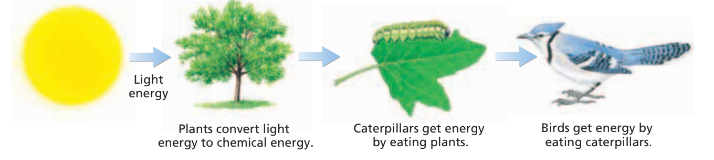
- Organisms can be put into 2 categories based on how they get energy:
- autotroph: organisms that produce their own energy
- photosynthesis: process in which autotrophs create their own energy - taking light energy from the sun and turning it into [typically] carbohydrates
- heterotroph: organisms that get energy from food
- biochemical pathway - linked series of chemical reactions
Overview of Photosynthesis
- O₂ and some organic compounds are produced
- cellular respiration - O₂ and organic compounds are used to make CO₂ and water
- products of photosynthesis are reactants of cellular respiration, and vice versa
2 Stages of Photosynthesis
- Light Reactions: [sun]light energy → chemical energy; stored in ATP and energy carrier molecule NADPH
- Calvin Cycle: organic compounds made using CO₂ and chemical energy from the ATP & NADPH in Step 1
- Photosynthesis equation - 6CO₂ + 6H₂O → C₆H₁₂O₆ + 6O₂
Capturing Light Energy
- first stage of photosynthesis includes light reactions
- chloroplasts absorb light
- chloroplasts: organelles found in plant & algae cells
- chloroplasts are surrounded by a double membrane
- inside the inner membrane there’s another system of membranes that are arranged as stacked flattened sacs called thylakoids
- grana: stacks of the thylakoids
- stroma: basically the cytoplasm of the chloroplast
Light and Pigments
- visible spectrum - white light when reflected into a prism reflects into 7 colors; ROYGBIV, violet having the smallest wavelengths and red having the largest.
- white light can be reflected, transmitted or absorbed into objects
- pigments: compounds that absorb light
- pigments absorb colors and therefore subtract others, reflecting a not white light
Chloroplast Pigments
- chlorophylls: one of the pigments found in the membrane of thylakoids
- Common Types of Chlorophylls:
- Chlorophyll A - absorbs more red light than Chlorophyll B
- Chlorophyll A - directly involved in the light reactions of photosynthesis
- Chlorophyll B - absorbs more blue light than Chlorophyll A
- Chlorophyll B assists Chlorophyll A - therefore an accessory pigment
- NEITHER absorb as much green light - green light is reflected or transmitted. This makes plants that contain a lot of chlorophyll green.
- carotenoids - brown, yellow, and orange accessory pigments in the thylakoid membrane
- accessory pigments help Chlorophyll A with getting more light as they absorb colors that A doesn’t
Converting Light Energy To Chemical Energy
- Once light energy is captured, it has to be turned into chemical energy
- chemical energy is temporarily stored in ATP and NADPH
- O₂ is given off during this process
- photosystem: a cluster of pigment molecules & the proteins they are weaved into; found in the thylakoid membrane
- two types of photosystems: photosystem I & photosystem II
- similar pigments, different roles in light reactions
- Light Reaction Beginning
- accessory pigment molecules absorb light
- molecules acquire some of the light’s energy
- molecules pass the energy through their photosystem that eventually reach a pair of chlorophyll A molecules; these molecules can absorb light as well
- Post Chlorophyll A Receiving Said Energy
- Light energy “excites” the electrons of two chlorophyll A molecules of photosystem II
1. this means the electrons leave the chlorophyll A molecules 2. causing an oxidation reaction in the A molecules
- the primary electron acceptor is the reduction reaction to the oxidation reaction; this is a molecule in, you guessed it, the thylakoid membrane.
- primary electron acceptor sends electrons through an electron transport chain
1. electron transport chain- chain of molecules that send the electrons through each molecule, causing the electrons to lose of the “excited” energy 2. energy loss is used to move protons into the thylakoid
- light is absorbed at the same time by both photosystem I and II, electrons move from a pair of chlorophyll A molecules [photosystem I] to a different primary electron acceptor
1. electrons lost by the chlorophyll A molecules are replaced by electrons from the electron transport chain in photosystem 2. 2. primary electron acceptor of photosystem I gives electrons to a different electron transport chain, transferring the electrons to the membrane layer touching the stroma. then electrons combine with a proton and NADP+.
1. NADP+ is an organic molecule that accepts electrons when an oxidation/reduction reaction happens
- NADP+ → NADPH
Replacing Electrons in Light Reactions
- As seen in step 4, electrons from chlorophyll molecules in photosystem II replace electrons that leave chlorophyll molecules in photosystem I
- if this didn’t happen, photosynthesis wouldn’t work
- the replacements for the electrons in photosystem II come from water electrons
- enzymes split water molecules inside the thylakoid into protons, electrons, and oxygen
- for every 2 water molecules split: 4 available electrons
- protons made are left inside the thylakoid and the oxygen diffuses out of the plant
Making ATP in Light Reactions
- chemiosmosis - synthesis of ATP
- remember the concentration gradient of protons due to the water molecules splitting up; higher concentration in the thylakoid vs. the stroma
- this concentration gradient represents potential energy,
- energy is harnessed by the enzyme ATP synthase in the thylakoid membrane
- ATP synthase adds a phosphate group to ADP (di- two) to make it ATP (tri- 3); process id driven by movement of protons
- this proton movement also helps NADP+ become NADPH; both NADPH and ATP are used in the next part
The Calvin Cycle
Carbon Fixation
- Calvin cycle: chemical reactions assisted by enzymes that eventually make a three-carbon sugar
- carbon fixation: carbon atoms from CO₂ are bonded (fixed) into organic compounds in the Calvin cycle
- 3 CO₂ must enter the Calvin cycle in order to make the three-carbon sugar that is used to make the organic compounds.
- Calvin cycle occurs in the stroma
Steps of the Calvin Cycle
- CO₂ diffuses into the stroma. Enzyme combines CO₂ with 5-carbon molecule ribulose bisphosphate (RuBP). 6-carbon molecules are unstable and split into 2 3-carbon molecules called 3-phosphoglycerate (3-PGA)
- All 3-PGA molecules → another 3-carbon molecule glyceraldehyde 3-phosphate (G3P).
- Two step process→ 3-PGA receives a phosphate group from ATP
- this compound gets a proton (H+) from NADPH and releases a phosphate group, making G3P
- (ADP, NADP+, & phosphate are used again in light reactions to make ATP & NADPH)
- One of the G3P molecules leaves Calvin cycle and used to make carbohydrates
- Remaining G3P converted back into RuBP using phosphate groups from ATP, then RuBP enters the Calvin cycle again
- Calvin cycle is most common pathway for carbon fixation
- plant species that only use Calvin cycle are called C₃ plants (due to three-carbon compound that was originally made)
Alternative Pathways
- plant species in hotter dry places fix carbon in other ways
- stomata: small pores that can let water out easily. Underneath the leaves
- plants can partially close the stomata when it’s hot and dry
- stomata are the most important passageways for CO₂ to enter and O₂ to leave
- when stomata is partially closed → less CO₂ in the plant and O₂ rises as light reactions generate it
- inhibits carbon fixation
- there are alternate pathways to solve this
The C₄ Pathway
- this pathway fixes CO₂ into four-carbon compounds
- called C₄ pathway, used by C₄ plants
- C₄ plants keep stomata partially closed
- some cells in C₄ plants have enzymes that fix CO₂ even when it’s low and O₂ is high
- compounds then are shipped to other parts of the cells when CO₂ is released and put through the Calvin cycle
- C₄ plants - corn, sugar cane, and crab grass
- lose 1/2 as much water as C₃ while producing equal amount of carbs
- C₄ evolved from tropical conditions
The CAM Pathway
- CAM Pathway: plants like cactuses and pineapples open their stomata during the night and close during the day, contradictory to other plants
- “__C__rassulacean __A__cid __M__etabolism”
- Nighttime → takes in CO₂ and fixes into many compounds
- Daytime → CO₂ is released from compounds and enters Calvin cycle
- CAM plants grow slower but lose less water than C₃ or C₄ plants
A Summary of Photosynthesis
- TWO STAGES:
- Light Reactions
- sunlight energy absorbed, converted to chemical energy, temporarily stored in ATP and NADPH
- Calvin Cycle
- CO₂ and chemical energy from ATP and NADPH form organic compounds
- Photosynthesis is a cycle, the products of the light reactions are used in the Calvin cycle, and some products of the Calvin cycle are used in light reactions
- other products from Calvin cycle make organic compounds; amino acids, lipids, & carbohydrates
- extra carbohydrates are stored as starch in chloroplasts and in roots & fruits
- starch is where the chemical energy that is important for both auto & heterotrophs come from and need
- Overall equation for photosynthesis: 6CO₂ + 6H₂O → (CH₂O) + O₂
- carbohydrate is often replaced by glucose (C₆H₁₂O₆), which means it’d look more like this: 6CO₂ + 6H₂O → C₆H₁₂O₆ + 6O₂
- however, glucose isn’t a direct product of photosynthesis, it’s in the equation to show the relationship between photosynthesis & cellular respiration, which glucose is crucial to
- as light reactions and the Calvin cycle are a cycle, so too is photosynthesis and cellular respiration
- light reactions = light-dependent reactions
- Calvin cycle = light-independent reactions or dark reactions (not needing direct light, while proceeding during the day because light reactions produce the material that the Calvin cycle uses to fix carbon)
Factors that Affect Photosynthesis
Light Intensity
- rate of photosynthesis increases as light intensity increases.
- higher light intensity excites more electrons in both photosystems.
- there is a maximum rate of photosynthesis
CO₂ Levels
- similar to light, more CO₂ → higher rate of photosynthesis until reaches maximum
Temperature
- increased temperature → accelerated rate of chemical reactions that are part of photosynthesis
- rate peaks at a certain temperature → enzymes begin to not work and stomata closes, limiting CO₂ and water