Chapter 3 - The Second Law
- Second Law of Thermodynamics - No process is possible in which the sole result is the absorption of heat from a reservoir and its complete conversion into work.
The direction of spontaneous change
3.2 Entropy
- Entropy (S) - A measure of the energy dispersed in a process.
- Second Law of Thermodynamics - The entropy of an isolated system increases in the course of a spontaneous change: ΔS > 0.
The thermodynamic definition of entropy
It concentrates on the change in entropy, ΔS, that occurs as a result of a physical or chemical change.
- Boltzmann formula - The entropy calculated from it is sometimes called the statistical entropy.

Entropy as a state function
- Entropy is a state function.
- Carnot cycle
- Reversible isothermal expansion from A to B at Th - The entropy change is qh/Th, where qh is the energy supplied to the system as heat from the hot source.
- Reversible adiabatic expansion from B to C - No energy leaves the system as heat, so the change in entropy is zero. In the course of this expansion, the temperature falls from Th to Tc ' the temperature of the cold sink.
- Reversible isothermal compression from C to D at Tc - Energy is released as heat to the cold sink; the change in entropy of the system is qc/Tc; in this expression qc is negative.
- Reversible adiabatic compression from D to A - No energy enters the system as heat, so the change in entropy is zero. The temperature rises from Tc to Th.
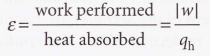
- Efficiency (ε)
The thermodynamic temperature
- Thermodynamic temperature scale - The efficiency of a heat engine.
The Clausius inequality
- Clausius inequality

3.3 Entropy changes accompanying specific processes
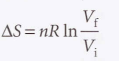
Expansion
- Trouton's rule - A wide range of liquids give approximately the same standard entropy of vaporization, about 85 J K^-1 mol ^-1.
3.4 The Third Law of thermodynamics
- Third Law of thermodynamics - The entropy of all perfect crystalline substances is zero at T = 0.
The Nernst heat theorem
- Nernst heat theorem - The entropy change accompanying any physical or chemical transformation approaches zero as the temperature approaches zero: ΔS → 0 as T → 0 provided all the substances involved are perfectly crystalline.
Third-Law entropies
- Third-Law entropies - Entropies reported on the basis that S(0) = 0.
- Standard (Third-Law) entropy - S°(T).
- Standard reaction entropy - The difference between the molar entropies of the pure, separated products and the pure, separated reactants, all substances being in their standard states at the specified temperature.

Concentrating on the system
3.5 The Helmholtz and Gibbs energies
Criteria for spontaneity
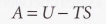
- Helmholtz energy (A)
- Gibbs energy (G)

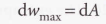
Maximum work
- The change in the Helmholtz function is equal to the maximum work accompanying a process.
3.6 Standard reaction Gibbs energies
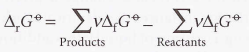
- Standard Gibbs energy of reaction - The combination of standard entropies and enthalpies of reaction. It can also be defined as the difference in standard molar Gibbs energies of the products and reactants in their standard states at the temperature specified for the reaction

- Standard Gibbs energies of formation - The standard reaction Gibbs energy for the formation of a compound from its elements in their reference states.
Combining the First and Second Laws
3.7 The fundamental equation
- Fundamental equation

3.8 Properties of the internal energy
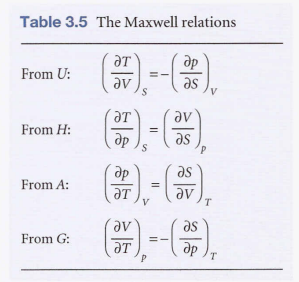
- Maxwell relations
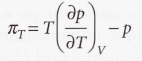
Variation of internal energy with volume
- Thermodynamic equation of state
3.9 Properties of the Gibbs energy
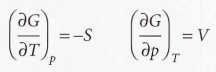
First relation
- Because 5 > 0 for all substances, G always decreases when the temperature is raised (at constant pressure and composition).
- Because (dGldT)p becomes more negative as 5 increases, G decreases most sharply when the entropy of the system is large.
Second relation
- Because V> 0 for all substances, G always increases when the pressure of the system is increased (at constant temperature and composition).
- Because (JG/Jp)T increases with V, G is more sensitive to pressure when the volume of the system is large.
Variation of the Gibbs energy with temperature
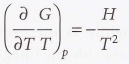
- Gibbs-Helmholtz equation