Ancient Egypt
- Geography and climate:
- Consists of many deserts
- Mountains which isolate the area
- Earliest Egyptians were hunter-gathers in the Nile River Valley
- Lower Egypt: north of the river, includes the deltas
- Upper Egypt: south of the river, has cataracts
- Navigating is dangerous
- Nile River is a very important water source, as there is little rainfall
- Flooded in the summer, and the muddy silt allowed for agriculture
- Ample food supply and natural barriers allowed Egypt to flourish
- Egypt’s first dynasties:
- Pharoah Narmer from upper Egypt united the upper and lower.
- From Narmer, the first dynasty of Egyptian Pharoahs was establish
- Many dynasties rose and took power.
- This era is called the Old Kingdom
- The Old Kingdom: 2650 BC - 2200 BC
- Cities grew and trade became more widespread
- Social and political systems were established
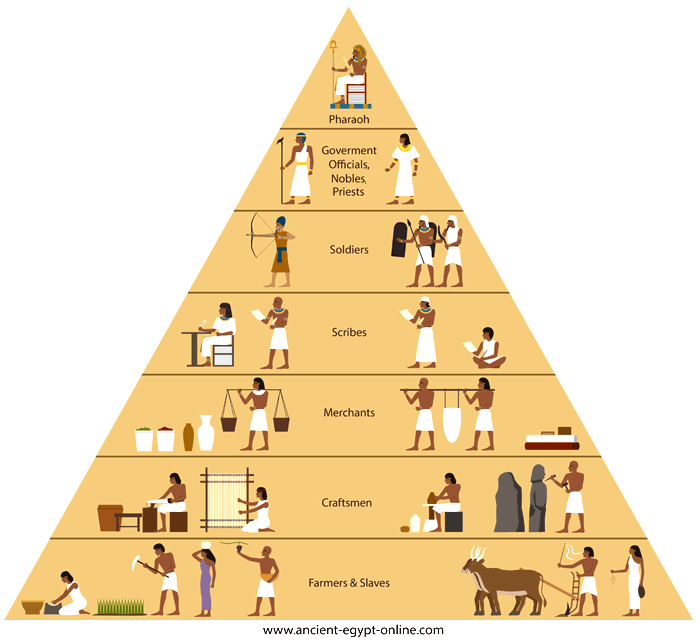
- Social order from high to low: pharoah, priests, nobles, traders, artisans, farmers, slaves
Religion:
- Early Egyptians were polytheistic
- Ra: god of the sun
- Hapi: god of the Nile
- Osiris: god of the underworld
- Isis: god of fertility
- They built temples, performed rituals and made prayers.
- Believed in rebirth. Everyone has a ka (life force)
- Kept ka intact by mummifying the body
- Pyramid:
- Started being built during the Old Kingdom
- Served as burial tombs for Egyptian royalty
- Size reflected the importance of the individual entombed
- Old Kingdom Achievements:
- Economy flourished because of trade with kingdoms
- Developed a form of writing called hieroglyphics and used papyrus
- Decline of the Old Kingdom:
- Power hungry nobles sought to take control from the pharoah
- Economic troubles rose due to expensive projects
- Devastating famine
- The Middle Kingdom:
- Egypt faced political and economic instability after the fall of the Old Kingdom
- In 2050 BC, Pharoah Mentuhotop II restored order and moved the capital from Memphis to Thebes.
- Increased trade with Syria
- Added new lands, including kingdom of Nubia
- Weak pharoahs failed to the hold the Kingdom
- Conflicts with rivals and invasions led to political instabilities
- Pharoah Hyksos attacked, and Egypt’s technology was no match
- Conquered Lower Egypt and ruled for 100 years
- Under Hyksos, Egypt adopted strong technology
- In 1550 BC, Egyptian leader Ahmose ousted Hyksos
- The New Kingdom:
- Egypt because powerful through military invasions to Syria and Kush, and gained control over trade routes
- Great Pharoahs of the New Kingdom:
- Hatshepsut: female pharoah from 1450 BC
- Expanded the economy through trade
- Traded with other civilizations and got ebony and gold
- Built many great monuments and temples
- Amenhotep IV: 1370 BC
- Ordered that one god, Aton, be worshipped. Close temples for other gods
- Egyptians resented him
- Under him, Egypt was attacked and lost territory
- Tutankhamen: age between 10-19
- His tomb was found in 1922, still intact
- Ramses II: 1280 BC
- Reigned for 66 years.
- Military reconquered lost territory in southwest Asia
- Commissioned construction of many temples
- Decline of Egypt:
- Location as a trade center made it a target to attacks
- Didn’t have advanced weapons.
- Lack of wealth from famines and a civil war
- In 600 BC, the Assyrian empire conquered Egypt