Unit 3 Science 8 - Density, Chemical Bonding, Laws of Conservation, Acids vs. Bases, Endo/Exothermic Reactions
⚖Density
🧠Key Vocab:
Mass - the amount of mass measured in an object
~ Measured in grams (g)
Volume - the amount of space an object takes up
```~ Measured in milliliters (mL) ot cubic centimeters (cm3)
Density - the amount of matter in a given amount of space
~ Measured in g/mL or g/cm3
Remember: I 💘DENSITY (mass/volume)
📐Strategy
Density = D = M/V
Mass = M = D x V
Volume = V = M/D
⚛Chemical Bonding
There are 2 types of chemical bonds.
Ionic Bonding ▫ Electron Transfer
An ionic bond is a positive and negative attraction.
Positive metal ions and negative nonmetal ions create a neutral compound.
➡ Atoms have no charge because they have an equal number of protons and electrons
➡ Ions either have too many or too few electrons, because they take or lose them to have a full balance (8)
➡ Bond between a metal and a non-metal
TIP: When ionic bonds transfer, the element losing the atom becomes positive, and when the element loses an atom, it becomes negative
Covalent Bonding ▫ Electron Sharing
Bond between 2 non-metals
Think no co!
➡ Covalent compounds share valence electron pairs
Remember, hydrogen is pretty weird; it's mostly covalent.
📜Laws of Conservation
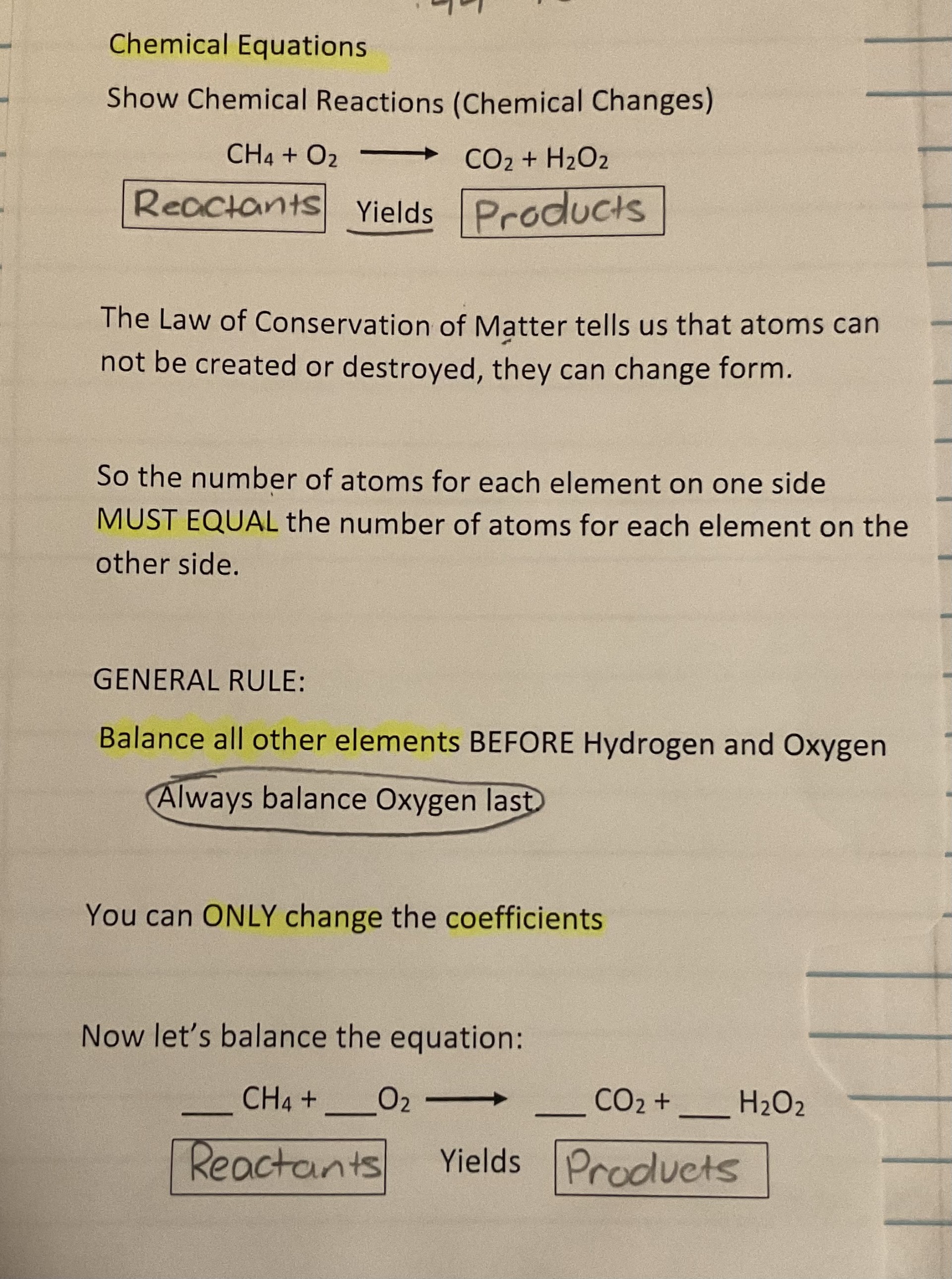
The law of conservation states that matter can not be created or destroyed, but matter can change form (physically and structurally)
🧪Chemical Formulas
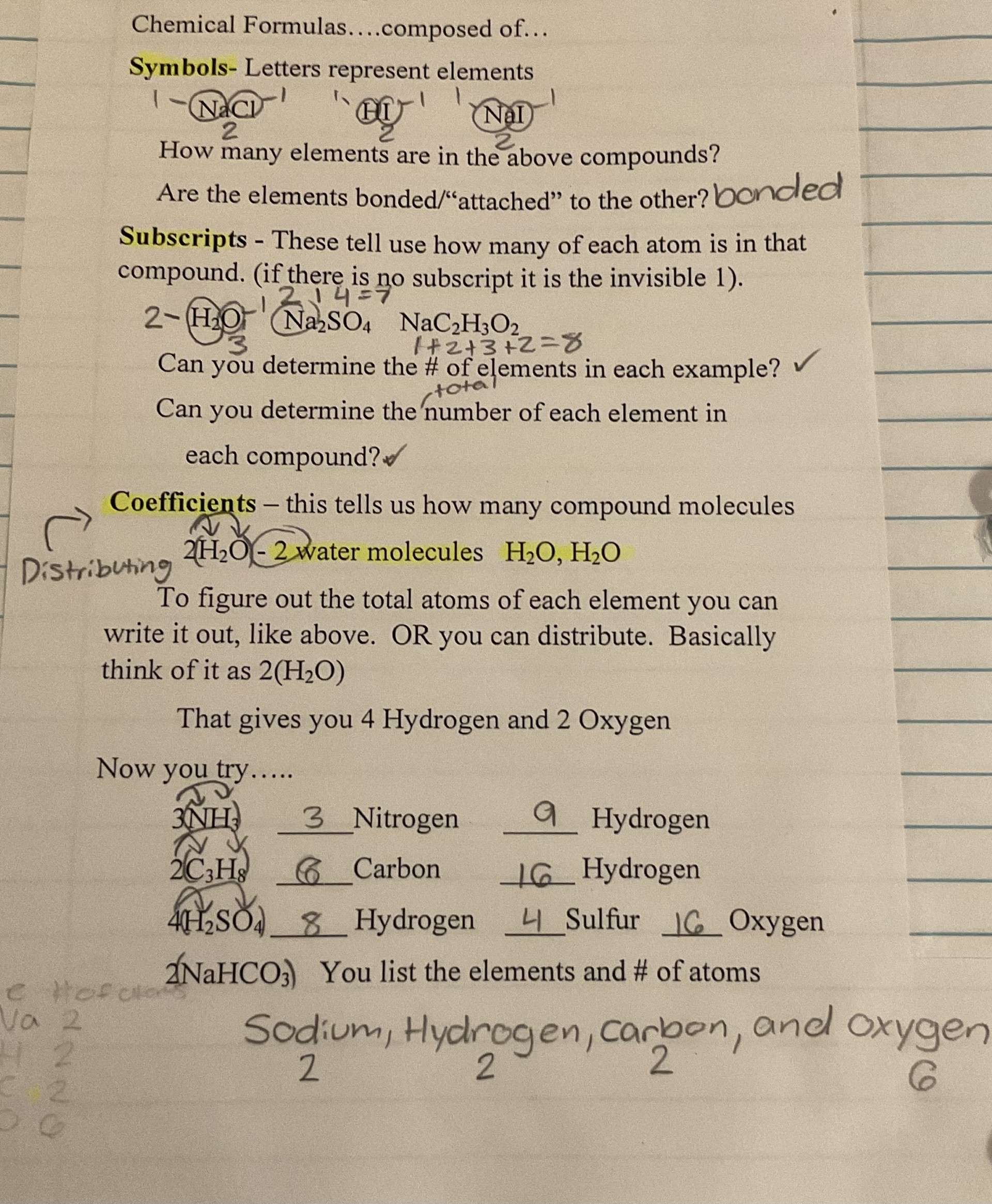
Uses numbers and systems to represent elements for atoms, molecules, and compounds.
{reactants} {products}
⬅The 3 next to the H is a subscript
⬆
The 3 in the equation is a coefficient.
~ Subscript = number of atoms
~ Coefficient = number of molecules
The left side of the equation is called the reactants.
The right side of the equation is called the products.
The arrow is called yields.
Solving Chemical Equations:
🧫Acids vs. Bases
Acid + Base = Neutralization
On a scale from 0 to 14, the lower pH solutions (0-6) are strong acids; higher pH solutions (8-14) are bases. Solutions measuring pH 7 are neutral.
Acids:
➡ Acid is a chemical substance that has a pH lower than 7.
➡An acid is any hydrogen-containing substance that is capable of donating a proton to another substance.
➡Lemon juice is an example of an acid; it has a pH of 2.
Bases:
➡ A base is a chemical substance that has a pH higher than 7
➡ A base is a molecule or ion able to accept a hydrogen ion from an acid
➡Bleach is an example of a base substance; it has a pH of 12.6
💥Endothermic and Exothermic Reactions
The absorption and release of energy, usually heat energy.
Exothermic Energy:
Exothermic release (heat) energy into the surroundings
➡ Energy is leaving the system (Think exo = exit)
➡ The temperature of the surroundings increases
➡ Can think of energy as a product
Endothermic Energy:
The absorption of (heat) energy from the surroundings.
➡ Energy is going into the system
➡ The temperature of the surroundings decreases
➡ Can think of energy as a recantant.
State change is related to energy (Kinetic Molecular Theory): movement = more energy.
⚛Practice Questions
What subatomic particle gives an ion its charge?
What do subscripts, like the one in H2O, represent?
Can you balance a simple equation? C + S8 -> CS2
What side are the reactants on in a chemical equation? What side are the products? What is the arrow?
How do you find density?
Physical Change vs. Chemical Change?
Conservation of Matter?
Covalent bonds are between......
Ionic bonds are between.....
Chemical bonding, chemical equations are examples of physical or chemical change?
Metals _______ electrons and non-metals _______ electrons in _____________ bonds.
When a diagram shows interconnecting circles, what kind of bond is it?
Isotopes have the same number of protons but a different number of neutrons.