Plants
Key Terms:
- Radicle: the first part of a seedling (a growing plant embryo) to emerge from the seed during the process of germination.
Land plants have evolved to occupy a specific niche:
- Sessile
- Must avoid being eaten
- Find a mate and reproduce
- Disperse their offspring
- Autotrophic
- Collect raw materials for photosynthesis
- Expose themselves to sunlight
- Terrestrial
- Avoid drying out
- Deal with gravity
- Multicellular
- Find ways to transport substances more quickly and over larger distances
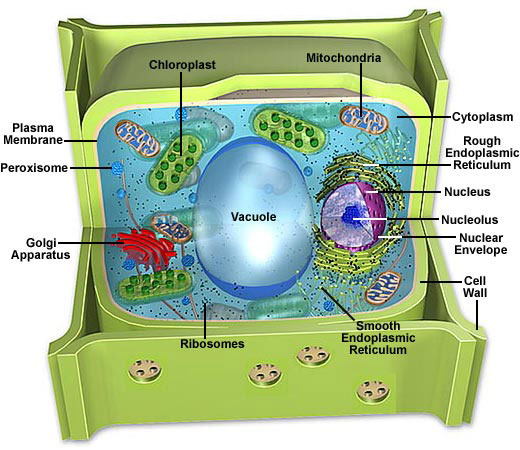 Plant Cells
General Characteristics:
- Cell wall – provide support
- Large central vacuole - provides
- Chloroplasts – photosynthesis
Three tissue types:
- Vascular tissue
- Xylem and Phloem
- Dermal tissue
- Covers all parts of the plant
- Ground tissue
- Everything else
Ground tissue: 3 subtypes
- Parenchyma - thin cell walls
- Collenchyma - medium cell walls - firm yet flexible
- Sclerenchyma - thick, hard cell walls (e.g. spines)
Vascular tissue:
- Carbohydrates made in the leaves must be carried to all other living cells
- Phloem
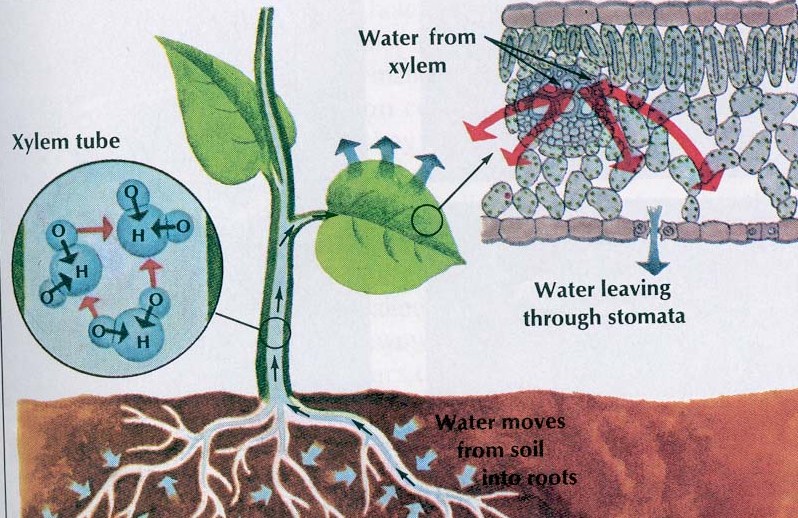
- Water and dissolved nutrients must be taken up by the roots and transported to the rest of the plant
- Xylem
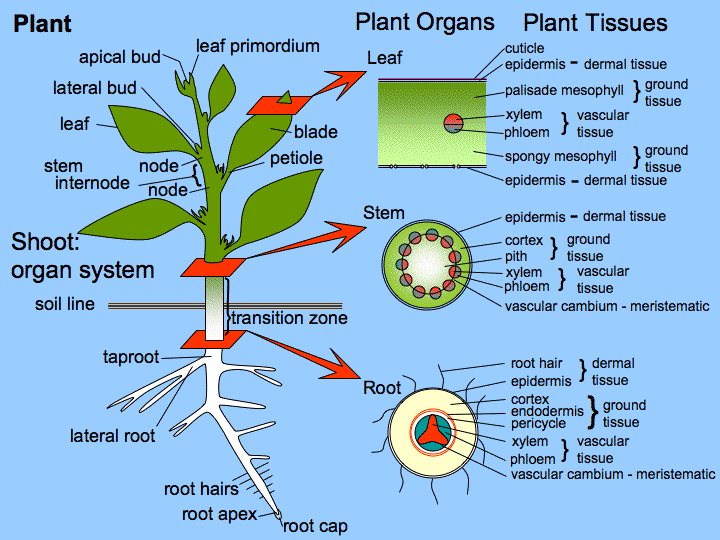
Roots - Anchor
- Root systems are specialized to anchor a plant into the type of soil it grows in.
Roots - gather/store water and minerals
- Vascular tissue
- Concentrated in the centre of the root, and surrounded by a waterproof endodermis.
- This regulates the movement of mineral ions and water into the vascular tissue
- Plants drive minerals into the vascular tissue by active transport.
- Water follows, due to osmosis.
- This increases the pressure in the xylem, which in turn pushes the water (and minerals) up into the stem
- Root hairs
- Tiny extensions of individual epidermal cells on plant roots
- Increase surface area available for absorption of water and nutrients
- Cortex
- Outer layer of roots specialized in some plants to store large amounts of carbohydrates
Stems
Stems Functions
- Supports the plant
- Spaces the leaves to maximize the amount of light and air they get
- Contain xylem and phloem
- Stores food
Types of stems - herbaceous
- Annual plants
- Thin, soft green, short-lived, and contain little or no wood
- Can photosynthesize
- Usually do not grow taller than 1 meter (exception: palm tree)
- Contain Collenchyma Cells
- allows plants to bend without being broken
Types of stems - woody
- Perennial plants
- Increase in diameter each year as more vascular tissue is created
- Layers in Woody Stem:
- Heartwood – dead xylem that no longer functions
- Sapwood – xylem that still conducts fluid
- Bark – contains living phloem and periderm
- Periderm:
- Cork Cambium – stem growth
- Periderm:
(width)
- Cork – Outer layer of bark
Leaves
Leaf Function
→ the major site of photosynthesis
- Problem:
- Large surface area and exposure to the air provides two ingredients for photosynthesis.
- BUT - these characteristics increase the rate of water loss.
- Leaves are specialized for the niche of the plant they belong to.
Layers of the leaf
- Epidermis
- The outer covering of the leaf
- Cuticle
- waxy substance secreted by epidermal cells
- helps reduce water loss by evaporation
- Mesophyll
- Photosynthetic region between the upper and lower surface of the leaf
- Contains parenchyma cell
- Specialized cells that have lots of chlorophyll
- Palisade Mesophyll
- Under the upper epidermis
- Primary site for photosynthesis
- Spongy Mesophyll
- Above the lower epidermis
- Randomly arrange with large spaces for rapid carbon dioxide diffusion
Guard Cells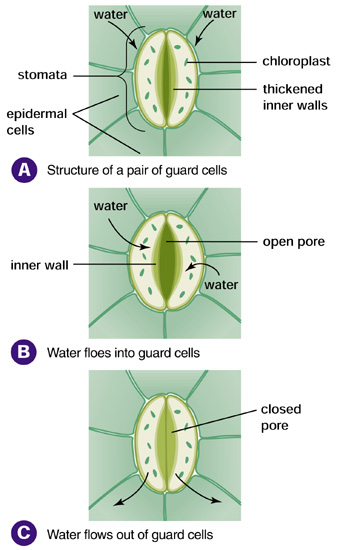
- Contain chlorophyll
- During photosynthesis, become swollen with water
- Forces stomata open
- Therefore on sunny days
- Stomata are open providing lots of CO2
- Dark night
- No photosynthesis – stomata close
- Prevents water from escaping
Transpiration Pull
- Around 98% of the water that reaches the leaves is lost to evaporation through the stomata (transpiration)
- This creates a negative pressure that acts to pull water up to replace the lost water
- This is the second mechanism which plants use to transport water up to the leaves.
Sugar Transport in Phloem
- Photosynthesis in the leaves produces sugars
- Sugars are actively transported into the phloem.
- Water follows by osmosis.
- Pressure in phloem increases, so sap moves towards where sugar is being removed from phloem.
Sexual Reproduction in Angiosperms
- Most diverse and widespread plants on Earth
- Reproductive organ - FLOWER
The flower - 4 sets of modified leaves
- Flowers have 4 organs:
- Sepals
- Protect the flower bud and can look like small leaves of flower petals
- Petals
- Colorful structures that attract pollinating insects
- Stamens
- Male reproductive organ
- Composed of a filament and anther
- Filament: supports the anther
- Anther: produces pollen grains, which contain sperm cells, through mitosis and meiosis
- Pistils
- Female reproductive organ
- Composed of a stigma, a style and a ovary
- Pollination occurs at the stigma. The style connect the stigma to the ovary, which contains one or more ovules
- Sepals
During sexual reproduction
- Anther releases pollen that goes down style and enters the ovary
- After fertilization, seeds, each containing an embryo and a food supply, form within a fruit that develops from the ovary wall
- Fruits are dispersed by wind, or by animals, and the seeds are released and can grow into a new plant
Variations among flowers - structural differences
- Complete vs. incomplete flowers
- A flower is considered incomplete if it is missing one or more flower organs (sepals, petals, stamens, and pistils)
- Perfect vs. imperfect flowers
- A flower that does not contain both the male and female reproductive organs (pistil and stamen) and is considered imperfect
Variations among flowers - pollination mechanisms
- Pollination
- Transfer of pollen from the male anther to the family stigma
- Self-pollination and cross-pollination
- A plant can pollinate itself or another flower of the same plant
- This leads to inbreeding and loss of genetic variation
- Animal pollination
- Flowers are brightly coloured, have strong scents and produce nectar to attract pollinators
- As animals move from one plant to another, they carry pollen with them
- Wind pollination
- Usually lack colourful or fragrant flowers
- Produce large quantities of light pollen grains that can be carried by wind
Angiosperm classification
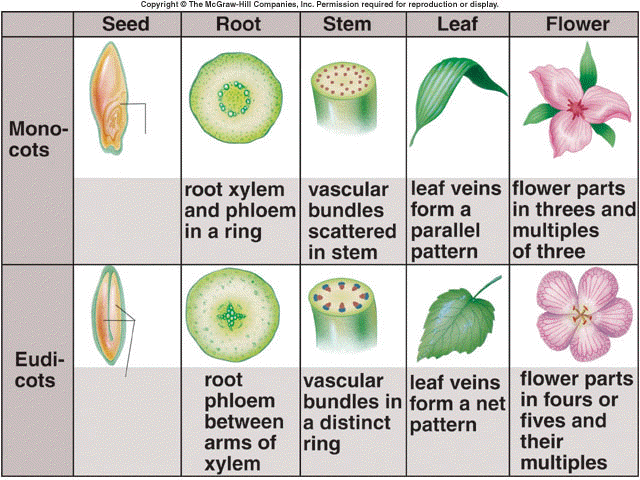
- Divided into two main groups based on a structure called a seed lead or cotyledon
- The cotyledon is a structure in the seed that helps to nourish the plant as it first starts to grow (before leaves are available for photosynthesis)
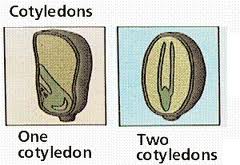
Monocot and Dicot
- Monocots
- Produce seeds which only have one cotyledon (seed leaf)
- Examples: corn, water lilies, onions, orchids, grasses
- Dicots
- Produce seeds which have two cotyledons
- Examples: beans, maples, oaks, peas, beans, potatoes
- There are many other characteristics that can be used to distinguish monocots and dicots
- The arrangement of vascular tissue in roots and stem, the number of petals and the arrangement of veins the leaves all differ
Plant Growth
- Plants grow at specialized meristematic tissues
- Meristem
- Specific regions in plants that undergo mitosis
- Cells produced by meristematic tissue eventually differentiate to become other types of tissues
- Apical meristems
- Meristems at the root tips and shoot tips
- Lateral meristems
- Cylindrical regions in roots and stems
- Responsible for increases in diameter
Types of Lateral Meristem
- Vascular cambium
- Produces cells that will become new xylem and phloem tissue
- Cork Cambium
- Produces cork and bark
Growth of Lateral Meristem
- Primary growth
- All growth in length of roots and stems throughout a plant’s entire life
- All growth in the diameter of roots and stems which occurs in the first year of a plants life
- Secondary growth
- Plant growth originating at the lateral meristems which results in the increase in the diameter of roots and stems after the first year of a plants life
Plant growth and development
- Seeds germinate when conditions are ideal - they absorb water, and the radicle penetrates the seed coat
- Germination and growth is influenced by the presence of plant hormones, as well as environmental factors
Plant Hormones:
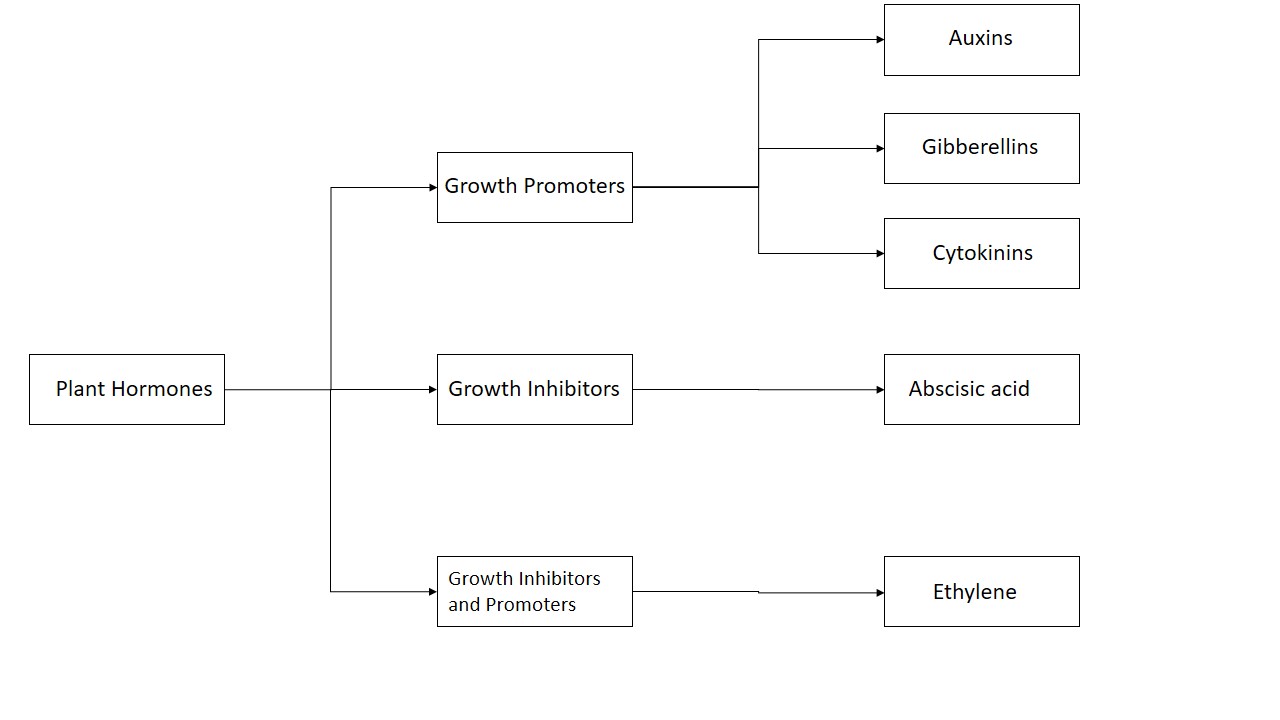
- Hormones act as chemical signals between cells and tissues in different parts of the plant
- Can stimulate or inhibit plant growth
Stimulatory Hormones
- Auxins
- Stimulate cell division and elongation in stems and roots
- Regulate cell expansion in plant responses to light and gravity
- Prevents premature fell of leaves, flowers, fruits
- Promotes flowering
- Helps in cell division and xylem differentiation
- Cytokinins
- Stimulate lateral shoot growth
- Stimulates the formation of chloroplasts in leaves
- Gibberellins
- Stimulate cell elongation in the stem
- Stimulate seed germination
Ethylene
- Both stimulatory and inhibitory
- Gaseous
- Promotes ripening of fruits
- Promotes growth of seeds and buds
- Promotes leaf aging and release
Plant response to environmental stimuli
- Tropic response
- The growth response of a plant to an external stimulus
- Positive Tropism
- The plants growth is towards the stimuli
- Negative tropism
- The plants growth is away from the stimuli
Tropic Responses
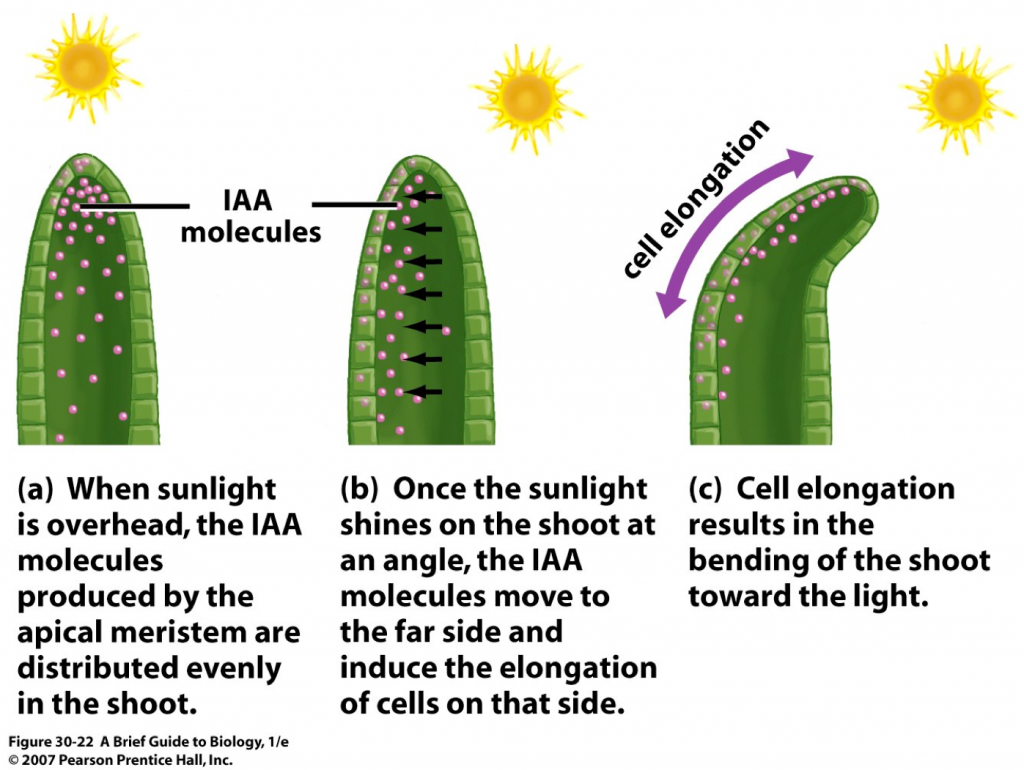
- Phototropism
- Growth response to light caused by an unequal distribution of auxin
- More auxin is present on the side of the plant further away from the light
- The auxins cause these cells to elongate
- The stem curves towards the direction of light
- Gravitropism
- Growth response to gravity
- Stems exhibit negative gravitropism
- Plant grows upwards, pushing against gravity
- Thigmotropism
- Growth response to mechanical stimuli
- I.e. contact with an object
- Growth response to mechanical stimuli
- Hydrotropism
- Growth of roots towards water
Other Factors that effect plant growth
- Plant growth is also influence by light energy from the sun, carbon, air, and water from teh soil
- Ex. photoperidism: plant responses to changes in the length of day
- At light latitude, length of day changes a lot - and so does temperature
- Therefore, plants go into dormancy in response to lengthening days