recap 2nd
carolus linnaeus came up with a classification system
how do scientist classify organisms on?
their cell structure
how they get food
how tthey reproduce
what is the building block of all plants?
plants cells
what is the 6 kindgdoms of life?
animal
plant
fungi
protist
eubacteria
archae bacteris
look up all definitions of them
what is the taxonamy pyramid in order?
kingdom
phylum
class
order
family
genus
species
how is the taxonomy pyramid grouped?
size, shape, diet, habitat, babies
taxonamy is the?
Science of naming, describing, and classifying organisms. (including plants animals and microorganisms)
what is classification?
the grouping or organisms by characteristics and similar traits
what characteristics do the animal kingdom have?
many celled,
feed on living or once living
what characteristics do the plant kingdom have?
many celled
make their own food
what characteristics do the fungi kingdom have?
most are many celled
absorb food from other living things or dead things
what characteristics do the protists kingdom have?
most are called one celled
make own food, feed on living, or once living
what characteristics do the monerans kingdom have?
one celled
no cell nucleus
some make food
some feed on living or onced living
monerans example(s) are
bacteria
protists example(s) are
algae, amoebas euglena, paramecium
fungi example(s) are
mushrooms,yeasts, molds
plants example(s) are
trees, flowers, grasses, ferns, mosses
animals example(s) are
monkey, humans, birds, frogs, fish, spiders
why are plants important?
Most living things gain energy directly or indirecttly from plants.
Plants can serve as a source of?
food and they also help make earths climate stable.
Vascular plants
they have plant cells that form tubes that carry water and nutrients throughout the plants
Non-Vascular plants
they do not have tubes to carry materials
materials must slowly move from one cell to another therefore non vascular plants are small
cell- the smallest unit that can carry out activities of life
all cells must-
obtain nurtiewnts and energy
remove waste products
grow
reproduce
most cells are too small to be seen with a microscope
unicellular- made of one cell
multicellular- made of many cells
cells were not discovered until the invention of the microscope
the first person to describe cells was robert hooke
cell theory:
all living things are made of cells
cells are the basic unit of living things
all cells come from existing cells
living things are organized in the way they are made
cells - tissues - organs - organ system
organelle- structuresd that enable the cell to live, grow and reproduce
prokaryotic cell
no membrane covered nucleus
no membrane covered organelles
circular dnaa
are bacteria
eukaryotic cells
have a nucleus
membrane covered organelles
linear dna
are all other cells
cell membrane
outer layer of the cell
"gate into the city"
allows nutrients into the cekk and wastes outside of the cell
protects the cell
contreol incoming and outgoing substances
maintains concentrations of various substances
selectively permable- allows some molcules in, others are kept out
all maintains homeostatsis (internal balance)
cytoplasm
a jelly-like fluid
contained in the cell that holds the organelles
nucleus
the control center of cell
contains the cells DNA
"mayors office"
mitochondria
power center of cell
provides the neergy the cell needs to move, divide, ect
"electric company of the cell"
ribosomes
site where proteins are made
cell parts are made of proteins
"factories of the cell"
endoplasm reticulcum
transportations system of the cell
rough e r - ribosomes attached
smooth er- no ribosomes attached
"roadways of the cell"
lysosomes
digest food, particles, and cell parts
"garbage men"
other job
protects cell by digesting foregin invaders
"police men"
vacuole
stores water, food, and waste
vacuole is a larger organelle in plannt cell
cell wall
found in plant cells
protects and supports the cell
cloroplasts
found only in plant cells
contains clorophyll (makes plants green)
where photosynthesis takes place
Organelles found in both cells
mitochondeion
nucleus
endoplasmic reticulum
cell membrane
ribosomes
vacuoles
golgi aparatus
found in plant cells
cloroplasts
cell wall
animal cells
Lysosomes (only found in animal cells)
Equilibrium- the number of molecules is equal inside and outside the cell
Passive transport
does not require energy for the movement of molecules of high concentration to low concentration
active transport
requires energy for the movement of molecules
cell membrane
protects the cell
contreol incoming and outgoing substances
maintains concentrations of various substances
selectively permable- allows some molcules in, others are kept out
all maintains homeostatsis (internal balance)'
homeostasis- internal balance
a cell will divide into 2 identical copies of itself
as new cells form, multicellular organisms grow larger
cell division replaces old damage cells with new cells
cell division begins with
mitosis, the process in which the cell nucleus divides
Usually, DNA cannot be seen in a cell, but during mitosis, it coils from chromosomes
DNA- a material that stores coded info about how the cell will grow and reproduce
The cell is at its largest before it begins the process of
mitosis and divides
When we are younger we contain less amount of cells. This is due to the fact that the cells are not at their largest and have no need to divide because they have no cells to replace old/ damaged cells
Heredity- the passing of traits from parents to offspring
Traits- the observable characteristics or qualities on individual carries
aquired traits- what individuals develope life time and arent inherited from their parents
Variations of traits can be generic or environmental
inherited traits- passed down traits from parent to offspring and can be physical or behavioral
alleles- a different form of a gene or trait, there is one copy (allele) from mom and one copu (allele) from dad
DNA- the material that carries all the info about how a living thing looks and functions
Inherited traits come from our genes, which are made up of DNA
for every gene you have 2 of the same allele
or you can have 2 different alleles
a recessive allele will only produce a phenotype if there is no dominant allele present
in other words
you need 2 copies of the recessive allele in order to have the trait that it codes for recessive alleles are symbolized by lowercase letters
dominant allele + dominant allele= dominant phenotype =homozygous (HH)
dominant allele + recessive allele = dominant phenotype = heterozygous (Hh)
female sex cell- egg cells
male sex cell - sperm cells
zygote-- when the egg and the sperm cells combine, to make a new cell, this is called the zygote
fertilization - when the sperm meets the egg to form the zygote
similarities in prokaryotic and eukaryotic is that they both have cytoplasm and nucleus
habitat - natural live place for an animal
biotic - living organism
biotic- nonliving
organism- an individual thing plant, animal, or a single cell life form
individual- a single organism in an environment
population- several individuals in an environment
community- all the populations of organisms living together in an environment
niche- the role each population has its habitat
individuals of the same species make up a population
populations of a different organisms live together in a community
biome- a community of plants and animals that have common characteristics for the environment they exist in. They can be found over a range in continents. Different than a habitat because biomes are very very large.
Major biomes: Tundra, Taiga, Temperate/Decidous forest, Grassland, Desert, Rain Forest, Freshwater Biome, Marine/Saltwater Biome
Tundra- contains perma forest: permanently frozen soil. Located at the top of the Earth. Very little precipitation. Tundra means treeless. Plants and animals here have adapted to survive harsh weather.
Taiga-located below the Tundra. Life here is a little easier than the permanently frozen Tundra. The Taiga gets more sunlight than the Tundra.
Animals in Taiga- Bears, Wolverines, foxes, squirrels, and mooses
Plants in the Taiga- pine, oak, maple, and elm trees
Very cold here (Taiga), but living conditions are much better for plants and animals than the Tundra.
Located just below the Tundra (Taiga). Northern Russia, Canada, Alaska
We live in the Temperate/ Deciduous forest.
Temperate Forest- most forest here in North America L\leaves fall in Autumn.
Ex: Plants and animals- include flowers, moss, fems, bears, rabbits, birds
Rain forest- Earths oldest biome. Located near the equator. Massive amounts of rain, plants and animals.
Rainforests have amazing and diverse populations of plants and animals. Rainforests are essential to life on earth. The rainforest provides food, medicine, and oxygen to the Earth.
Desert- very dry climate. Most deserts are hot during the day but can drop to very cold temps at night
Very little rain, plants, and animals have adapted to survive. Deserts cover 20 % of the Earth.
Grasslands- large open places filled with grass
ex: plants and animals include buffalo's, owl's, bird's, and tall grasses
Oxygen can move in and out of the cell membrane by the process of diffusion.
Many of earths resources pas through ecosystems in a continuous cycle
Important materials that organisms include nitrogen, water, carbon, oxygen
If these materials were not recycled, these resources would run out and organisms would die out.
Nitrogen:
Nitrogen is one of the most important resources for all living things
Plants get nitrogen from bacteria
Animals get nitrogen by eating plants or prey that have eaten plants
fixed nitrogen- combined w other elements, most organisms can us nitrogen that is fixed, organisms need to survive
free nitrogen- fixed by bacteria that live in the soil
The Nitrogen cycle
Free nitrogen is fixed by bacteria in the soil
Decomposers break down dead organisms and fixed nitrogen is released into the soil
animals get nitrogen by eating plants or other animals that eat plants
bacteria in the soil can break down fixed nitrogen into free nitrogen which enter the air again
a. organelle: structures that enable the cell to live, grow, and reproduce
b. predator: an animal that hunts and feeds on others
c. consumer: a living thing that eat producers and other animals
d. heredity: The passing of traits from parents to offspring
e. trait: the observable characteristics or qualities on individual carries
f. Allele: different forms of a gene or trait
g. dominant allele: a trait, presented with an uppercase letter when in a equation, that produces a certain phenotype
a) Give an example of a dominant allele: ___(B) brown eye _____
h. recessive allele: a trait not visible, presented with a lowercase letter, that must be present with a dominant allele
a) Give an example of a recessive allele: (b) blue eyes in humans, _______
i. camouflage: a disguise to protect organisms to be unnoticed
j. Adaptations: special features organisms must keep them alive in their environment.
k. photosynthesis: the process food is created by plants
a) Where does photosynthesis take place inside a plant cell in the chloroplast ____________
l. selective breeding: the process commonly used to assure desirable characteristics, or traits, in the offspring of animals
cell theory.
1. All living things are made of one or more cells
2. Cells are the basic units of all living things
3. All cells come from existing cells
Any change in the DNA is called a ____mutation___________.
Of the 15 roses, 13 are red and 2 are white. The trait for red is dominant____________. The trait for white is ___recessive___________.
What are the advantages of reproducing asexually?
Reproduction takes less time, partners aren’t required, and produces more offspring than with a mate
. Genes are on which part of the cell? nucleus
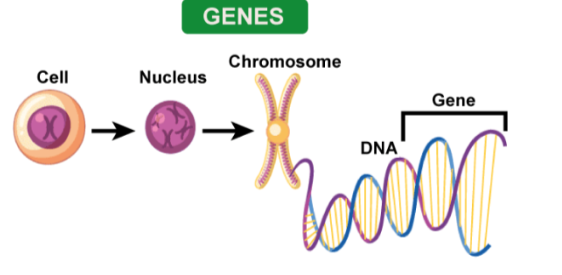 . On what structures are genes found? chromosome
What kind of beak would a finch need to have to pick insects off a cactus? small and straight
What does an energy pyramid show? ____The flow of energy in an ecosystem_____________________
. Which group belongs to carnivores? ___secondary consumers
Which group belongs to herbivores? producers and primary consumers
WHat is Carbon?
an element
the basis of life of earth
found in rocks, oceans, atmosphere
A chemical
building block of life
Carbon cycle
The same carbon atoms are use repeatedly on Earth. They cycle between the earth and the atmosphere.
Plants pull carbon dioxide from the atmosphere and use it to make food- photosynthesis
The carbon becomes part of the plant (Stores food)
Photosynthesis- the plant make food in the form of sugar (C6, H12, O6) or another type but it still contains carbon
When organisms eat plants, they take in the carbon and some of it becomes part of their own bodies
When plants and animals die, most of their bodies are decomposed and carbon atoms are returned to the atmosphere
some are not fully decomposed and end up in deposits underground (oil, coal, etc.)
Carbon in rocks and underground deposits is released very slowly into the atmosphere(this process takes many years)
Additional carbon is stored in the ocean
Many animals pull carbon from water to use in shells, etc.
Animals die and carbon substances are deposited at the bottom of the ocean
ocean contains earth's largest store of carbon
Humans impact
fossil fuels release carbon stores very slowly
burning anything releases more carbon into the atmosphere- especially fossil fuels
Increase carbon dioxide in atmosphere increases global warming
fewer plants mean less CO2 removed from atmosphere
Force
push or pull
described by its size and direction
all motion is created by force
all forces are exerted by one object on another
the unit of force is the newton
Unbalanced forces cause acceleration
If the object is at rest, force makes it move
any change in velocity is acceleration
right=positive
left=negative
Balanced forces cause no changes
Netforce (equation) = Fn + Fg = 10N + (-10N)
netforce (Definition) - all of the forces together
sliding friction- movement of one surface past another
Rolling friction- resists a motion of a rolling object
static friction- resists the motion of an object as it resist to move
friction- force that resists the movement of one surface past another (sliding or rolling over it)
one tool to measure the force of gravity is the spring scale
Types of forces
air resistance force
applied force
spring force
frictional force
gravitational force
electric force
normal force
magnetic force
air resistance force
basically friction between an object and air
Applied force
when a living creature puts pressure on a object
Spring force
when an object is oushed together, then when presure is taken away and pops back to it's normal self
frictional force
everywhere in our daily life
impossible to reduce it completely
The cause of resistive force of friction are molecular adhesion, surface roughness, and plowing effect
Adhesion is the molecular force resulting when two materials are brought into close contact with eachother
Electrical force
The attractive or repulsive interaction between any two charged objects is an electric force. Like any force, its affect uoon objects
Normal force
The support force exerted upon an object which is in contact with another stable object
Ex: if a book is resting upon a surface, then the surface is exerting an upward force upon the book in order to support the weight of the bank
Magnetic force
Magnetic force is the force exerted by a magnetic field on a moving electric charge or a magnetic material.
"Like gravitational and electrical forces, the true nature of magnetic force is not fully understood. However, magnetic force is different because its energy comes from changes in an electrical field over time."
Water resistance- friction between water and an obkect. The water slows down an object going through it.
Speed= distance/time
speed1 + speed 2 + speed 3
average= -------------------------------
3
GRAVITY
gravitational force- the force of attraction between any object and every other object
all life on earth is affected by gravity
gravity depends the mass of an object, the stronger gravitational force
gravitational force depends on distance between 2 objects
if the distance between 2 objects increases, the gravitational pull between them decreases
WEIGHT V.S. MASS
Mass and weight may seem like the same thinng but in fcat these two measurments are very different
Mass- total amount of matter, or "stuff", in an object
Weight is the force of gravity on an object
Mass always stays the same, but weight can change depending on how mucj gravity is acting upon an object
Object are pulled toward the center of rhe earth by a force we call the weight of an object
MOTION
FRAME OF REFERENCE
The way you describe motion depends on your frame of reference
The frame of reference is the ibject ab ibserver uses to detect motionWhen riding on a rollar coaster, if the seat is your frame of reference, then you are not moving relative to the seat
However, if the ground is your frame of reference,then the seat is moving relative to you while the ground is not.
Typically, we consider earth to be our frame of reference
As you dit in your desk you're not in motion related to earth
relative to the sun you're in motion as you whirl through space
KINDS OF MOTION
circular motion
straight-line motion
vibrational motion
Circular motion
takes place around a central point
EX: Ferris wheel, Earth's prbit, Bicycle wheel
STRAIGHT-LINE MOTION
motion along a straight line
Ex: bicycle traveling down a path, parade moving along a road, firing a bullet, sliding door, elevators
VIBRATIONAL MOTION
a vibration is a rapid back and forth motion
occurs when an object moves back and forth about its mean position
Ex: strings on a violin or guitar
OTHER WORDS FOR MOTIONLESS
still
unmoving
stationary
fixed
immobile
SPEED
The speed of an object measures how fast it's moving
a quantity in physics to describe "how fast an object is moving"
You can find speed by dividing the distance traveled by the time needed to move that distance
Soeed is often measured in kilometers per hour
The prefix kilo means 1,000 meters
Average speed = distance/time
CONSTANT SPEED V.S. CHANGING SPEED
An object speed at any moment is instaneous speed
the speedometer of a cartells the instanrous speed that the car is traveling
VELOCITY
The speed of an object in a particular direction
On the bus's first trip, it's velocity would be 54km/ h east
On the return trip, its velocity would be 54km/ h east
A chance in either speed or direction causes a change in velocity
The velocity of an object moving along a curved path constuantly changes because the direction is always changing.
ACCELERATION
The motion of moving objects usually isn't constant
The instaneous speed and direction of motion may change
Accekeration is the rate at which velocity changes
The bus accelerates when we speed up
Acceleration isn't jsut going faster
also happends when an object slows down or changes direction
Each time the bus moved slower or travels around a curve, it's accelerating
The velocity of an object can only change if a force acts on a object
Acceleration is therefore the result of unbalanced forces acting on eachother
NEWTON LAWS OF MOTION
FIRST LAW OF MOTION
an objrct remains at rest or in constant motion un;ess an unbalanced force acts on it
an object remains at rest or in constant motion unless an unbalanced force acts on it
Ex: if you place your book on a desk the book will not move unless you pick it up or another force acts unit
Ex: if you place a soccer ball on a field you have to kick it to move
law of inertia
inertia is the tendency of an object to remain at rest or in constant motion unless a force acts on it
SECOND LAW OF MOTION
the acceleration of an object depends on the mass of the object and the size of the net force applied
force/mass=(Mass x Acceleration)/mass
Acceleration= force/mass
The equation shows that accelerayion is affected by both force and mass
The direction of acceleration depends on the direction of force on the object
THIRD LAW OF MOTION
When a force is applied to an object, the object exerts an equal force in the oppisite direction
law of action and reaction