Cells and Cell Theory
OVERVEIW:
-Koch’s postulates
-Pathogens (Antibiotics, resistance)
-Prokaryotes V Eukaryotes
-Prokaryotic organelles
-Eukaryotic organelles
-Cell specialization
-Cell theory
-Endosymbiotic theory
-Plant V animal cells
[[Koch’s Postulates[[
Koch’s postulates are steps to find if a microorganism is causing disease. The steps are:
1. ==Collect samples== from diseased animals2. ==Grow== microorganisms in a culture and ==identify==.3. ==Inject== each culture into an animal4. ==Re-isolate== the microorganism from the step 3 animal.5. ==Grow== the culture and ==identify== if it is the ==same== as from step 2. ]]Pathogens:]] A pathogen is an ==organism that can cause disease==. They include parasites, fungi, protists, and viruses. Pathogens are not the only things that cause disease, but they are common causes. ==Antibiotics== are one way to fight of diseases, specifically those caused by bacteria. Antibiotics stop metabolism in bacterial cells to stop them from causing disease. However, bacteria can develop antibiotic resistance when they mutate and can no longer be killed by antibiotics {{Prokaryotic VS Eukaryotic Cells{{ Prokaryotic cells are the smaller, less complex cells of the two. They have , evolved first, and are about 4 billion years old. All prokaryotic cells are bacterial cells! These are the larger, more complex cells of the two. They have a nucleus, evolved second(see endosymbiotic theory), and are around 2 billion years old. These are non bacterial cells, so animal cells, plant cells, fungi, and protists are all eukaryotic. All cells have -DNA/RNA -Cell membrane -Cytoplasm -Ribosomes }}Bacterial Cells (Prokaryotic)}}Bacterial cells come in %%3 shapes.%%
Coccus: Circular shape
Bacillus: Oval/sausage shape
Spiral: Spiral shape
There are also two different types.
Gram positive-Thinner capsule
Gram negative-Thicker capsule
%%Organelles of Prokaryotic Cells:%%
Flagella-Tail-like things used to move the cell through water
Pili- Hair like organelles that are used to stick to surfaces and other bacteria
Capsule- Strong, armor like outer coating. Only some cells have it.
Cell wall-Protects the membrane. Not hard in prokaryotic cells.
Plasmid-Tightly coiled DNA
Cell membrane-Controls what goes in/out of cells
Ribosomes/ RNA-Makes proteins
Cytoplasm- The gooey substance on the inside of the cell where most chemical reactions take place.
DNA- Uncontained, free floating strands of DNA
Nucleoid area-The area the DNA is in. 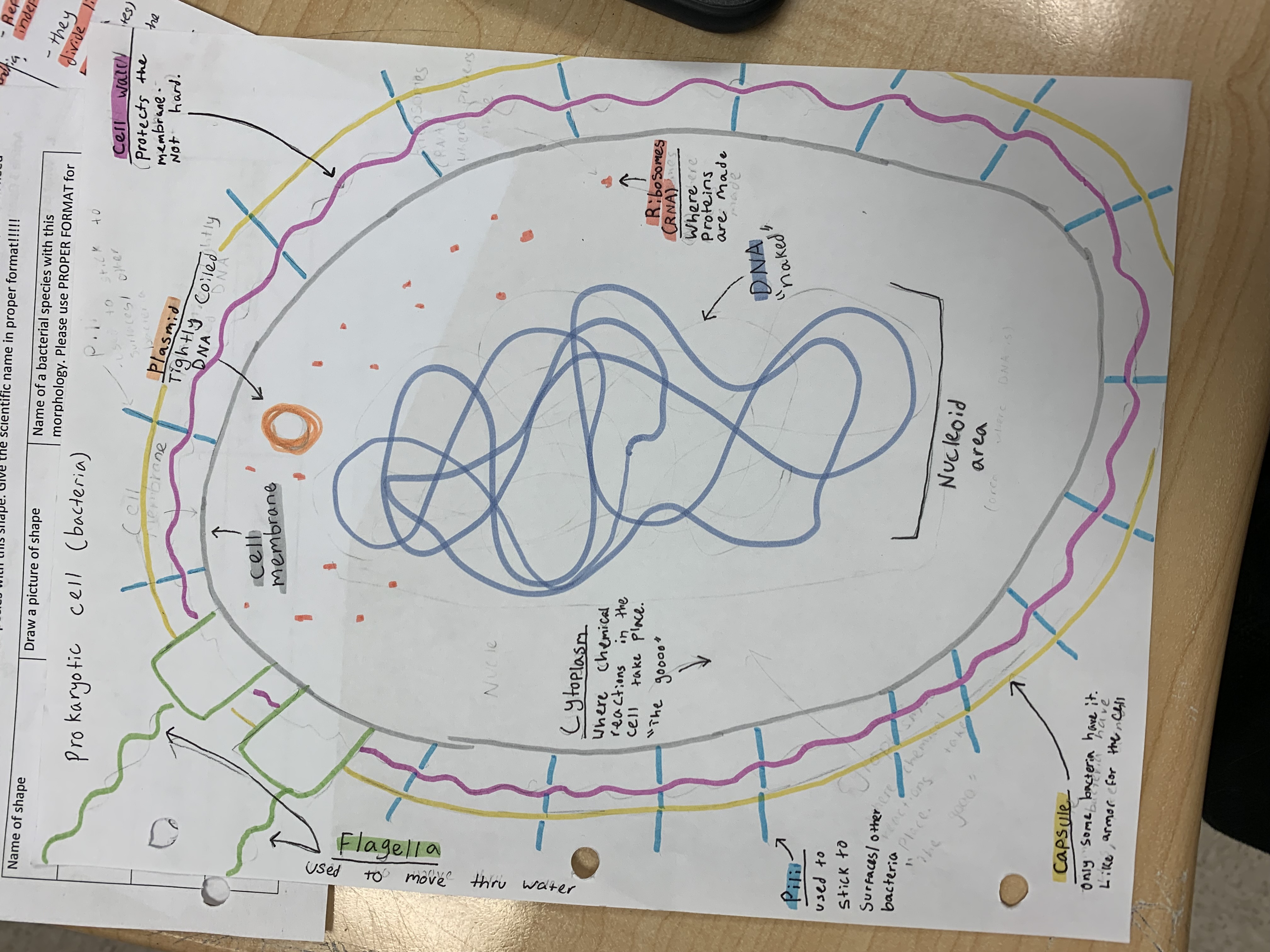 <
<
]]Cell specialization]]
Cell specialization means that a cell has a specific function in a multicellular organism. Cell specialization never occurs in unicellular organisms or STEM cells.
Three main tenants:
1. All living things are made of 1+ cells
2. Cells come from pre-existing cells
3. Cells are responsible for all structures and functions of life Stuff has been added on to cell theory throughout time. Many scientists throughout the years have added onto this theory. The microscope was essential to developing this theory. Scientists who contributed to cell theory: @@Robert Hooke@@-English scientist who discovered cells by looking at cork cells under a microscope. Named cells after the cells in a prison/monastery.
@@Anton van Leuwenhoek@@-as the first person to describe single celled life, invented single lens microscope.
Theodor S
The idea widely used before this was @@spontaneous generation@@, which was the idea that life could be made from non-living/dead things. Ex: Flies from bananas