Week 15: Newborn Assessment
Newborn Assessment Class Notes
Objectives
Review the health promotion and maintenance of a newborn
Assist clients with performing and learning newborn care
Techniques of physical assessment
Non-pharmacological comfort interventions
Nutrition
Infant safety & nursing care and discharge teaching
Assessment and management of newborn complications
Newborn Assessment Overview
Understanding physiological responses in a newborn and physical assessment findings is imperative for providing nursing care following birth.
Key Topics:
APGAR Score
Normal newborn appearance
New Ballard Score
Newborn Vital Signs & measurements
Procedures and baby care
Skin is wrinkly, as it is sitting in amniotic fluid.
Blue hands and feet (acrocyanosis), as their body’s perfusion is focused on the vital organs.
Tiny white papules are normal (milia). Erythemia toxica, newborn rash. Epstein pearls, white/yellow cysts that are on the gums, not natal teeth.
Lanugo, fine hair that covers the fetus, is often present and sheds shortly after birth.
Normal Newborn Appearance
Newborn Priorities:
1st Priority: Airway
2nd Priority: Warmth
Newborn Procedures in First Hours
Procedures include suctioning, cord cutting, and APGAR scoring.
Parents can hold their baby skin to skin during these procedures.
Cord cutting is when the baby starts to work independently, breathing on their own, and AVA closes.
Suctioning: Suction the mouth first before the nose to prevent aspiration.
Done especially for C-section, as you are immediately removing them from the abdomen.
When delivering vaginally, the compression of contractions enhances the lung’s ability to remove secretions post-birth.
AVA: The veins have stem cells (which can be donated) and have a jelly substance called Wharton's jelly that provides cushioning and support to the umbilical cord, protecting the blood vessels during pregnancy.
APGAR Scoring
Purpose: Assess the newborn's adjustment to extrauterine life at 1 minute and 5 minutes after birth.
Scoring Criteria:
7 - 10: Indicates minimal or no difficulty adjusting.
4 - 6: Indicates moderate difficulty.
< 4: Indicates need for resuscitation.
APGAR Components and Scoring
Criteria | Score 0 | Score 1 | Score 2 |
|---|---|---|---|
Respiratory Effort | Absent | Weak/Grunting | Strong Cry |
Heart Rate | Absent | <100 BPM | >100 BPM |
Muscle Tone | Floppy | Some Flexion | Active Movement |
Reflex Response | None | Grimace | Cry on Stimulus |
Color | Blue/Pale | Acrocyanosis | Pink |
Normal Newborn Vital Signs
Heart Rate: 110-160 BPM
Tap your foot along to follow the heartbeat better.
Transient murmurs are not abnormal.
Respiration: 30-60 breaths per minute
Short periods of apnea, no longer than 15 seconds.
Blood Pressure: 60-80 systolic, 40-50 diastolic
Typically not done unless in the NICU.
Temperature: 97.7 - 99.5 °F
Done in auxiliary.
Adjustments to extrauterine life involve rapid changes in the respiratory and circulatory systems, including the closure of the ductus arteriosus, foramen ovale, and ductus venosus.
Transient heart murmurs can be normal.
Heart Rate Variability
The average heart rate at 140 BPM at birth.
Variations in heart rate include:
70-100 BPM during sleep
110-160 BPM when awake
Point of Maximum Impulse (PMI) is located at the 4th intercostal space to the left midclavicular line.
Physical Assessment: Temperature Regulation
Temperature can drop due to exposure and skin heat-loss mechanisms, stabilizing within 8-12 hours post-admission.
A newborn should NEVER have a fever during the first couple weeks of life.
If this is the case, a spinal tap would be required.
Signs of infection include:
Temperature instability
Deviation >1°C (2°F) should be monitored at least once every 8 hours.
Increased temperature may indicate overheating.
Newborn Thermoregulation
A newborn’s temperature is initially high due to a warm uterine environment, which drops drastically after birth.
Skin-to-skin is the best way to maintain temperature.
Large body surface area, limited ability to shiver, and underdeveloped subcutaneous fat contribute to a newborn's susceptibility to hypothermia, making careful monitoring of their temperature essential.
Mechanisms of heat loss include:
Evaporation: Moisture loss from skin and lungs
Prevention: Dry the infant immediately after birth.
Convection: Heat loss to cooler air
Prevention: Keep the bed away from open windows.
Conduction: Heat loss to cooler surfaces
Prevention: Warm stethoscopes and other instruments before use, and place a blanket on a scale before weighing them.
Radiation: Heat loss to nearby cooler objects
Prevention: Keep the infant away from fans/AC.
Preventive measures for each mechanism are necessary.
Respiratory Assessment
Average of 30-60 respirations per minute with abdominal rising and falling during breathing.
Signs of respiratory distress may include nasal flaring, retractions, grunting, tachypnea (>60 breaths/minute), and episodic breathing is normal.
Key Techniques for Assessment
Count the respiratory rate for a full minute, and auscultate the anterior and posterior chest.
Be mindful of color and heart rate changes in newborns.
Newborn Measurements
Weight
Average: 3405 g (7 lb, 8 oz)
Range: 2500-4000 g (5 lb, 8 oz to 8 lb, 13 oz)
Physiologic weight loss: 5-10% for term newborns, up to 15% for preterm newborns
Growth: 198 g (7 oz) per week for the first 6 months
Length
Average: 50 cm (20 in)
Range: 46-56 cm (18-22 in)
Growth: 2.5 cm (1 in) per month for the first 6 months
Head Circumference
Average: 33-35 cm (13-14 in)
Range: 32-37 cm (12.6-14.6 in)
Big heads because the brain is the fastest-growing muscle in the body.
Chest Circumference
Average: 32 cm (12.6 in)
Range: 30-35 cm (11.8-13.4 in)
Newborn Appearance
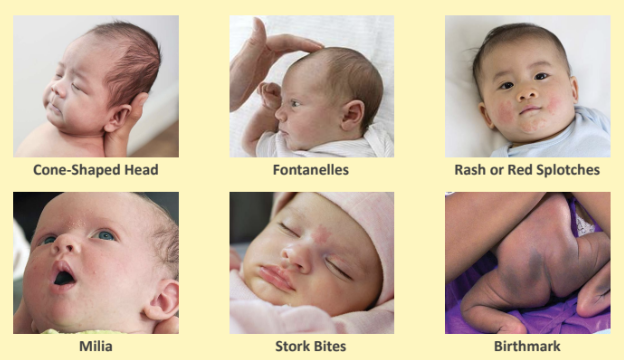
Typical features include:
Cone-shaped head due to molding during delivery
Fontanelles (soft spots on the skull)
Common rashes or red splotches
Milia (small white spots on the face)
Stork bites (salmon patches) and other birthmarks
Newborn Head Molding
Caput Succedaneum: Edema that crosses suture lines
“It sucks”, doesn’t look good.
Cephalohematoma: Birth trauma with a collection of blood not crossing suture lines
Seen in children born using a vacuum or forceps. Greater concern!
Congenital Dermal Melanocytosis
Formerly referred to as Mongolian spots.
Benign, flat, dark blue-gray markings that are often found on the lower back and buttocks of newborns.
They typically fade during the first few years of life and are more common in infants with darker skin tones.
Caused by melanocytes in deeper skin layers.
Normal Variants
Acrocyanosis: Normal blueness of hands and feet in the first 24 hours.
Cyanosis: May also include circumoral cyanosis; it often indicates cooler temperatures.
Sign of poor oxygenation. This is alarming, especially if it’s seen around the tongue and the mouth.
New Ballard Score
Assesses neuromuscular and physical maturity of newborns.
Total score indicates weeks of gestation (e.g., a score of 35 equals 38-39 weeks of gestation = approximately full-term).
The higher the score, the more maturity.
Premature babies may have lower scores as they are “floppy”.
Heel to ear: means you could take a baby’s foot to their ear and measure their flexibility and muscle tone.
Typically done when mom hasn’t done any prenatal care, if the baby is born too large or too small.
View handout!!
Newborn Medications
Newborns lack intestinal flora at birth (considered sterile until 7 days after birth); vitamin K is necessary for blood clotting.
Vit K is administered to prevent hemorrhage and bleeding.
Eye Prophylaxis
Administered to prevent gonococcal and chlamydia ophthalmia (the worst pink-eye infection that could lead to blindness if untreated).
Options for administration:
0.5% Erythromycin, 1 cm ribbon
Start at the inner to the outer canthus of the eye, applying the ointment gently along the lower conjunctival sac to ensure maximum coverage.
1% Tetracycline, 1 cm ribbon
1% Silver Nitrate Solution, 2 drops
Vitamin K
A single injection is recommended for every newborn to prevent bleeding issues.
Signs of Vitamin K deficiency may include:
Oozing from the umbilical stump
Blood in stool or vomit
Excessive bleeding from circumcision.
Hepatitis B Vaccine
Administered within 12 hours after delivery or before discharge.
Induces productive anti-hepatitis B antibodies.
Three doses are recommended at 0, 1, and 6 months for optimal immunity.
Do it on the opposite leg from vitamin K to determine an allergic reaction.
Reflexes in Newborns
Moro Reflex: Startle reflex
Spreading out of the arm and pulling in.
Rooting Reflex: Baby turns towards the cheek that is touched
Tonic Neck Reflex: Head turns to the side, extending that arm and leg while flexing the opposite ones
Other reflexes include the Grasp reflex and Babinski reflex (a positive Babinski reflex indicates immature neurological pathways).
Palmer: When they grab the finger of someone with their palm.
Planter: put a finger and watch the baby’s toes wrap around the digit.
Babinski: brush your thumb against the foot of the baby, and they fan out/curl their toes.
Newborn Head-to-Toe Assessment
Head: Observe the shape and size of the head, checking for any abnormalities such as asymmetry or malformations.
Ears that are not aligned with the eyes (lower onset ears) would indicate Down syndrome.
Starbiusis/Lazy Eyes: not abnormal in newborns.
Compress one nostril at a time to assess nares functionality.
Listening to heart and lung sounds: Evaluate the heart rate and respiratory rate (40-60, with short periods of apnea) while observing for any abnormal sounds or difficulties in breathing.
Look at their back: dimples may indicate potential spina bifida or other neural tube defects, while a smooth, symmetrical back is a normal finding.
Assessing reflexes: Check for other newborn reflexes, such as the Moro reflex, in which the baby startles in response to a sudden noise or movement, and the rooting reflex, in which the baby turns their head towards a stimulus when the cheek is stroked.
Assess sucking reflex and palate.
Crepitus: could indicate bone fractures, seen in shoulder dystocia babies.
Count fingers and toes, indicate any abnormalities; an extra digit (polydactyly) could be common if genetic and can be removed.
The diaper area is inspected last.
Boys may be edematous in their genital area.
Psdeuomenstration: Presented due to mom’s hormones, and you’ll find some blood in the baby girl’s diaper within the first week of life.
Infant Feeding
Breastfeeding Benefits
Promotes immunity and nurtures the mother-baby bond.
Cost-effective and environmentally friendly.
Acts as a natural contraceptive and prompts oxytocin production.
8 or more feeds in 24 hours.
Formula Feeding
Comes in three forms: powdered, concentrated, and ready-to-feed.
Digests more slowly than breast milk, may spoil quickly, and should never be microwaved.
Newborn Care Procedures
Procedures include:
Testing and health assessments.
Discharge teaching should cover safe sleeping positions, immunizations, feeding schedules, and car seat usage.
Newborn Screening Tests
Involves a heel prick to test for metabolic conditions that may not show symptoms but require immediate treatment.
Usually done 24 hours after birth.
These tests are crucial for early detection of conditions such as phenylketonuria (PKU) and congenital hypothyroidism, ensuring timely intervention to prevent long-term complications.
Hearing tests are performed shortly after birth.
Circumcision:
The surgical removal of the foreskin of the penis. It is essentially a cosmetic procedure.
Vitamin K must be given before this procedure, and the baby must have voided at least once.
Hemorrhage/bleeding is the most common complication. Other potential complications include infection and pain, which should be monitored closely during the recovery period.
Reasons for circumcision:
Religious beliefs: A common practice in many faiths, including Judaism and Islam.
Cultural significance: Certain cultures view it as a rite of passage or tradition.
Medical reasons: Conditions like phimosis or recurrent urinary tract infections may necessitate circumcision.
Given lidocaine or oral sucrose for pain management.
Oral sucrose given PO, 1-3 cc 2 minutes before a procedure. Analgesic effect may last 5-8 minutes from the first administration.
Complications in Newborns
Common complications include neonatal substance withdrawal, hypoglycemia, respiratory distress syndrome, and infections.
Wellness screening and management of jaundice and other conditions are essential for newborn health.
Diapering (I’s & O’s)
Proper diapering techniques help monitor input and output, ensuring the newborn is adequately hydrated and recognizing any potential health issues early.
Day 1-2: meconium
Day 3-4: transitional
Day 5+: breastfed baby (lighter colored poop).
Improper cleaning can lead to UTI and even sepsis.
5 S’s of Soothing an Infant
Swaddlie
Suck
Shush
Swing/Sway
Side/Stomach Position
Shaken Baby Syndrome/Abusive Head Trauma
Caregivers should be educated on safe handling techniques to prevent injuries and promote healthy development in newborns.
This may happen when you shake, drop, throw, or hit a baby.
Long-term effects can be extremely serious:
Brain damage
Blindness
Deafness
Vegetative state
Paralysis
25-30% of shaken babies die.
Sudden Unexpected Infant Death (SUID)
The leading cause of death in infants under one year.
Preventative measures include proper sleeping positions and avoiding overheating.
Risk Factors:
Age (birth-6 months is at a higher risk)
Sleep position
Preterm infant/low birth weight
Sibling death
Exposure to nicotine
Lower socioeconomics
Lack of prenatal care
Genetics
Bedding
Prevention:
Tummy time
Breastfeeding
Checkups
Avoid overheating
Sleep
No smoking
Safe sleep (ABC’s)
Alone
Back
Crib
Pacifier use is recommended during sleep as the constant sucking reflex puts them in an easily arousable state of sleep instead of deep REM sleep.
Car Seat Safety
Emphasize rear-facing as long as possible.
Encourage parents to have installations checked at certified stations.
Ethical and Practical Implications
Educating parents on newborn care is critical for preventing complications and ensuring safe developmental practices.
By capturing all of this information in a structured manner, students can have a comprehensive understanding of newborn care and assessments necessary for nursing practice.