L29 Genetics and Pedigrees
Page 2: Family Pedigree Overview
Family Structure Diagram
Mexico family structure outlines familial relationships and health issues.
Members include:
Grandparents: Father (60's, colon cancer), Mother (70's, breast cancer diagnosed at 68)
Uncles and Aunts with various health issues (high cholesterol and blood pressure)
Siblings and cousins with age differences and health conditions described.
Notable conditions include heart attacks and clubfoot noted in family relationships.
Page 3: Understanding Pedigrees
Definition and Key Features
Pedigrees: Diagrams of family relationships, representing modes of inheritance (MOI).
Key Symbols:
Symbols = People
Lines = Genetic Relationships
Horizontal Lines = Mating
Vertical Lines = Offspring
Shading = Trait of Interest
Circles XX = Females; Squares XY = Males
Diagonal line denotes a deceased individual.
shading = trait of interest
Page 4: Genetic Disorders
BRCA2 Deficiency
BRCA2 as a genetic mutation reference; additional details or images listed under Creative Commons License indicating its importance in genetic studies.
Page 5: Sex Chromosome vs. Autosome Traits
Gene Location Importance in Inheritance
Pedigrees assist in identifying if a trait's gene resides on an autosome or a sex chromosome.
Page 6: Implications of Gene Positioning
Understanding Inheritance Patterns
Autosomal Traits: Passed from parents to offspring independent of sex chromosomes.
X-Linked Traits: Almost exclusively inherited via the X chromosome affecting individuals' sex determination (XX or XY).
Knowledge of inheritance types influences couples' reproductive decisions.
Page 7: Four Possible Modes of Inheritance (MOI)
Autosomal Recessive: Examples Cystic Fibrosis and Sickle Cell Anemia.
Autosomal Dominant: Example is Retinoblastoma.
X-Linked Recessive: Example is Duchenne Muscular Dystrophy.
X-Linked Dominant: Example is Rett Syndrome.
Page 8: Complexity of Inheritance
Evaluating Pedigree Complexity
Understanding that there are no shortcuts to determine which MOI applies, and some pedigrees may display multiple MOI.
Page 9: Pedigree Labeling Techniques
Freedom to choose labelling methods for pedigrees, with the necessity of including a legend for clarity.
Allelic Representation:
Autosomal = A+A+, A+A-, A-A-
X-Linked = XA+XA+, XA+XA-, XA-XA-, XA+Y, XA-Y
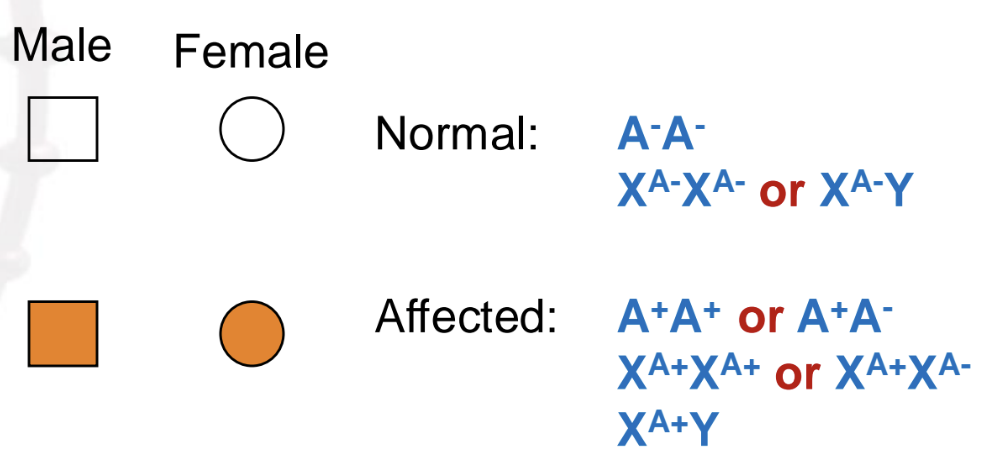
Page 10: Dominant Trait Legend
Understanding Dominant Traits in Pedigrees
Male:
Normal: A-A-
Affected: A+A+ or A+A-
Female:
Normal: XA-XA- or XA-Y
Affected: XA+XA+ or XA+XA- or XA+Y
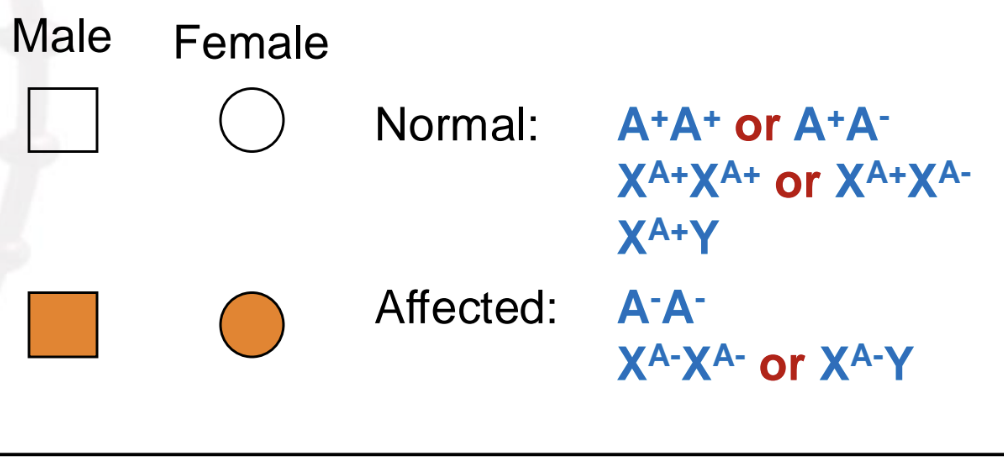
Page 11: Recessive Trait Legend
Understanding Recessive Traits in Pedigrees
Male:
Normal: A+A+ or A+A-
Affected: A-A-
Female:
Normal: XA+XA+ or XA+XA- or XA+Y
Affected: XA-XA- or XA-Y
Page 12: Key Takeaways from Pedigree Analysis
Parents are not assumed to be true-breeding strains, always investigate homozygosity.
Autosomal Dominant traits require individuals to be labeled distinctly: homozygous dominant vs. heterozygous.
Page 13: Understand Obligatory Heterozygosity
Distinguishing between normal (A-A-) and affected (A+A+) or (A+A-) individuals.
Critical to label individuals correctly for accurate pedigree analysis.
Page 14: Pedigrees as Data Representation
Recognition that pedigrees are often small and do not provide full 1:1 or 1:2:1 ratios.
Page 15: Dominant vs. Recessive Traits
Visual Representation
Autosomal Dominant Trait: Normal: A-A-, Affected: A+A+ or A+A-.
Autosomal Recessive Trait: Normal: A+A+ or A+A-, Affected: A-A-.
Page 16: X-Linked vs. Autosomal Traits
Identification Strategies
Identification of inheritance types through definitions/examples of X-Linked Dominance and Autosomal Dominance.
Page 17: Male-Male Transmission
Identifying Autosomal Inheritance
Male to male transmission supports an autosomal trait; identifies the importance of understanding inheritance modes.
Page 18: Practice Exercise
Trial Dominant Inheritance Scenario
Understanding contributions to traits based on pedigree analysis, further reinforcing MOI practice.
Page 19: Importance of Comprehensive Data
Generational Analysis
Importance of collecting data from multiple generations to accurately determine MOI from pedigrees.
Page 20: Pedigree Analysis Exercise
Exclusion Methods for X-Linked Inheritance
Analyze pedigree data to exclude possible inheritance types based on male to male transmission.
Page 21: Mixing Modes of Inheritance
Key Reminders
Avoid mixing alleles from different inheritance modes: either autosomal or X-linked, but not both.
Page 22: Simplicity in Analysis
Recessive Hypothesis Evaluation
Consider statistical likelihood of recessive traits across generations; review clues in exam questions for dominance or recessive indications.
Look at question text for clues:
Is the disease present in every generation?
Is the family outbred?
suggests dominance
Is the family inbred?
Are generations skipped? (data missing)
suggests recessive
Page 23: Understanding Inbreeding
Review of Genetic Relationships
Discussion on inbreeding and its relation to genetic diseases; focus on the family members involved and their potential genetic links.
Page 24: Inbreeding Analysis
Key questions to determine inheritance type and mode based on family relations and genetic conditions noted in pedigree analysis.
Page 25: Genetic Disease Inquiry
Autosomal vs. X-Linked Enquiry
Thought exercise regarding dominant and recessive classifications for diseases within pedigree contexts.
Page 26: Confirmation on X-Linked Traits
Analyze unaffected members of the pedigree to rule in or rule out X-linked inheritance hypotheses based on the traits present.
Page 27: Autosomal Confirmation
Critical Analysis
Evaluating potential for an autosomal recessive disease based on observed family member traits in the pedigree.
Page 28: Exploring Albinism
Mode of Inheritance Practice
Exercises to explore albinism through all four modes of inheritance presented earlier in the course slide.