exam 2
Exam 2
Immune System
Part 1 Innate Defenses
Surface Barriers: Skin and mucosae
Innate internal defenses: Cells; Phagocytes, Natural killer cells, Inflammation, Antimicrobial proteins, fever
Part 2 Adaptive Defenses
Antigens
Lymphocytes and antigen-presenting cells
Humoral immune response > B Cells
Cellular immune response > T Cells
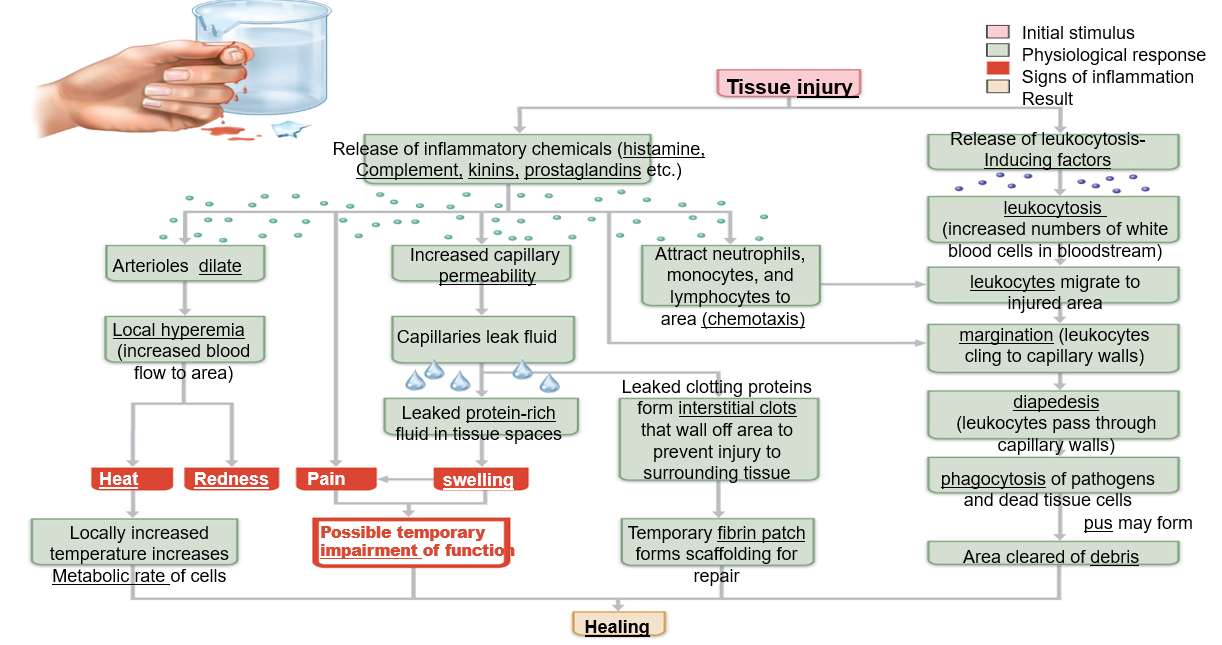
Tissue injury
Repair by connective tissue involves the influx of debris-removing inflammatory cells, formation of granulation tissue (a substance consisting of fibroblasts and delicate capillaries in a loose extracellular matrix) and conversion of said granulation tissue into fibrous tissue that is remodeled over time to form a scar
Phagocytosis:
Phagocyte adheres to Pathogens or debris
Phagocyte forms pseudopods that eventually engulf the particles, forming a phagosome
Lysosome fuses with the phagocytic vesicle, forming a phagolysosome
Lysosomal enzymes digest the particles, leaving a residual body
Exocytosis of the vesicle removes indigestible and residual material
Phagocyte mobilization: Phagocytes migrate into tissues to combat infection and maintain tissue homeostasis
Leukocytosis: Neutrophils enter blood from bone marrow
Margination: Neutrophils cling to capillary wall
Diapedesis: Neutrophils flatten and squeeze out of capillaries
Chemotaxis: Neutrophils follow chemical trail
Innate defenses -> Internal defenses
Virus enters cell and replicates
Interferon genes switch on
Cell produces interferon molecules
Interferon binding stimulates cell to turn on genes for antiviral proteins
Antiviral proteins block viral reproduction
Second line of Defense: Innate cellular
Phagocytes: Engulf & destroy pathogens that breach surface barriers
Natural Killer (NK) Cells: Promote apoptosis (cell death) by attacking virus-infected or cancerous body cells
Inflammatory response: Prevents injurious agents from spreading to nearby tissues, disposes of pathogens & dead tissue cells & promotes tissue repair (attracts phagocytes to area)
Interferons: Proteins released by virus-infected cells; act as chemical messengers to protect uninfected tissue cells from viral takeover
Fever: High body temperature inhibits microbes from multiplying
Adaptive Response
Origin: Both B and T lymphocyte precursors originate in red bone marrow
Maturation: Lymphocyte precursors destined to become T cells migrate to the thymus and mature there | B cells mature in the bone marrow
Seeding: Secondary lymphoid organs and circulation; immunocompetent but still naïve lymphocytes leave thymus and bone marrow and circulate through blood and lymph
Antigen encounter and activation: When a lymphocyte antigen receptors bind its antigen, that lymphocyte can be activated
Proliferation and differentiation: Activated lymphocytes multiply and then differentiate into effector cells and memory cells
Humoral Immunity
Active Naturally acquired; Infection- contact with pathogen
Active Artificially acquired; vaccine- dead or attenuated pathogens
Passive naturally acquired; antibodies passed from mother to fetus via placenta or to infant in her milk
Passive artificially acquired; injection of exogenous antibodies (gamma globulin)