lab practical
Lab review sheet for Biology 112 –Exam 2
Lab 6– How diseases spread – Epidemiology
Terminology
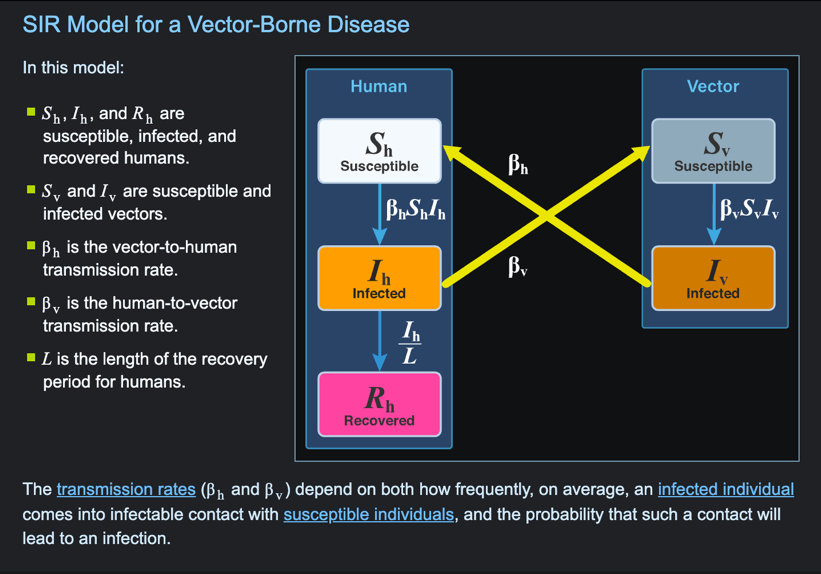
SIR model – tracks the movement of people through susceptible, infected, and recovered to predict the spread of disease and how it will move from one compartment to another.
Direct transmission – disease move from one host to another through direct contact; person to person
Indirect transmission – moves from one host to another through an intermediate agent
R0 – basic reproductive number which can predict whether and how quickly a disease will spread in a population.
Herd immunity – occurs when a sufficient number of individuals in a population are immune to a disease such that the disease will not spread through the population. Can be achieved through vaccination or immunity with previous exposure to the pathogen.
Inanimate vector – an inanimate agent responsible for spreading pathogens
Biological Vector – a biological agent responsible for spreading pathogens and transmitting disease from an infected individual to a susceptible one without being infected themselves.
Fecal-oral transmission – when the fecal material of an infected individual enters a body of water or is, in some way, consumed by a susceptible individual.
Susceptible individual (S) – individual capable of being infected
Antibiotics – chemicals that target processes unique to bacteria
Viral Vs Bacterial infection – bacterial can be treated with antibiotics
Quarantine – practice of physically isolating an infected individual that is sufficient to slow or stop disease transmission.
Infections period (L) – the average period of time that an infected person can transmit the disease to a susceptible person.
Transmission rate (β) – the rate (per unit of time) of disease transmission between infected and susceptible individuals in the population. Depends on how frequently susceptible and infected people made contact.
Infections individual (I) – individual infected with the pathogen and is able to transmit the disease to others
Virulence – level of harm caused to a host by a pathogen. Usually calculated by level of mortality.
Describe the different modes of transmission for diseases.
- Indirect and Direct
Describe the difference between viruses and Bacteria.
- Bacteria are single cells that can survive on their own, inside or outside the body. Viruses cause infections by entering and multiplying inside the host's healthy cells
Describe the different ways in which the spread of viruses can be controlled.
- Herd immunity: when individuals who are immune to a disease ensure that it does not spread to more susceptible individuals. Herd immunity is achieved when the proportion of vaccinated individuals is greater than the critical immunization threshold (pc)
- Community Mitigation Strategies: actions taken to slow spread of infectious disease that can be used when vaccines and drugs are not available.
How do quarantines and vaccines reduce the spread of diseases?
- Reduce the frequency of contact between susceptible and infected people.
Does the method of control depend on the transmission mode of the virus?
- Yes
What is logistic growth versus exponential growth? What are the characteristics of each type of growth?
- Logistic growth considers resource limitations and carrying capacity (K)
- Exponential growth assumes infinite resources and results in unrestrained population growth.
Describe the SIR model of disease transmission rates. What do each of the terms stand for?
- tracks the movement of people through susceptible, infected, and recovered to predict the spread of disease and how it will move from one compartment to another.
How does changing the numbers in this model affect predicted transmission and infection rates of disease?
- Changing the numbers can change the amount of individuals that are susceptible and infected, which can then change the way the disease is predicted to spread. This means that different prevention methods may need to be used.
Describe what R0 is. Describe how the R0 model is used in determining vaccination rates?
- R0 is the basic reproduction number. The higher the value, the more individuals that need to be immune in order to prevent an epidemic.
At what value of R0 will we see a spread of disease or a cessation of disease spread.
- Higher R0 value means the disease spreads more readily.
How does vaccination rate help the general population?
- Promotes herd immunity
How does the proportion vaccinated affect the SIR model?
- It shows how many individuals are not susceptible anymore. This reduces the a number of contacts between susceptible and infectious people.
How does vaccination rate affect the spread of disease? Why does it affect it in this way?
- vaccines can prevent transmission, potentially leading to herd protection whereby unvaccinated people are protected from infection by the vaccinated people around them because they have less chance of exposure to the virus.
Describe the spread of measles and how it cycles through populations. How does birth rate affect populations and the spread of measles?
- Measles is spread through sneezing and coughing. In places where vaccination is not widespread, it almost exclusively infects children, which confers their lifelong immunity. Thus, children make up most of the susceptible population.
Be able to describe the different curves on a graph that represent the terms of the SIR model.
What is acquired immune response?
- The immune system learns and remembers the pathogens it has been exposed to, so subsequent responses are more rapid
What is the difference between treating a virus versus a bacterial infection?
- Bacteria can reproduce in a dead organism, viruses cannot. The have different treatment methods, antibiotics for bacteria and antivirals for viruses.
How do vaccines work?
- Vaccines contain weakened or inactive parts of a particular organism (antigen) that triggers an immune response within the body.
SimBio lab- Niche Wars
Ecological Niche: a term for the position of a species within an ecosystem
Abiotic interactions: interactions between nonliving components of an ecosystem
Biotic interactions: interactions between living components of an ecosystem
Competitive exclusion: only one species can take up an ecological niche, at a given time
Limiting resource: factors in an ecosystem that are limited (water, food,
etc.) that regulate how many organisms can live in that ecosystem.
Fundamental niche: is the potential niche a species could occupy given the correct circumstances.
Realized niche: is the actual niche a species occupies.
.
Describe what an ecological niche is.
- a term for the position of a species within an ecosystem
Compare and contrast fundamental niche and realized niche. What is a realized niche? How is this different from a fundamental niche?
- Fundamental niche is the potential niche a species could occupy given the correct circumstances. Realized niche: is the actual niche a species occupies.
- Competition can lead to the realized niche being different from the fundamental niche.
What factors make up an ecological niche?
- Abiotic and Biotic factors that a species needs to survive and reproeduce.
How is it that two species can coexist in the same niche? What happens to an organism’s ability to occupy its niche if there is no competition for a limiting resource? What occurs when there is competition for a limiting resource?
- Resource partitioning: when there is a differentiation or separation of niches by space or time that enables similar species to coexist in the same ecosystem.
- Competitive Exclusion
- Character Displacement: When different species are in direct competition for resources within an ecological niche it can result in the development of morphological differences in within the species.
What happens if two species niches overlap?
- Competitive exclusion
Describe what the principle of competitive exclusion is and how it influences survival of species in a habitat.
- The Competitive exclusion principle states that two species cannot occupy the same niche at the same time, one will out compete the other and pressure the other species into extinction in the local area.
Blackboard lab- Animal Behavior
Ethogram: an inventory of meaningful behaviors, organized into categories and clearly defined. For example, an “approach” might be defined as any time one animal comes with 1 meter of another animal in the group
Focal Sampling/follows: In focal animal sampling, a particular subject animal is followed for a set amount of time and all pertinent behaviors are recorded for that subject
Scan sampling: During scan sampling, behavioral data is collected at pre-set time intervals or for pre-determined behaviors.
All occurrences sampling: This sampling method involves recording all of the occurrences of pre-determined behaviors for a specified set of animals for a pre-set amount of time.
Agonistic behavior: aggressive interactions or submissive displays that reveal dominance relationships among group members.
Foraging behavior: these behaviors reveal important information about food preferences, time spent feeding, time spend locating food, and seasonal differences in feeding behavior
Mating behavior: mate choice, competition, parental care, prenatal care
Mate choice: choosing a specific mate based on specific characteristics.
Ad libitum: This sampling method is when an observer records any behaviors of “interest” during breaks from regular sampling schedules
Behavioral event: An event is a behavior which has no appreciable duration and are usually calculated as frequencies.
Dominance hierarchies: type of social hierarchy that arises when members of animal social groups interact, creating a ranking system.
- Describe what an ethogram is and what types of behaviors can be categorized in an ethogram.
- an inventory of meaningful behaviors that are put into categories and defined
- Why do researchers use ethograms?
- allows researchers to compare behavioral results on a particular animal across studies because the same behavioral definitions were used.
- several researchers can collect data simultaneously on different group members and be assured that they are classifying behaviors the same way.
- increases inter-observer reliability, which is incredibly important in collecting accurate and consistent behavioral data.
- Be able to determine what type of sampling techniques are being used in a behavioral experiment.
- Be able to distinguish between the different types of sampling techniques.
- How are behavioral events observed and recorded? Describe what a behavioral event is.
- An event is a behavior which has no appreciable duration and are usually calculated as frequencies.
SimBio Lab – Action Potentials Explored
Neurons: cells in nervous system that use electrical and chemical signals to receive, process, and transmit information.
Action Potential: short pulses of electrical activity that travel along neurons
Neurotransmitters: chemcials that carry information between neurons
Senses:
Stimulus: an aspect of an organism’s environment that is detectable by a neuron
Nociceptors: neuron that detects or transmits information about damaging stimuli or tissue damage.
Axon: cable-like protrusion of the neuron which the action potential travels down
Dendrites: tree-like set of extensions that receive stiumli
Soma: cell body that contains the nucleus
Synapse: at the end of neuron’s axon and allows neuron to communicate with another.
Synaptic connections: where connections with other neurons and input occurs.
Receptive field: a pain receptor responds to stimuli in a specific location
Membrane potential: voltage difference between inside and outside of the cell (Vm)
Resting Potential:
Threshold potential: membrane potential above which a resting neuron will generate an action potential.
Botulinum toxin: deadliest neurotoxin that could kill over a million people. Causes paralysis.
Lidocaine: local anesthetic that blocks pain sensation by interfering with action potential in pain receptors and motor neurons
Ions: atoms or molecules that have a net positive or negative charge due to loss or gain of one or more electrons.
Membranes: encloses a cell, separating inside and outside
Neurotoxins: chemicals that can interfere with neuron functioning
Ion channels: the way ions can move into our out of the neuron is through protiens call ion channels.
Na+ channels: neurons have more concentration of Na+ outside cell than inside
K+ channels: neurons
Diffusion:
Depolarized: when neuron becomes more positive compared to resting potential
Hyperpolarized: when neuron becomes more negative compared to resting potential
Na+/K+ Ion pump: helps maintain osmotic equilibrium and membrane potential in cells.
Transduction: Change in Vm in response to a stiumus
Transduction channels: initial transduction signal is facilitated by these channels that open in response to a particular stimulus.
Voltage-gated Ion channels: When the membrane potential is high enough, electrical forces push the gate open.
- How does an action potential travel from a pain stimulus to the brain?
- Be able to describe the step by step process of stimulus to perception, including the types of receptors that are involved.
- What is occurring in a neuron when it is depolarized? Describe which ions are involved and the direction of their movement across the neuronal membrane.
- when neuron becomes more positive compared to resting potential
- When just Na+ channels are open, the neuron depolarizes because positive charge is entering the cell.
- What is occurring in a neuron when it is hyperpolarized? Describe which ions are involved and the direction of their movement across the neuronal membrane.
- When just K+ channels are open, the neuron hyperpolarizes because positive charge is leaving the cell.
- when neuron becomes more negative compared to resting potential
- What is a threshold stimulus? How is it involved in neuronal communication? What is occurring in the neuron when threshold is reached?
- Threshold stimuli are of enough energy or potential to produce an action potential (nerve impulse).
- How does the intensity of a stimulus affect the transmission of an action potential?
- an aspect of an organism’s environment that is detectable by a neuron. The stronger the stimulus, the more detectable
- What occurs at the synapse between a muscle and a motor neuron? How does the intensity of the stimulus affect the interaction between a muscle cell and a motor neuron?
- at the end of neuron’s axon and allows neuron to communicate with another.
- How do different neurotoxins affect neural signaling? Be able to interpret an action potential signal to determine what type of ion channel is being affected by a neurotoxin.
- chemicals that can interfere with neuron functioning
- How is a neuron’s membrane potential established? What ions are involved? How are they distributed across a membrane at rest?
- Membrane potential: voltage difference between inside and outside of the cell (Vm)
- The resting potential is determined by concentration gradients of ions across the membrane and by membrane permeability to each type of ion
- When there is an action potential, what ion channels are involved? How and when do they open and close?
- Na+ and K+ ion channels are involved and they help maintain osmotic equilibrium and membrane potential in cells.
- K+ channels open first and there is anet movement of K+ ions outside of cell, and Vm becomes negative. When Na+ channels open, Na+ move into the cell and Vm becomes more positive.
- What type of process is involved in the movement of ions across a neuron’s membrane? Is this active or passive transport? What types of transport are involved?
- Active transport is the pumping of molecules or ions through a membrane against their concentration gradient. It requires a transmembrane protein (usually a complex of them) called a transporter and energy. The source of this energy is ATP
SimBio Lab – Isle Royale
Crepuscular
Succession
Per capita: per individual
Carrying capacity: the number of individuals a given environment can support depending on the availability of resources.
Exponential vs. logistical growth: logistic is a population whose growth is limited by resource abundance, and exponential is unlimited growth without resource or predation limitations.
Population oscillation (cycling): population periodically increases/decreases in a predictable patter
Paradox of enrichment: when food availability for the prey increases dramatically, and leads to destabilization in the predator population or the entire food chain.
Null hypothesis: there is no effect or relationship, and any results are by chance.
Alternative hypothesis: claims an effect or a relationship
T-test: used to determine whether or not the average value of tow group sis the same or different
Critical Thinking questions
- What is carrying capacity?
- the number of individuals a given environment can support depending on the availability of resources.
- What happens to population growth as the population nears carrying capacity?
- The growth slows down
- Be able to describe how predator-prey population growth cycle around each other.
- if the prey species rapidly multiplies, the number of predators increases - until the predators eventually eat so many prey that the prey population dwindles again
- Describe how the populations of prey would be different on an island with and without predators.
- Generally the answer is that without predators to suppress their number, prey outstrip available food resources, nesting sites, or some other limited resource and thus begin to suppress their further growth through competition.
- What would happen to the predator – prey interactions on an island if it suddenly had an influx of additional prey species (it originally had 1 prey species but then got another?)
- Without enough food, the predator's population may also die and both animals could become extinct. One animal depends on another.
- What is logistic growth versus exponential growth? What are the characteristics of each type of growth?
- Logistic growth considers resource limitations and carrying capacity (K)
- Exponential growth assumes infinite resources and results in unrestrained population growth
- How would growth rates change in predator and prey species when the abundance of plant life is also taken into consideration?
- This can lead to cyclical patterns of predator and prey abundance, where prey increase in number and then, with abundant food, predator number increases until the predators begin to suppress prey numbers and then decrease as well.
SimBio Lab – Keystone predators
Community ecology: focuses on structures and dynamics of ecological communities
Trophic levels: position of an organism in the food chain
Primary producers vs. consumers: generates its own food vs. gets energy from other organisms
Herbivores: create own energy
Carnivores: energy from other organisms omnivores: both
Filter feeders:
Sessile vs. mobile: stationary vs. moveable
population size index:
biomass:
competition: an interaction between two organisms vying for the same limited resource, such as food, space, or mates.
Predation: (consumption)
competitive dominance hierarchy: summarizes the competitive relationships among species in a community.
food chain: feeding relationships in a community
food web: describe path of consumption and illustrate energy flow
dominant species: species that have more biomass/individuals than any others.
keystone species: species that have large effects on the community despite being rare
community structure: Composition and relative abundance of different types of organisms present in an ecological community
direct vs. indirect effects of predation:
invasive species: exotic species introduced into an ecosystem.
- Describe what community structure is.
- Composition and relative abundance of different types of organisms present in an ecological community
- Compare and contrast Keystone species with dominant species. How do keystone species affect community structure?
- dominant species: species that have more biomass/individuals than any others.
- keystone species: species that have large effects on the community despite being rare
- What is a competitive dominance hierarchy?
- summarizes the competitive relationships among species in a community.
- Be able to rank species according to the competitive dominance hierarchy.
- From the simulation: you should be able to describe the roles of the species in the intertidal zone. Who are the producers? Who are the predators? Who are the filter feeders? Who are sessile? Who are mobile?
- Describe the roles of organisms in the different trophic levels of a food chain or food web? Can organisms occupy more than one trophic level?
- Producers, herbivores, predators
- Organisms can occupy more than one tropic level
SimBio Lab- Nutrient Pollution
Algae: aquatic plant
Algal bloom: rapid and pronounced population growth of phytoplankton
Asexual reproduction: a mode of reproduction in which a new offspring is produced by a single parent
Biomagnification: process by which concentration of a contaminant increases as it moves through successive trophic levels in a food chain
Biomass: amount of organic tissue in an organism
Biomolecule: specialized molecules that require large amounts of carbon, hydrogen, oxygen, nitrogen, phosphorus, and sulfur.
Chlorophyll: pigment in plants that gives green color
Consumer: animal that consumes others
Cyanobacteria: photosynthetic bacteria in aquatic ecosystems
Cyanotoxin: toxins produced by cyanobacteria
Direct effect: direct impact of one thing on another
Dissolved oxygen: oxygen dissolved in a liquid
Eutrophication: occurs when extra nutrients are added to a lake
Filter feeder: animals that feed by straining suspended matter and food particles from water, typically by passing the water over a specialized filtering structure.
Food chain: feeding relationships in a community
Herbivore: plant eating organisms
Indirect effect: impact of one thing on anther through something that mediates that effect
Limiting nutrient: nutrient whose addition to a system increased growth of one or more primary producer
Microcystin: class of cyanobacteria caused by algal blooms
Nitrogen fixation: conversion of atmospheric nitrogen to usable forms
Nutrient: elements required by living organisms
Nutrient pollution: excess nutrients are added to an aquatic system
Photosynthesis: converting solar energy into useable energy
Phytoplankton: unicellular organisms that float in the water.
Predator: animal that naturally preys on others
Primary producer: organisms that use solar energy to create organic tissue out of basic nutrients
Trophic levels: position of an organism in the food chain
Zooplankton: bigger and longer-lived aquatic animals
- Describe the role of consumers in an ecosystem.
- animal that consumes others
- What are the different types of consumers found in an ecosystem? Can organisms be classified in different trophic levels?
- Herbivores, omnivores, carnivores
- Producers, herbivores, predators
- What are nutrients? What does it mean for a nutrient to be limiting?
- Nutrient: elements required by living organisms
- Limiting nutrient: nutrient whose addition to a system increased growth of one or more primary producer
- Describe the connection between nutrients and biomolecules.
- Biomolecules help make up nutrients essential to the organism
- Be able to interpret graphs to determine limiting nutrients and bioaccumulation of toxins.
- What role do cyanobacteria play in an ecosystem?
- Nitrogen fixation
- How does increased availability of limiting nutrients affect lake ecosystems?
- Increases growth of primary producers
- Are limiting nutrients the same for all species?
- No
- Describe eutrophication.
- Abundance of nutrients causing extra plant growth and algal blooms
- Interpret what happens to dissolved oxygen when limiting nutrients pollute a lake ecosystem.
- Excess algae can reduce or deplete dissolved oxygen available to aquatic life and, in many instances, produce toxins that can harm people, animals, and aquatic life.
- What are direct and indirect effects of nutrient pollution?
- Direct and indirect ecological impacts of nutrient enrichment include increased primary productivity, increased phytoplankton biomass, reduction in water clarity, increased incidences of low oxygen events (hypoxia and anoxia), and changes in the trophic structure,