Bio 8 Level 2 and 3
Level 2
What are the parts of the cell membrane?
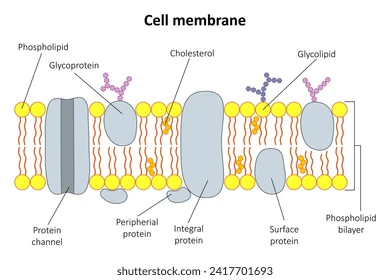
How does the structure of the cell membrane keep the internal and external environments separate?
The cell membrane is selectively permeable.
What is passive transport? What is active transport? How are they similar? How are they different?
Passive: Moves through cell membrane WITHOUT energy.
Active: Moves through cell membrane WITH energy.
Similar: Allows things to move in and out of the cell.
Different: One uses energy and one doesn’t.
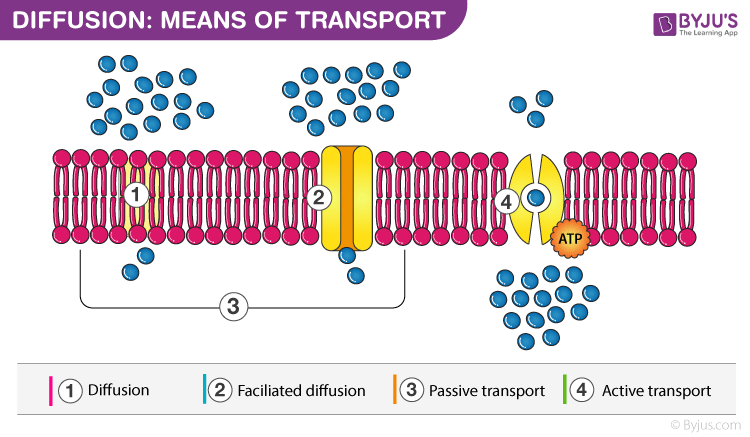
What is a concentration gradient?
Area where more solute is.
What does it mean to move with the concentration gradient?
Move from an area of high concentration or low concentration.
What does it mean to move against concentration gradient?
Moving from an environment of low to high concentration.
Be able to label an area of high solute concentration and an area of low solute concentration.

How do particles move in the process of simple diffusion?
Begins to flow across the membrane from the side of higher concentration to the side of lower concentration.
Be able to identify the percent concentration of water or solutes in a solution if you are given one or the other.
Level 3
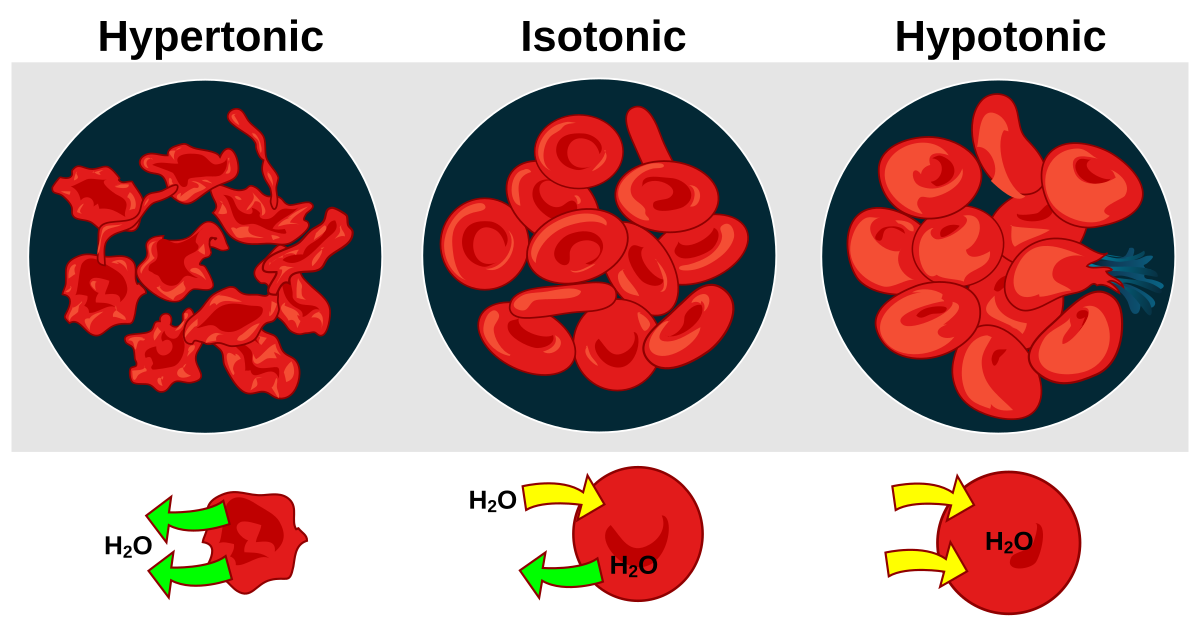
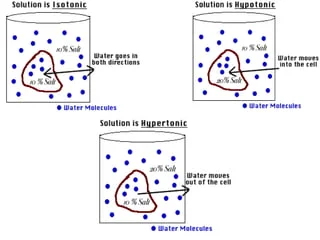
What does it mean to be isotonic? Hypotonic? Hypertonic?
Isotonic: a solution that contains the same concentration of water and solutes
Hypotonic: a solution containing a lower amount of solute in comparison to the solute concentration
Hypertonic: a solution that has a high solute concentration and low water concentration
What are the 3 different types of passive transport?
diffusion: movement of particles from an area of higher concentration to an area of lower concentration.
facilitated diffusion: uses specialized proteins to help molecules move across a cell membrane.
osmosis: movement of water molecules from a solution with a high concentration of water molecules to a solution with a lower concentration.
What are the 2 different types of active transport?
exocytosis: a process for moving large molecules out of the cell to the cell exterior.
endocytosis: a process wherein the materials move into the cell rather than are engulfed by the cell
How might temperature and pH affect active or passive transport?
If the temperature becomes too high, it can denature the proteins involved in active transport.