INTERMOLECULAR FORCES
Intermolecular Forces (IMFs) are defined as the invisible "dotted lines" that hold different molecules together. They are distinct from intramolecular forces, which are the forces within a molecule that hold the atoms together (e.g., covalent bonds). Intermolecular forces can be classified into two categories based on the molecule's polarity:
Polar Molecules: Molecules with a net dipole moment due to differences in electronegativity between atoms, leading to partial positive () and partial negative () charges.

Non-Polar Molecules: Molecules that do not have a net dipole moment; the charge distribution is even, and they typically include molecules with identical atoms or symmetrical molecules.
Types of Intermolecular Forces
London Dispersion Forces (LDF)
Strength Level: The weakest of all intermolecular forces.
Real-life Example: Mineral Oil.
Mechanism of Formation: Instantly formed dipoles (a pair of equal and opposite charges) in non-polar atoms create temporary attractions between them.

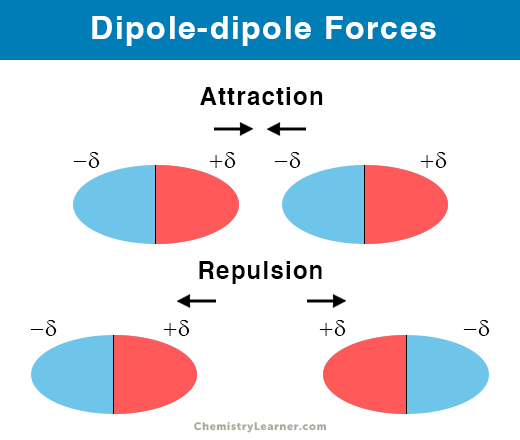
Dipole-Dipole Forces
Strength Level: Medium strength.
Real-life Example: Acetone.
Mechanism: Occur between the positive end of one polar molecule and the negative end of a neighboring polar molecule
Ion-Dipole Forces
Strength Level: Very strong forces.
Real-life Example: When table salt () dissolves in water, the sodium ions () and chloride ions () interact strongly with polar water molecules.
Mechanism: An electrostatic attraction between a fully charged ion (either a positive cation or negative anion) and a polar molecule

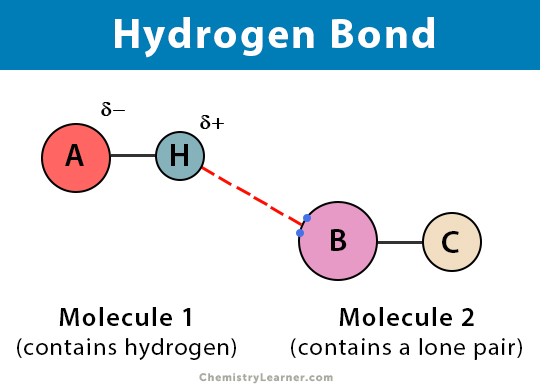
Hydrogen Bonding
Strength Level: The strongest of the standard IMFs.
Real-life Example: Water and Alcohol.
Mechanism: Occurs when hydrogen is bonded to highly electronegative atoms like Nitrogen, Oxygen, or Fluorine, allowing for strong attractions between them.
Concepts Demonstrating Intermolecular Forces
Volatility (Evaporation)
Definition: The measure of how easily a liquid converts into a gas.
Real-life Example: Perfume evaporating quickly due to weaker IMFs allowing molecules to escape into the air.
Mechanism: weaker IMFs = evaporting quickly

Surface Tension (The Penny Test)
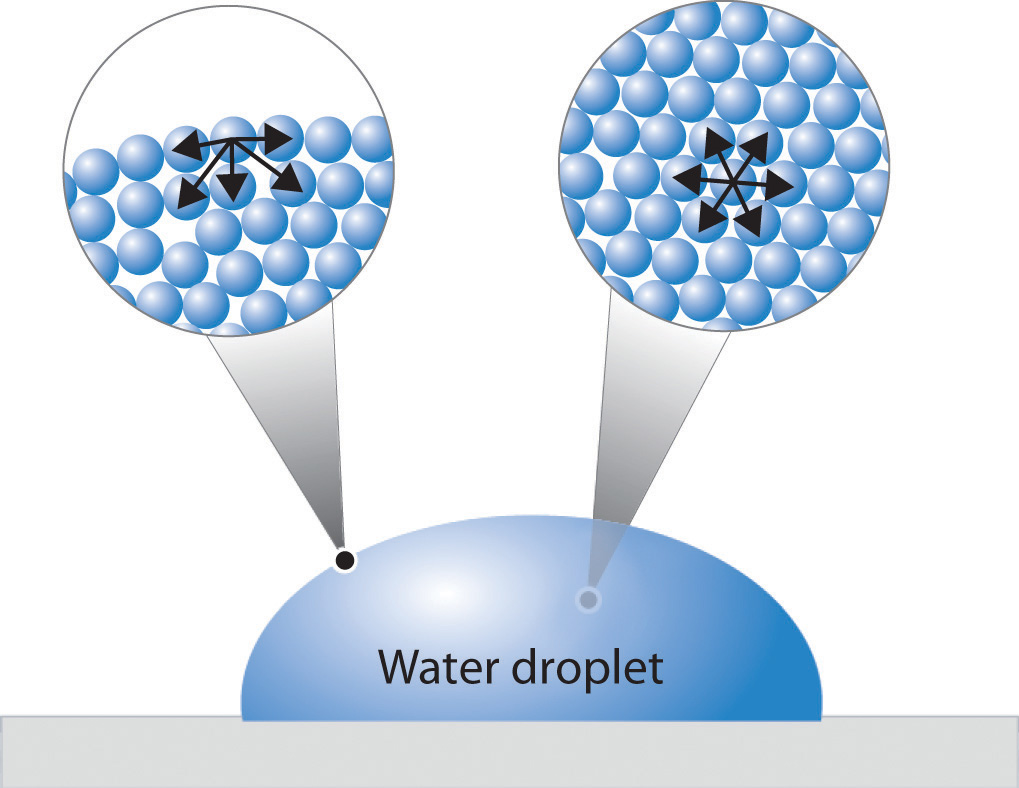
Definition: How well a liquid holds itself together in a "dome" shape due to cohesive forces.
Real-life Example: The ability of water to form droplets on a penny, demonstrating strong IMFs at the surface.
Mechanism: stronger IMFs = hold itself better
Solubility (The Salt Test)
Rule: "Like Dissolves Like."
Real-life Example: Salt dissolving in water due to ion-dipole attractions between water and salt ions. Non-polar liquids like oil do not dissolve salt because they cannot form ion-dipole attractions.