Earth Space II - Intro to Petrology - Unit 7
What is a Rock?
Rock - a mixture of minerals
Rocks can be made of only 1 mineral (example: Rock salt/Halite)
15 mineral make up 95% of the crustal rocks of Earth
Examples of Common Rocks:
Granite - has a mixture of 4 silicate minerals: Quartz, Mica, Hornblende, and Feldspar
Quartz - usually clear
Mica - tan to black
Hornblende - dull black
Feldspar - can be white, pink, or red (the color in granite)
Most solid rock exists as a buried layer of Bedrock (covered by regolith and soil)
An outcrop is a solid rock exposed at the surface
Three Basic Types of Rocks
Igneous rocks - formed by the cooling and solidifying of hot, molten material
Make up 95% of all rocks of Earth
Found deep in Earth, mountains, and volcanic areas
Example: Granite
Sedimentary rocks - formed by the deposit, hardening, and cementing of sediments (sand, clay, silt, and lime)
Make up 4% of all rocks, but cover 75% of the surface of the Earth
Example: Sandstone
Metamorphic rocks - formed from mainly igneous and sedimentary rocks that have been changed by heat and pressure
Make up only 1% of all rocks
Found deep in mountains and volcanic areas
Example: Marble
The Rock Cycle
Rock Cycle - the process where one rock type changes to another rock type over a long period of time
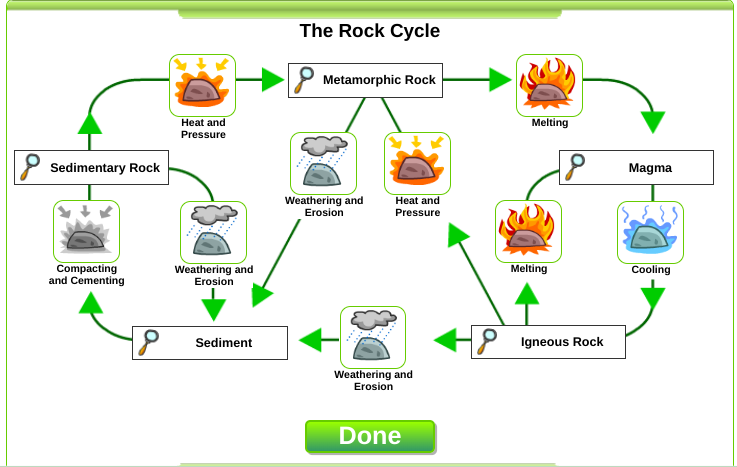
Igneous Rocks
Formed by the cooling and hardening of molten material in the Earth
Igneous is Latin for fire
What is the Origin of Igneous Rocks?
Magma - molten rock deep inside the Earth. Hotter and chemically different than lava.
Lava - molten rock on or near the Earth’s surface. Temperature of 1,800 to 2,200*F
Pyroclastics - tiny pieces of solid volcanic rock that have been explosively ejected out onto the surface by a volcano.
Tuff or Tephra - welded pyroclastics
How are Igneous Rocks Classified?
Mineral Composition - the chemicals in the molten material
Felsic rocks are lighter in color and have a higher silica content
Mafic rocks are darker in color and contain more iron and magnesium
Texture - size of the mineral gains or crystals in the rock
The texture is based on the cooling rate of the molten material
Igneous rocks are interlocking and the crystals are at random (no pattern)
Contain no fossils
Basic Types of Igneous Rocks
Plutonic (Intrusive)
Slow cooling of magma due to the surrounding rocks that insulate it
Form deep in the Earth
Coarse-grained texture (large and viable crystals)
Example: Granite
Volcanic (Extrusive)
Fast cooling of lava on or near the surface of the Earth
Fine-grained texture (very small to microscopic grains)
Example: Basalt
Special Types of Igneous Rocks
Porphyry - large crystals in a fine-grained rock
Formed by irregular cooling of magma
Vesicular - composed of many bubble shaped vesicles
Formed when gas escapes from lava
Example: Scoria
Glassy - rock has no crystals with smooth, glass-like texture
Example: Obsidian
Formed when lava is cooled superfast, such as in the ocean
Intrusive Igneous Rock Types
Granite - most common coarse grained igneous rock
Composed mainly of light silicate minerals (felsic)
Color varies from white, gray, pink, or red
Diorite - coarse grained having a dark gray, black, to greenish-black color
Composed mainly of dark silicate minerals (mafic)
Extrusive Igneous Rock Types
Rhyolite - fine grained igneous rock with the same mineral composition as granite. Can show gas bubbles
Andesite - fine grained with same minerals as Diorite. Name comes from the Andes Mountains
Basalt - most common fine grained igneous rock. Has the same minerals as Gabbro.
Formation of Plutons
Batholith - large, irregular rock mass under the surface (greater than 40 mi2).
Usually made up of granite (continental bedrock)
Called a stock if less than 40 mi2
Example: El Capitan in Yosemite, CA
Sill - igneous rock intrusion (sheet-like) that cuts parallel with other rock layers
Dike - igneous rock intrusion (wall) that cuts across other rock layers
Laccolith - dome or mushroom-shaped igneous intrusion forming deep in the Earth.
Dike is “feeder stem” of laccolith
Example: Stone Mt. in Georgia
Lava flow - extrusive igneous rock from a volcano
Sedimentary Rocks
Formed by the deposit, hardening, and sometimes cementing of sediments
Sediments come from the weathering and erosion of rocks/minerals on the surface. This allows the rock cycle to continue on.
How are Sedimentary Rocks Identified?
Texture - the size of the sediments or materials making up the rock
Mineral composition
Example: Limestone is made out of Calcite
General Characteristics of Sedimentary Rocks
Texture is determined by the degree of weathering and erosion of the original material
Non-interlocking texture
Usually found in layers or strata
Can contain fossils of plants/animals
Slow formation (usually indicates an aquatic environment)
Classification of Sedimentary Rocks
Clastic or Detrital - Composed of fragments of preexisiting rocks in the form of cobbles, gravel, sand, silt, or clay.
Examples of Clastic Rocks:
Conglomerate - composed of rounded, pebble-sized fragments
Minerals can have quartz sand and pebbles, gravel, clay, chert, flint, etc.
Nicknamed “Nature’s Concrete
Breccia - composed of angular fragments
Sandstone - fine to medium grained rock composed of compacted and cemented sand (Quartz)
Has a variety of colors (white, brown, red, yellow) due to impurities in the quartz and/or cement
Shale - fine grained rock composed of hardened mud, clay, silt (weathered silicateS)
Nicknamed “Creek Rock” (used for skipping across water)
The most abundant sedimentary rock on Earth
Chemical and or Organic Rocks - formed by the precipitation of soluble materials or more complicated chemical reactions
Examples of Chemical/Organic Sedimentary Rocks:
Limestone - fine to medium-grained rock composed of the mineral calcite (lime).
Bubbles in HCL acid
#1 rock in Indiana
Types of Limestone:
Lithographic - crystalline form, commonly called gravel
Coquina - over 90% shell fragments cemented together. Common on Florida beaches
Fossiliferous - contains many fossils and organics in a darker, more compact rock
Travertine - composed of light/dark bands of precipitated calcite
Found in caves and hot springs like Yellowstone National Park
Chalk - soft, white, porous rock (Dover, England)
Oolitic - made up of small, spherical grains formed by back and forth waves in a shallow sea
Dolostone - fine to medium grained rock composed of the mineral dolomite
Nicknamed is “Pink Limestone”
Can bubble in HCL acid if rock is powdered
Rock Salt - formed from the mineral Halite
Rock Gypsum - formed from the mineral Selenite Gypsum
Both are usually found in massive pieces, and formed as an evaporite in shallow seas
Coal - organic fossil fuel classified as a rock
Stages of Coal’s Formation
Started as a swampy plany environemnt around 300 million years ago.
Peat - decayed plant material (usually brown in color and woody texture)
Lignite - formed from increased pressure from peat. Soft, brown to black color with many impurities.
Bituminous - sedimentary coal with dull, black color
Composed of mainly Carbon with some Sulfur
Most common coal in the United States
Anthracite - hard metamorhpic coal formed by heat and/or pressure from bituminous coal
Shiny, black color composed of almost pure Carbon with minor impurities
Best coal for energy use, but not widespread and expensive to extract
Graphite - formed by heat and pressure on anthracite coal deep in mountainous areas
Silver when pure; layers of carbon atoms
Diamond - formed by heat and pressure on Graphite deep in the Earth. Carbon atoms have a complex pattern.
Metamorphic Rocks
Formed from other rocks that were changed by heat pressure or chemicals
Can be recrystallized and/or minerals can be rearranged in order
How are Metamorphic Rocks Classified?
Mineral composition
Texture - size of the mineral grains in the rock and how the grains are arranged (foliated vs. non-foliated)
What are general characteristics of Metamorphic Rocks?
Interlocking texture
Mineral grains can be at random like igneous or in layers like sedimentary
Foliation - when metamorphic rocks have layers like sedimentary rocks
Usually no fossils due to extreme heat and pressure
Foliated Metamorphic Rocks
Gneiss - coarse grained minerals in parallel bands or layers. Usually comes from granite (igneous), but can form from certain conglomerates (sedimentary)
Schist - fine to medium grained texture in thin, flaky layers. Usually comes from Slate. Varities include biotite, muscovite, garnet, talc, staurolite, graphite, etc.
Slate - fine grained texture in thin, dense layers. Shiny with a variety of colors. Comes from shale (sedimentary)
Non-foliated Metamorphic Rocks
Quartzite - medium to fine grained hard rock usually white or pink. Non porous. Comes from Sandstone (sedimentary)
Marble - medium to fine grained texture. Very shiny with many colors (white, pink) Will bubble in HCL acid. Comes from Limestone (sedimentary)