Chemistry - Bonding II
Polarity and Bond character
Electronegativity trend -
Fluorine is the most electronegative element, and electronegativity increases moving toward fluorine. (Not counting noble gases)
Bonds + Polarity -
Electrons can be shared, but not shared equally. Unequal sharing causes a polar covalent bond
Non Polar Covalent Bond- Electrons Shared equally - atoms close together on the Periodic Table
Polar bond- electrons shared unequally “medium distance” on the Periodic Table
Ionic bond- electrons transferred- far apart on the periodic table
Bond Polarity
The more electronegative element develops a partial negative charge, the other becomes partially positive
The molecule would then be similar to a small magnet
Molecule polarity
Entire molecules contain one or more bonds. Evaluating if an entire molecule is polar is more complex.
FYI - Hydrocarbons (only C and H in molecule) are considered nonpolar.
Non-polar molecules will be “symmetrical” – meaning have an even distribution of highly electronegative elements and/or lone pairs of electrons
Polar molecules will display a lack of symmetry, leading to distinct positive and negative sides.
Consider multiple planes of symmetry when evaluating molecules.
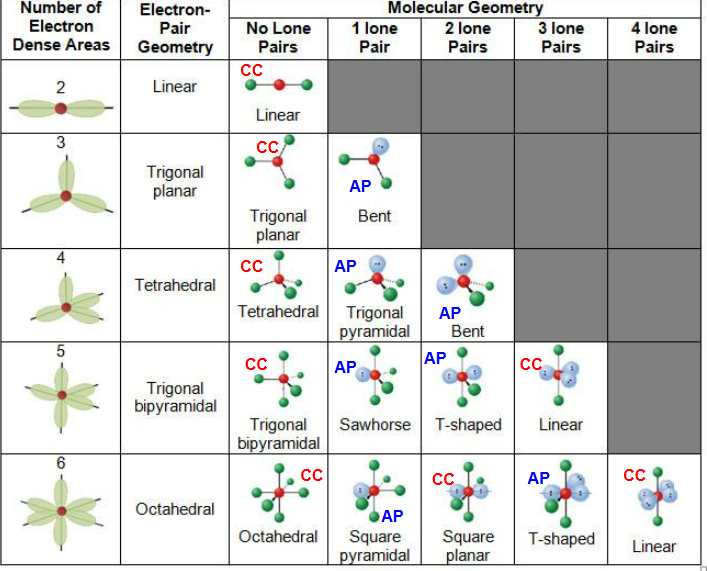
AP - These shapes are always polar
CC - Check connections.
Identical atoms attached to center = nonpolar (symmetry)
If not identical, it is polar.
“Like dissolves like”
Polar mixes with (dissolves) other polar substances, and nonpolar mixes with non-polar.
A polar substance will not mix with (dissolve) a nonpolar one.
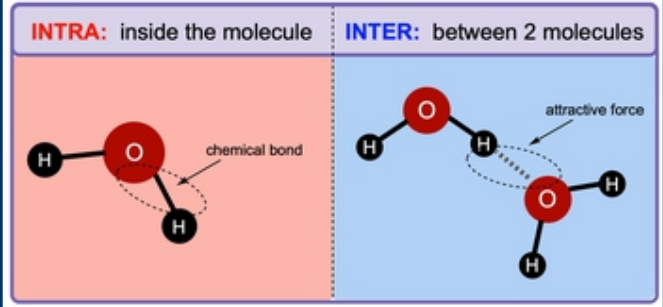
Intramolecular bond – bond within a molecule – holds atoms together – i.e. a covalent bond
Intermolecular Force – (IMF) – force BETWEEN two neighboring molecules – MUCH weaker
Dipole-Dipole Forces
Occurs between polar molecules
Partial positive and negative charges attract like a magnet.
“medium” IMF
London dispersion forces (LDF)
Occurs between nonpolar molecules
Weakest IMF
Hydrogen Bonding
Occurs between polar molecules that have H bonded directly to N, O or F
The strongest IMF (but still much weaker than a covalent bond)
First you must draw the Lewis Structure
ALL molecules experience LDF
All POLAR molecules experience dipole-dipole force
Some polar molecules can H-bond
The WEAKER the IMF LOWER the boiling point.
Very low IMF – gas at room temp
Medium IMF – liquid at room temp
High IMF – solid at room temp
When IMFs are the same type, as atomic mass increases, IMF gets stronger. Three nonpolar molecules:
Cl2 – Gas at room temp
Br2 – Liquid at room temp
I2 – Solid at room temp
-
-
-
-
-
VSEPR Theory Practice Questions
1. Determine the molecular geometry and bond angles:
• a. CO₂ (Carbon dioxide)
• b. NH₃ (Ammonia)
• c. H₂O (Water)
• d. SF₄ (Sulfur tetrafluoride)
2. Predict the electron domain geometry and molecular geometry:
• a. BF₃ (Boron trifluoride)
• b. CH₄ (Methane)
• c. H₂S (Hydrogen sulfide)
• d. PCl₅ (Phosphorus pentachloride)
3. Identify the ideal bond angles for the following molecules based on their geometry:
• a. A molecule with a trigonal planar geometry.
• b. A molecule with a tetrahedral geometry.
• c. A molecule with an octahedral geometry.
4. Given the molecular formulas, predict whether the molecule will be polar or nonpolar:
• a. CO₂ (Carbon dioxide)
• b. CH₄ (Methane)
• c. H₂O (Water)
• d. CCl₄ (Carbon tetrachloride)
5. Which of the following molecules has a lone pair on the central atom and what is its molecular shape?
• a. NH₃
• b. CO₂
• c. BeCl₂
• d. CH₄
-
-
Bond Length Practice Questions
1. Arrange the following bonds in order of increasing bond length:
• a. C–C (single bond), C=C (double bond), C≡C (triple bond)
• b. O–H (single bond), O=O (double bond), O≡O (triple bond)
• c. N–N (single bond), N=N (double bond), N≡N (triple bond)
2. Which of the following factors would make a bond shorter?
• a. Increasing the atomic size of the bonded atoms.
• b. Increasing the bond order (e.g., from a single bond to a double bond).
• c. Decreasing the electronegativity difference between the two atoms.
3. For the molecule HCl, how does the bond length compare to that of HF (hydrogen fluoride)?
• a. HCl has a longer bond length than HF.
• b. HCl has a shorter bond length than HF.
• c. The bond lengths of HCl and HF are the same.
4. Compare the bond lengths of C–Cl, C–Br, and C–I. Which one is the shortest and why?
5. Which of the following molecules has the longest bond length?
• a. C–O (in CO₂)
• b. C–C (in C₂H₆)
• c. O–O (in O₂)
• d. N≡N (in N₂)
Bonus Questions:
1. For the molecule CH₂O (formaldehyde), determine the electron domain geometry, molecular geometry, and bond angles.
2. Given a molecule with a central atom that has three bonding pairs and one lone pair of electrons (e.g., NO₃⁻), predict its molecular shape and bond angles.
3. Rank the following bonds by increasing bond strength:
• a. O–H, O=O, O≡O
• b. C–C, C=C, C≡C
-
-
Tips for VSEPR and Bond Length:
• VSEPR theory: Always start by counting the number of bonding pairs and lone pairs around the central atom. Use this to determine the electron domain geometry (e.g., linear, trigonal planar, tetrahedral). The molecular geometry depends on the positions of the atoms after considering lone pairs.
• Bond length: Generally, as bond order increases (single to double to triple), the bond length decreases because the atoms are more strongly pulled together. Larger atoms also form longer bonds due to less overlap of orbitals.
Concepts:
• Single bonds are generally the longest (e.g., C–C > C=C > C≡C).
• Double bonds are shorter than single bonds, and triple bonds are the shortest.
• Atomic size influences bond length: the larger the atom, the longer the bond.
• Electronegativity: A higher electronegativity difference typically results in shorter, stronger bonds, but it is not the primary factor affecting bond length compared to atomic size or bond order.
VSEPR Concepts:
• Electron Domain Geometry describes the arrangement of electron pairs (bonding and lone pairs) around the central atom.
• Molecular Geometry describes the arrangement of atoms (not including lone pairs) in the molecule.
• Lone pairs distort bond angles because they occupy more space than bonding pairs.
• The geometry affects whether a molecule is polar or nonpolar, depending on the symmetry of the distribution of electrons.