Social Psychology - PSYC 3806
Social Psychology - PSYC 3806
Textbook Link Here
Knowt Link Here
About the Course
Social psychology studies human beings and human behavior in a social context. The course covers how people behave in groups and the behavior of individuals in a social context.
Required Textbook
★ Kassin, S., Fein, S., Markus, H.R., & Burke, T.M.(2013). Social psychology (2nd Canadian ed.). Nelson: Toronto.
★ There will not be final exam questions on the contents of Chapter 2 but there will be questions on Chapter 1.
How to Study
★ Read the online course guide before reading the textbook chapters. ★ Look at the learning outcomes which will tell you what ideas to focus on in the textbook chapters.
★ Do a quick overall reading of each chapter before rereading and taking notes. ★ Participate in the learning activities.
Assignment Guidelines
★ There will be two written assignments
★ The questions appear at the end of each part
★ You have to hand in an assignment from two different parts of the course (ex. Part ! and Part III). Can’t submit two essays from the same part
★ Required to use 2-3 additional resources that aren’t in the textbook ★ References are in APA format
★ Online Quizzes are 30 minutes long and are open-book
Discussion Postings
★ You don’t have to include a full APA citation just need a link if you used a direct quote
★ Must complete 2 of the 3 Discussion Forum Postings
★ Can only choose 1 discussion topic within a set of modules (ex. For Discussion 1 can post in either Module 3 OR 4)
★ Throughout the online course material, there are Learning Activities. Choose from those marked “(Discussion Forum),” follow the specific instructions provided, and post in the appropriate forum.
★ Each posting should be no more than 200 words. Relate your answer to the course content. Answers which have no reference to topics covered in the module will not receive marks.
★ Read your classmates' postings on the same topic as you wrote and respond to one of them by the posting deadline. Your response should be approximately 100 words. Provide evidence if you have a different perspective or experience. Responses will not be individually marked but can count toward bonus points ★ Respond to someone with the same question as you
★ Clarification from prof:
○ If you decided to do Discussion Forum Posting 1, then you can post either under Module 3 or 4.
○ You only need to choose one. If you choose Module 3, for example, you only need to complete 3.1 or 3.2.
○ As noted in the Assignment Schedule, you need to post in 2 different Discussion Forums. So you could post in DF 1 & 2 or 1 & 3 or 2 & 3. ○ Note that only discussion forum postings are graded, and not learning activities.
○ Responses are for bonus marks
★
Module 1 – Section A
Introduction to Social Psychology
Overview
★ Social Psychology is the scientific study of how people think, feel, and behave in social situations. It is a course about individual behavior when the individual is interacting with others and sometimes even just thinking about others. ★ Required Reading: Chapter 1 in Textbook: What is Psychology?
Chapter 1 Notes:
★ Social Psychology - The scientific study of how individuals think, feel, and behave in a social context.
★ Scientific Study - applies the scientific method of systematic observation, description, and measurement to study the human condition.
★ How Individuals Think, Feel, and Behave - Social psychologists investigate various attitudes and contexts, such as individuals’ attitudes toward particular groups of people or how their attitudes are affected by their peers or their moods.
○ While sociology classifies people by their nationality, race, class, and other factors, social psychology focuses on the psychology of the individual
★ Social Context - What makes social psychology unique is its emphasis on the social nature of individuals
○ social psychologists sometimes examine nonsocial factors that affect people’s thoughts, emotions, motives, and actions (ex. If hot weather makes people more aggressive)
○ They also study thoughts and feelings about nonsocial things like shoe brands to see if their feelings are influenced by the actions of others ○ Both examples are social psychological pursuits because the thoughts,
feelings, or behaviors either (a) concern other people or (b) are influenced by other people
★ Distinctions between social Psychology and other related fields:
Field of Study | Similarities Differences |
|---|---|
Social Psychology | ★ Focuses on the individual ★ N/A level of social influences |
Sociology | ★ Share an interest in many ★ social psychologists are issues, such as violence, more likely than prejudice, cultural sociologists to conduct differences, and marriage experiments in which they manipulate some variable and determine the effects of this manipulation ★ Sociology focuses on group level and social psych focuses on individual level |
Clinical Psychology Personality Psychology | ★ Both may address how ★ Clinical psychology seeks to people cope with anxiety understand and treat people or pressure in social with psychological difficulties situations; how depressed or disorders and nondepressed ★ Instead of focusing on individuals differ in the disorders, social psych way they perceive or act focuses on the more typical toward others; or how ways in which individuals being bullied or think, feel, behave, and stereotyped by others can influence each other. affect individuals’ health and feelings of self-worth ★ Both are concerned with ★ Personality psychology individuals, their thoughts, seeks to understand the feelings, and behaviors differences between ★ Both are under the same individuals that remain division under the relatively stable across a Canadian Psychological variety of situations, Association ★ Social psychology seeks to understand how social factors affect most |
individuals, regardless of their different personalities. ★ Personality psychologists are interested in cross-situational consistency. ★ Social psychologists are interested in how different situations cause different behaviors. |
|---|
Cognitive Psychology ★ Often interested in the same processes
★ History of Social Psychology
★ Cognitive psychologists study mental processes such as thinking, learning, remembering, and
reasoning.
★ Social psychologists are interested in how people learn, think, remember, and reason concerning social information and how these processes are relevant to social behavior
○ No systematic and scientific study of social psychological issues developed until the end of the nineteenth century
○ American psychologist Norman Triplett is credited with having published the first research article in social psychology at the end of the nineteenth century (1897–1898).
○ The writers of the first three textbooks in social psychology were the English psychologist William McDougall (1908) and two Americans, Edward Ross (1908) and Floyd Allport (1924).
○ In Canada, McGill University, in Montreal, offered a course in Social Psychology as early as 1913
○ The person believed to have had the biggest impact on social psychology is Adolf Hitler
■ Hitler’s rise to power and the ensuing turmoil caused people around the world to become desperate for answers to social psychological questions about what causes violence, prejudice and genocide, conformity and obedience, and a host of other social problems and behaviors
○ In 1936, Gordon Allport and others formed the Society for the Psychological Study of Social Issues (SPSSI)
○ Kurt Lewin was another contributor to social psychology ■ Fled Nazi Germany to the United States in the early 1930s
■ Helped establish the following principles of social psychology ● Behavior is a function of the interaction between the person
and the environment – Later known as the interactionist
perspective
○ An emphasis on how both an individual’s personality
and environmental characteristics influence behavior
○ Combination of internal and external factors
○ Psychoanalysis – Emphasis on internal motives and
fantasies
○ Behaviorism – focus on external rewards and
punishments
● Social psychological theories should be applied to important, practical issues
○ Showed how social psychology could enlarge our
understanding of social problems and contribute to
their solution
● Lewin: “No research without action, no action without
research”
○ During and after the war, social psychologists sought to understand the prejudice, aggression, and conformity the war had brought to light ○ Leon Festinger (1954, 1957) introduced two important theories—one concerning how people try to learn about themselves by comparing themselves to other people, and one about how people’s attitudes can be changed by their behavior—that remain among the most influential theories in the field.
○ Stanley Milgram’s research in the early and middle 1960s linked the post-World War II era with the coming era of social revolution
■ Inspired by destructive obedience by Nazis
○ Most research from women was left out because their input wasn’t considered as important at the time
○ Researchers began to recognize that different fields and questions needed different research techniques
○ In the 1990s, social psychology began to spread from solely the United States and social psychologists began appearing all over the world ■ This broadened the research and allowed it to include many different cultural backgrounds
★ Integration of Emotion, Motivation, and Cognition
○ Social cognition – The study of how people perceive, remember, and interpret information about themselves and others
○ investigating how people’s motivations influence nonconscious cognitive processes, and vice versa
○ Ex. of hot and cold variables = wanting to be right and wanting to feel good about yourself
■ Want to be accurate in our judgments about ourselves and others but also don’t want to be accurate if it means that our feelings will be hurt
○ Growing interest in automatic and controllable processes
★ Biological, Evolutionary, and Cultural Perspectives
○ We are biological organisms, and our brains and bodies influence and are influenced by, our social experiences
○ Social psychologists are concerned with physiological influence in discussions of self-perception, attribution, attitude change, attraction, and aggression
○ Social neuroscience – the study of the relationship between neural and social processes
■ Explores how the social world affects the brain and biology and vice versa
○ Behavioral genetics – a subfield of psychology that examines the effects of genes on behavior
■ Is aggression an inherited trait?
■ Do genes play a role in sexual orientation/identity?
○ Evolutionary psychology – uses the principles of evolution to understand human behavior
■ Ex. How have pressures changed over time regarding jealousy ○ Culture –a system of enduring meanings, beliefs, values, assumptions, institutions, and practices shared by a large group of people and transmitted from one generation to the next.
○ Cross-cultural research – examining similarities and differences across different cultures
○ Multicultural research – examining racial and ethnic groups within cultures
★ New Technologies
○ Advances in technology allow researchers to see images of the brain without being invasive
○ Using virtual reality to examine psychological questions
■ Allows them to test scenarios that would be impractical, impossible, or unethical (because the event isn’t real but feels real)
○ Also using the internet to study how people interact online
○ Social media sites allow the study of how attraction, prejudice, group dynamics, and other things happen online vs. offline
★ Practice Questions from Module
○ Social psychology is similar to sociology but different from other branches of psychology in that both social psychology and sociology focus on group-level trends rather than individual behavior.
■ False
○ Cause and effect relationships can be demonstrated using well-designed correlational studies
■ False
○ Social psychology is about 100 years old.
■ True
○ Surveys of a few thousand people can represent the views of the general population if properly conducted.
■ True
CHAPTER REVIEW FOUND ON PAGE 45/610
Chapter 2
Research Methods Explained (Not a part of any modules)
Chapter 2 Notes:
★ The First Stage of Research – Asking Questions
○ Inspiration for questions can come from anywhere (something distressing, amusing, or perplexing for ex.)
○ Once the question is selected, the researcher must see what previous research has already been done on the topic and related topics
○ Psychology literature databases: PsycArticles & PsycINFO
○ Most of the time the researcher’s original question is changed during their research
■ Becomes more specific (more readily testable)
○ Hypothesis – an explicit, testable prediction about the conditions under which an event will occur. Based on observation, existing theory, or previous research findings
○ Theory – an organized set of principles used to explain observed phenomena ■ Usually evaluated by:
● Simplicity
● Comprehensiveness
● Ability to generate a new hypothesis (generativity)
■ The best theories are elegant and precise; encompass all of the relevant information; and lead to new hypotheses, further research, and a better
understanding
■ Even if a theory is accurate, it has little worth if not tested
■ A theory can have a big impact even if it's wrong
○ Social psychologists don’t try to make grand theories that cover everything, instead, they rely on theories that cover the specific aspects of how people behave, think, and feel
★ Basic research – seeks to increase understanding of human behavior ○ Designed to test a specific hypothesis from a specific theory
★ Applied Research – uses social psychology theories/methods to help understand naturally occurring events and to contribute to the solution of social problems ★ Operational Definition – the specific way in which a conceptual variable is manipulated or measured
★ Conceptual Variables – when a researcher develops a hypothesis and the variables are in abstract, general form
○ Ex. prejudice, conformity, attraction, love, violence, group pressure, and social anxiety
★ Construct Validity – the extent to which:
1) The manipulations in an experiment manipulate the conceptual variables they were designed to manipulate
2) The measures used in a study measure the conceptual variables they were designed to measure
★ Measuring variables
○ Variables are placed into two categories: self-reports and observations ★ Self-reports – in which people disclosure their thoughts, feelings, desires, and actions ○ Can be one question or a set
○ Not always accurate: can be misleading (ex. The desire to look good to others might change our responses)
○ Participants memory may be inaccurate and can lead to false information ○ Participants have to give specific answers to specific questions
★ Interval-contingent self-reports – respondents report their experiences at regular intervals (like once a day for ex.)
★ Signal-contingent self-reports – respondents report experiences as soon as possible after being signaled to do so
★ Event-contingent self-reports – respondents report on a designated set of events as soon as possible after the event
★ Narrative studies – collect long responses on a general topic
○ Can come directly from participants or other resources like diaries
★ Observations
○ Can be simple like seeing which of two items someone picks
★ Interrater reliability – level of agreement among multiple observers of the same behavior
○ Data is only trusted when multiple people agree on it
★ Observations
○ Benefits:
■ Avoid bad memory
■ Avoid altered stories or statements
○ Cons:
■ When people know they’re being observed their actions change (might want to seem like better people than they are)
● This leads to subtle observations by researchers
★ Technology
○ Psychologists use different machines to measure things like changes in heart rate, levels of particular hormones, and sexual arousal
○ Computers are used to see the speed of responses, how quickly participants can identify things (eye-tracking and timers)
■ Eye tracking is used to see where and how long people look at things ○ Brain imaging shows researchers what parts of the brain seem to “light up” or show increased activity in response to a particular stimulus or situation ★ Research Testing Methods
○ Qualitative research – The collection of data through open-ended responses, observation, and interviews
○ Quantitative research – The collection of numerical data through objective testing and statistical analysis
○ Psychologists don’t only test things that would support their idea, they test things that would prove them wrong
○ Experimentation is the most preferred method of research
■ Can see cause and effect
○ Descriptive research – to describe people and their thoughts, feelings, and behaviors
○ Archival research – involves examining existing records of past events and behaviors, such as newspaper articles, medical records, diaries, sports statistics, personal ads, crime statistics, or hits on a Web page
■ Pros
● because the researchers are observing behavior secondhand,
they can be sure that they did not influence the behavior by their
presence
■ Cons
● available records are not always complete or sufficiently detailed,
and they may have been collected in a nonsystematic manner
○ Surveys
■ Can be conducted over the phone, in person, by mail, or through the internet
■ asking people questions about their attitudes, beliefs, and behaviors ■ Involve variables that are impossible or unethical to observe directly or manipulate, such as people’s sexual behaviors or their optimism about the future
■ For a survey to be accurate, the sample of people must be similar to, or representative of, the population on important characteristics such as age, sex, race, income, education, and cultural background
○ Random sampling – a method of selection in which everyone in a population has an equal chance of being selected for the sample
○ Correlational research –. Measures the relationship between different variables ■ Can be conducted using observational, archival, or survey methods ○ Correlational coefficient – A statistical measure of the strength and direction of the association between two variables
■ Can range from -1.0 to +1.0
■ The absolute value of the number indicates how strongly the two variables are associated (the bigger the # the stronger the association) ■ A positive correlation coefficient indicates that as one variable increases, so does the other
■ A negative coefficient indicates that the two variables go in opposite directions: As one goes up, the other tends to go down
■ Pros
● Can study the associations of naturally occurring variables that cannot be manipulated or induced (gender, race, ethnicity, and
age)
● Can examine things that would be difficult or unethical to create (love, hatred, abuse)
● Freedom of how where the study takes place (lab or in a mall) ● helping them understand variables better and allowing them to use one variable to predict the other
■ Cons
● Correlation is not causation
● A could cause B; B could cause A; or a third variable, C, could cause both A and B
○ Experiment – A form of research that can demonstrate causal relationships because the experimenter has control over the events that occur and participants are randomly assigned to conditions
○ Random assignment – A method of assigning participants to the various conditions of an experiment so that each participant in the experiment has an equal chance of being in any of the conditions
○ Independent variables – In an experiment, a factor that experimenters manipulate to see if it affects the dependent variable
○ Dependent variables – In an experiment, a factor that experimenters measure to see if it is affected by the independent variable
○ Subject variable – A variable that characterizes pre-existing differences among the participants in a study
○ Experimenter expectancy effects – The effects produced when an experimenter’s expectations about the results of an experiment affect his or her behavior toward a participant and thereby influence the participant’s responses
○ External validity – The degree to which there can be reasonable confidence that the results of a study would be obtained for other people and in other situations
○ Mundane realism – The degree to which the experimental situation resembles places and events in the real world
○ Experimental realism – The degree to which experimental procedures involve participants and lead them to behave naturally and spontaneously
○ Deception – In the context of research, a method that provides false information to participants
○ Confederates – Accomplice of an experimenter who, in dealing with the real participants in an experiment, acts as if he or she is also a participant
○ Meta-analysis – A set of statistical procedures used to review a body of evidence by combining the results of individual studies to measure the overall reliability and strength of particular effects
○ Informed consent – An individual’s deliberate, voluntary decision to participate in research, based on the researcher’s description of what will be required during such participation
○ Debriefing – A disclosure, made to participants after research procedures are completed, in which the researcher explains the purpose of the research, attempts to resolve any negative feelings, and emphasizes the scientific contribution made by the participants’ involvement
CHAPTER REVIEW FOUND ON PAGE 74/610
Module 2 – Section B
The Social Self
Overview
★ Our social self includes our self-concept of who we are
○ How we describe ourselves and value ourselves, our self-esteem, and our sense of self-worth
★ Considers how we evaluate ourselves and present ourselves to others ★ Considers the self-perception theory, social comparison theory, and two-factor theory
Chapter 3
★ Self-concept – the sum total of beliefs that people have about themselves ○ Made up of self-schemas
○ Memories shape the self-concept
★ The cocktail party effect – the tendency of people to pick a personally relevant stimulus out of a complex environment
○ Shows that the self is an important factor in our attention
★ Self-schemas – beliefs about oneself that guide the processing of self-relevant information
★ Consciousness can only shine on one object at a time but can move from one object to another very quickly
○ The self is front and center of this spotlight
★ The self is a frame of reference that powerfully influences our thoughts, feelings, and behaviors
★ The ability to see yourself as a distinct entity is a necessary first step in the evolution and development of a self-concept
★ Looing-glass self – a theory by Charles Cooley that suggests other people serve as a mirror in which we see ourselves
○ Many believe that we draw our sense of who we are from our past and current relationships with the significant others in our lives
★ Affective forecasting – The process of predicting how one would feel in response to future emotional events
★ Self-perception theory – The theory that when internal cues are difficult to interpret, people gain self-insight by observing their own behavior ★ Facial feedback hypothesis – The hypothesis that changes in facial expression can lead to corresponding changes in emotion
○ Facial feedback can evoke and magnify certain emotional states ○ The face is not necessary for the experience of emotion
★ Intrinsic motivation – originates from factors within a person ○ When the activity is done from their own interest, the challenge, or for sheer enjoyment
★ Extrinsic motivation – originates from factors outside the person ○ When the activity is done as a means to an end, for tangible benefits (ex. Money, grades, recognition, to avoid punishment)
★ Overjustification effect – The tendency for intrinsic motivation to diminish for activities that have become associated with reward or other extrinsic factors ★ Social comparison theory – The theory that people evaluate their own abilities and opinions by comparing themselves to others
○ Two main questions of focus:
■ When do we turn to others for comparative information?
■ Of all the people who inhabit Earth, with whom do we choose to compare ourselves?
★ Two-factor theory of emotion – The theory that the experience of emotion is based on two factors: physiological arousal and a cognitive interpretation of that arousal
★ Flashbulb memories – enduring, detailed, high-resolution recollections ★ Cultural factors also influence self-concept
○ Individualism and collectivism for ex.
★ Dialecticism – An Eastern system of thought that accepts the existence of contradictory characteristics within a single person
★ Self-esteem – An affective component of the self, consisting of a person’s positive and negative self-evaluations
○ Some people have higher self-esteem than others
○ State of mind that varies in response to success, failure, changes in fortune, social interactions, and other life experiences
○ The stableness of self-esteem also changes
○ Self-esteem is needed because people want to see themselves in a positive light
○ The desire for self-esteem is driven by the desire to connect with others and gain their approval
■ Social rejection can lower self-esteem
○ Humans are biologically programmed for self-preservation
■ People are afraid of death so they try to distract themselves with thoughts about how great their life is and how good they are at
everything they do
○ People with positive self-images tend to be happy, healthy, productive, and successful
■ They are also confident, bringing a motivating attitude which leads them to persist longer at difficult tasks, sleep better at night,
maintain their independence in the face of peer pressure, and
suffer fewer ulcers
○ People with negative self-images tend to be more depressed, pessimistic about the future, and prone to failure
■ Lacking confidence, they have a harder time completing tasks and feel more defeated
○ By trying hard to boost and maintain their self-esteem, people often become anxious, avoid activities that risk failure, neglect the needs of others, and suffer from stress-related health problems
○ There are differences in self-esteem between different racial and cultural backgrounds
○ Individualists present themselves as unique and self-confident, while collectivists present themselves as modest, equal members of a group ○ The basic need for positive self-regard is universal but the specific drive toward self-enhancement is culturally ingrained
★ Self-awareness theory – The theory that self-focused attention leads people to notice self-discrepancies, thereby motivating either an escape from self-awareness or a change in behavior
○ Two basic ways of coping with the discomfort
■ 1) “Shape up” by behaving in ways that reduce our
self-discrepancies
■ 2) “Ship out” by withdrawing from self-awareness.
○ The solution depends on whether people think they can reduce self-discrepancies or not
○ If a successful reduction of self-discrepancy seems unlikely, individuals will take a second route: escape from self-awareness
★ Private self-consciousness – A personality characteristic of introspective individuals, often attending to their inner states
★ Public self-consciousness – A personality characteristic of individuals who focus on themselves as social objects, as seen by others
★ To achieve goals and get out of self-consciousness, people must engage in self-reflection the processes by which we seek to control or alter our thoughts, feelings, behaviors, and urges
★ Self-regulation fatigue – when people self-regulate themselves too much they will eventually not be able to control their urges/desires and won’t be able to regulate anymore
★ People might be able to restore their capacity for self-control by stopping to mentally bolster or “affirm” their sense of who they are
★ “Choking” seems to be a paradoxical type of failure caused by thinking too much ○ Ex. basketball players missing a dunk or shot when it matters ★ Ironic processes – at times, the harder you try to inhibit a thought, feeling, or behavior, the less likely you are to succeed
★ Implicit egotism – A nonconscious and subtle form of self-enhancement ★ A lot of people exhibit an optimistic bias about their future, predicting that their lives will be more glamorous than undesirable
○ This is because people think they can control more than they actually can ★ Procrastination – a purposeful delay in starting or completing a task that is due at a particular time
○ Provides an excuse for possible failure
○ People sometimes purposely set themselves up for failure to preserve their self-esteem
★ Self-handicapping – refers to actions people take to handicap their own performance to build an excuse for anticipated failure
★ Bask in reflected glory (BIRG) – To increase self-esteem by associating with others who are successful
★ Implications: If the people around us achieve more than we do, how does that affect our self-esteem?
★ Downward social comparisons – The defensive tendency to compare ourselves with others who are worse off than we are
○ Less successful, less happy, or less fortunate
★ In addition to making social comparisons between ourselves and similar others, we make temporal comparisons between our past and present selves ★ People like to affiliate with others in the same predicament who are adjusting well, role models who offer hope and guidance. But they tend to compare themselves with others who are worse off
★ Spotlight effect – a tendency to believe that the social spotlight shines more brightly on them than it actually does
★ Self-presentation – strategies people use to shape what others think of them and what they think of themselves
★ Strategic self-presentation – consists of our efforts to shape others’ impressions in specific ways to gain influence, power, sympathy, or approval ★ Two strategic self-presentation goals are very common
○ 1) ingratiation – the term used to describe acts that are motivated by the desire to “get along” with others and be liked
○ 2) self-promotion – the term used to describe acts that are motivated by a desire to “get ahead” and gain respect for one’s competence
■ the need to project a favorable public image can lure us into unsafe patterns of behavior
★ Brown nosing – when you try too hard to please someone
★ Self-verification – the desire to have others perceive us as we truly perceive ourselves
★ Self-monitoring – the tendency to regulate one’s behavior to meet the demands of social situations
★ Practice Questions from Module
○ Humans are the only animals that recognize themselves in a mirror ■ False
○ Some animals can recognize themselves in a mirror
■ True
○ You can manipulate someone’s emotions by asking them to smile or frown ■ True
○ In general, people tend to be optimistic about their own future ■ True
○ Most people think highly of themselves most of the time
■ True
○ One reason people procrastinate is that it provides an excuse for possible failure
■ True
CHAPTER REVIEW FOUND ON PAGE 117/610
Module 3 – Section C
Perceiving Persons
Overview
★ To engage in a social context means that we need to interact with others and that we need to understand other people
★ Heuristics are strategies that help us make decisions quickly but that may be wrong
○ We frequently use heuristics to assign meaning, even though the heuristics may lead us astray
★ The fundamental attribution error refers to our tendency to overestimate the role of personal factors and underestimate the role of situational factors ★ Implicit personality theories affect our impressions of other people as does the confirmation bias
★ Our need to believe in a just world means we are more likely to criticize victims and blame them for their fate
Chapter 4
★ Social perception – the process by which people come to understand one another
○ Raw data of social perceptions: persons, situations, and behavior ★ In life, you are both a perceiver and a target of other’s perceptions ★ First impressions are influenced in subtle ways by a person’s height, weight, skin
color, hair color, tattoos, eyeglasses, facial beauty, and other aspects of appearance
★ Sometimes we even infer attitudes that we assume an individual holds, just based on their face
★ Human beings are programmed by evolution to respond gently to infantile features so that real babies are treated with tender loving care
★ Faces are seen as trustworthy if they look happy, an emotion that signals a person is safe to approach, and untrustworthy if they look angry, an emotion that signals danger to be avoided
★ Behavioral scripts (like whether or not to clear the dinner table) are culture specific
○ Can influence perceptions and behavior
★ We sometimes see what we expect to see in a particular situation ○ Ex. looking at a photo of someone and being told they are experiencing joy, they will look happier
★ People use what they know about social situations to explain the causes of human behavior
○ You learn more about someone when their behavior deviates from normal behaviors
★ Mind perception – The process by which people attribute humanlike mental states to various animate and inanimate objects, including other people. ★ Behavioral cues are used not only to identify someone’s actions but also to determine his or her inner states
★ Nonverbal behavior – Behaviour that reveals a person’s feelings without words— through facial expressions, body language, and vocal cues ○ Ex. hand gestures (like thumbs up or middle finger), eye contact, and touch (High five, hug)
★ Nonverbal communication norms vary from one culture to the next ★ Four channels of communication provide relevant information: words, the face, the body, and the voice
★ When people lie, they can control their face and body but their voices show lies (hesitation, sped up and raised pitch of voice)
★ Dispositions – stable characteristics such as personality traits, attitudes, and abilities
★ Attributions – the explanations we come up with to questions about other people’s behavior as well as our own
★ Attribution theory – A group of theories that describe how people explain the causes of behavior
★ The explanations people give are grouped into two categories: personal and situational
★ Personal attribution – Attribution to internal characteristics of an actor, such as ability, personality, mood, or effort
★ Situational attribution – Attribution to factors external to an actor, such as the task, other people, or luck
★ The task of the attribution theorist is not to determine the true causes of such an event but, rather, to understand people’s perceptions of causality ★ Correspondent inference theory – predicts that people try to infer from an action whether the act itself corresponds to an enduring personal characteristic of the actor
○ 1st factor: degree of choice
■ Behavior that is freely chosen is more informative about a person than behavior that is coerced
○ 2nd factor: expectedness of behavior
■ an action tells us more about a person when it departs from the norm than when it is typical, part of a social role, or otherwise
expected under the circumstances
○ 3rd factor: intended effects or consequences of someone’s behavior
■ Acts that produce many desirable outcomes do not reveal a person’s specific motives as clearly as acts that produce only a
single desirable outcome
■ Ex. a person staying at a job that is enjoyable, high paying, and in a nice location vs. a miserable job in a nice location
★ the causes of human behavior can be derived only through experiments ○ One has to make more than a single observation and compare behavior in two or more settings in which everything stays the same except for the independent variables
★ Covariation principle – A principle of attribution theory holding that people attribute behavior to factors that are present when a behavior occurs and absent when it does not
○ Consensus, distinctiveness, and consistency
★ Consensus information – how different people react to the same stimulus ★ Distinctive information – see how the same person reacts to different stimuli ★ Consistency information – see what happens to the behavior at another time when the person and stimulus both remain the same
★ Two ways social perceivers differ:
○ 1) individuals vary in the extent to which they believe that human behaviors are caused by personal characteristics that are fixed
○ 2) some individuals are more likely than others to process information in ways that are colored by self-serving motivations
★ Availability heuristic – The tendency to estimate the likelihood that an event will occur by how easily instances of it come to mind
○ social perceptions are influenced more by one vivid life story than by hard statistical facts
★ False consensus – The tendency for people to overestimate the extent to which others share their opinions, attributes, and behaviors
○ Bias is pervasive
○ In part a byproduct of the availability heuristic
○ We tend to associate with others who are like us in important ways, so we are more likely to notice and recall instances of similar rather than dissimilar behavior
★ Base-rate fallacy – The finding that people are relatively insensitive to consensus information presented in the form of numerical base rates ○ People are moved by seeing the events than seeing the numbers ★ Counterfactual thinking – The tendency to imagine alternative events or outcomes that might have occurred but did not
○ Like thinking “What if…..?”
★ People are very influenced by the situational context of behavior
★ Ex. parents are surprised to hear that their child who misbehaves at home behaves at school.
★ Fundamental attribution error – The tendency to focus on the role of personal causes and underestimate the impact of situations on other people’s behavior. This error is sometimes called correspondence bias
★ Without realizing it, people often form quick impressions of others based on a brief glimpse at a face or sample of behavior
★ Two-Step Model of the Attribution Process:
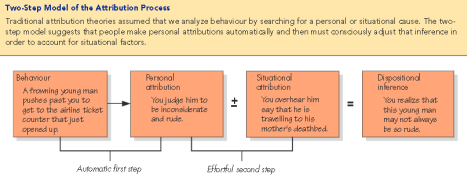 ★ Perceivers are more likely to commit the fundamental attribution error when they are cognitively busy or distracted because they give the target person less attention
○ When people are distracted the second step suffers more than the first ○ People are more likely to say “It depends on the situation” when talking about their own behaviors than those of others (ex. Might say your outgoingness depends on the situation but say matter of factly that your friend IS or ISN’T outgoing)
★ Actor-observer effect – The tendency to attribute our own behavior to situational causes and the behavior of others to personal factors
★ People have a strong need for self-esteem, and this motive can lead us to make favourable, self-serving, and one-sided attributions for our own behaviour ★ People take more credit for their successes than their failures
★ We overestimate the extent to which others think, feel, and behave as we do, in part to reassure ourselves that our own ways are correct, normal, and socially appropriate
★ Belief in a just world – The belief that individuals get what they deserve in life, an orientation that leads people to disparage victims
○ “We get what we deserve” and “we deserve what we get”
○ can help victims cope and serves as a buffer against stress
○ If people cant help those of misfortune they turn on them and say that they are in that situation because of their own laziness and carelessness ★ Impression formation – The process of integrating information about a person to form a coherent impression
★ Information integration theory – The theory that impressions are based on perceiver dispositions and a weighted average of a target person’s traits ○ Impressions on others are based on a combination/integration of: ■ 1) personal dispositions of the perceiver
■ 2) a weighted average (not a simple average) of the target person’s characteristics
★ Priming – The tendency for recently used or perceived words or ideas to come to mind easily and influence the interpretation of new information ○ Even subconsciously
○ (ex. If are hearing or seeing a lot of phrases about petting dogs and you see a dog later that day, you are probably more likely to pet it than if you didn’t hear/see those phrases)
★ Across cultures, people can be distinguished from one another by 5 broad traits: ○ Extroversion
○ Emotional stability
○ Openness to experience
○ Agreeableness
○ Conscientiousness
★ Trait negativity bias – the tendency for negative information to weigh more heavily than positive information
★ The impact of trait information on our impressions of others depends not only on characteristics of the perceiver and target but on context as well ○ Two contextual factors that are important:
■ 1) implicit theories of personality
■ 2) the order in which we receive information about one trait relative to other traits
★ Implicit personality theory – A network of assumptions people make about the relationships among traits and behaviours
○ Knowing that someone has one trait leads you to infer that they have other traits as well
■ Ex. might assume that someone who is unpredictable is dangerous ★ Central traits – Traits that exert a powerful influence on overall impressions ★ Primacy effect – The tendency for information presented early in a sequence to
have more impact on impressions than information presented later ★ Need for closure – The desire to reduce cognitive uncertainty, which heightens the importance of first impressions
★ Confirmation biases – The tendency to seek, interpret, and create information that verifies existing beliefs
★ Belief perseverance – The tendency to maintain beliefs even after they have been discredited
★ Self-fulfilling prophecy – The process by which one’s expectations about a person eventually lead that person to behave in ways that confirm those expectations
★ There are two different views of social perception (both are correct) ○ 1) suggests that the process is quick and automatic (people make judgements about others without much thought or awareness)
○ 2) suggests that to process is mindful (people observe others carefully and don’t judge until they know more about the individual)
★ Practice Questions from Module
○ We often make judgements of others based on their physical appearance ■ True
○ Lie detection experts are generally able to identify those who are telling lies
■ False
○ We have a tendency to overestimate how much others agree with our point of view
■ True
○ We overestimate the role of situational factors and downplay the role of personal factors when explaining the behaviour of others
■ False
○ People all over the world explain behaviors the same way
■ False
○ People are more accurate at judging the personality of friends and acquaintances than of strangers
■ True
CHAPTER REVIEW FOUND ON PAGE 159/610
Module 4 – Section D
Title Here
Overview
★ Define stereotypes, prejudice, and discrimination;
★ Explain the roles of motivation, cognition, and culture in stereotypes, prejudice, and discrimination;
★ Explain the mechanisms of racism and sexism;
★ Explain the concept of stereotype threat;
★ Discuss means to reduce stereotypes, prejudice, and discrimination.
★
Chapter 5
★ Racism - Prejudice and discrimination based on a person’s racial background, or institutional and cultural practices that promote the domination of one racial group over another
● Individual level - anyone can be racist towards another person
● Institutional level - jobs that hire or don’t hire based on race
● Cultural level - certain individuals are hired to maintain the status quo ★ Sexism - Prejudice and discrimination based on a person’s gender, or institutional and cultural practices that promote the domination of one gender over another.
★ Stereotype - A belief or association that links a whole group of people with certain traits or characteristics.
★ Prejudice - Negative feelings toward persons based on their membership in certain groups.
★ Discrimination - Negative behaviour directed against persons because of their membership in a particular group
★ Group - Two or more persons perceived as related because of their interactions with each other over time, membership in the same social category, or common fate
○ Having at least one of the following characteristics
1. Direct itneractions with each other over a period of time
2. Joint members in a social category based on sex, race, or other attributes
3. A shared, common fate, identity, or set of goals
★ Ingroups - Groups with which an individual feels a sense of membership, belonging, and identity.
○ our country, religion, political party, even our hometown sports team ★ Outgroups - Groups with which an individual does not feel a sense of membership, belonging, or identity.
★ Modern Racism - A form of prejudice that surfaces in subtle ways when it is safe, socially acceptable, and easy to rationalize.
○ Most people are racially ambivalent (meaning they carry some anxiety concerning other racial groups)
★ Implicit Racism - Racism that operates unconsciously and unintentionally. ○ can skew their judgments, feelings, and behaviours, without inducing the guilt that more obvious, explicit forms of racism would trigger.
★ Implicit Association Test (IAT) - A covert measure of unconscious attitudes, it is derived from the speed at which people respond to pairings of concepts, such as black or white with good or bad.
○ measures the extent to which two concepts are associated.
★ TRUE OR FALSE – Children do not tend to show biases based on race; it is only after they become adolescents that they learn to respond to people differently based on race. – FALSE
★ The divides between racial and ethnic groups tend to be more vast and may promote stronger feelings of hostility, fear, and distrust than the divides based on other social categories, such as those based on gender, appearance, age, and so on
★ There are some ways that sexism is different, however. Gender stereotypes are distinct from virtually all other stereotypes in that they are prescriptive rather than merely descriptive. That is, they indicate what many people in a given culture believe men and women should be.
★ Ambivalent sexism - A form of sexism characterized by attitudes about women that reflect both negative, resentful beliefs and feelings, and affectionate, chivalrous, but potentially patronizing beliefs and feelings
○ Hostile sexism - negative, resentful feelings about women’s abilities, values, and ability to change men’s power
○ Benevolent sexism - affectionate, chivalrous feelings founded on the potentially patronizing belief that women need and deserve protection ★ Superordinate goal - A shared goal that can be achieved only through cooperation among individuals or groups.
★ Realistic conflict theory - The theory that hostility between groups is caused by direct competition for limited resources.
○ one group may fare better than another group in the struggle for land, jobs, or power. The loser becomes frustrated and resentful, the winner feels threatened and protected—and before long, conflict heats to a rapid boil.
★ Relative deprivation - Feelings of discontent aroused by the belief that one fares poorly compared to others.
★ Ingroup favouritism - The tendency to discriminate in favour of ingroups over outgroups.
★ Minimal groups - persons catagorized on the basis of trivial, minimally important similarities
★ Social identity theory - The theory that people favour ingroups over outgroups in order to enhance their self-esteem
○ Everyone strives to enhance their self-esteem (which has two components):
1. A personal identity
2. Various collective of social identities that are based on the groups to which we belong
★ Two basic predictions arise from this theory:
1. Threats to one’s self-esteem heighten the need for ingroup
favoritism
2. Expressions of ingourp favoritism enhance one’s self-esteem ★ Cultural differences can also influence social identity processes. Collectivists are more likely than individualists to value their connectedness and interdependence with the people and groups around them, and their personal identities are tied closely with their social identities
★ Social dominance orientation – A desire to see one’s ingroups as dominant over other groups and a willingness to adopt cultural values that facilitate oppression over other groups
○ ingroup loyalty and outgroup prejudice are more intense for groups that are in the minority than for members of large and inclusive majorities. ○ Individuals in groups that benefit from advantages that other groups do not have may be motivated to justify and protect those advantages.
★ System justification – processes that endorse and legitimize existing social arrange-ments.
★ Social categorization – The classification of persons into groups on the basis of common attributes.
○ cate-gorizing people leads us to overestimate the differences between groups and to under-estimate the differences within groups
★ Outgroup homogeneity effect – The tendency to assume that there is greater similarity among members of outgroups than among members of ingroups. ○ In other words, there may be fine and subtle differences among “us,” but “they” are all alike
★ Dehumanizing outgroups – when outroups are seen more as objects than people
○ Dehumanization has played a role in atrocities throughout history, such as in the Nazi propaganda that characterized the Jews in Germany as disease-spreading rats and Blacks as half-apes
★ Illusory correlation – An overestimate of the association between variables that are only slightly or not at all correlated.
★ Distinctive – variables that capture attention simply because they are novel or deviant
○ People overestimate the joint occurrence of variables they expect to be associated with each other, such as stereotyped groups and stereotypic behaviours.
○ perceivers make attributions, or explanations, about the causes of other people’s behaviours and these attributions can sometimes be flawed
★ Socializarion – the process by which people learn the norms, rules, and information of a culture or group.
★ Social role theory – The theory that small gender differences are magnified in perception by the contrasting social roles occupied by men and women. ★ Stereotype content model – A model proposing that the relative status and competition between groups influence group stereotypes along the dimensions of competence and warmth.
○ proposes that stereotypes about the competence of a group are influenced by the relative status of that group in society—higher relative status is associated with higher competence. Stereotypes about the warmth of a group are influenced by perceived competition with the group—greater perceived competi-tion is associated with lower warmth.
★ Subliminal presentation – A method of presenting stimuli so faintly or rapidly that people do not have any conscious awareness of having been exposed to them.
★ QUESTION – Very brief exposure to a member of a stereotype group does not lead to biased judgements or responses, but longer exposure typically does – FALSE
Automatic stereotype activation: important factors
Factors that make automatic activation Factors that make automatic activation more likely less likely |
|---|
Cognitive Factors |
● Stereotype is accessible (e.g., ● Exposure to counter-stereotypic recently activated or primed) group members ● Depleted cognitive resources due ● Knowledge of personal information to prior attempts to suppress about the individual stereotypic thinking, fatigue, age, intoxication |
Cultural Factors |
● Popular stereotype in culture ● Not common stereotype in culture ● Norms and values that accept ● Norms and values that are stereotyping opposed to stereotyping |
Motivational Factors |
● Motivated to make inferences ● Motivated to avoid prejudice about the person quickly ● Motivated to be fair, egalitarian ● Motivated to feekl superior to the other person |
|---|
Personal Factors |
● Endorse stereotypes, high in ● Disagree with stereotypes, low in prejudice prejudice |
★ The motivation to not stereotype or discriminate against others may be externally driven—not wanting to appear to others to be prejudiced. It may also or instead be internally driven—not wanting to be prejudiced, regardless of whether or not others would find out
★ the harder you try to suppress an unwanted thought, the less likely you are to succeed.
★ Self-regulation of prejudices responses model – people who are truly motivated to be fair and unprejudiced are often confronted with the sad reality that they have failed to live up to that goal.
★ Older people have a harder time suppressing stereotypes than younger people, which may explain in part why older people often appear more prejudiced than younger people
★ exercising self-control is like flexing a muscle, and mus-cles can become fatigued from use
★ one of the best strategies for avoiding the influence of stereotypes is to try instead to activate thoughts about the individual who happens to be a member of that group.
★ Stereotype threat – The experience of concern about being evaluated based on negative stereotypes about one’s group.
○ stereotype threat can hamper achievement in aca-demic domains in two ways. First, reactions to the “threat in the air” can directly inter-fere with performance—for example, by increasing anxiety and triggering distracting thoughts. Second, if this stereotype threat is chronic in the academic domain, it can cause individuals to disidentify from that
domain—to dismiss the domain as no longer relevant to their self-esteem and identity.
★ Contact hypnosis – The theory that direct contact between hostile groups will reduce prejudice under certain conditions.
★ Jigsaw classroom – A cooperative learning method used to reduce racial prejudice through interaction in group efforts
○ Schools often fail to meet the conditions for reducing prej-udice, in part because competition is too high. One pro-gram that is designed to foster intergroup cooperation and interdependence suggests that the right kinds of contact can improve attitudes and behaviours in a school setting.
★ Decatagorization – leads people to not only pay less attention to categories and intergroup boundaries, but also to perceive outgroup members as individuals ★ Recatagorization – leads people to change their conception of groups, allowing
them to develop a more inclusive sense of the diversity characterizing their own ingroup
★ Multiple choice questions:
○ Children do not tend to show biases based on race; it is only after they become adolescents that they learn to respond to people differently based on race.
■ False. Children learn about social categories quite early and use stereotypes when they are very young. Children show biases in favour of the racial ingroup on both explicit and implicit measures.
○ Very brief exposure to a member of a stereotyped group does not lead to biased judgments or responses, but longer exposure typically does. ■ False. Even very brief exposure to a member of a stereotyped group can activate the stereotype about the group, and this
activation can bias subsequent judgments and reactions. Learning more information about the individual, however, sometimes reduces the effects of the stereotype.
○ Even brief exposure to sexist television commercials can significantly influence the behaviours of men and women.
■ True. Exposure to sexist commercials can make men behave in more sexist ways toward women and can make women engage in more stereotypical behaviours.
○ A black student is likely to perform worse on an athletic task if the task is described as one reflecting sports intelligence than if it is described as reflecting natural athletic ability.
■ True. Research on stereotype threat suggests that black students are likely to be concerned about being seen through the lens of
negative stereotypes concerning their intelligence if the task is
described as one that is diagnostic of their sports intelligence—a situation that could undermine their performance. White students tend to show the opposite effect: Their performance is worse if the task is described as reflecting natural athletic ability.
○ Groups with a history of prejudice toward each other tend to become much less prejudiced soon after they are made to interact with each other in a desegregated setting.
■ False. When the contact between groups involves unequal status between them, lacks personal interaction between individual group members, and does not involve cooperation to achieve shared
goals, contact is not likely to reduce prejudice.
Module 5 – Section E
Overview
★
Chapter 6
★ Attitude – A positive, negative, or mixed reaction to a person, object, or idea. ★ Attitude scale – A multiple-item questionnaire designed to measure a person’s attitude toward some object
★ Bogus pipeline – A fake lie-detector device that is sometimes used to get respondents to give truthful answers to sensitive questions
★ Central route to persuasion – The process by which a person thinks carefully about a communication and is influenced by the strength of its arguments ★ Cognitive dissonance theory – The theory that holding inconsistent cognitions arouses psychological tension that people become motivated to reduce. ★ Elaboration – The process of thinking about and scrutinizing the arguments contained in a persuasive communication.
★ Facial electromyograph (EMG) – An electronic instrument that records facial muscle activity associated with emotions and attitudes.
★ Implicit attitude – An attitude—such as prejudice— that one is not aware of having.
★ Implicit relational assessment procedure (IRAP) – A way of measuring unconscious attitudes, similar to the IAT, that focuses on cognition and specific relations rather than general associations
★ Inoculation hypothesis – The idea that exposure to weak versions of a persuasive argument increases later resistance to that argument.
★ Insufficient deterrence – A condition in which people refrain from engaging in a desirable activity, even when only mild punishment is threatened.
★ Insufficient justification – A condition in which people freely perform an attitude-discrepant behaviour without receiving a large reward
★ Need for cognition (NC) – A personality variable that distinguishes people on the basis of how much they enjoy effortful cognitive activities.
★ Peripheral route to persuasion – The process by which a person does not think carefully about a communication and is influenced instead by superficial cues. ★ Persuasion – The process by which attitudes are changed.
★ Psychological reactance – The theory that people react against threats to their freedom by asserting themselves and perceiving the threatened freedom as more attractive
★ Sleeper effect – A delayed increase in the persuasive impact of a noncredible source.
★ Theory of planned behavior – The theory that attitudes toward a specific behaviour combine with subjective norms and perceived control to influence a person’s actions.
MULTIPLE CHOICE QUESTIONS
❖ Researchers can tell if someone has a positive or negative attitude by measuring physiological arousal.
➢ FALSE. Measures of arousal can reveal how intensely someone feels, but not whether the person’s attitude is positive or negative.
❖ In reacting to persuasive communications, people are influenced more by superficial images than by logical arguments.
➢ FALSE. As indicated by the dual-process model of persuasion,
people can be influenced by images or arguments—depending on
their ability and motivation to think critically about the information.
❖ People are most easily persuaded by commercial messages that are presented without their awareness.
➢ FALSE. There is no research evidence to support the presumed effects of subliminal ads.
❖ The more money you pay people to tell a lie, the more they will come to believe it.
➢ FALSE. Cognitive dissonance studies show that people believe the lies they are underpaid to tell as a way to justify their own actions.
❖ People often come to like what they suffer for.
➢ TRUE Studies show that the more people work or suffer for
something, the more they come to like it as a way to justify their
effort.
Module 6 – Section F
Overview
★
Chapter 7
★ Collectivism – A cultural orientation in which interdependence, cooperation, and social harmony take priority over personal goals.
★ Compliance – Changes in behaviour that are elicited by direct requests. ★ Conformity – The tendency to change our perceptions, opinions, or behaviour in ways that are consistent with group norms.
★ Door-in-the-face technique – A two-step compliance technique in which an influencer prefaces the real request with one that is so large that it is rejected. ★ Foot-in-the-door technique – A two-step compliance technique in which an influencer sets the stage for the real request by first getting a person to comply with a much smaller request.
★ Individualism – A cultural orientation in which independence, autonomy, and self-reliance take priority over group allegiances.
★ Informational influence – Influence that produces conformity when a person believes others are correct in their judgments.
★ Low-balling – A two-step compliance technique in which the influencer secures agreement with a request but then increases the size of that request by revealing hidden costs.
★ Minority influence – The process by which dissenters produce change within a group
★ Normative influence – Influence that produces conformity when a person fears the negative social consequences of appearing deviant.
★ Obedience – Behaviour change produced by the commands of authority. ★ Private conformity – The change of beliefs that occurs when a person privately accepts the position taken by others.
★ Public conformity – A superficial change in overt behaviour, without a corresponding change of opinion, produced by real or imagined group pressure. ★ Social impact theory – The theory that social influence depends on the strength, immediacy, and number of source persons relative to target persons. ★ That’s-not-all technique – A two-step compliance technique in which the influencer begins with an inflated request, and then decreases its apparent size by offering a discount or bonus.
MULTIPLE CHOICE QUESTIONS
❖ When all members of a group give an incorrect response to an easy question, most people most of the time conform to that response.
➢ FALSE. In Asch’s classic conformity experiments, respondents conformed only about a third of the time.
❖ An effective way to get someone to do you a favour is to make a first request that is so large the person is sure to reject it.
➢ TRUE. This approach, known as the door-in-the-face technique, increases compliance by making the person feel bound to make a concession.
❖ In experiments on obedience, most participants who were ordered to administer severe shocks to an innocent person refused to do so.
➢ FALSE. In Milgram’s classic research, 65 percent of all participants obeyed the experimenter and administered the maximum possible shock.
❖ As the number of people in a group increases, so does their impact on an individual.
➢ FALSE. Increasing group size boosts the impact on an individual only up to a point, beyond which further increases have very little
added effect.
❖ Conformity rates vary across different cultures and from one generation to the next.
➢ TRUE. Research shows that conformity rates are higher in cultures that are collectivistic rather than individualistic in orientation, and
values change over time even within cultures.
Module 7 – Section G
Overview
★
Chapter 8
★ Biased sampling – The tendency for groups to spend more time discussing shared information (information already known by all or most group members) than unshared information (information known by only one or a few group members).
★ Brainstorming – A technique that attempts to increase the production of creative ideas by encouraging group members to speak freely without criticizing their own or others’ contributions.
★ Collective – People engaged in common activities but having minimal direct interaction.
★ Collective effort model – The theory that individuals will exert effort on a collective task to the degree that they think their individual efforts will be important, relevant, and meaningful for achieving outcomes that they value.
★ Deindividuation – The loss of a person’s sense of individuality and the reduction of normal constraints against deviant behaviour.
★ Distraction-conflict theory – A theory holding that the presence of others will produce social facilitation effects only when those others distract from the task and create attentional conflict
★ Escalation effect – The condition in which commitments to a failing course of action are increased to justify investments already made.
★ Evaluation apprehension theory – A theory holding that the presence of others will produce social facilitation effects only when those others are seen as potential evaluators
★ Graduated and reciprocated initiatives in tension-reduction (GRIT) – A strategy for unilateral, persistent efforts to establish trust and cooperation between opposing parties.
★ Group cohesiveness – The extent to which forces exerted on a group push its members closer together.
★ Group polarization – The exaggeration through group discussion of initial tendencies in the thinking of group members.
★ Groupthink – A group decision-making style characterized by an excessive tendency among group members to seek concurrence.
★ Integrative agreement – A negotiated resolution to a conflict in which all parties obtain outcomes that are superior to what they would have obtained from an equal division of the contested resources.
★ Mere presence theory – A theory holding that the mere presence of others is sufficient to produce social facilitation effects.
★ Prisoner’s dilemma – A type of dilemma in which one party must make either cooperative or competitive moves in relation to another party; typically designed in such a way that competitive moves are more beneficial to either side, but if both sides make competitive moves, they are both worse off than if they both cooperated
★ Process loss – The reduction in group performance due to obstacles created by group processes, such as problems of coordination and motivation. ★ Resource dilemmas – Social dilemmas concerning how two or more people share a limited resource.
★ Social dilemma – A situation in which a self-interested choice by everyone creates the worst outcome for everyone.
★ Social facilitation – A process whereby the presence of others enhances performance on easy tasks but impairs performance on difficult tasks. ★ Social identity model of deindividuation effects (SIDE) – A model of group behaviour that explains deindividuation effects as the result of a shift from personal identity to social identity.
★ Social loafing – A group-produced reduction in individual output on easy tasks where contributions are pooled
★ Transactive memory – A shared system for remembering information that enables multiple people to remember information together more efficiently than they could alone.
MULTIPLE CHOICE QUESTIONS
❖ People will cheer louder when they cheer as part of a group than when they cheer alone.
➢ FALSE. People tend to put less effort into collective tasks, such as group cheering, than into tasks when their individual performance
can be identified and evaluated.
❖ People brainstorming as a group come up with a greater number of better ideas than the same number of people working individually.
➢ FALSE. Groups in which members interact face-to-face produce fewer creative ideas when brainstorming than the same number of people brainstorming alone.
❖ Group members’ attitudes about a course of action usually become more moderate after group discussion.
➢ FALSE. Group discussion often causes attitudes to become more extreme as the initial tendencies of the group are exaggerated.
❖ Groups are less likely than individuals to invest more and more resources in a project that is failing.
➢ FALSE. Although individuals often feel entrapped by previous
commitments and make things worse by throwing good money (and other resources) after bad, groups are even more prone to having
this problem.
❖ Large groups are more likely than small groups to exploit a scarce resource that the members collectively depend on.
➢ TRUE. Large groups are more likely to behave selfishly when faced with resource dilemmas, in part because people in large groups feel less identifiable and more anonymous
CHAPTER 9
● Explain why humans have a need to affiliate;
○ Humans have a fundamental need to affiliate due to the pervasive drive to form and maintain lasting, positive, and significant interpersonal
relationships. This need to belong is a basic human motive, supported by everyday observation and research. People feel joy when forming new social attachments and react with anxiety and grief when these bonds are broken. The need to belong runs deep, and individuals seek to establish and maintain an optimum balance of social contact, sometimes craving the company of others and sometimes wanting to be alone.
● Describe the social difficulties caused by shyness and loneliness; ○ Shyness is a pervasive problem that sets people up to have unrewarding interactions with others. People who are painfully shy are at risk for loneliness, a feeling of isolation, and social deprivation. Loneliness, a
feeling of deprivation about existing social relations, can lead to distress when neglected, rejected, excluded, stigmatized, or ostracized. Both shyness and loneliness can lead to social anxiety, intense feelings of discomfort in situations that invite public scrutiny, and can impact individuals' ability to form and maintain social connections.
● Discuss predictors of attraction, such as beauty, familiarity, attractiveness, and proximity;
○ Attraction is influenced by various factors, including physical
attractiveness, familiarity, and proximity. People are drawn to others with whom a rewarding relationship seems possible, and they tend to become involved romantically with others who are equivalent in physical
attractiveness, supporting the matching hypothesis. Additionally, the mere exposure effect suggests that the more often people see a stimulus, the more they come to like it. Physical attractiveness plays a significant role in initial attraction, as people respond more favorably to individuals who are physically attractive.
● Explain how intimate relationships develop;
○ Intimate relationships often involve feelings of attachment, affection, and love, the fulfillment of psychological needs, and interdependence between partners. These relationships can go through specific stages, but evidence for a fixed sequence is weak. Intimate relationships can be sexual or non-sexual, involve partners of the same or opposite sex, and vary in emotional intensity. Self-disclosure between partners often becomes broader and deeper over time, and the development of intimacy varies with the state of the relationship.
● Distinguish between different kinds of love;
○ There are different kinds of love, including passionate love and companionate love. Passionate love is intense and often involves strong emotional and physical attraction, while companionate love is less intense but deeper and more enduring. Companionate love is based on mutual trust, caring, friendship, commitment, and willingness to share intimate facts and feelings. The triangular theory of love suggests that love consists of three components: intimacy, passion, and commitment, and these components can combine to form different types of love.
● Discuss sexuality and sexual orientation;
○ Sexuality and sexual orientation are important aspects of human relationships. Sexual orientation refers to an individual's enduring physical, romantic, and/or emotional attraction to others. It can be heterosexual, homosexual, or bisexual. Understanding and respecting diverse sexual
orientations is crucial for promoting inclusivity and acceptance in
relationships and society.
● Summarize the research on how people cope with the end of intimate relationships.
○ When intimate relationships end, people may cope with the emotional distress through various mechanisms. Research suggests that individuals adaptively become motivated to affiliate with others who can help them cope with the distress. Seeking social support, engaging in self-disclosure, and finding ways to manage stress are common coping strategies. Additionally, individuals may seek cognitive clarity about the situation by interacting with others who have experienced similar circumstances. These coping mechanisms can help individuals navigate the challenges associated with the end of intimate relationships and facilitate their emotional recovery.
Definitions:
● Attachment style
○ The way a person typically interacts with significant others.
● Communal relationship
○ A relationship in which the participants expect and desire mutual responsiveness to each other’s needs.
● Companionate love
○ A secure, trusting, stable partnership
● Equity theory
○ The theory that people are most satisfied with a relationship when the ratio between benefits and contributions is similar for both partners
● Exchange relationship
○ A relationship in which the participants expect and desire strict reciprocity in their interactions.
● Excitation transfer
○ The process whereby arousal caused by one stimulus is added to arousal from a second stimulus, and the combined arousal is attributed to the second stimulus
● Hard-to-get effect
○ The tendency to prefer people who are highly selective in their social choices over those who are more readily available
● Intimate relationship
○ A close relationship between two adults involving emotional attachment, fulfillment of psychological needs, or interdependenc
● Loneliness
○ A feeling of deprivation about existing social relations.
● Matching hypothesis
○ The proposition that people are attracted to others who are similar in physical attractivenes
● Mere exposure effect
○ The phenomenon whereby the more often people are exposed to a stimulus, the more positively they evaluate that stimulus
● Need for affiliation
○ The desire to establish and maintain many rewarding interpersonal relationships.
● Passionate love
○ Romantic love characterized by high arousal, intense attraction, and fear of rejection
● Reciprocity
○ A mutual exchange between what we give and receive—for example, liking those who like us.
● Self-disclosure
○ Revelations about the self that a person makes to others.
● Sexual orientation
○ One’s sexual preference for members of the same sex, opposite sex, or both sexes.
● Social exchange theory
○ A perspective that views people as motivated to maximize benefits and minimize costs in their relationships with other
● Triangle theory of love
○ A theory proposing that love has three basic components— intimacy, passion, and commitment—which can be combined to produce eight subtypes.
● What-is-beautiful-is-good stereotype
○ The belief that physically attractive individuals also possess desirable personality characteristics.
True or False:
● People seek out the company of others, even strangers, in times of stress ○ True – Research has shown that external threat causes stress and leads people to affiliate with others who are facing or have faced a similar threat. ● Infants do not discriminate between faces considered attractive and unattractive in their culture.
○ False – Two-month-old infants spend more time gazing at attractive than unattractive faces, indicating that they do make the distinction.
● People who are physically attractive are happier and have higher self-esteem than those who are unattractive.
○ False – Attractive people are at an advantage in their social lives, but they are not happier, better adjusted, or higher in self-esteem.
● When it comes to romantic relationships, opposites attract.
○ False – Consistently, people are attracted to others who are similar—not opposite or complementary—on a whole range of dimensions.
● Men are more likely than women to interpret friendly gestures by the opposite sex in sexual terms.
○ True – Experiments have shown that men are more likely than women to interpret friendly opposite-sex interactions as sexual come-ons.
● After the honeymoon period, there is an overall decline in levels of marital satisfaction.
○ True – High marital satisfaction levels among newlyweds are often followed by a measurable decline during the first year and then, after a period of stabilization, by another decline at about the eighth year—a pattern found among parents and non-parents alike.
● The more friends one has on Facebook, the higher one’s level of satisfaction with one’s life.
○ True
● Whether in fearful or embarrassing situations people prefer to be in the company of others.
○ False
● The least lonely groups in North America are individuals between 18 and 30 years.
○ False
● Physically attractive individuals are more socially skilled but not necessarily happier than their peers.
○ True
● “Birds of a feather flock together” is a proverb that accurately reflects relationships.
○ True
● Passionate love is characterized by high levels of self-disclosure. ○ False
CHAPTER 10
● Explain evolutionary theories of helping behaviours;
○ Evolutionary scientists use principles of evolution to understand human social behavior. Two key evolutionary factors in helping are kin selection, where individuals protect their own genes by helping close relatives, and
reciprocal altruism, where those who give also receive. Group selection may also play a role in the evolution of human psychology, as groups with altruistic members may be more likely to thrive and avoid extinction than groups with only selfish individuals.
● Describe reasons why people help or do not help;
○ People help others due to various factors such as empathy,
perspective-taking, and emotional responses. Altruistic motives for helping are driven by empathic concern for a person in need, while egoistic motives are driven by personal distress or self-oriented concerns. Situational influences, social norms, and personal influences also play a role in determining whether people help or not.
● Compare and contrast egoistic and altruistic motives for helping; ○ Egoistic motives for helping are driven by self-oriented concerns such as enhancing one's résumé, relieving negative emotions, or conforming to prosocial norms. Altruistic motives, on the other hand, are driven by other-oriented emotions and concerns, such as empathic concern and social responsibility. The empathy-altruism hypothesis suggests that taking the perspective of a person in need creates feelings of empathic concern, which produce the altruistic motive to reduce the other person’s distress. ● Explain how being in a group affects the likelihood of helping; ○ Research on the bystander effect indicates that the presence of others can inhibit helping in an emergency. Bystanders are less likely to offer direct aid when they do not feel competent to do so, and they may not help if they fear that behaving in a helpful fashion will make them look foolish. Group dynamics and social norms can also influence the likelihood of helping, as individuals may feel a sense of duty and obligation to help those in need.
● Describe the five stages of helping;
○ The five steps necessary for helping include noticing, interpreting, taking responsibility, deciding how to help, and providing help. These stages are influenced by situational factors, personal influences, and social norms, and can be affected by the presence of others and the perceived characteristics of the person in need.
● Discuss characteristics that influence helping behaviours.
○ Personal influences such as empathy, advanced moral reasoning, and genetic factors can influence an individual's likelihood of helping. Social norms, including norms based on fairness, reciprocity, equity, and social responsibility, also play a significant role in shaping helping behaviors. Additionally, situational influences such as time pressure, location, and cultural factors can impact the decision to help or not help.
Definitions:
● Altruistic
○ Motivated by the desire to improve another’s welfare
● Arousal: cost-reward model
○ The proposition that people react to emergency situations by acting in the most cost-effective way to reduce the arousal of shock and alarm.
● Audience inhibition
○ Reluctance to help for fear of making a bad impression on observers ● Bystander effect
○ The effect whereby the presence of others inhibits helping.
● Diffusion of responsibility
○ The belief that others will or should take the responsibility for providing assistance to a person in need.
● Egoistic
○ Motivated by the desire to improve one’s own welfare.
● Empathy
○ Understanding or vicariously experiencing another individual’s perspective and feeling sympathy and compassion for that individual
● Empathy-altruism hypothesis
○ The proposition that empathic concern for a person in need produces an altruistic motive for helping
● Good mood effect
○ The effect whereby a good mood increases helping behaviour.
● Kin selection
○ Preferential helping of genetic relatives, so that genes held in common will survive.
● Negative state relief model
○ The proposition that people help others in order to counteract their own feelings of sadness
● Norm of social responsibility
○ A moral standard emphasizing that people should help those who need assistance
● Pluralistic ignorance
○ The state in which people mistakenly believe that their own thoughts and feelings are different from those of others, even when everyone’s
behaviour is the same.
● Prosocial behaviours
○ Actions intended to benefit others.
● Social norm
○ A general rule of conduct reflecting standards of social approval and disapproval
● Threat-to-self-esteem model
○ The theory that reactions to receiving assistance depend on whether help is perceived as supportive or threatening
True or False:
● People are more likely to help someone in an emergency if the potential rewards seem high and the potential costs seem low.
○ True – For both emergency situations and more long-term, well-planned helping, people’s helping behaviours are determined in part by a
cost-benefit analysis.
● In an emergency, a person who needs help has a much better chance of getting it if three other people are present than if only one other person is present. ○ False – In several ways, the presence of others inhibits helping. ● People are much more likely to help someone when they’re in a good mood. ○ True – Compared to neutral moods, good moods tend to elicit more helping and other prosocial behaviours.
● People are much less likely to help someone when they’re in a bad mood. ○ False – Compared to neutral moods, negative moods often elicit more helping and prosocial behaviours. This effect depends on a number of factors, including whether people take responsibility for their bad mood or blame it on others; but in many circumstances, feeling bad leads to doing good.
● Attractive people have a better chance than unattractive people of getting help when they need it.
○ True – People are more likely to help those who are attractive. This attractiveness can be based on physical appearance or friendliness. ● In any situation, people are more likely to help a friend succeed than a stranger. ○ False – Although we tend to help those closest to us more than we help others, this tendency is often eliminated or even reversed if the task is very important to our own self-esteem and if our friend’s success is threatening to our ego.
● Women seek help more often than men do
○ True – At least for relatively minor problems, men ask for help less frequently than women do.
● Evolutionary principles about passing on our genes may explain why we help others.
○ True
● Altruism is more important that egoism when it comes to volunteering.
○ False
● The more bystanders who witness an accident, the greater the likelihood of someone helping.
○ False
● Help from strangers is more likely to happen in Toronto than in Sudbury. ○ False
● We are more likely to help those who are not responsible for their own misfortune.
○ True
CHAPTER 11
● Define aggression, anger, hostility, and violence;
○ Aggression is behavior intended to harm another individual,
encompassing various forms such as physical, verbal, and indirect aggression.
○ Anger is an emotional response to perceived injury, while hostility is an antagonistic attitude.
○ Violence refers to the use of physical force to injure, damage, or destroy. ● Describe cultural and gender differences in aggression;
○ Rates of violence and the forms violence takes vary dramatically from one society to another.
○ Men tend to be more overtly physically aggressive than women, while women tend to engage in more indirect or relational aggression. ○ Some research suggests that individualistic cultures tend to have higher rates of aggression than collectivistic cultures.
● Compare evolutionary and social learning theories of aggression; ○ Evolutionary accounts propose that gender differences in aggression can be traced to competition for status and sexual jealousy.
○ Social learning theory emphasizes the influence of models on aggressive behavior, showcasing how individuals learn from the example of others and from direct experiences with rewards and punishments.
● Discuss the frustration-aggression hypothesis;
○ The frustration-aggression hypothesis proposes that frustration produces the motive to aggress and that aggression is caused by frustration. ○ Frustration can produce many motives, and aggression is caused by many factors, not just frustration alone.
● Describe pornography and describe the effects of exposure to violent pornography;
○ Exposure to violent pornography can trigger aggressive cognitions and hostility.
○ Habitual viewing of media violence can desensitize people to violence, increasing aggressive behavior and decreasing helping behavior.
○ Violent pornography increases aggression, particularly male-to-female aggression.
● Discuss sexual aggression among students and the family as well as domestic violence and child abuse.
○ Men are more likely than women to engage in sexually coercive behavior, often involving alcohol consumption.
○ National surveys reveal that women engage in more aggressive behavior against a partner than do men, but women are more likely to be killed, seriously injured, or sexually abused by a partner.
○ A shockingly high number of children are victimized, often by parents and caretakers, and children who witness parental violence or are themselves abused are more likely as adults to abuse their partners and their own children.
Definitions:
● Aggression
○ Behaviour intended to harm another individu
● Catharsis
○ A reduction of the motive to aggress that is said to result from any imagined, observed, or actual act of aggression.
● Cultivation
○ The process by which the mass media (particularly television) construct a version of social reality for the public
● Cycle of family violence
○ The transmission of domestic violence across generation
● Desensitization
○ Reduction in emotion-related physiological reactivity in response to a stimulus
● Displacement
○ Aggressing against a substitute target because aggressive acts against the source of the frustration are inhibited by fear or lack of access. ● Emotional aggression
○ Inflicting harm for its own sake
● Frustration-agression hypothesis
○ The idea that frustration always elicits the motive to aggress, and that all aggression is caused by frustration.
● Hostile attribution bias
○ The tendency to perceive hostile intent in other
● Instrumental aggression
○ Inflicting harm in order to obtain something of value
● Mitigating information
○ Information about a person’s situation indicating that he or she should not be held fully responsible for aggressive actions
● Pornography
○ Explicit sexual materia
● Social learning theory
○ The proposition that behaviour is learned through the observation of others as well as through the direct experience of rewards and
punishment
● Weapons effect
○ The tendency of weapons to increase the likelihood of aggression by their mere presence.
True or False:
● In virtually every culture, males are more violent than females.
○ True – In almost every culture and time period that have been studied, men commit the large majority of violent crimes.
● For virtually any category of aggression, males are more aggressive than females.
○ False – Girls are often more indirectly, or relationally, aggressive than boys; and women often exhibit levels of aggression similar to men’s when they have been provoked or when they feel relatively anonymous and deindividuated.
● Children who are spanked or otherwise physically disciplined (but not abused) for behaving aggressively tend to become less aggressive.
○ False – Evidence indicates that the use of even a little physical punishment to discipline children is associated with increases in
subsequent aggressive and antisocial behaviour by the children, even years later, although this relationship may depend on a variety of other factors.
● Blowing off steam by engaging in safe but aggressive activities (such as sports) makes people less likely to aggress later.
○ False – Although people may be less likely to aggress immediately after such activities, initial aggression makes future aggression more, not less, likely.
● Exposure to TV violence in childhood is related to aggression later in life.
○ True – Laboratory experiments, field experiments, and correlational research all suggest a link between exposure to violence on TV and subsequent aggressive behaviour.
● Men are much more likely than women to aggress against their spouses or partners.
○ False – Some evidence suggests that women engage in more acts of serious aggression against their partners than men do; but men are much more likely to injure, sexually abuse, or kill their partners.
● Adults who as children were abused by their parents are less likely to inflict abuse on their own children than are other adults.
○ False – Although most people who have experienced such abuse do break the cycle of family violence, on average they are more likely to abuse their own children than are people who have never experienced parental abuse.
● Spreading a vicious rumour about someone does not meet the definition of aggression.
○ False
● Men and women tend to be equally violent.
○ False
● According to social learning theory, aggressive behaviour can be learned. ○ True
● There is widespread support for the frustration-aggression hypothesis that all aggression is caused by frustration.
○ False
● As the temperature gets colder, we are more likely to become aggressive. ○ False
● There is no correlation between watching media violence and being aggressive. ○ False
★ https://web.kamihq.com/web/viewer.html?state=%7B%22ids%22%3A%5B%2215 EE9QqtLmAtHKXhXqQbpsCCKO3v6Wa9J%22%5D%2C%22action%22%3A%2 2open%22%2C%22userId%22%3A%22112625665547388714000%22%7D&file name=undefined&kami_user_id=26526210