BIOL 2100 Exam 3 Notes
BIOL 2100- Exam 3 Notes
Chapters 2-8
knowt →https://knowt.com/note/d5e0d6dc-0eb5-4454-aeb2-31a1ac4efb59/Untitled
Chromosomes and Cellular Reproduction - Chapter 2
Binary fission - literal separation of the cell into 2 halves
Archea → prokaryotic
Viruses are neither prokaryotic nor eukaryotic
What are viruses and are they alive
Prokaryotic cells
Simple division; separation of a replicated circular chromosome
Origin of replication; they have 1
High rate of replication
Eukaryotic cells
Homologous pairs
Diploid → 2 sets of genetic information
Haploid → 1 set of genetic information
Humans have 46 chromosomes, 23 pairs of chromosomes
Gametes are haploids
Chromosome structure
Centromere - attachment point for spindle microtubules
Telomeres are tips of a linear chromosome
Origins of replication are where DNA synthesis begins
If a chromosome does not have a kinetochore
Spindle microtubules would not attach to the chromosome
Chromosomes would not be drawn into the newly formed nucleus
The resulting daughter cells would be missing a chromosome
The Cell Cycle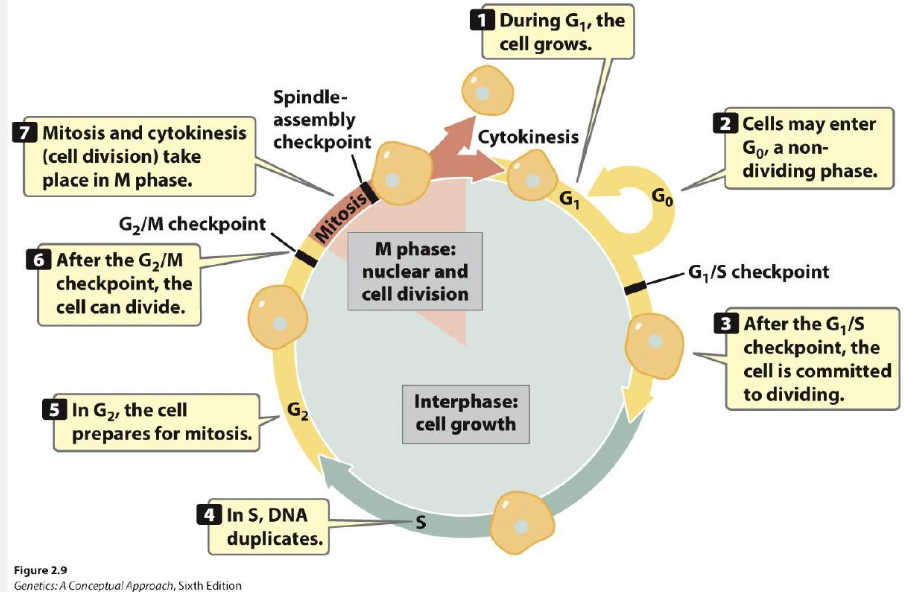
Interphase → an extended period between cell divisions, DNA synthesis, and chromosome replication phase
M phase → mitotic phase
Phase checkpoint → key transition points; cells cannot move forward unless checkpoint permits them to
*G phase stands for growth phase*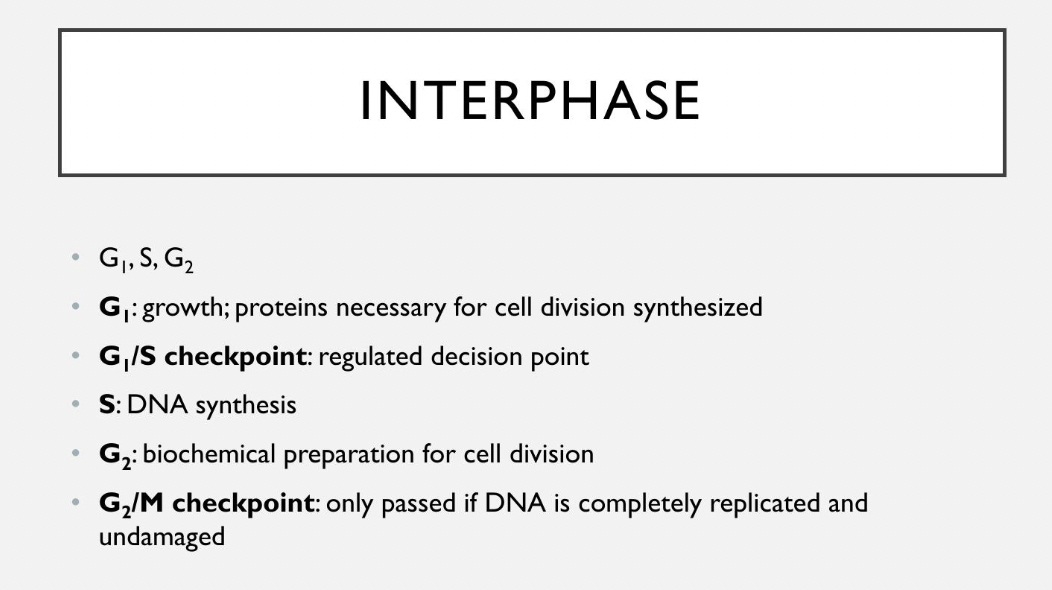
g1 - g2 is interphase
Mitosis
Spindle microtubules are made up of proteins called tubulin subunits, these can assign polarity to the spindle microtubules
Genetic consequences of the cell cycle
Cycle produces 2 genetically identical cells
Newly formed cells contain a full complement of chromosomes
Each newly formed cell contains approximately half the cytoplasm and organelle content of the original parental cell
*know this about the cell cycle*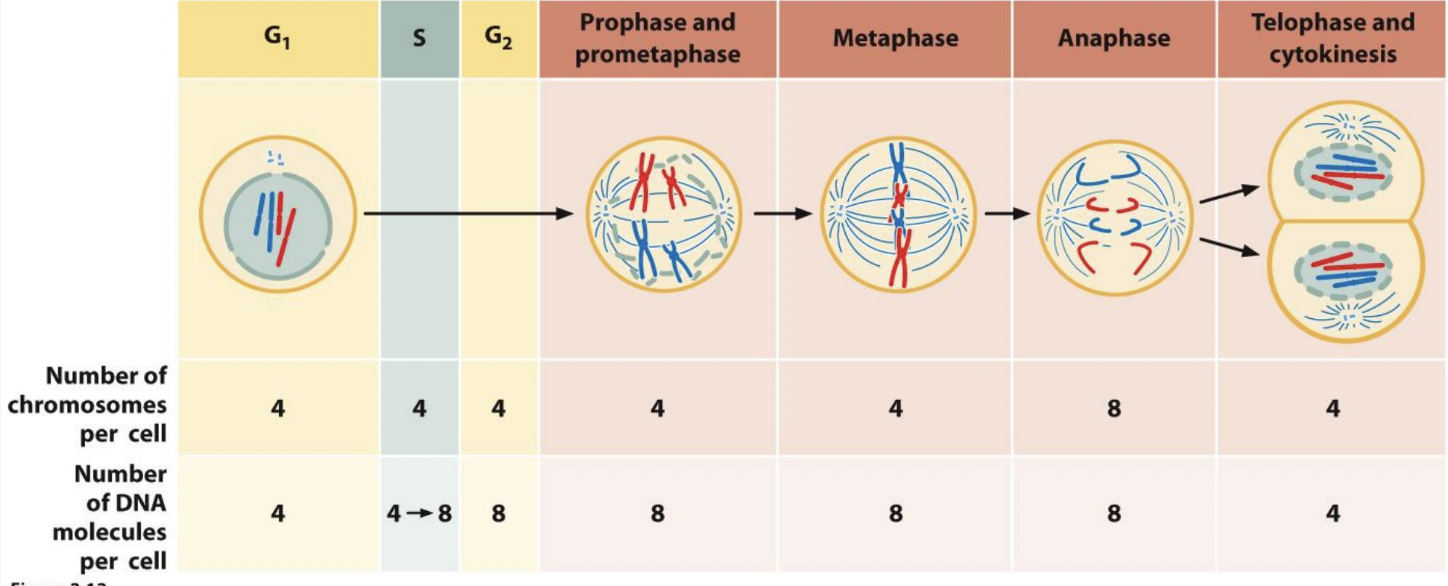
Sexual reproduction and genetic variation
Meiosis is the production of haploid gametes
Fertilization is the fusion of haploid gametes
Genetic variation is the consequence of meiosis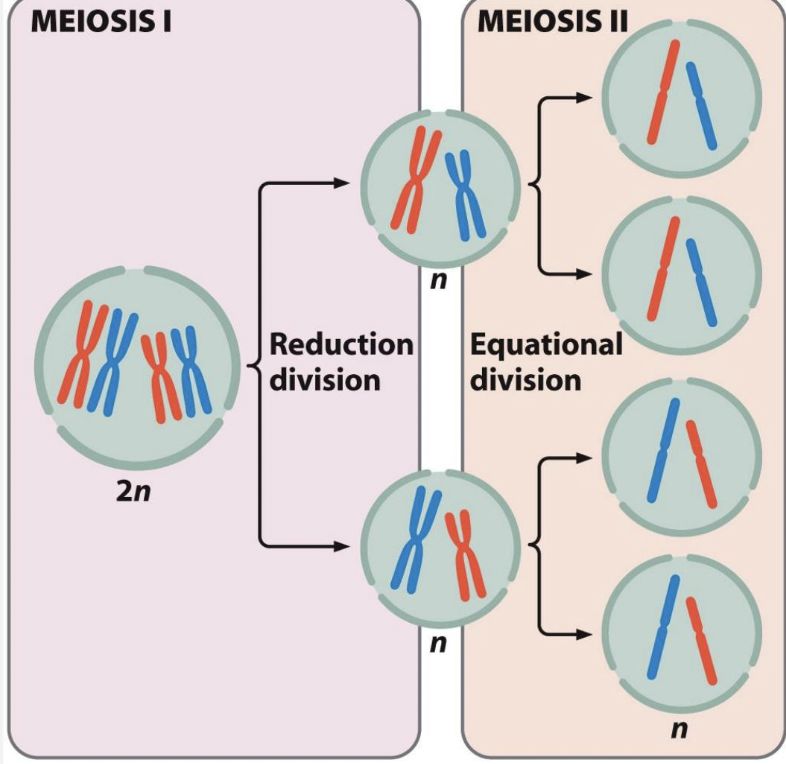
Meiosis
Interphase - dna replication and chromosome replication
Meiosis I, separation of homologous chromosome pairs, reduction of chromosome number - reductional
Meiosis II, separation of sister chromatids, known as equational division - equational
Meiosis I
Prophase I
Synapsis; close pairing of homologous chromosomes
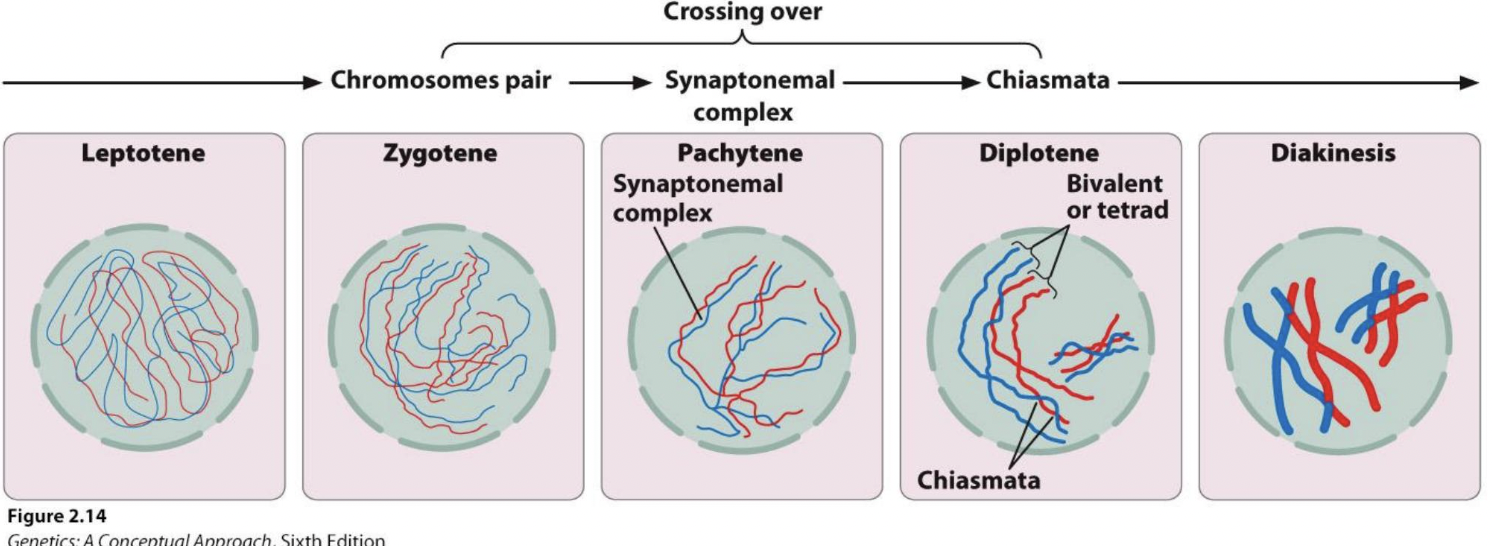
Tetrad; closely associated four sister chromatids of two homologous chromosomes
Crossing over; crossing over of chromosome segments from the sister chromatid of the other synapsed chromosome - exchange of genetic information
Metaphase I - random alignments of homologous pairs
Anaphase I - separation of these homologous chromosomes
cohesions- proteins that hold the chromatids together and are the key to the behavior of chromosomes in mitosis and meiosis.
shugoshin protects cohesion from degrading
how does shugoshin affect sister chromatids in meiosis I & II
Anaphase I → protects cohesion at centromeres, during anaphase II, shugoshin breaks down
Meiosis in animals:
Spermatogenesis → male gamete production
Oogenesis → female gamete production
during the second half of male & female gamete production, both become haploid. (2n → n)
Chromosome Variation - Chapter 8
Karyotyping - chromosomes prepared from actively dividing cells
Halted in metaphase
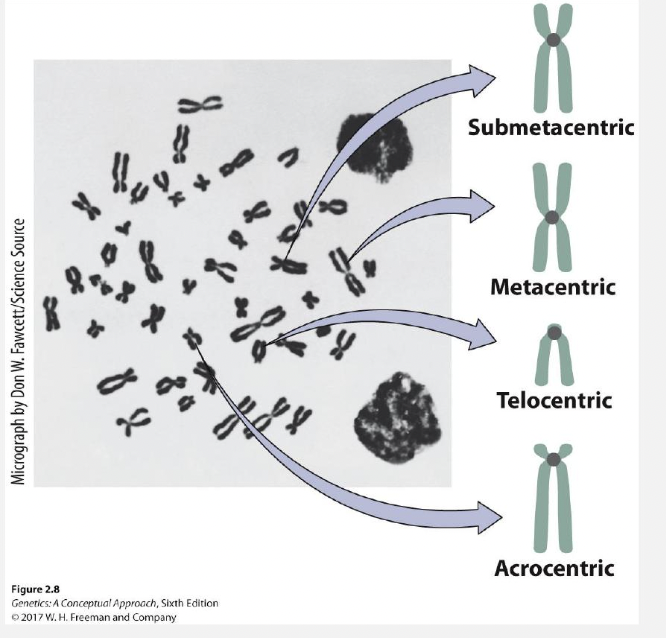
Chromosomes are arranged according to size
*the 23rd & 24th are the sex chromosomes*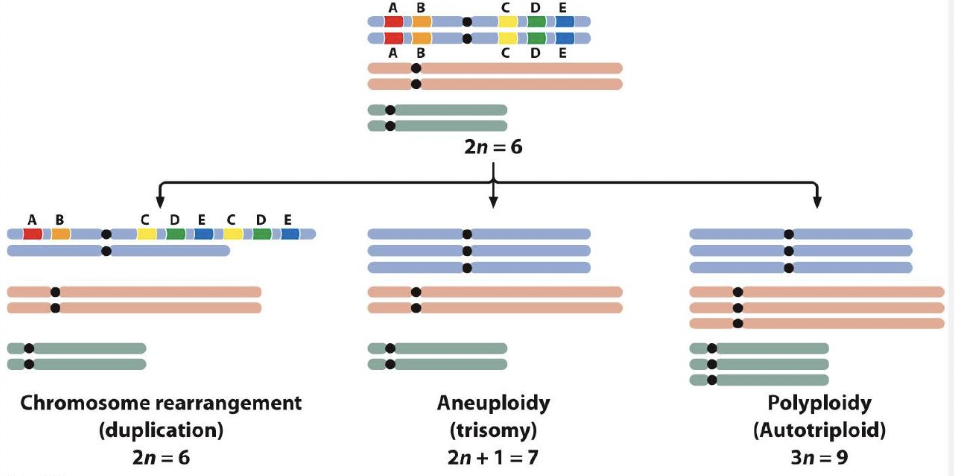
Types of Chromosome Mutations
Chromosome rearrangements
Alter the structure of chromosomes
Aneuploidy
Alters the number of chromosomes for one type of chromosome
Polyploidy
One or more complete sets of chromosomes are added
Unbalanced gene dosage
Pseudodominance - recessive gene is expressed due to gene deletion
Effects of deletions
Imbalances of gene product
Expression of a normally recessive gene(pseudo dominance)
Haploinsufficiency
Types of inversions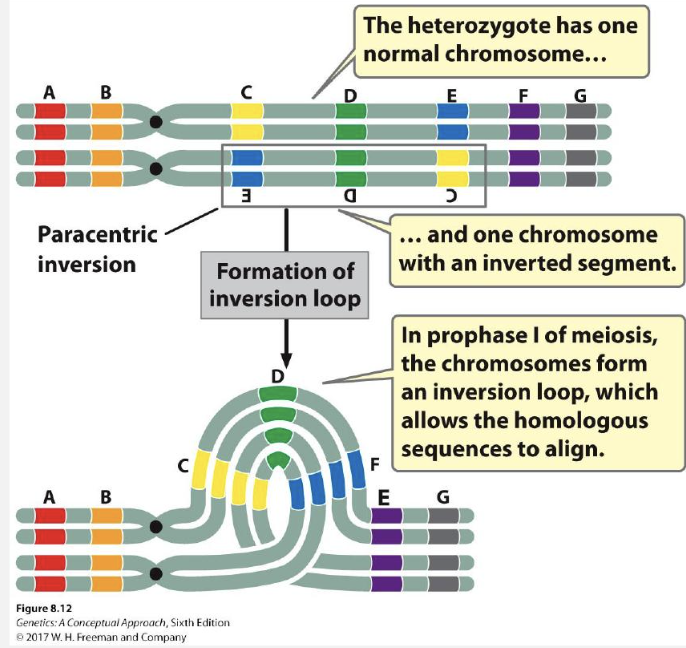
Paracentric inversions
Centromere does not move due to inversion
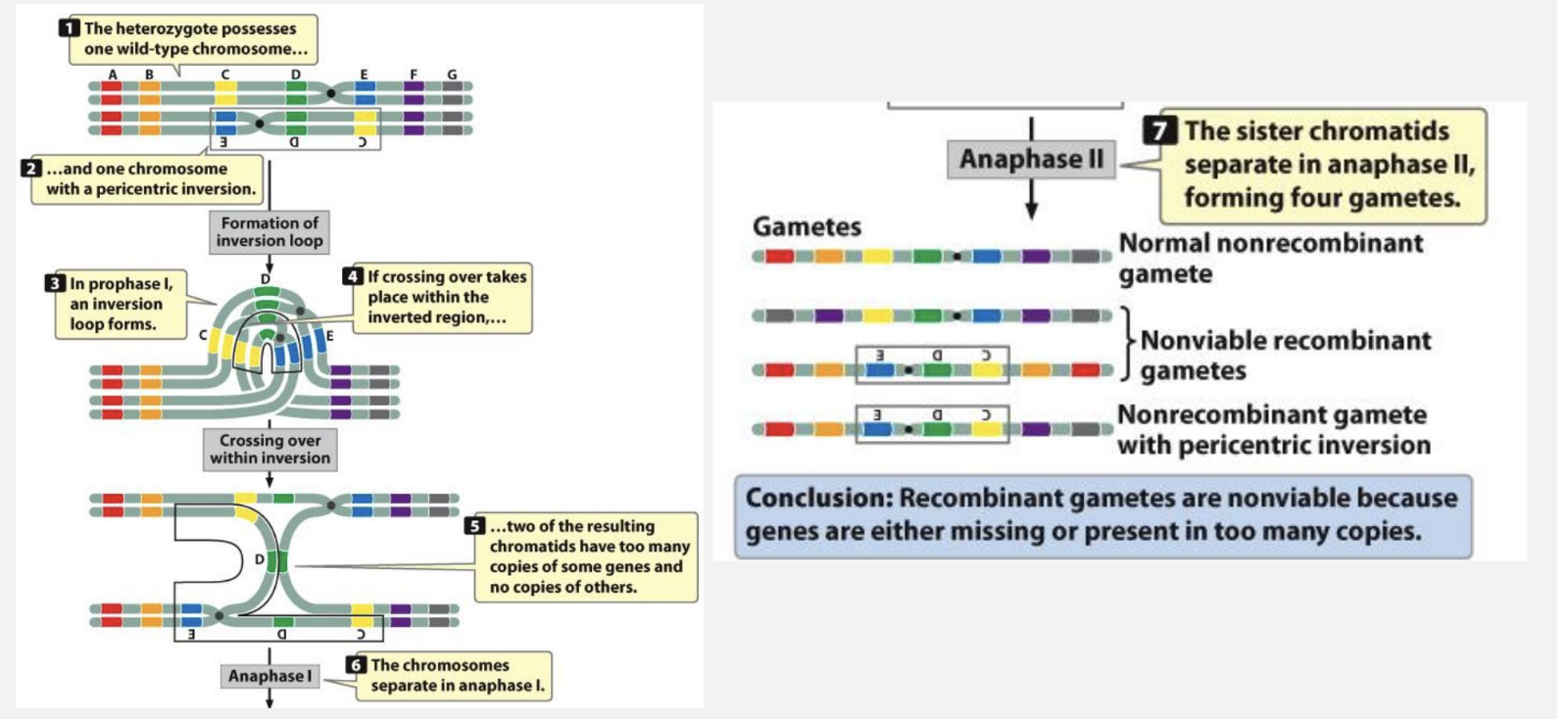
Pericentric inversions
One that involves a shift in location of centromere, arm length changes
Inversions in meiosis
No issues occur in individual homozygous
Individual heterozygous
Only align if inversion loop is formed
Demonstrates reduced recombination as it is formed from a nonviable offspring
Have abnormal gametes formed in pericentric inversions
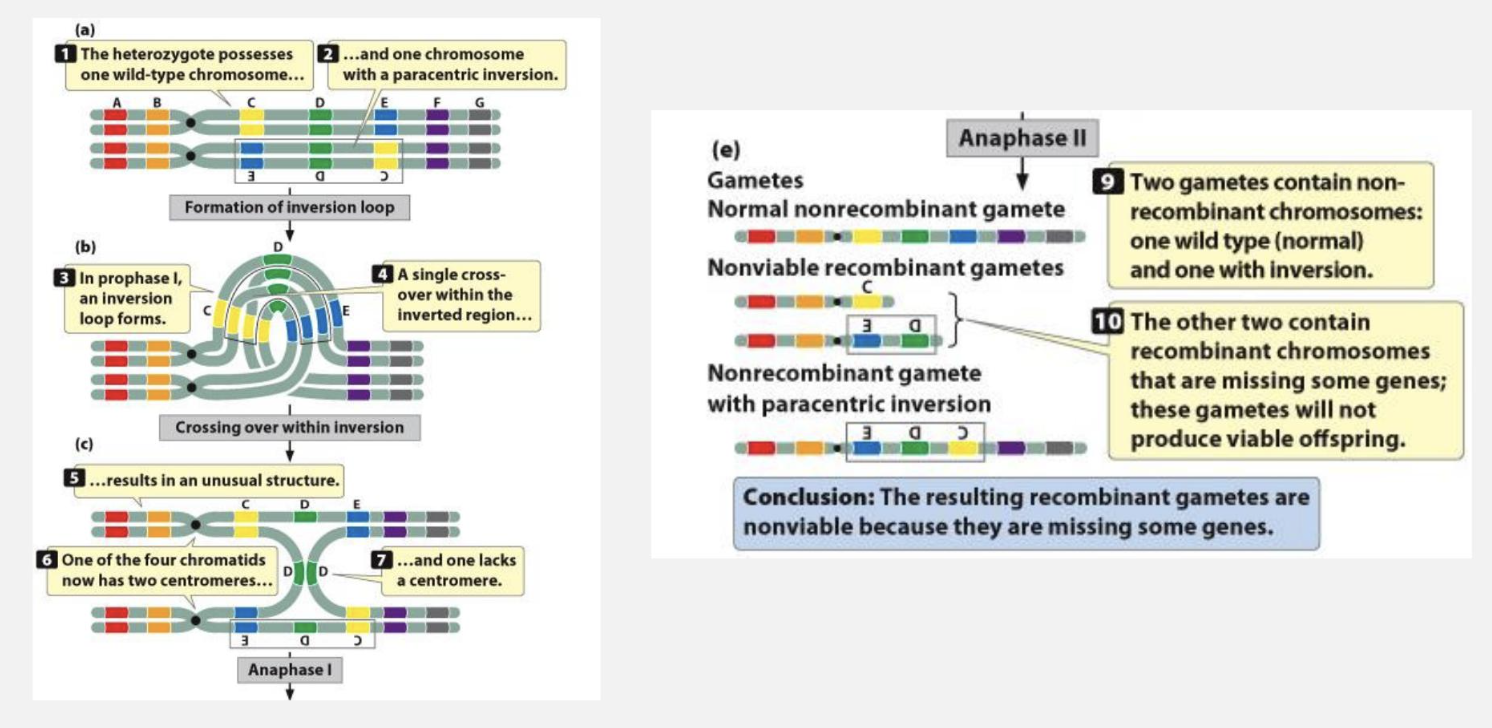
← paracentric inversion
pericentric inversion→
Translocations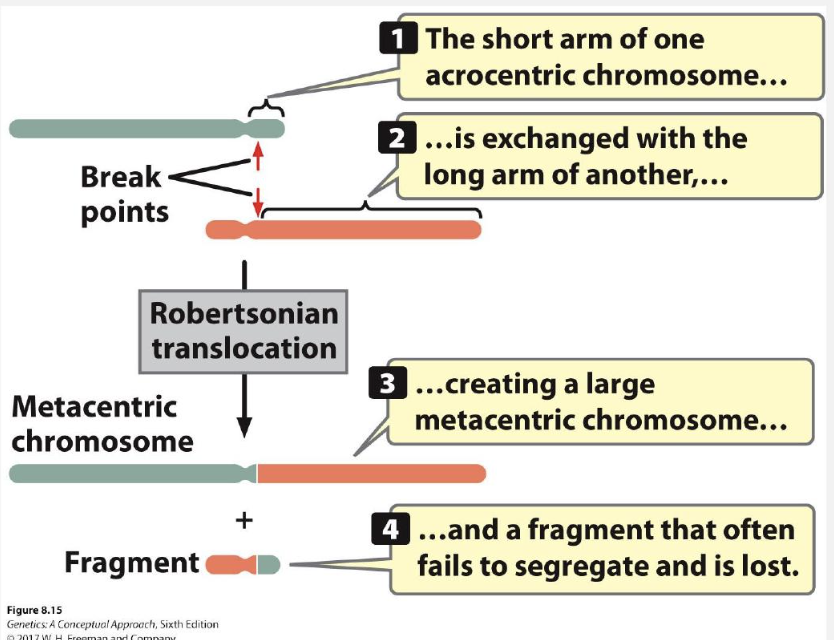
Robertsonian
Reciprocal
Nonreciprocal
Robertsonian translocation - involves 2 acrocentric chromosomes and 2 breakage events, exchange in chromosomal arms occurs, forming one metacentric chromosome with abnormally long arms, and one chromosome with very short arms, and major pieces missing
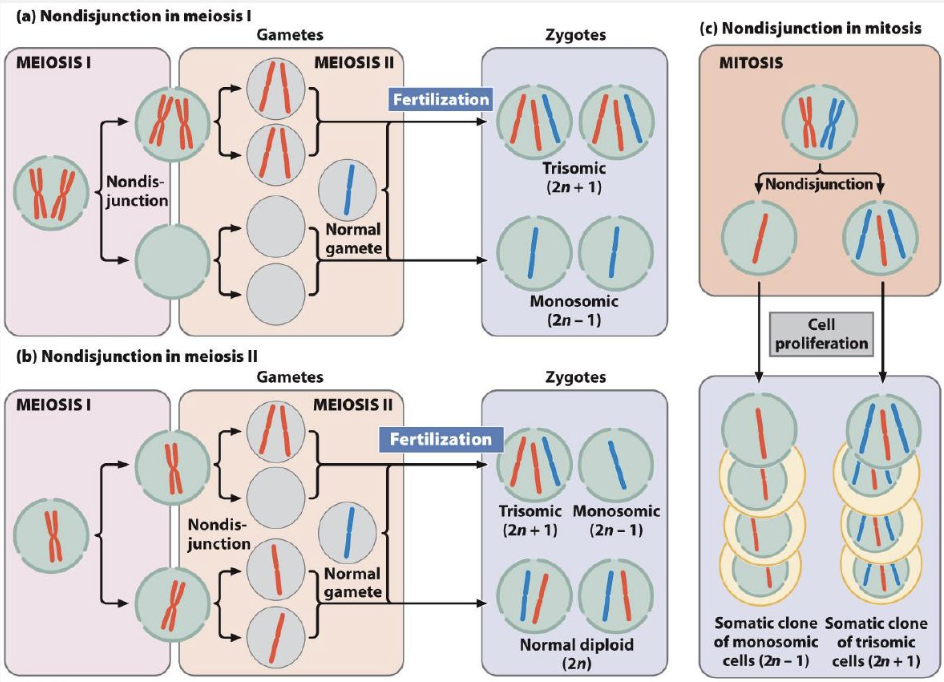
Variations in copy number are aneuploidy and polyploidy
Causes of aneuploidy
Deletion of a centromere
Robertsonioin translocation
Nondisjunction during mitosis and meiosis
Nondisjunction → improper separation of chromosomes or chromatids in anaphase; this dictates the # of chromosome copies each cell gets
Types of aneuploidy
Nullisomy → loss of both members of homologous chromosomes; 2n-2
Monosomy → loss of a single chromosome; 2n-2
Trisomy → gain of a single chromosome; 2n + 1
Tetrasomy → gain of 2 homologous chromosomes; 2n + 2
Effects of aneuploidy
In plants, mutants could be trisomics
In humans
Sex chromosome aneuploids
1. Turner syndrome, XO
2. Klinefelter, XXY
Autosomal Aneuploids
Trisomy 21 → Down syndrome
Primary Down syndrome → 75% nondisjunction in egg formation
Familial Down syndrome → Robertsonian translocation between chromosomes 14 & 21
In humans
Autosomal aneuploidy
Aneuploidy & maternal age →
Causes of aneuploidy
Uniparental disomy → both chromosomes inherited from the same parent
Mosaicism(nonapparent chromosomal defect)& nondisjunction in mitotic division
Genetic mosaicism of the sex chromosome produces a gynandromorph
Polyploidy
→ can arise through nondisjunction in mitosis or meiosis
The presence of more than 2 sets of chromosomes
Autopolyploidy is from a single species
Allopolyploidy is from two species
The significance of polyploidy → increases cell size, can cause larger plant attributes, can give rise to new species through evolution

←Meiosis - autotriploid (3 sets of chromosomes) homologous chromosomes can or can not pair in 3 ways
Mendelian Genetics - Chapter 3
Used pisum satvium (peas) to experiment → never looked at plant chromosomes
Observed seed color
Seed shape & coat color
Pod color & shape
Flower position and stem length
Mendel conducted his experiments between 1856 through 1863
Monohybrid cross → cross between 2 parents that differ in a single characteristic
Conclusion 1 = two genetic factors encode character
Conclusion 2 = two genetic factors (alleles) separate when gametes are formed
Conclusion 3 = the concept of dominant & recessive traits
Conclusion 4 = two alleles separate with equal probability into gametes

Principal of segregation (mendels first law)→ each individual diploid organism possesses two alleles for any particular characteristic, they segregate when gametes are formed, and one allele goes into each gamete
The concept of dominance → one allele is typically shown over another the “dominant” allele
Sutton ⇒ chromosomal theory of hereditary
Law of segregation
Each individual organism possesses two alleles encoding a trait; before meiosis*
Alleles separate when gametes are formed; anaphase I*
Alleles separate in equal proportions; anaphase I*
Law of independent assortment - the way 2 different traits get distributed (not related to one another)
Alleles at different loci separate independently; anaphase I ∫
∫ This is assuming crossing over occurs, if crossing over does not occur, then segregation & independent assortment may also occur in anaphase II

Monohybrid crosses reveal the principle of segregation & the concept of dominance
Tested the theory of inheritance of dominant traits using backcrosses
Predicted the outcomes of genetic crosses through punnet squares
Dihybrid cross → involves examining 2 traits at a time
This relates back to the principle of independent assortment
Related independent assortment to meiosis Ω
Gametes located on different chromosomes will sort independently
Ω at the end of anaphase I, each daughter chromosome will get its own full set of chromosomes, and genes on each different pair of chromosomes will sort independently, thereby giving different outcomes
chi-square goodness of fit test →
indicates the probability that the difference between the expected & observed value is due to chance
∑(O-E)2 ⁄E - Goodness of Fit Equation
If the chi-square value is greater than 0.5, it indicates that the probability difference expected is due to chance
Chapter 4 - Sex determination & inheritance of sex-linked characteristics

there are several different mechanisms of sex determination; x& y pair up
sex determination
Alternate between haploid & diploid states
hermaphroditism → both sexes are seen in the same organism
Monecious has both
Diecious is one of the two
XX-XO system:
XX- female
XO - male
grasshoppers
XX-XY system
XX - female
XY - male
mammals
There also exists the ZZ-ZW system

ZZ are males
ZW are females
⇐ Found in birds, reptiles, snakes, butterflies, amphibians, & fish
Haplodiploid system
Haploid set- male
Diploid set - female
Bees, wasps, and ants
Gene sex-determining system
No sex chromosomes, only the sex-determining genes
Plants, protozoans, & fish

Environmental sex determination
Limpet’s neck position ⇒
Turtle temperature

Sex determination in drosophila melanogaster
Uses genic balance system
X:A ratio; (x is the number of chromosomes, a is the haploid set of autosomes)
Metamales and metafemales are low viability, these tend to not rise from the larvae.
In humans
Turner syndrome - XO, 1/3000 female births
Klinefelter - XXY, XXXY, XXXXY, or XXYY; 1/1000 male births
poly-X females; 1/1000 every female births
The role of sex chromosomes
The X chromosome contains genetic information essential for both sexes, one copy of X at least is required
The male determining gene is located on the Y chromosome, A single Y produces a male phenotype
Absence of Y results in a female phenotype
In males
sry(sex determining region)
Androgen-insensitivity syndrome
Caused by a defective androgen receptor
Dosage compensation ⇒ the amt of protein produced by x-linked genes & random inactivation in two sexes

Lyon hypothesis →
Within each female cell, one of the two chromosomes is inactivated.
need one functioning X chromosome
Tortoise-shelled cats are a result of random x-inactivation; this occurs in 2 steps
Cell assess # of present X chromosomes
One X chromosome is picked to stay active, whereas the others become inactivated
all cells contain all chromosomes
Calculating recombinant frequency can be done by:
(number of recombinant progeny) / (total number of progeny) * 100%
Nonrecombinant ratio is 1:1:1:1
Mapping techniques
molecular markers
rflps (restriction fragment length polymorphism)
Genome-wide association studies (gwas)
Association within populations
haplotype
Linkage disequenceilibrium
Physical mapping
Somatic cell hybridization
Deletion mapping
Physical mapping through molecular analysis
Fluorescent In Situ Hybridization (FISH)
Fluorescent probe binds to complementary regions of the target gene, & targets specific dna sequences for genetic diagnosis (alexa-fluor 488)
eggs are single-cell
Levels of recombination vary between the species, chromosomes of a single species, and between males and females