S1Q2 | OCC
Why do we need to care about the speaking styles of people?
- Writing or delivering a speech, a writer/speaker should consider the audience and purpose of writing or speaking
- Knowing what your audience know will help you tailor your speech
MARTIN JOOS |
|---|
- Linguist and a german professor
- The author of the English verb forms and meanings
- Writer of the book “The Five Clocks”
- Correlation of speaking style and time
- Different people and situation call for a different speech style
Speech Style Theory (1961) |
|---|
→ the form of language that the speaker uses which is charaterized by a degree of formality or informality
☆ Five Clocks of Martin Joos
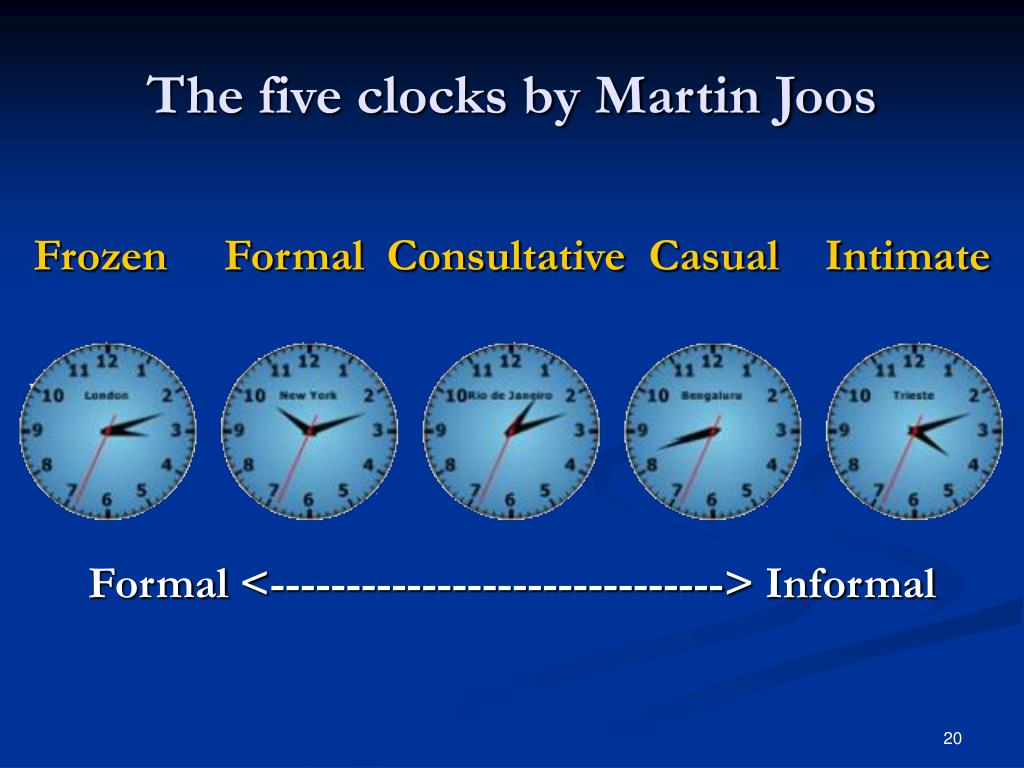
1. Intimate
– non-public; there is an element of privacy
– sender and receiver have known each other very well
– uses private vocabulary including non-verbal messages
– meaning is shared without correct linguistics forms
– intonation is more important than wording or grammar
Examples:
- Convo w parents
- Close friends
- Fam members
2. Casual
– used among ordinary friends and acquaintances
– does not require background info
– uses slangs
– informal context
– interactive / transactional model
Examples:
- Classmates
- Convo w ordinary ppl
3. Consultative
– most operational among other styles
– element of authority
– used among ppl who do not share common experience or POV
– speaker provides background info
– uses formal language with generally accepted grammatical structures
Examples:
- Employee discussing a proposal w their boss
- Peace negotiation process
4. Formal
– imparting info
– must be well-organized, correct grammar, and dictation
– uses technical vocabulary with exact definitions
– straightforward and direct
– includes presentations and intro
– sometimes linear (listener is passive)
- No interruptions; can also be interactive
5. Frozen
– used in formal ceremonies
– printed unchanging language
– wording is exactly the same time it is spoken
– static and ritualistic in nature
Examples:
- Pledge of allegiance
- Prayers
- Wedding vows
Types of Speech Act (1962) |
|---|
☆ John Austin
- a british philosopher of language
☆ John Searle
- an english professor
→ language just not only used to inform or describe things, it is also used to do things or to perform acts
→ talking is not just saying something but acting and making meaning out of the received message
★ Locutionary Act
- utterance
Example:
- “Please keep your phone”
★ Illocutionary Act
- intention
- social function of what is said
Example:
- The speaker is either requesting or commanding the addressee
★ Perlocutionary Act
- response
- resulting act of what is said
Example:
- The addressee would either keep or not keep the phone
Categories of Illocutionary Act John Searle – 1975 |
|---|
1. Commissive
- commits the speaker to do something in the future
- includes: promising, planning, vowing
Example:
- I promise to do better for this quarter
2. Assertive
- the speaker expresses belief about the truth of a proposition
- includes: reporting, boasting, concluding, claim
Example:
- I am empowered by my God, and I can do better
- My God is not stupid
3. Directive
- The speaker tries to make the addressee perform an action
- includes: asking, ordering, requesting, inviting, advising, begging
Example:
- Double your effort for this quarter
4. Expressive
- the speaker address their feelings or emotional actions
- includes: thanking, apologizing, welcome, complaining
Example:
- I felt sorry for my last quarter performance
5. Declarative
- An act which brings a change in the external situation
- includes: blessing, firing, baptizing, bidding, passing a sentence, excommunication
- presence of frozen speech style
Example:
- Congratulations! You’ve made this quarter
Types of Communicative Strategies (1990) |
|---|
☆ Communication
- process of sharing and conveying message or information
☆ Strategy
- a plan of action used to achieve a goal
→ plans, ways, or means of sharing information which are adopted to achieve a particular purpose
Nomination |
|---|
– allowing the listeners of audience to tune in to the topic
– presenting or introducing a particular topic
❀ Why nominate?
- Help audience to recall background information about the topic
- Prepares them to listen to what is to be said about the topic
- Give your audience the first impression of your speech
- Establish your credibility with your audience
❀ How to nominate?
To begin a speech, speakers can use:
- A related quotation/proverb/bible verse
- An anecdote
- Short story of a personal experience
- Thought-provoking question
- Survey results
- Research findings
- Thesis statement
- A claim to prove across your speech/research
- An unconventional position
- Concrete objects
★ Critique the nomination strategy ☆ Speech of Dananjaya Hettiarachchi
☆ Speech of Mohammed Qahtani
☆ Speech of Roselle Ambubuyog
|
|---|
Restriction |
|---|
– constraining the topic of discussion to make it specific and manageable
– limiting the response of the other person involved in the communication
❀ Why restrict?
- The listener is forced to respond only within the set of categories that is set of planned by the speaker
- Properly restricted topic
❀ How to restrict?
- Using a statement with an alternate response question (i.e. yes/no, agree/disagree)
Turn-taking |
|---|
– changing from one speaker to another
– recognizing when to speak or take the turn of speaking
❀ Why take turn?
- Gives other people a chance to be heard
- Discredits the idea of monopoly of information
- Makes the communication interactive
❀ How to take turn?
- Knowing when to talk required matching our verbal and non-verbal cues
- It uses either formal or informal approach
- Formal: permission to speak is requested
- Informal: just jump in and start talking
- Sir I agree with the point that you have made. But may I add that…
Topic Control |
|---|
– focuses on the topic without straying into other discussions
– using a simple question and answer formula that moves the discussion forward
– keeping the interaction by asking questions by eliciting a response
– series of question about the same topic/series of related question moving the communication forward
– open ended
❀ Why control?
- Remain focus on the topic
Topic Shifting |
|---|
– changing from one topic to another
– introducing a new topic to discuss
❀ Why shift the topic?
- To begin a new topic, thus widening the information of the audience
- To share other topic/s that the speaker finds more comfortable to discuss
❀ How to shift the topic?
- Let us turn to the issue of…
Repair |
|---|
– clarifying what the speaker is saying if misunderstood
– rephrasing or using other words to better express the meaning to their audience
❀ Why repair?
- To correct erroneous information
- Rephrasing or using other words to better express the meaning to his/her audience
❀ How to repair?
- What I mean is…
- Let me rephrase the statement by saying that…
- What I am trying to drive at is…
- What I want to point out is…
Termination |
|---|
– ending properly any speech or discussion
– concluding the communication using verbal or non-verbal signs
❀ Why terminate?
- Summarize the shared information
- To have a clear takeaway, thus the audience remembers your topic well
❀ Importance
- Helps you drive home the big picture with your audience
❀ How to terminate?
- A strong and remarkable one-liner statement about your stand
- Using a quotation
- Using an anecdote
- Using a question (the audience will ponder on it)
- Using a line of a poem/song
- Using a picture
How to Apply Comm Strats |
|---|
1. Always use I-B-C Format
Intro: attention grabbing, one-liner statement
Body: 3 sub points, credible factual evidence
Conclusion: summarize your statement in one sentence
2. Follow S-E-E
Statement
Evidence
Emotion: writing examples or telling stories
Speech According to Purpose |
|---|
- Informative / Expository
- Demonstrative
- Persuasive / Motivational
- Entertainment
Informative |
|---|
– educates the audience by providing useful & interesting information
– helps the listeners to understand a topic in a more in-depth matter
– generally objective, not subjective
– observes the IBC format in written and spoken forms
– the purpose should always begin with the infinitive “to inform”
Example:
- Sona
- News broadcast
- Research or paper presentation
Four Types of Informative Speech |
|---|
Speech about…
1. People or objects - focuses on people and tangible objects
** Hidilyn Diaz
Speech purpose: To inform people about the latest accomplishments of Hidilyn Diaz in the field of weight lifting
**object: deconstructed roads → to inform the Bulaceños about the newly yet poorly constructed roads
2. Process - focuses on procedure or sequence of events
** Passport
Speech purpose: To inform the applicant about procedure in applying for Philippine passport
3. Event - focuses on an event that happened, is happening, or might happen in the future
** Vacation
Speech purpose: To inform HSAM parents and students about the school’s long christmas break
4. Concept - focuses on beliefs, knowledge, theories, principles, or ideas
** Kakistocracy → a government handled by the least suitable or incompetent citizens of a state
Speech purpose: To inform the Filipino people that kakistocracy is present in PBBM’s administration
Some Must’s |
|---|
- Knowledge level of the audience
- Demographic profile of the audience
- Socio-cultural, political, & religious affiliations of the audience

Demonstrative |
|---|
– instructs and educates the audience on how to do something step-by-step
– show and tell
– delivers the speech while performing the process
– generally objective because of its procedure
– observes IBC format in written and spoken form
– should always begin with the infinitive “to demonstrate”
Example:
- DIY
- Product presentation
Some Must’s |
|---|
- Visuals - use visual aids, concrete materials (the backbone of the speech)
- How to - focuses on how to rather than the what is
- Skills - decide on what practical skills you want your audience to gain
** Baked Mac
Speech purpose: To demonstrate the proper way of cooking baked macaroni…
Persuasive |
|---|
– convince people to change the way they think or do something
– encourages people to start doing something that they are not currently doing
– presents reasonable arguments why the audience has to
– utilizes objective and subjective POV
Some Must’s |
|---|
- Logical argument - think of it as if you were a lawyer proving a case in court
- Opinion - opinion must be accompanied with proof (logos) if you want to persuade your audience
- Manner - the best place to start is to appear friendly and approachable while you speak
☆ Motivational Speech
- communicates company strategy with clarity
- helps employees to see the future in a positive light
- inspires workers to pull together
Entertainment |
|---|
– provides pleasure and enjoyment to the audience
– most challenging; makes the audience laugh using humorous jokes & amusing anecdotes
– does not intend to share into nor persuade the audience
– observes IBC format in written and spoken forms
- Intermission speech during a program
- After dinner typical speech
- Stand-up comedians
Some Must’s |
|---|
- Timing - no matter how a statement is, it remains useless if not delivered on the right time in the right way
- Manner - humor has to be felt & seen in one’s voice & manner of speech
- Respect - never make fun of others to entertain people
Types of Speeches According to Delivery |
|---|
- Reading from a manuscript
- Memorized speech
- Impromptu speech
- Extemporaneous speech
1. Reading from a manuscript
– every word from a pre-written speech
– can’t miss any single word or important fact since it’s directly from the script
– speaking with advanced preparation
– planned & rehearsed speech
– reading aloud w written message
❀ Situations
- Newscasting
- Presenting the legal proceeding & verdict in a court
- Reading
❀ Advantages
- Guided speech
- Exact repetition of the written words
❀ Disadvantages
- Boring & uninterested situation
- Lacks rapport
❀ Tips
- Focus on key phrases & highlighted words
- Practice your speech
- Glance at the highlighted words to remember
- Familiarize
- Monitor
- Rehearse
- Observe
2. Memorized Speech
– planned & rehearsed speech
– reciting a written message
– speaking with advanced (?) speech
❀ Advantages
- Monitored eye contact
- Gestures are used
❀ Disadvantages
- Fast paced
❀ Tips
- Rehearse
- Make it short
3. Impromptu Speech
❀ Advantages
- Thinking ability
- Comes off more natural
- More focused belief
❀ Disadvantages
- Disorganized thoughts
- Lack connecting with the audience
- No time to prepare & no evidence
- Lack of preparation
- Nerve wracking
❀ Scenario
- Birthday toast
- Ms. Universe
- Interview
- Speaking without advance preparation
- Unrehearsed
- Spoken conversation
❀ Tips
- Read
- “Less is more”
- Us a mnemonic
- Pause for a moment to plan in your head
- State your main points briefly
- End by saying thank you
4. Extemporaneous Speech
– speaking with limited time
– guided by notes or outline, but not necessarily holding a manuscript
– delivered conversationally
❀ Scenario
- Campaign
- Report a topic in class
❀ Advantages
- Look confident
- Engage the audience
❀ Disadvantages
- Inadequate time preparation to plan
❀ Tips
- Create an outline
- Organize your points
- Use facts or real-life experience
- Manage your time
- Rehearse, rehearse, rehearse
Principles of Speech Writing |
|---|
- Deciding on an interesting topic to discuss
- Determining the audience and the purpose
- Sourcing the information
- Outlining & organizing the speech content
1. Deciding on an interesting topic to discuss
- knowing the what
a. Look for a topic / subject that interests you
❀ How?
Choose a topic that:
- You know
- You love
- Audience cares about
- Timely & relevant
- Relatable
- Has social impact
b. Find something interesting on the chosen topic or the topic assigned to you
❀ How?
Ask the following questions on the assigned or chosen topic
- Is it relatable?
- Is it supported with story?
- Is it relatable with current events or trends?
- Is it injected with humor?
2. Determining the audience and the purpose
- make an audience analysis
- knowing the who & why
❀ How?
Have an audience profile
- Demography
- age
- Male - female ratio
- Educational background
- Situation
- time
- Venue
- Occasion
- Psychology
- values
- Belief
- Cultures & tradition
3. Sourcing the information
- looking materials for your speech
- knowing the where
❀ How?
Depends on your topic & purpose
- Is it academic?
- Is it controversial?
- Is it technical?
- Is it loaded with emotions?
- Is it abstract?
❀ 2 Sources
1. Primary - direct, firsthand sources of info or data
2. Secondary - discuss; rework info from primary sources
4. Outlining & organizing the speech content
- narrowing down the topic to make it manageable to discuss/present given the allotted time
- knowing the how
❀ How?
- Decide on a thesis statement
- State your central idea in a sentence or a word form
- Use accurate, precise, and comprehensive language in discussing the supporting details
❀ 2 classifications of outlines:
1. Topic Outline - from words & phrases
2. Sentence Outline - uses sentences
★ Guidelines for Speech Writing
- Your speech is meant to be heard, not read
Keep
It
Short &
Simple
- They can create confusion to the audience
Jargon
Acronym
Too technical terms
- Make your speech more personal by using I/We
- Use active verbs to make it more conversational
Active voice:Holy Spirit Academy inaugurates four new constructions
Passive voice: four new constructions are inaugurated by HSA
- Be careful with your joke & non-verbal cues
- Use metaphors & other figures of speech to convey your point
- Make sure that the speech falls under the given time limit
Principles of Speech Delivery |
|---|
- intimidating
8 C’s for public speaking
1. Context | 5. Clarity |
|---|---|
2. Connection | 6. Clothing |
3. Content | 7. Concentration |
4. Confident/conviction | 8. Choreography |
★ Effective public speaking is…
1. Purposive - must have a clear purpose
2.Under Pressure - intimidating & nerve-wracking
3. Building Up - support your main ideas with details; you must have something valuable to say about the topic
4. Logically Organized - arrange your ideas
5. Inspiring -
6. Contextualized -
7. Sincere - be sincere not only with your words but also with your actions
8. Perform - be an actor or actress on stage
9. Engaging - talk to you audience
10. Always Prepare - practice your speech several times/prepare for the unexpected
11. Keep Audience Attention - to hook & maintain audience
12. Inclusive - cover all main points
13. Not Perfect - accept that lapses & the unexpected can happen
14. Gain Confidence - develop a confidence to speak in front of a large crowd