Topic 6- Animal Diversity II
Outcomes:
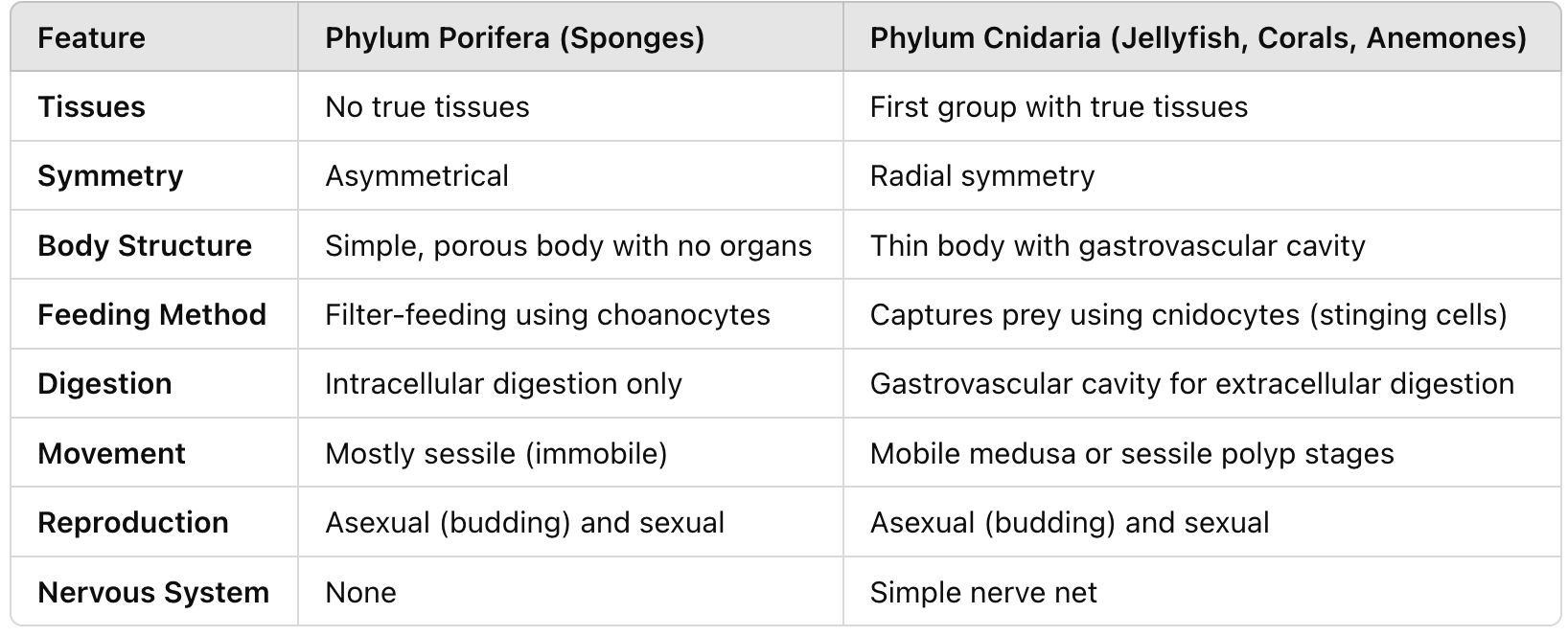
Compare and contrast Porifera and Cnidaria
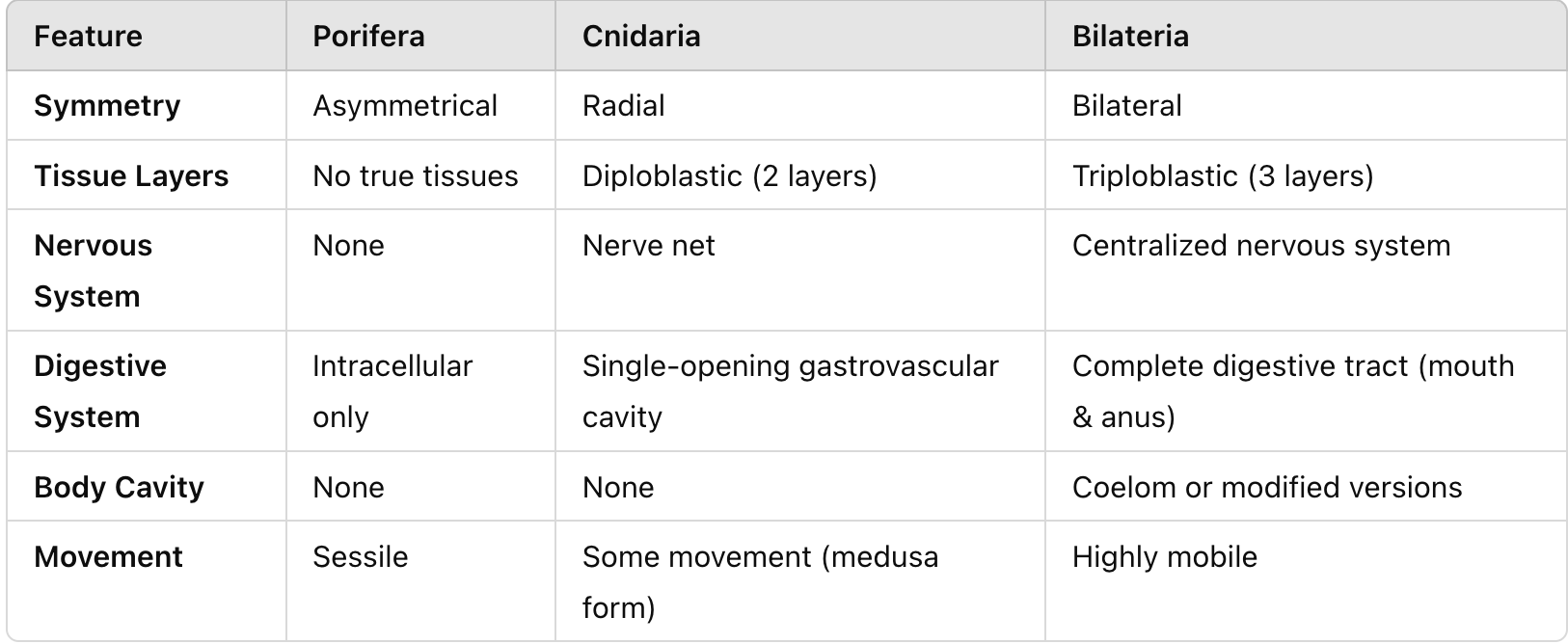
Compare and contrast major animal groups
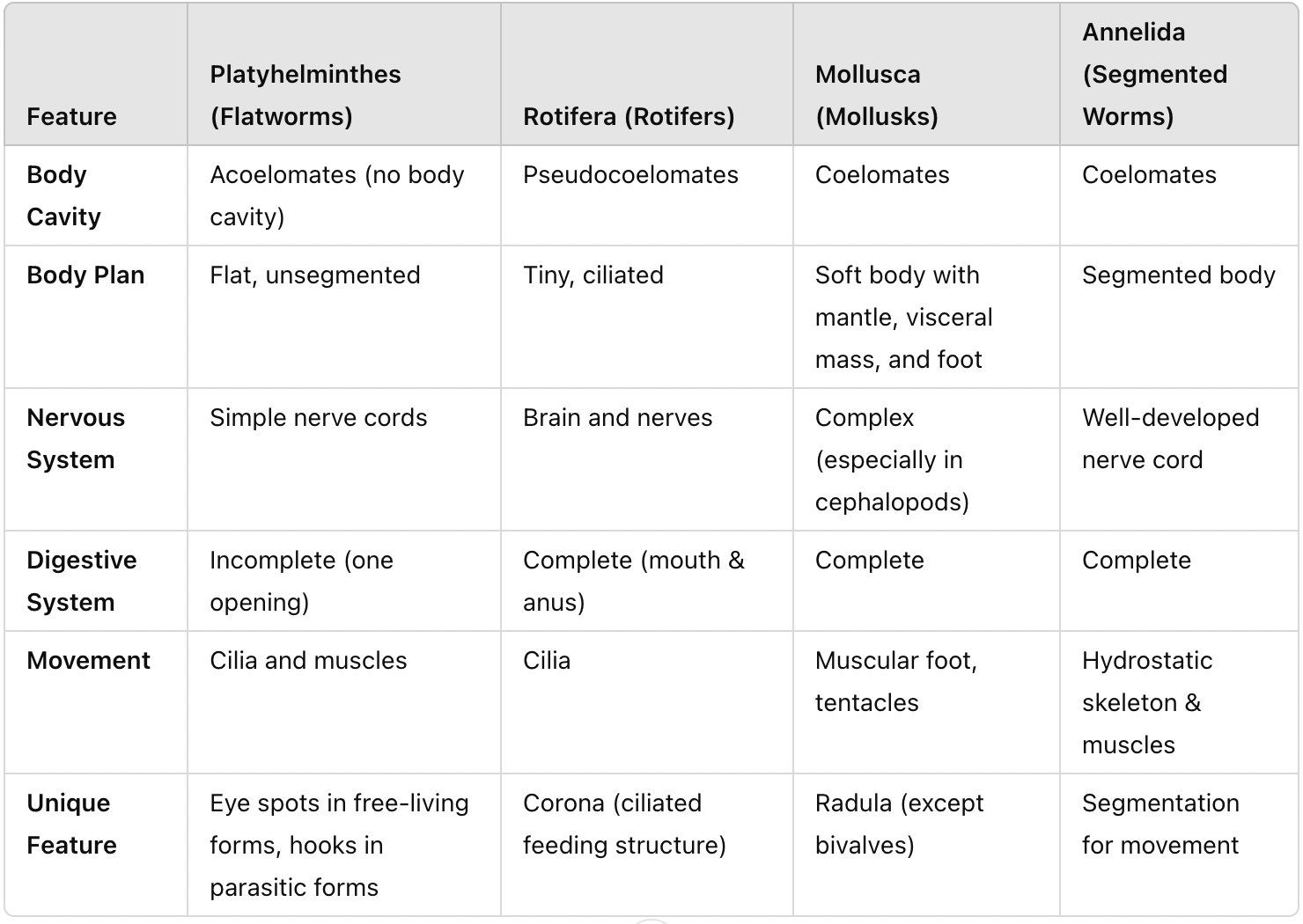
Compare and contrast Spiralians
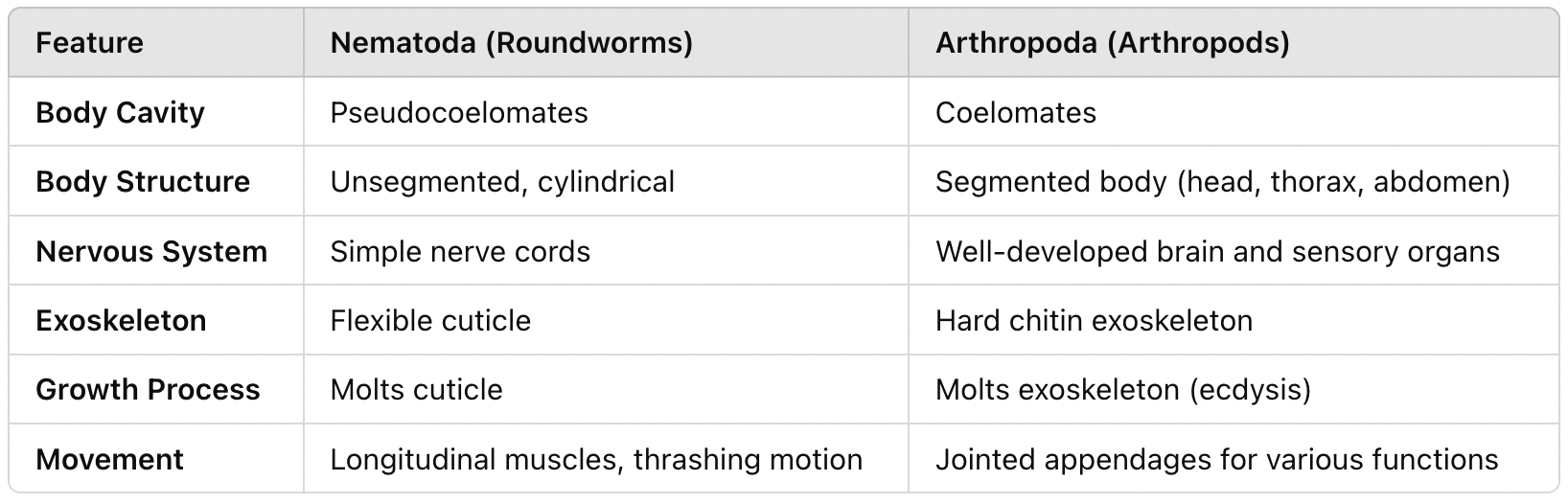
Compare and contrast Ecdysozoans
I. Basal Animals (Choanoflagellates)
Basal animals are the most primitive members of the animal kingdom. They have general derived traits shared with all animals but lack more specialized traits found in more complex organisms. They are characterized by:
Lack of true tissues (except Cnidaria).
No organs or organ systems.
Simple body structures adapted for filter-feeding or passive food absorption.
A. Phylum Porifera (Sponges)
Name Porifera means “to have pores”, referring to their porous bodies.
Least complex animals.
Multicellular with an extracellular matrix (ECM) but no true tissues, symmetry, or organs.
Considered basal metazoans, meaning they are among the earliest animal lineages.
Sponge Morphology
Osculum: The large opening at the top of the sponge where water exits.
Spongocoel: The central cavity where water circulates.
Water flow system:
Water enters through pores (ostia), moves into the spongocoel, and exits through the osculum.
This movement allows filter feeding—the extraction of food particles from the water.
No digestive cavity:
Digestion occurs inside individual cells (intracellular digestion).
Only sponges rely solely on intracellular digestion.
Choanocytes (Collar Cells)
Specialized feeding cells unique to sponges.
Flagellated:
Their movement creates water currents.
Helps capture food particles.
Line the spongocoel and function by ingesting bacteria and other microscopic food particles.
B. Phylum Cnidaria (Jellyfish, Corals, Sea Anemones)
First group to have true tissues.
Radial symmetry (symmetrical around a central axis).
Diploblastic: Develop from two germ layers (ectoderm and endoderm).
Thin body structure with a gastrovascular cavity:
A single opening serves as both mouth and anus.
Functions in both digestion and circulation.
Unique Feature: Cnidocytes
Specialized stinging cells unique to cnidarians.
Used for defense and capturing prey.
Found in jellyfish, corals, and sea anemones.
Mostly marine species.
Considered basal eumetazoans (first group with true tissues).
II. Introduction to Bilateria
Bilaterians are a major group of animals with bilateral symmetry and triploblastic body structures.
A. Shared Derived Traits of Bilateria
Bilateral symmetry: Body divided into left and right halves.
Triploblastic: Have three germ layers (ectoderm, mesoderm, endoderm).
Body cavity (coelom):
Some, like Acoela, lack a body cavity.
Nephrozoa: Includes animals with true coeloms or a modified version of one.
B. Protostomia ("First Mouth")
Monophyletic group (evolved from a common ancestor).
Characterized by protostome development:
Spiral cleavage.
Determinate cell fate.
Mouth develops first from the blastopore.
Highly diverse group, including mollusks, annelids, and arthropods.
C. Deuterostomia ("Second Mouth")
Monophyletic group distinct from protostomes.
Characterized by deuterostome development:
Radial cleavage.
Indeterminate cell fate.
Anus develops first from the blastopore.
Includes echinoderms (sea stars, sea urchins) and chordates (vertebrates like humans).
III. Spiralia Clade
Spiralia is a clade, not a phylum. Members are grouped based on DNA similarities and their shared protostome development patterns.
A. Shared Derived Traits
Grouped by molecular evidence (DNA sequencing).
All members have ancestral traits from their bilaterian ancestor:
Bilateral symmetry.
Triploblasty (three germ layers).
B. Phylum Platyhelminthes (Flatworms)
Dorsoventrally flattened bodies.
Acoelomates (lack a body cavity).
Two main groups:
Free-living flatworms:
Have eye spots to detect light and dark.
Parasitic flatworms:
Have hooks and suckers for attachment.
Most of their body is devoted to reproduction.
C. Phylum Rotifera (Rotifers)
Live in freshwater, marine, and damp soil environments.
Extremely small (50 nanometers to 20 millimeters).
Derived traits:
Corona: A ciliated structure at the anterior end used for movement.
Pseudocoelomates: Have a fluid-filled body cavity that is only partially lined with mesoderm.
D. Phylum Mollusca (Mollusks)
Coelomates with three major body parts:
Mantle:
Thin tissue covering the visceral mass.
Often secretes a calcium carbonate shell.
Visceral Mass:
Main body mass containing internal organs.
Foot:
Used for locomotion.
Radula (Feeding Structure)
Belt of teeth in the mouth region.
Used to scrape up food.
Absent in bivalves (clams, oysters, etc.).
Major Mollusk Clades
Gastropods ("stomach-foot"): Snails and slugs.
Bivalves ("two-shells"): Clams, oysters, mussels.
Cephalopods ("head-foot"): Squids, octopuses.
E. Phylum Annelida (Segmented Worms)
Name Annelida means “little rings”, referring to their segmented bodies.
Segmentation allows for flexibility and movement.
Hydrostatic skeleton: Uses fluid pressure for support.
Found in marine, freshwater, and soil environments.
IV. Ecdysozoa Clade
Ecdysozoa is a clade, not a phylum, and includes animals that shed their outer covering (molting).
A. Shared Derived Trait
Ecdysis: Molting—shedding the external cuticle during growth.
Ancestral traits inherited from bilaterian ancestors:
Bilateral symmetry.
Triploblasty.
Protostome development (though some exhibit deuterostome-like traits).
B. Phylum Nematoda (Roundworms)
Covered in a cuticle (outer protective layer).
Pseudocoelomates (body cavity not fully lined with mesoderm).
Found in aquatic environments, soil, and as parasites.
C. Phylum Arthropoda (Arthropods)
Name means "jointed-foot".
Largest phylum in the animal kingdom (includes insects, spiders, crustaceans).
Coelomates.
Some arthropods retain deuterostome traits despite being protostomes.
Arthropod Body Structure
Segmented bodies with specialized functions.
Often divided into three main sections:
Head
Thorax
Abdomen
No internal walls dividing segments.
Derived Traits
Jointed appendages: Specialized for different functions (movement, feeding, sensing).
Exoskeleton:
Made of chitin and protein.
Provides protection, prevents water loss, and serves as muscle attachment.
Limitations:
Restricts growth (must molt to grow).
Limits body size due to weight.
Arthropods are vulnerable after molting.