aging
Aging - winter semester
___
January 8 - january 13
January 11, 2024
Important concepts in the Psychology of aging
KEY IDEAS IN THE LIFE SPAN APPROACH 9BALTES, 1987
Concept of aging being focused on
Creating concepts of lifespan development
Baltes made the argument that you develop all your life, it never stops
Development is a lifelong process - as we moce thru life, different developments accur
Development is multidimensional - our physical selves change, dont run as fast as u use to , get wrinkles , but we also develop socially, emotionally, psychosically - all sorts of things are changing and they interact
Dev is multidirctional - we use to think of dev as just as becoming more, but he made the argument also involves becoming less , not just becoming more, you're also taking some things away
Chart - across the lifespan, we have more gains when were young, there's interplay too within the gains and losses as well
Synaptic pruning - losing the ability to communicate u lose synapses, u may lose access to hearing or produce certain phonemes - prodicing different sounds,
Autism causing synaptic pruning>
Losses happen young, but they happenw when we get older more often,
You can gain wisdom, gain maturity through experience all ur life, balty encouraged this
Dev is plastic - malleable, changeable - people could be aging in a no great way, developing eart disease, not maintaining relationsip, losing cognitive stuff, - now we can say we can stop these bad things
You should exercise. Always. Anti aging regime
5 dev doesnt occur in a vacuum - historical embeddness
People in their 20’s now, grew up w technology
People in their 80/s - no internet or tech really. These differences, people w no distractions have better ability to focus rather than the person who grew up w distractions
Balti gives warning u have to consider people's life ecpeirnces
Is it fair to compare to people who went to uni v didnt - we need to remember the differences and factors that have a impact on how people develop
6 dev should be studied and multidisciplinary
Balti asked also, are we the same person throughout our lifespan
Evidence supprtong both stability and change
SOURCES OF CHANGE
Non-normative influences - trauma, usnual, one thing doesnt happen to everyone, like losing your legs is non - normative
Normative age-graded influences - prof loft her father in freshman year of uni, but norm could also be not losing parents till ur 50-60s. Happens to most people, predictable, like retiring in 60’s
Normative history-graded influences - events that occur for everyone, but people at different ages will get these eventas at different times in their lilves, like covid, people of all ages experienced it at the same but, but different ages.
SOURCES OF STABILITY
Genes - determine a lot, maybe youll have mental health issues due to it being in ur genetics ,
Environment - lifelong impacts, 1946 harvard study of men, in this study, many variables were meadsures, like parental warmth vs coldness, they found as they followed these men, men who had warmer parents were more successful and happier throughout theyr life vs those who didnt did not have a good life. Attachment stylle, secure life, secure relationship
Gene- environment interactions
AGEISM AND LIFESPAN RESEARCH DESIGN
The seneance view of aging - refers to stagnation andf decline - aging is ab declining overtime, ur not gonna change at all, youll just decline.
Agesit research designs - people will ask biased questions - u think everything gets worse after your 30s, so youll design research that will prove that- not good, not accuare, makes it biased. This is a seen trend in psychology7 of aging, researchers would pick anything, they would worry about a topic getting worse. For example; memory. If researchers were talking ab memory, they would just assume that asbyou age, memory just gets worse - cross sectional comapsisions
HOW TO AVOID AGESIT BIASES - ab the book
Is the research question bias - is there any possibility the researcher couldve found something else to what they found , more than one ansswer
Is the comapsrion being made fair , is it fair tocompare older and younger populations on the taks beong investoigatyed
Test for mechanism, not just differences - is this ab neurological changes, or a skill
OPERATIONALIZING AGE
Chronological age reflecting how ong weve been alive, but its not all that interesting
Our research is focvused on chornologcal age
Functional age
Biological age
Psychological age
Social age
Functional age - might not match chronological age , old person (70 yr old) can life 200 pounds, making her functional age a lot younger than her real (chronological age)
A FRAMEWORD FOR SUCCESSFUL AGING - selective optimization w compensation (baltes, 96)
Arthur rubesteing, pianist till his 80/s
He realied he was not the same type of good when he was younger, he lost his ability to play the piano at his best, he had to select and narrow down what to play.
He had to practice selected pieces A LOT more
He had to cater to his age and slow it down
HOW TO ENGAGE IN SELECTIVE OPTIMIZATION WITH COMPENSATION
Selection - focuses on most important goals
Optimization - practices the selected goals - acquire new skills if needed - more energy and time on these things
Compensation: find a way to overcome losses that optimization alone can't conquer
January 16 - January 20
RESEARCH METHODS
OUTLINE
Three main age-related research designs
> cross sectional
> logtiudtal
> sequential
Any data collection method fine for all three
> experimental - bringing people into lab or fields and randomly assign people to be exposed to independent variable (a thing ur manipiulating) and measure how they react to that variable to the dependent variable (thing ur measuring)
> survey - questionnaires
> observational research - watching people w our interacting w them
> archival - accessing pre existing data sets,
A FEW DEFINITIONS
Dependent variables - what your measuring (reaction time, personality traits)
Independent variables - only exist in an experiment, everything else is dependent. Its the thing ur manipulating (how quickly people read a paragraph in 20 pt font so the iv is the font size, dv is the reading speed)
Random assignment - thing u do in experiment to create the most equivalent groups you can possibly create across the levels of your independent variable. Random assignments only used in experiments, we dont use it in other forms of research bcv we dont have the IV and RA job is to make sure thst the different people experiencing the different level of your independent variable are similar
Subject variables - important is known as a participant variable that created on prerexisting differences between groups (age is subject variable 20, 50s, 8-s we wanan compare performance og people in these groups and we talk ab what we found causily. “Age caused this to happen”
CROSS SECTIONAL DESIGNS
Compare data collectewd from different age groups at the same point in time - contrast w lobngtitual design where u follow people over an amount of time
: Test different age groups all at once and compare - eg: MIDUS NATIONAL SURVERY (CLEARY et al, 2004) - differences in personal health practices for adults in different ages 7k adults
How much time do u devote to your personal health - ages 25 - 74 1-10
Women in any age group are putting way more effort than men ab their health, but older men and women also put more time inhealth vs the younger people.
Good if u want quick cheap easy data collection
BUT… - when ding dev research were interested in change over time, cross sectional doesnt tell us how people change over time.
THREE INTERPRETATIVE PROBLEMS
Survival principle - research suggests older groups may not rep the same pop as younger groups, older adults are people who survived into old age, younger have not survived into old age. Older is more specifc, thise who survive are dff for people who dont, eg older people taking care of more health. People who live a very long time got to be as old as dthey got to be not because they became special late in life but throutought their life they have been different in their life all over. They have more advantages causing them to live lo.nger versis poor people queen vs poor people. Theyve always been cautious, that's why their so old
Self selection - arte older people who elect to do research are they diff than the younger people? Taking old people and compare to undergrads
Cohort effects - gruo of people who share the same historial experiences i=at the same dspecifc time in their lives and makes it different than people who experuebnces it diff ages 9/11
COHERT EFFECTS EXAMPLE: AGE, OR EDUCATION
BRICKMAN ET AL 2006 - Measured memory ,exec function and white matter volume w MRI, ages 21- 79
Found the exec function in memory of these participants different across age groups where the young adults in the middle aged adults performed far better than the older adults
Also wehite matter different, people in 55+ had lower white matter than the younger people(signal across neuros) many tings to account for that, maybe getting olde w lose the volume, or nutrition an d health and education could have an imlact on our nuero dev
Different educations in these groups , youngers and more education cognitive activities csn cayse higher white matter
LONGITUDUAL DESIGNS
Follow same participants over time -
eg nun study (snowden, 1986+) - followed nins for 20 yrs, under 700 american members school sisters f notredame aged 75 -106
Very similar bg n experiences, day to day lives were the same
Predotcotr of alxeihmers compared perframces on tasks and looked at the compleitities f autobigrphical statements when they applied for the nunnery amd judged how cogntve are these essays
Found the degree of complexity in these statement depicted when they developed alzim=himers
Cogitnive abvbikloty or pracitce of that abiltiuy, depends on alzeihmers
PROS AND CONS OF LOGTITUAL DESIGNS
Good bc can establish pattern of development
But:
Cost of time
Cross generational problem
Practice effects
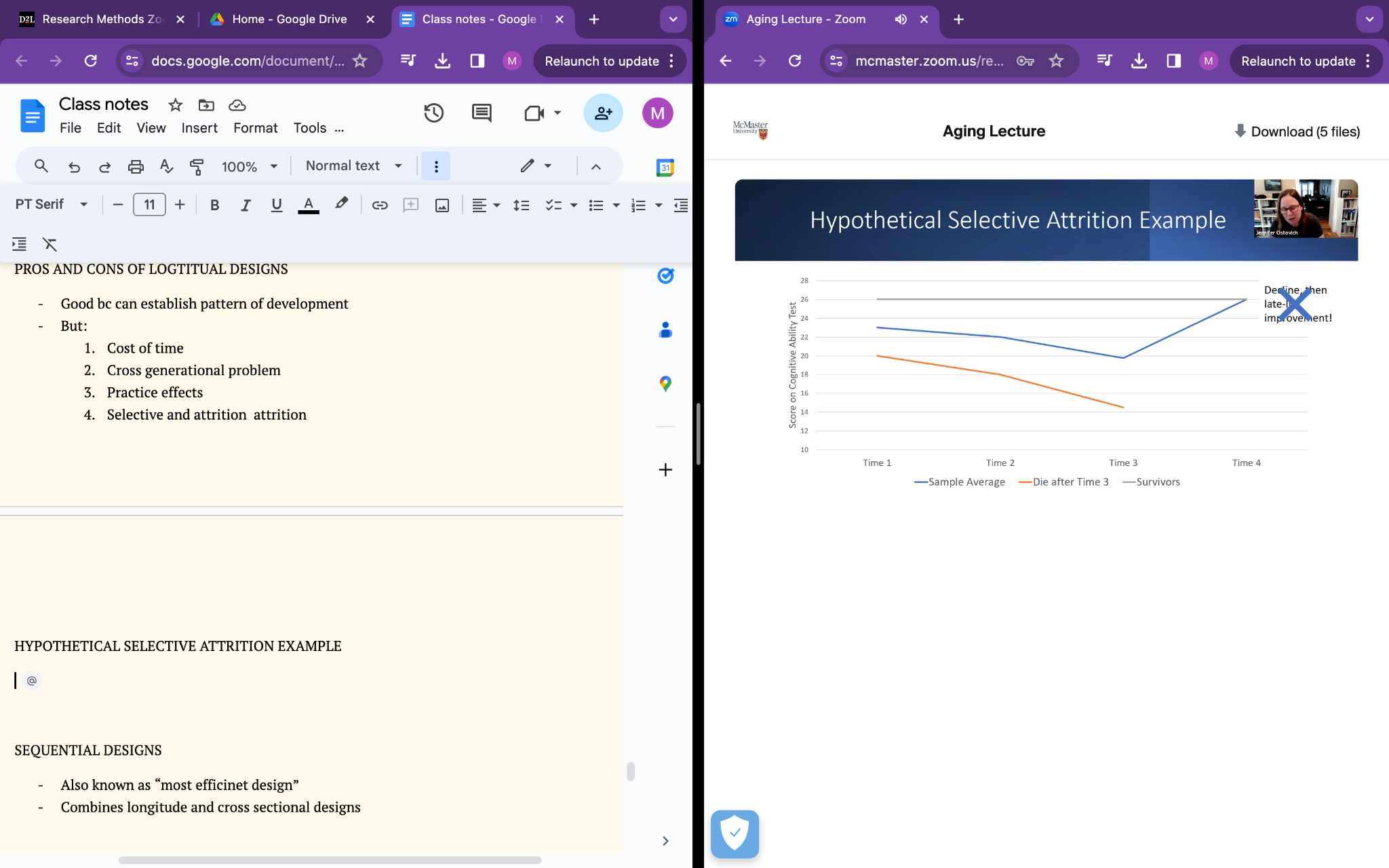
Selective and attrition attrition
HYPOTHETICAL SELECTIVE ATTRITION EXAMPLE
SEQUENTIAL DESIGNS
Also known as “most efficinet design”
Combines longitude and cross sectional designs
SEQUENTIAL DESIGN LAYOUT
Also known as most efficient design
Combines longitude and cross sectional designs
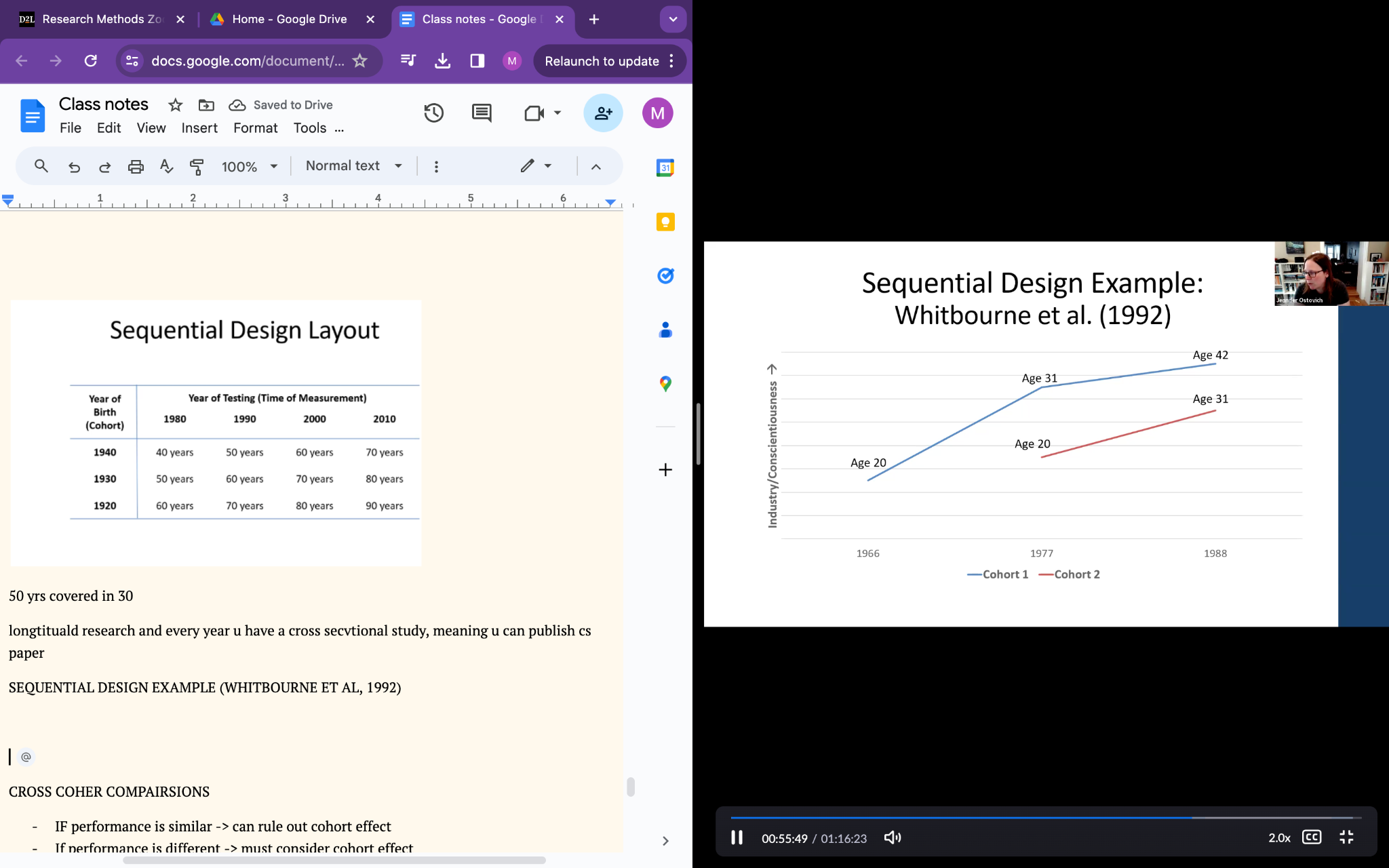
SEQUENTIAL DESIGN EXAMPLE (WHITBOURNE ET AL, 1992
Studying people born in 1920-40s
Testuig once a deade for four decades
The 40-70 yr olds
Thyme 30 yr old starting
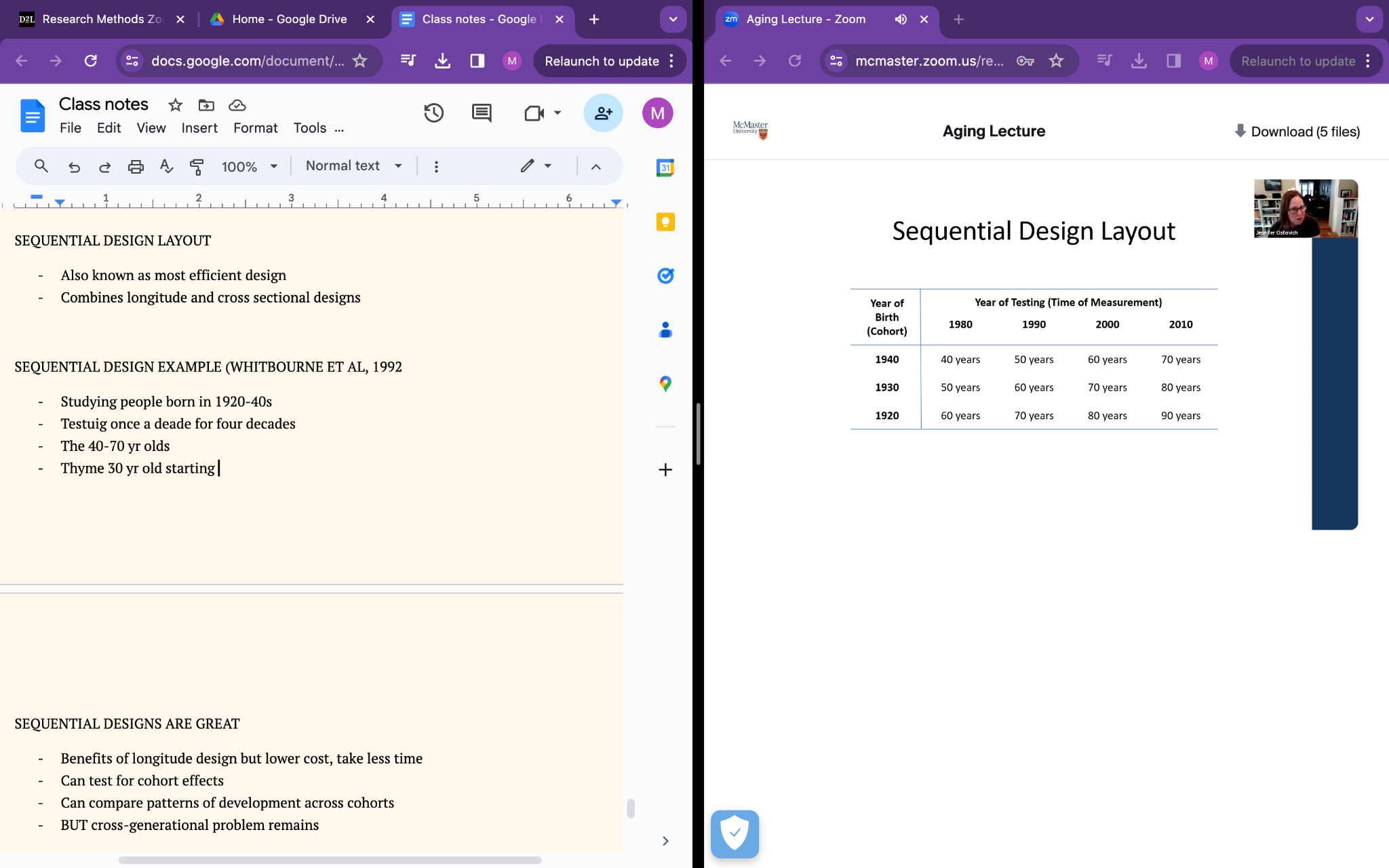
50 yrs covered in 30
longtituald research and every year u have a cross secvtional study, meaning u can publish cs paper
SEQUENTIAL DESIGN EXAMPLE (WHITBOURNE ET AL, 1992)
CROSS COHER COMPAIRSIONS
IF performance is similar -> can rule out cohort effect
If performance is different -> must consider cohort effect
SEQUENTIAL DESIGNS ARE GREAT
Benefits of longitude design but lower cost, take less time
Can test for cohort effects
Can compare patterns of development across cohorts
BUT cross-generational problem remains
AGING RESEARCH SNF CAUSAL CLAIMS
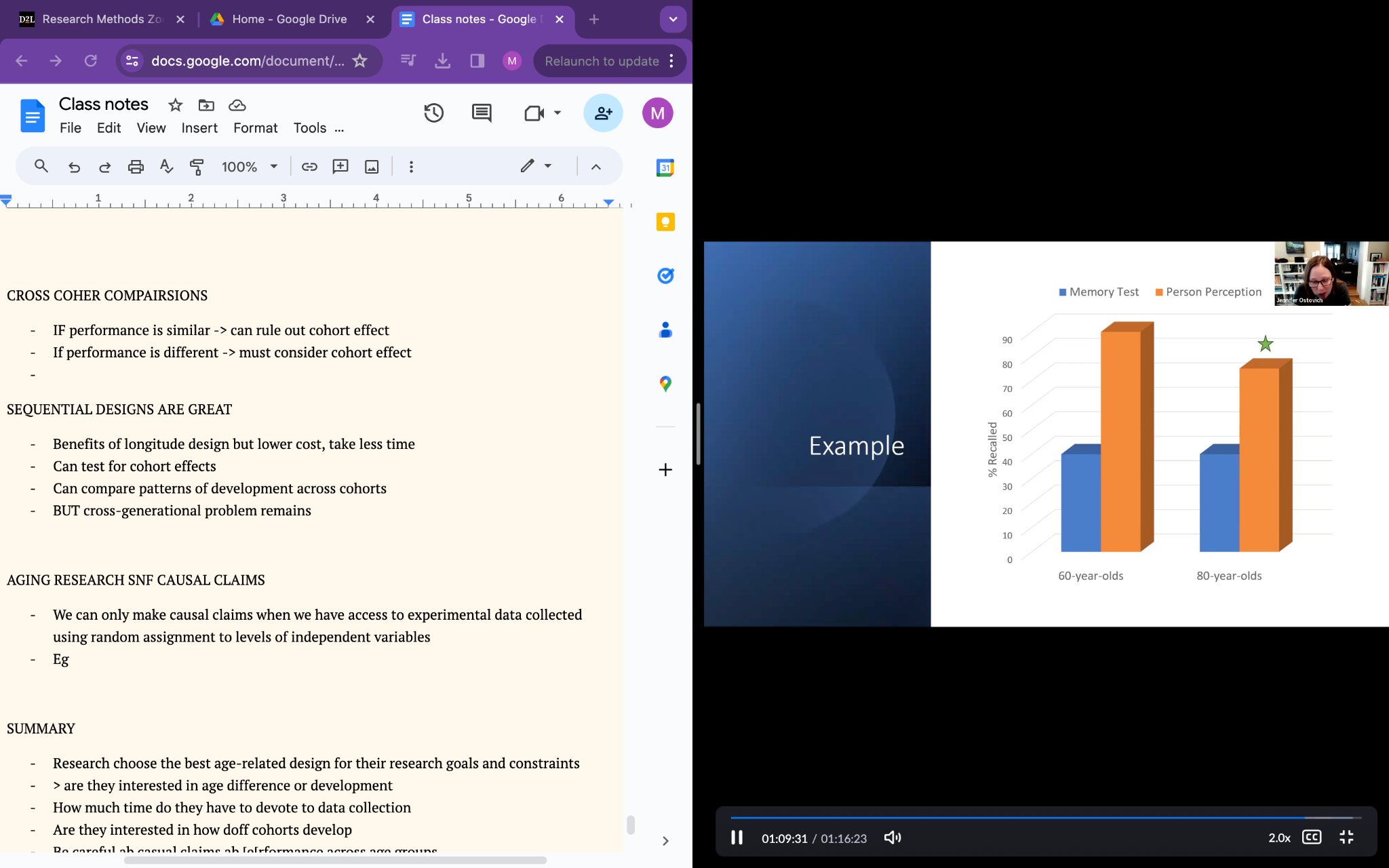
We can only make causal claims when we have access to experimental data collected using random assignment to levels of independent variables
Eg
SUMMARY
Research choose the best age-related design for their research goals and constraints
> are they interested in age difference or development
How much time do they have to devote to data collection
Are they interested in how doff cohorts develop
Be careful ab casual claims ab [e[rformance across age groups
Non equivalent (non-randomly assigned) groups cannot be compared
CORREKATION IS NOT CAUSATION
Dsb degroote
READING INTRO AND CAHPTER 1
JANUARY 25, 2024 - TOPIC THREE: AGE RELATED STEROTYPES
HOW DO AGING RELATED STEREOTYPES IMPACT PERFORMANCE IN THE LAB AND IN REAL LIFE
Outline:
Impact of stereotypes on health and longetivity
Imoact of stereotyp threat on performance
How to negate the impact of stereotypes and stereotype threat on performance in the lab
How to negate the impact of stereotypes on real-world behaviour
SELF- PERCEPTIONS OF AGING, HEALTH AND LONGETIVITY: RESEARCH EXAMPLES
Baltimtore longtiudidual study of aging (Levy et al., 2009) - asked ab opinions on people w old age, they fill out the cell perception of aging questionnaire but researchers also got all kind of other measurements , such as stuff associated with the risk of developing cardiovascular disease - people wnegative outlook on aging, more likely to have cardiovascular event over then next 38 years than those w positive stereotypes
Ohio longitudinal study of aging and retirement (Levy et al., 2002) on longevity - looked at negative self perceptions of aging adn longevity , followed people 50+ and measured self perceotiopn and whether they doed in 20 years
They found people w more negative cell perception of aging at baseline died an average of 7.5 years earlier than people w more positive self perceptions of aging . so thinking bc everyoj ein their family dies yound so they had a neg perception but this caused early dath for them too
AGE STEREOTYPES AND END - OF - LIFE - DECSISONS (LEVY ET AL., 2000)
IV: subliminal primes (positive, negative, neutral)
DV: “will to live” questionnaire
* chance of recovery
Amount of family support needed during treatment
Primes task -people were given
Positve primes
Guidance
Insightful
Astute
Wise a
Alert
Sage
Accomplished
Learned
Improving
Advise
Enlightened
Creative
Nagative primes
Alzehimers decline
Dementia
Confused
]depended
Senile
Misplaces
Dying
Forgets
Incompetent
Diseases
Decrepit
Neutral primes - nothing to do w aging
Together
Another
Between
Sentence
Wtc
Then given quill to live survey
IV: priming (positive, negative, neutral)
DV: “will to live” questionnaire
* chance of recovery
* amount if facility support needed during treatment
Varied seense of recovery from the questionnaire
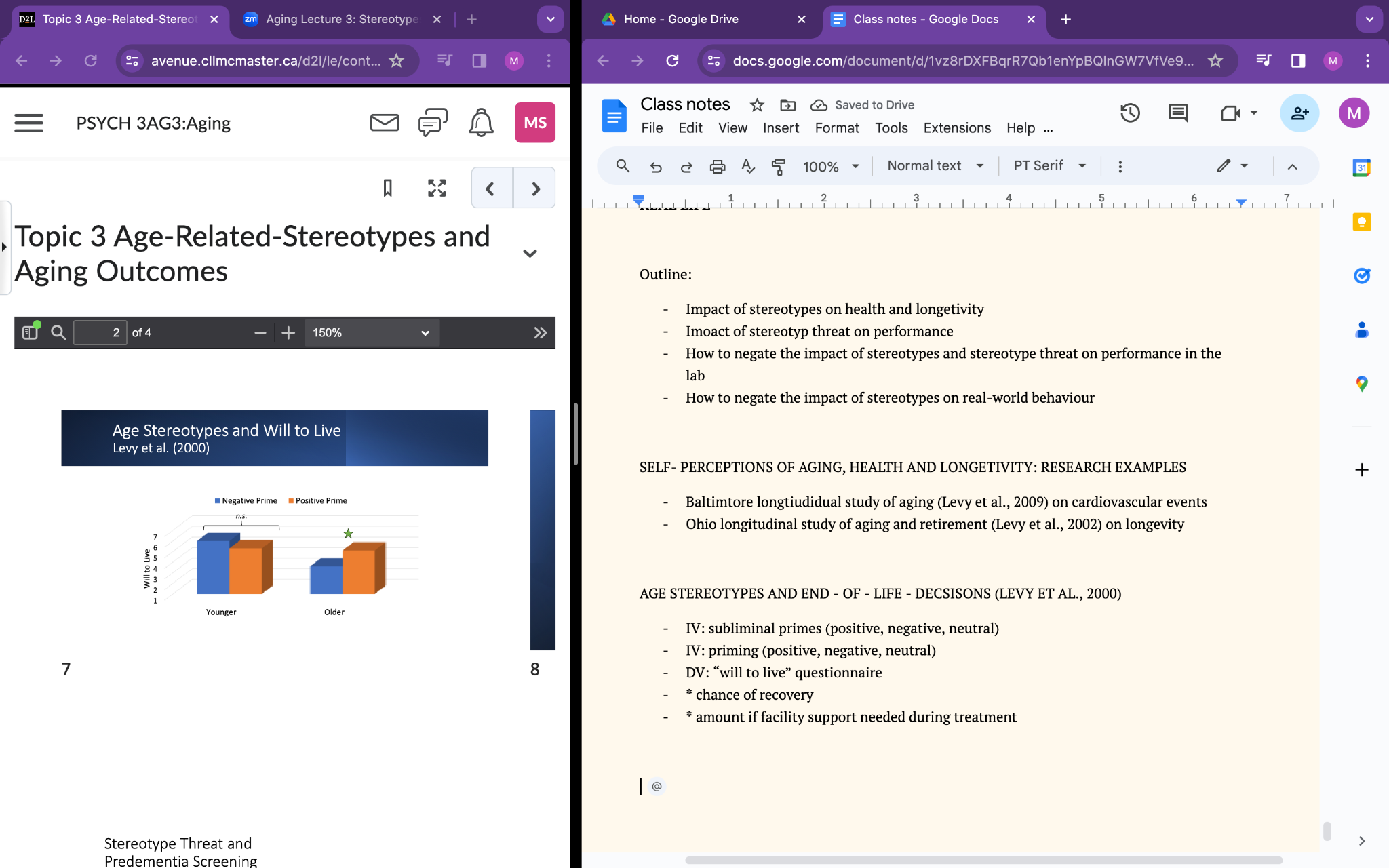
A sort of summary : holding negative staging stereotypes w the aging process and havujng negative self perceptions of aging are associated w negative outcomes for aging populations
STEREOTYPE THREAT
What is sterotype threat - when u belong to a group that usually is not sup[posed to perform well at something and as a consequence you acc dont perform well on purpose eg black students dropping out more than whote kids bc of their underperformance
Does strerotype threat exist in older populations ( Lamount et al, 2015, meta analysis) yes it does, concluded older people deal w st
Mechanism (steele 2010)
- distraction
- decreased motivation
Decreased resources due to emotional upset
STEREOTYPE THREAT AND PREDEMNTIA SCREENING - MAZEROLLE ET AL 2016
Worrying ab looking demeted can cause u to seem demented when u arent
Old ppl get diagnosed w prodomral alzeihmers disease meaning sort of early symptomatology of it
IV - stereotype threat (high vs low threat instructions) - old people knowing they’re being tested against younger people
Measures: pre dementia tools
- mini mental state examination (MMSE)
- monreal cognitive Assesment (MoCA)
DV: Proportion scoring positive for predemientia
People under jhigh threat scored more for high risk dementia , we stress them out
STEREOTYPES THREAT
What is a stereotype threat?
Does stereotype threat exist in the older population? (EG Lamont et al., 2015, meta-analysis)
Mechanism (steele, 2010)
* Distraction
* Decreased motivation
*Decreased resources due to emotional upset
HOW TO ADDRESS STERORTYPES AND STEROTYPE THREAT IN A RESEARCH SETTING
Use explicit instructions to decrease threat (eg mazorelle et als “low threst” condition)
Use implicit instruction that decrease threat ( eg thomas & Dbois, 2011)
We impicty given threat nessages , the person writing the momeru test knows whats going on , theyve been told implicity that theyre not supposed to perform well . so people think if the threat is implicit the solurion should also be implicit
STEROTYPE THREAT, TASK INSTRUCTIONS, AND MEMORY DISTORTION (THOMAS AND DUBOIS, 2011)
Were aware of finding that older adults are more likely than youn ger adults to falsey remember having seen what is called lures
Recognition test is likemc . but there are several wrong answers
Pic of lion and together
Word lsit and recognition list
Word u see lion, recog u see tiger , older adults falsey pick tiger for big cat
PROCEDURE , 2011
Recruited younger 19 yr old and old people 70 yr old
They
Encoding - look at this list of words and rate each word for pleasentless 0-7 , made it seem the test wasnt ab memory
Filler task - do something for 5 mins
Instruction (threat) - given instructuon for recognition task, high threat were rtold its ab memory and low thrat is ab verbal ability
Recognitiion task - incudes woird they saw and didnt see like they saw lion before but the word there was tiger
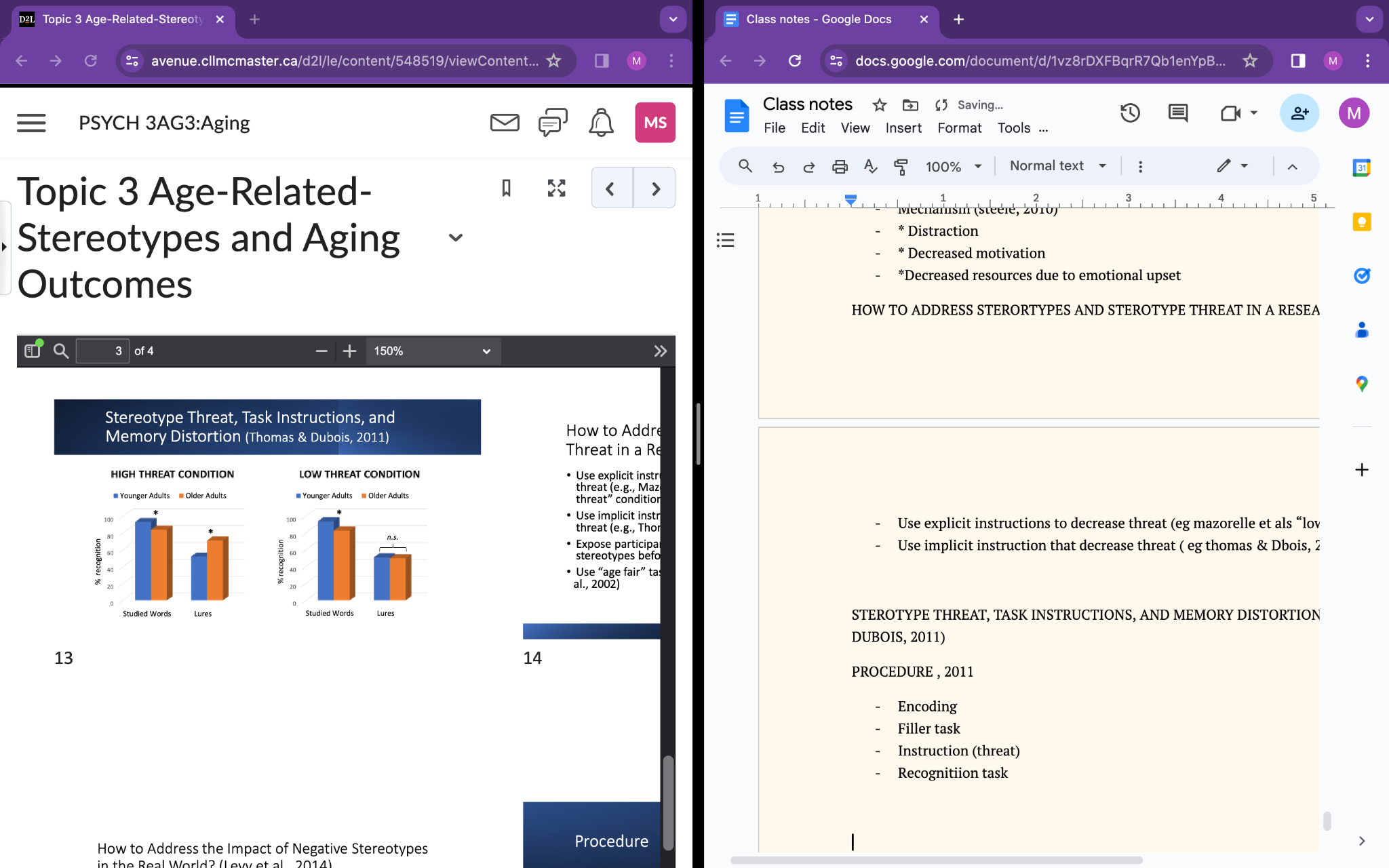
High threat Younger adults recognized 15% more words than the adults
Lures recignized more by older adults , older pop performed worse with lores than younger, recognizng more incorenelty
When low threat, studied words younger did better, noy significant
HOW TO ADDRESS STEROTYPES AND STT IN A RESEARCH SETTING
Use explicit instructions to decrease threat (MAzorrlee LOW THREAT condition
Use implicit instructions that decrease threat ( thomas and dabois
Expose participants to positive stereotypes before tasks
Use age fair tasks (adams et al 2002)
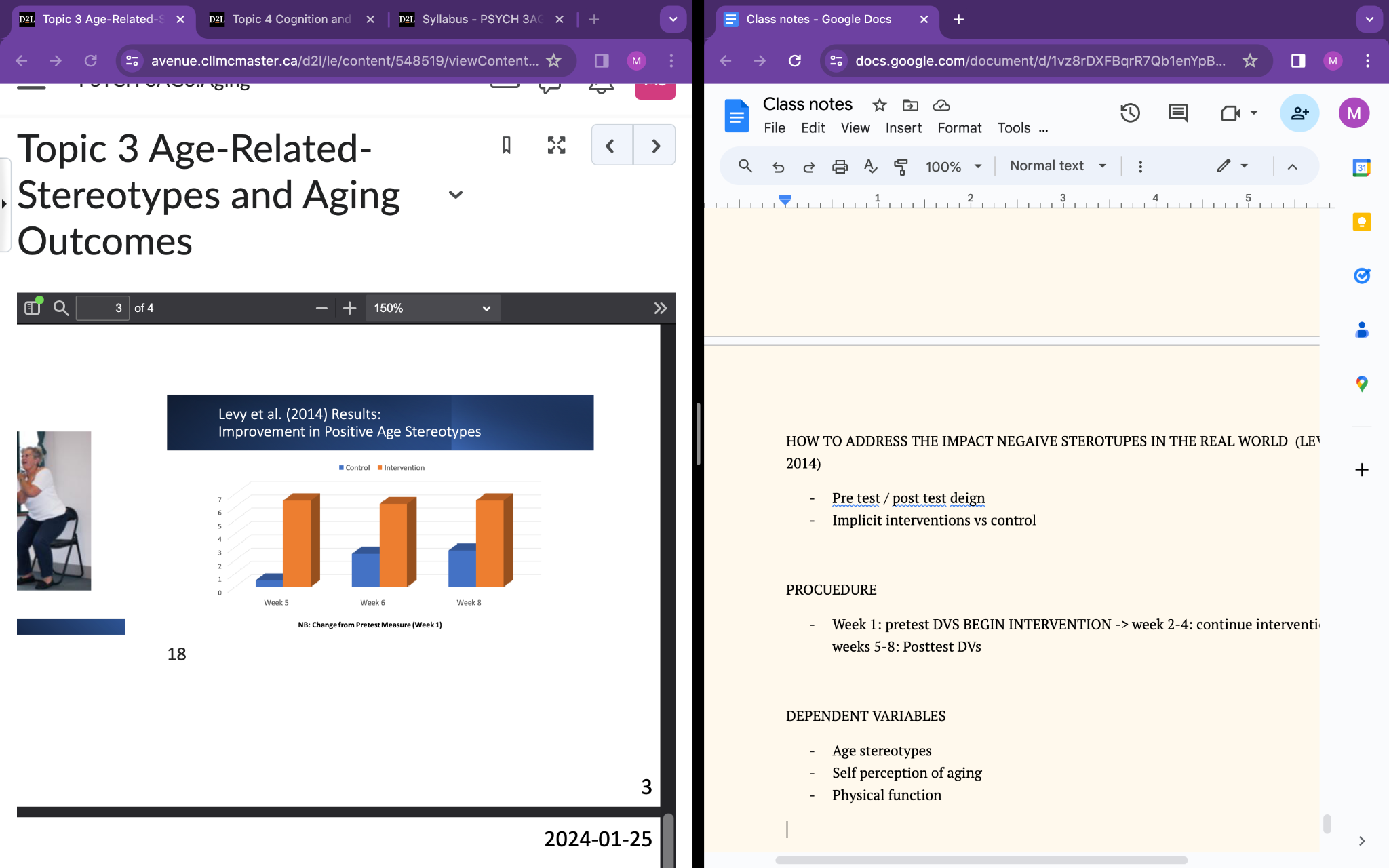
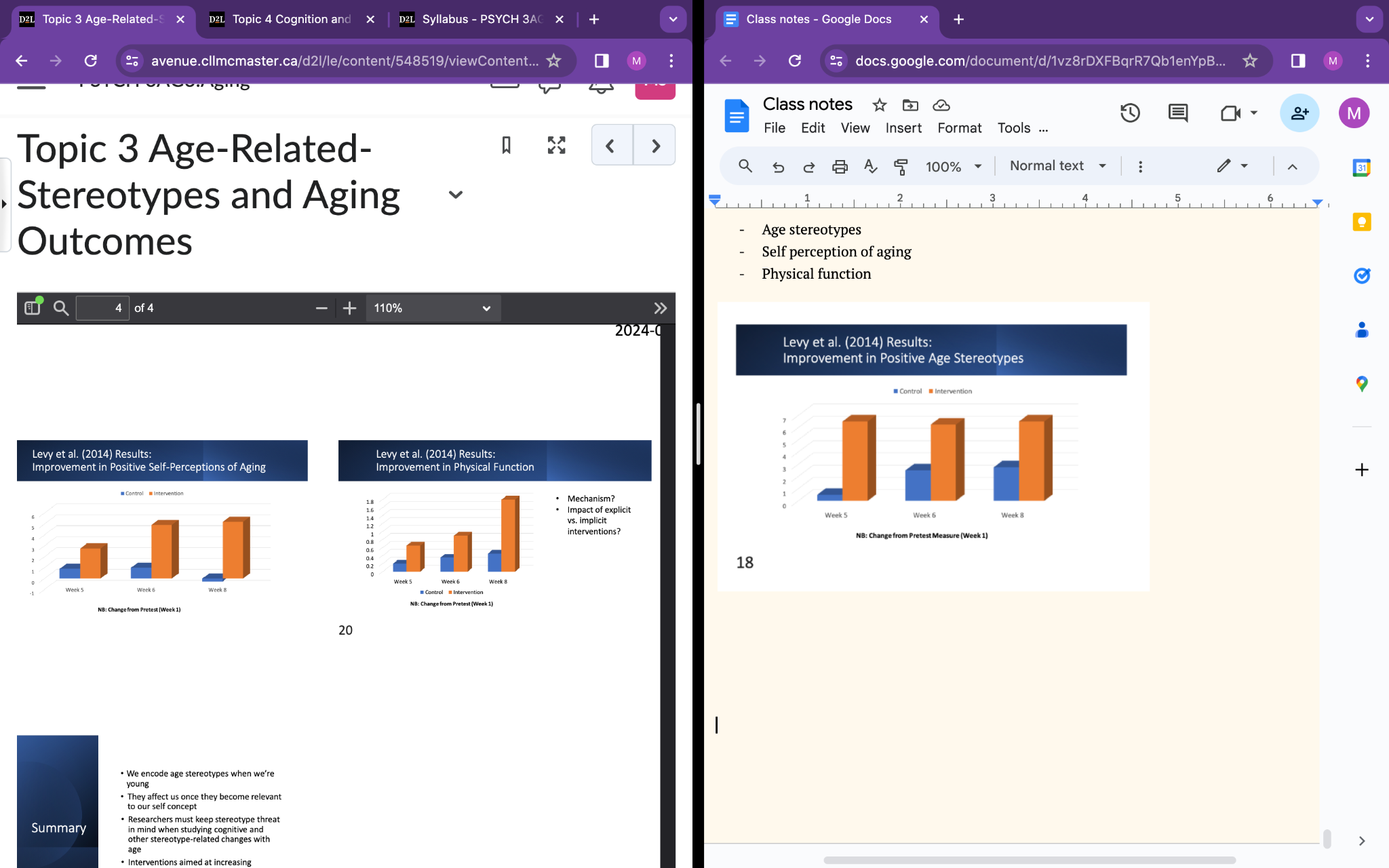
HOW TO ADDRESS THE IMPACT NEGAIVE STEROTUPES IN THE REAL WORLD (LEVY, ET AL, 2014)
Pre test / post test design - measured peoples
Implicit interventions vs control
PROCUEDURE
Week 1: pretest DVS BEGIN INTERVENTION -> week 2-4: continue intervention -> weeks 5-8: Posttest DVs
DEPENDENT VARIABLES
Age stereotypes
Self perception of aging
Physical function
SUMMARY
We encode age stereotypes when we are young
They affect us when they become relevant to our self concept
Research need to keep stereotype threat in mind when studying cognitive and other stereotype related changes with age
Intervention aimed at increasing positivity of agew stereotypes may help
FEB 1 - TOPIC FOUR: COGNITION AND AGING 1: INTELLIGENCE
OUTLINE
Different methods, different interpretations
Intelligence
Information processing
Interventions
RESEARCH METHIDS IN COGINTIVE AGING
Cross sectional vs. Longitudinal or sequential approaches
Methodolgy issue. Cross section data looks so bad when it comes to cogniitve aging but longitudinal looks fine
Led to fights between researchers
Can we draw any input from cross sections or logtidual research
This is imopirtant
1st - does it matter which data we pay attention to
Seconds - 2 people equally qualified, depending ojn which literature upay attention to u may end up hriing the younger person
Of cross sectional research is right and the declines start at their 20’s should we even bother to change things up
TYPICAL CROSS - SECTIONAL VS LONGTITUDINAL DATA (SCHAIE , 1996)
Cross sectional graph - starting in the 20’s u see a trend down, but logtitual down is there but starts later
Theres a difference in the trajectory if decline
Age group - across time - diff trajectories
THE ARGUMENT
K WARNER SCHAIE - SEATTLE LONGTITUDINAL STUDY UW
TIMOTHY A SALTHOUSE - COGNITIVE AGING LAB, UVA - cross sectional , he does his research better and longitudinal is misleading
SALTHOUSE (2009) WHEN DOES AGE - RELATED COGNITVE DECLINE BEGIN
Cognitive decline begins early, in the 20’s and is steep and linear throughout the lifespan
Cohort effects are irrelevant because same aged peopleare basically the same no matter when they were born - all 50 yr olds are the same doesnt matter when they were born
Practice effects explain the longitudinal data
In 2009 - he said cohort effect are just generations effects - this is wrong
SCHAIE 2009. SALTHOUSE AGAIN REILFIES THE “CROSS SECTIONAL FALLACY”
Cross - sectional fallacy - first argument - salt continues to refy the cross sectional fallacy that developmental change can ve inferred from cross sectional age differences- does not show development, believing make dev type conclusion from age differences - age can be identical and no difference between successive c
Test- retest data are inadequate
Short term effects
Long term effects
Are there really any effects at all ( abraham 2009) says u cant see practice effects, u only see in some of them so he says hes not sure saie found any practice effects
TAKE HOME MESSAGE
Lets be careful when addressing data on cognitive decline
How were the data collected
Did the author control for cohort effects
Could practice or attrition have been responsible for findings
Flyn effect if u look at average iq scores across time they increase but in sweden theres no more increase and we are seeing a reverse flynn effect.
AGING - RELATED CHANGES IN COGNITIVE FUNCTION 1: INTELLIGENCE
WHAT IS INTELLIGENCE?
Overall quality of a person's mental abilities
weinchester 1939 - defind it as “aggregate or global capacity of the individual to act purposely to think rationally and to deal effectively with his environment
Gottfredson 1997 - came u w the most agreed upon definition - “is a mental ability that involves the capacity to reason, plan and solve problems”
Spearmans g - intelligence is one big over arching thing he called G or general factor intelligence we cannot observe it we can only estimate it by testing the ability that iis under the umbrella if general intelligence , we measure everything that goes into G today.
HOW DO WE ASSESS INTELLIGENCE - THE WAIS-IV 2008)
Measure and performance iq - use to be the main ways of breaking down G into measurable abilities
Verbal iq- referred to ability to analyze information and solve problems using language. Language based reasoning aka reading and listening to words, having conversation, writing, thinking.
Performance iq - any type of problem solving thats non verbal aka doing mental rotation, piq was introduced by weshler when he realized verbal iq and thse type of questions require a certain type of education or wealt, so there could be a bias, so he inc,uded things you didnt need an education for such as performance iq
We see big fall off in performance iq
Now we have performance iq is in four indexes :
FOUR INDEXES
1. Verbal comprehension
2. Perceptual reasoning - indexes the age fair , performance iq subscale
3. Working memory - not age fair - this is the ability to take in and hold information in mind and then perform a mental operation on the information
4. Processing speed - not age fair - the ability to process simple or routine visual information quickly in efficiency. So it's visual in terms of motor speed. Those things do decline with age
So what weve done herre is by breaking this down in this way is weve given ourselves a way to assign an iq score that is age fair. Instead of using all 4 indexes to ve a full ascale iq u acc only use the 2 age fair indexes which is vervak comprehension and perceptual reasoning
2-4 performance iq
Produces two broad scores
Full scale iq - unfair - can't compare 80 yr old w 20 yr old
General ability index
VERBAL COMPREHNSION
Category
Information - on what continent is the tag mahal
Similarities - in what way are radio and television alike
Vocab - what does pusillanous mean
Comprehension - explain the meaning of the saying “ a journey of 1000 miles begins w a single step”
Supplemental index - u give people the 3 core indexes and their scores on them are so different that u dont know what to do, so yoiull go to supplemental index
PERCEPTUAL REASONING: BLOCK DESIGN
Is age fair
Get shown a 2 dimensional design that you have to make yourself out of blocks
This test is visual spatial processing and problem solving
PERCEPTUAL REASONING: MATRIX REASONING
Identify patterns
VISUAL PUZZLES
PICTURE TIOGETHER OUT OF PUZZLES
FIGURE WEIGHTS
What goes on the side of the scale
Picture completion
Whats missing in the image
WORKING MEMORY
Arithmetic - a pair of shoes thar normally swell for 70 has been reduced by 20 percent. How kuch dp they cost now
Digit span (forward, backward) - i am going to say some numbers. Listen dn when im through i want u to say them after me
Letter- number sequencing g- going to sy letters and numbers say them abcl to me w the numbers first in ascending order and then the ketters in alphabetical iorder
PRICESSING SPEED: SYMBOL RESEARCH - not age fair
Get 2 mins
Coding
NUMBER and match symvolw number
CANCELLATYION
SQUARE AND TRIANBLE
TYPES OF INTELLIGENCE - FLUID VS CRYSTALIZED INTELLIGENCE
This split was created by raymond katel
Fluid - based on flued thought processes, stuff you need education to know - this became performance iq
Crystalized - refers toability u picked up bc ur alive in the world and got an education
Fluid intelligence - defined by cattell 1963- ability to perceive relationships independent of previous specific practice or instruction concerning those relationships - so its associated with the ability to think and act quickly, to solve novel problems and actually encode memories - use our fi to get an answer on what we dont know
Many tests designed specificvallt to meaysre gf
Eg wais performance iq
Eg letter series test
Eg ravens progressive matrices
Racism also caused invention of fi
Fluid intelligence - based in physiological efficiency - age trend
CRISALLITZED INTELIGENTS - HORN AND CATTELL 1967
Stems from learning and accultruation and is refelcted in tests of knowledge, general information, use of language and a wide variety of acquired skills
Wais
Eg
Math probl,ems
Word problems
Ci based on ability to learn information from life experience ,
Age trends
Keep in mind everythinkg is related
Gf and gc interact to p;rouve g
FEB 8TH - TOPIC 4: COGNITION AND AGING 1: INTELLEGINCE PART 2
OUTLINE
Individal differences in performance losses
Proposed mecvhanism for age differences in intellectual performances
“Flynn effect” old people r dumb
INDIVIDIAL DIFFERENCES
Talking ab average 50% of people
Consequence of talking ab the average in an aging pop is that we've noted huge am of variability in losses cognitively in age
And talking ab average we hide it and dont talk ab it
If everyone hit cro in their 60’s wed say why live beyond 60 but we see lits of variability
Theyre doing something that maintains their intelect
ariabilty in scoring across individuals
* schaie 1996 - found at 80+ 53% people inhis study were perfoirming comparably high to young people, 20,30, 40 yr olds both fluid and crystalized intellectual tasks
So u can be 80 performing well as a 30 yr old
Overlapping distreibituions - average intellectual peformance of a younger person is higher than average iltelecgt performance of an older person , and difference can be small but statisstically ssignifant , but u have lots of overlap between them, so suggest that most older and younger people are similar in their perfo,mance
Overlapping distributions ^^^ talk people example
Variability in number of ability showing losses
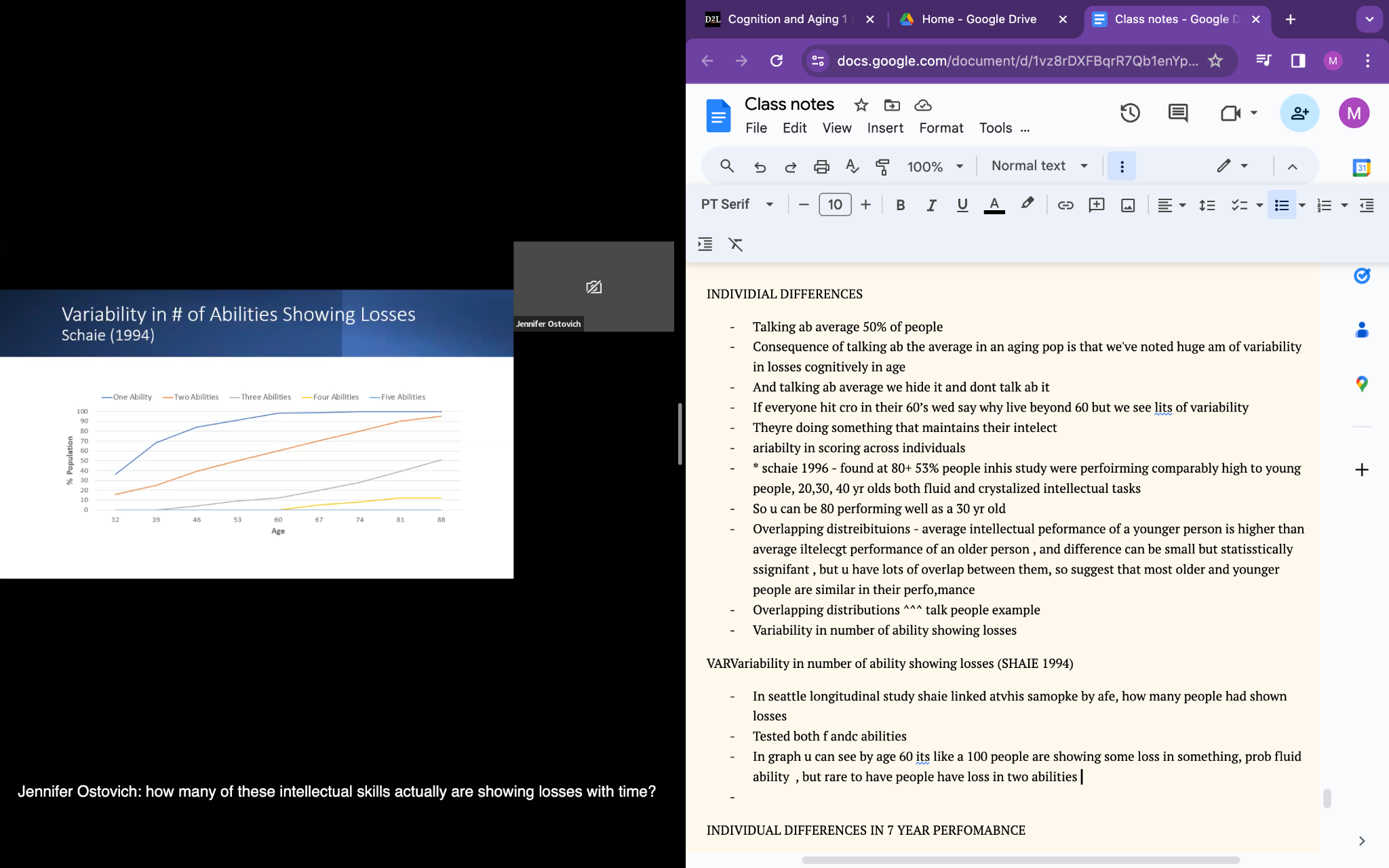
VARVariability in number of ability showing losses (SHAIE 1994)
In seattle longitudinal study shaie linked atvhis samopke by afe, how many people had shown losses
Tested both f andc abilities
In graph u can see by age 60 its like a 100 people are showing some loss in something, prob fluid ability , but rare to have people have loss in two abilities
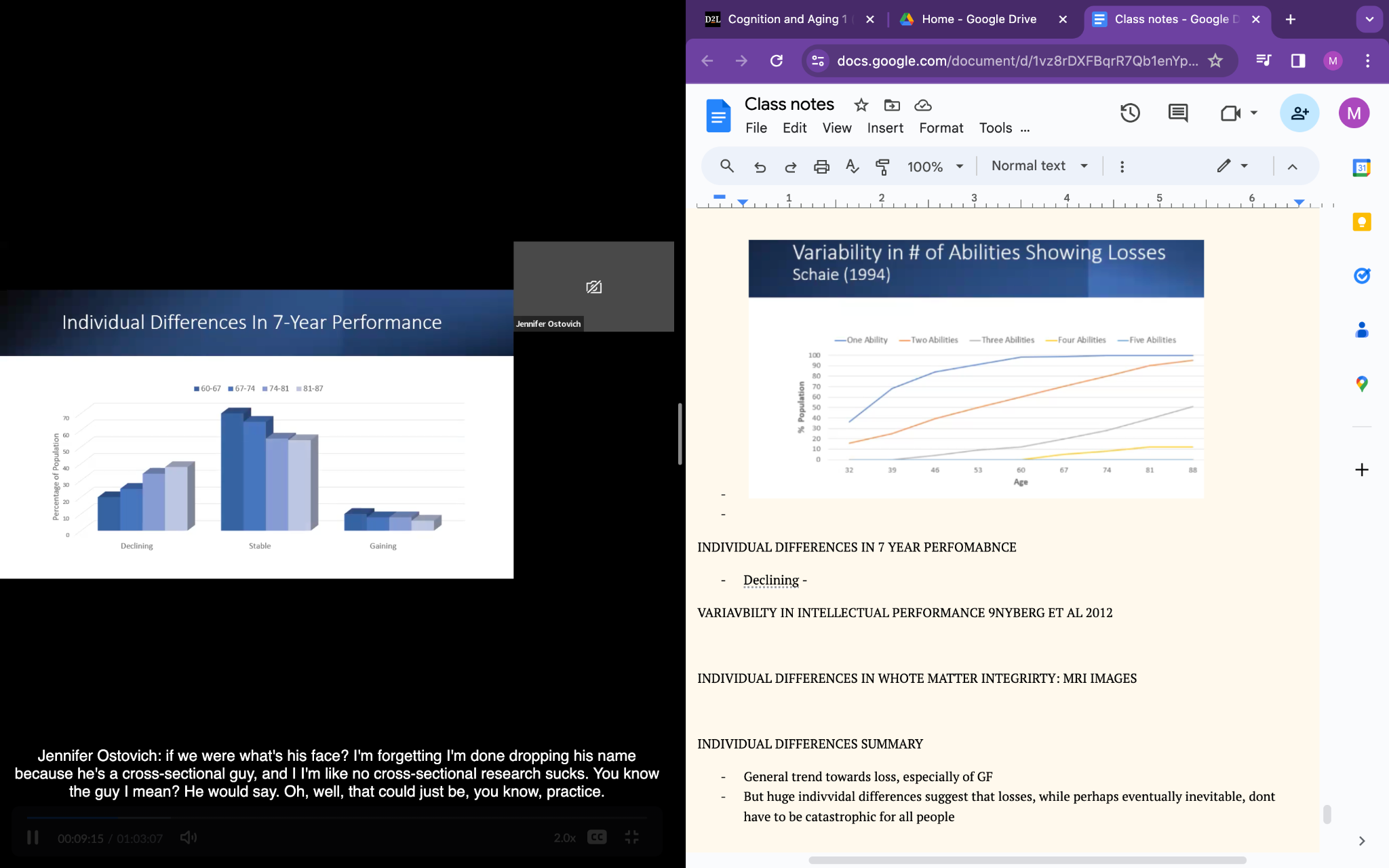
INDIVIDUAL DIFFERENCES IN 7 YEAR PERFOMABNCE
Declining -
VARIAVBILTY IN INTELLECTUAL PERFORMANCE 9NYBERG ET AL 2012
Graph shows meta analysis that sorted people into higher versus lower cognitive performance on general iq test combining c and fluid ability
U can see old people in low cognitive performance
Combing and doing well like theyre younger counterparts
INDIVIDUAL DIFFERENCES IN WHOTE MATTER INTEGRIRTY: MRI IMAGES
Both of 80 yr old
Brain w qhiote splotches are whgote matter hyperintesties and reflecgts degradation of myelin sheath
Myleniation important, keeps signal integrity high
As we age we lose it but some people dont
INDIVIDUAL DIFFERENCES SUMMARY
General trend towards loss, especially of GF
But huge indivvidal differences suggest that losses, while perhaps eventually inevitable, dont have to be catastrophic for all people
FACTORS ASSOCIARES EITH COHOT DIFFERENCES IN INTELLOGENCE
Can the mechanism behinms the dlynn efdfect keas uas to successful intervention
THE FLYN EFFEECT
META ANALYTIC FINDINGS (PEITSHNIG & VORACEK 2015)
Substantial gains for gf
Gains for gc
Stringer gainds for gf than dfo4r gc
Fluid might be ab better nutrition, healthcare
Crystaikzed, more education
Decreasing in recent decades
Bioggestr gains in indutrailized cultures
PROPOSED MECHANISM FOR THE FLYNN EFFECT
Prosperity -
Education - correlated w iq
Technology - not mian driving force boot el al
Test taking behaviour
Test wiseness - perform better or tests
Hybrid vigour - outbreeding, meeting more people and multi cuktral, weve begun mating people different to us , more genetic variability that can cause intelligence ro get higher
Blood lead levels - 1970s, lead is neurolgicaly awful , effort to get rid of it,
Nutrition -
Pathogen stress
Life history speed
SUMMARY
Longtiduanla and cross secuional evidcemnce shlow drcrerased permodmance on iq tests w increasing age
These dara probably reflect development as wel as cohiot effects
Individual differences and cohort differences mechanism suggest possivble interventions
TOPIC 5 Cognition and Aging 2: Information Processing/Memory Lecture
AGE - related changes in memory and information processing
“As you get older, three things happen. The frst is your memory goes, and i cant remember the other two” sir norman wisdom
We worry about memory and lawyas assume our age has to do w it when we get old
Anxiety won't improve your memory
We need to investigate when we see evidence of meomroy loss is it ereally evidence of a memory loss and where are wehaving these memory losses
AGE RELATED MEMORY DEFICITS: KEY IDEAS
Basic memory processes:
Remembering
Encoding - refers to means by which we get incoming into our long term memory storage, so that we can use it later
Retrieval - has to do with the means through which we find memory stored in our long term memory andncan retrieve them for use tonight, and produce them when we need them
Losses reflect ineffciancies in
effective encoding
Effective retrieval
FERGUS CRAIKS HYPOTHESIS processing resource -
As we get older creek says bc of normative age graded changes to our biological systems, everything ages, and we have fewer resources to use towards the various things we have to do in life. Including in the types of effortful processing needed to remember stuff
Craok says we are capable of doing these things, not that we forgot how to do it, not that we can't engage in effortful encoding and retrieval princesses, it's that we dont want to in a way. Not on a conscious level.
“I don't have that many resources to use for this right and so if i can take a shortcut why qoudlnt i”
U might use a shallow processing strategy which isnt encoded well or cant be found easily to retrieve
“Deep” vs “shallow” pricessinh (crak and lochhart, 1972)
Craik came up w the idea that deep processing is very effortful and we have fewer resources to dedicate towards it as we get older
EVIDENCE SUPPORTING CRAIKS HYPOTHESIS
Differential performance in tasks that test:
Recall - hardest , you need to be very effortful eg) remembering someone's name
Free recall is real hard
Recognition - easier , less effortful eg) dont need to know the name but u canr ecognize the person, like seeing ur friend
Studying a list of words and then identify in a larger list of words which words u saw previously
Priming - even easier , no effort , not studying bc its not presented as a memory test, youll see the word yellow and then say banana , this is priming
MORE EVIDENCE
False memory effects - very easy to do, esp if u didnt encode material properly
Thomas and dubois lion and tiger and older people were more likely to say tiger instead of lion
Younger adults have performewd older at adults at recognozing words theyd actually studied. And younger adults were sognifiganlty less liely than older adults to be fooled by lures
Low threeat where we arent pulling away these processing resources, older adults still didnt perfirm as good but they were close and not fooled by the lures
Impact of dul task procdeite on young people
So doing two things at the same time
If we give young people a word list to remember but give them a secondary task they perform like old people who dont even have a second task - evidence of processing info
MORE EVIDENCE JEEZ
Event based vs time vased prospective memory performance
Event based is passing fortnos and saying “oh i need to get a salad” passing dry cleaners oh let me pick up my suit
Time based is “its 8pm i have to call my grandchild’ “i have to take my pill bc its bedtime” this is uncued , which means it tajes more resources so when we get older it gets worse bc we lack the processing resources
Pill binders more effective w event based perspective, always keeping it next to ur bed
Summary of processing resources hypothesis - the more process required, the more lil we see age decretments on that task - w every increase in the processing needing processing resources needed for a task you're going to see worse perfrimnaces
SALTHOUSE GENERAL SLOWING HYPOTHESIS
Salthiuse says we arent running out of gas, we just slow down w age
Aging is accompanied by abgenerakl reduction in processing speed , which leads to global cogbitve decline
We see white matter loss, myleniation helps us princess, w out it we slow down
OUTLINE: INFORMATION PROCESSING MODEL OVERVIEW
Age graded changes in information processing
- Sensory memory
- Short term memory
- Longterm memory
ONFORMATION PROCESSING SYSTEM: THE “MODAL MODEL”
Sensory input-> sensory store (we do all our initial processing - all info lost in .5-3 seconds) - attention (if u decide to process it further)-> short term store (hold info for not too long, if u dont do much w it, its gone within 10-15 seconds) <- working memory - allows us to engage shawlole to deeper levels of processing of given information - info to be stored permanently -> long term store - if we process it good itll go here and we can retrieve it later, we can also pull out other things in long term to add to our short term
THE SENSORY STORE
What is sensory memory - touch taste smell, hold on long enough to see of we need to process iy
Aging researchers ignored it until fact: we get older our vision and hearing becomes degraded so the info in our sensory store will also be degraded so not very recognizable
Tajes too much processing and slows down
Glasses, normally at young need it at 3-5 years but old people need every 1 -2 years
Sensory deficit hypothesis - when we get older the qulair5v if the informartuon entering the sensory store is decreasing - itll take more resources if u should attend toi that info
Research design
Implications
SPINKS ET AL 1996 WFFECTS OF DEGRADED AUDITORY INOUT ON WORD RECALL
Normal degraded recording
Normal - younger outoerfirmed the old
Degraded - young people did badly the way old people did for normal
GILMORE ET AL 2006: EFFECTS OF DEGRADED VISUAL INPUTS ON DIGIT SYMBO TASKS
Only young people
Ra and they got a high contrast version and some got low
Younger people got the normak task they did better than the young people who got the bad one
THE SHORT TERM STORE
Where we hold stuff whether briefly or we lose it bc we didnt soend enough time thinking ab it
As long as ur thinking and processing it, itll stay in sensory store
WD 40
Tewo components
Primary memory (pm) : passive storage - like holding a honone number , i say 4 letters u say them back
Working memory (WM): active processing - biffer system, chewing on info that u wanna keep , manipulate the info and perform operation on it itll get sent to long term memory
LAB - BASSED WM TASK EXAMPLE : OPERATION SPAN
Involves seeingh a set of slides atp . its slides where u have to remember some letters but also shown a math problem and then anothe rletter and then another letter and keep going until u fail
In working memory its harder we see losses in wm by 65
Park et al 2002n
Cross sectional - participants bw 20 and 80 were given primary memory and woerking memory tasks and then basically compatee across age groups to see there afe differences in performance on thes ethings
CORSI BLOCK TAPPINH PM
REsearcher taps and they repeats and keep repeating till they fail
SPATIAL SPAN TAKS PM
Squares filled and not filled and they draw it
Park et al 2002n
Reading span tasks
Computation span task
LONG TERM MEMORY
Long term mem divided by 2 things: declarative & non-declaritive
Declarative: any memory that can be expressed verbally. Can be broken down into semantic (memory for words ideas conceptsw facts aka crysta intelliegecne and episodic (ewpisodes in ur life)
non declarative memory cant be expressed verbally, remembering to tie ur shoes, driving a car
SEMANTOIC MEMORY \
Used for remembering every day facts and information
Well presenefved except doe the tip of the tongue phenomenon
Processing resources explanation
EPISODIC MEMORY
Ab our ability to recall events
Memory for events u personally experience at a specific time and place
Giving encoding instructions or retrieval cues improves performance
Zelinksy & burnnight 1997 longitudinal study
Over the course ofb 216 yrs theyre is decrease
PROCEDURAL MEMORY
Involved in a skill learning retention, tying shoes, driving, dont see losses, people can still do these things
Dont need to think ab doing them when doing them
SUMMARY: NOT ALL LOST
MEMory systems showing age related dclines
Sensory processing
Working memory
Prospective memory
Epsiodocu memory
Preserved memory systems
Primary memory
Procedural memory
Semantic memory
MARCH 7TH - INDIVIDUAL DIFFERNECES
THEORETICAL FRAMEWORK: THE COGBITVE ENRICHMENT HYPOTHESIS
Our level of cognitive performance is malleable, it's not set. We have a rangwe of possible cog performances and we can sit anywhere in that range and what determines where we sit in that range are various things, some we have no control, some we do
Factors associated with cognitive function
Genes
Health
Bio sex
Personal/social factors
Intellectual factors
Exercise
THE COGBITVE ENRICHMENT HYPOTHESIS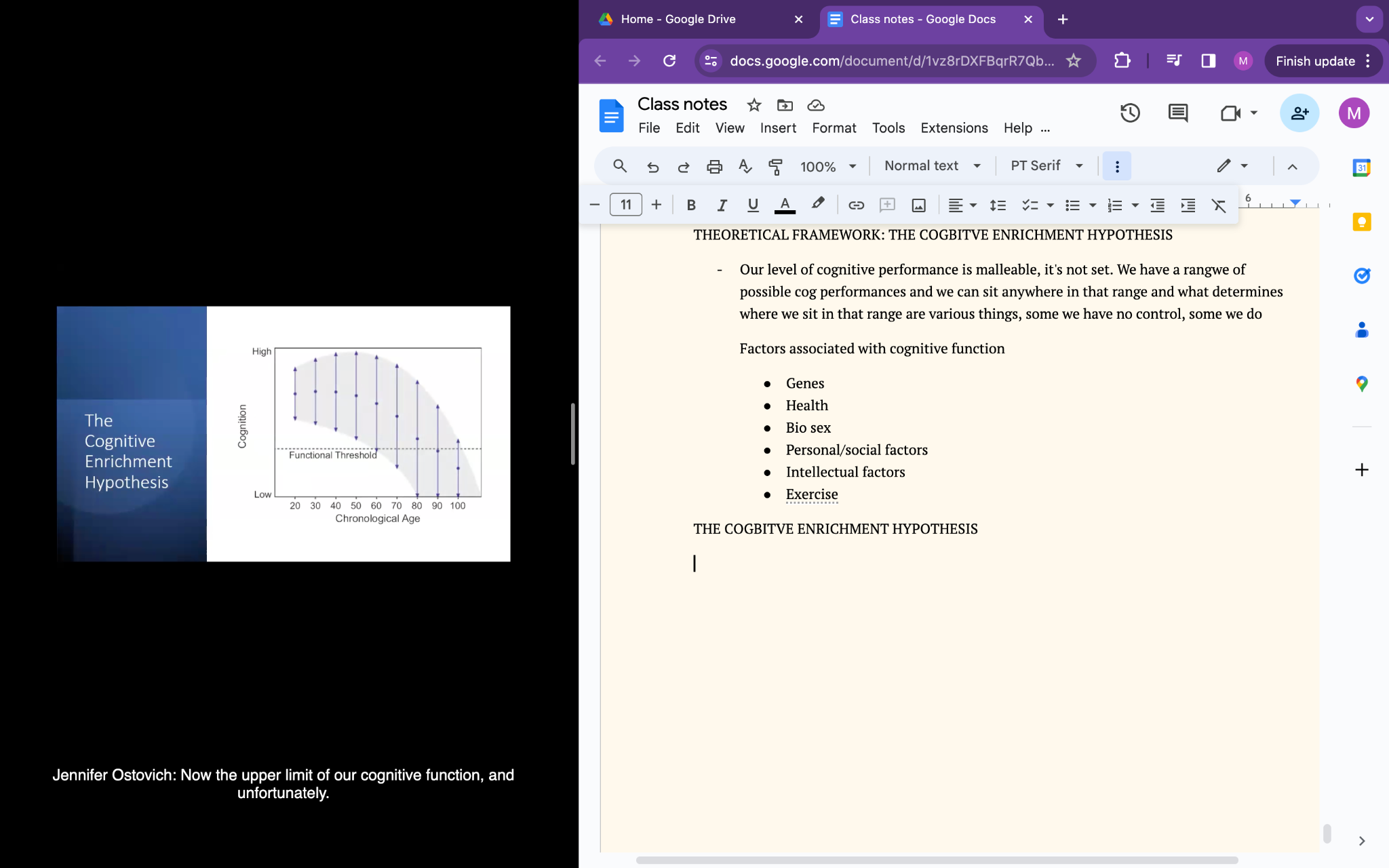
Grey shaded area that goes across the topss of these arrows, and button of it, gray is the zone of possible outcomes for cognitive performance.
Be at the bottom or middle or top,
Upper limit is hypothesized and determined by biology such as genes and how well the brain is functioning
This slope down with age , loss of gray and white matter eg the blue dots are meant to be right in the middfle of the grey shades and indicate developmental trajectory under typical circusimrtances so average person will be functioningnnormallty and lose cog function in elder years where they will cross the functional threshold and u cannot live independently anymore, some people might not cross that threshold, average person might.
But even a 60 yr old has a chance of doing so ‘we annaa know what gets someone to be at the top or bottom and design interventions
Loss of gray and whoter matter blue dots are supposed to be in the middle and indicate our developmental trajectory under typical curcumsitances
At some point theyll lose stuff
By 90 cross functional threshold , u wont really be able to live independently anymore
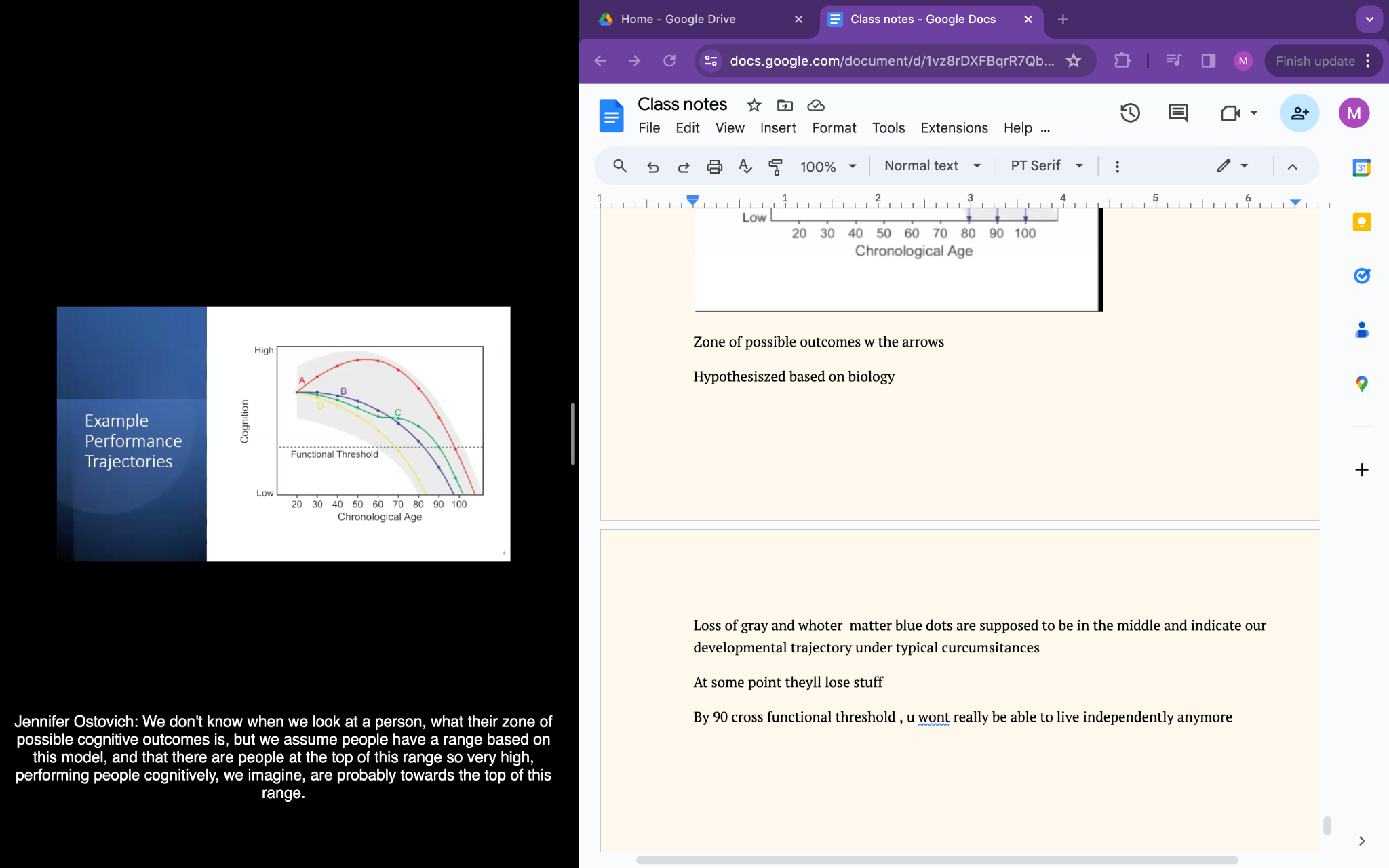
Line b is average eperson, we see decrease in cog performance until they cross the threshi=old and die
Curve a is someone who optimizes everything, he does everything right that is healthiest and thriving, so what are they doingt that made them like that. Its a hypothesized super performer . why?
Line D , is someone at the bottom and throughpoit their life they are not performing well, losing functionality early on
Line c my have not done everything right, but at some point they changed something and shifted their curve and after they made that change they were perdfoming better and they represent enrichment hypothesize, they may not perform as well as A but they changed and became better to match B and they crossed over the threshold much later. How do we do this
GENES AND COGNITVE PERFORMANCE
Intelligence and cog abilities are genetic, it our genotype
Plomin 1990 meta analysis - 50% of IQ scores can be explained by genes , the other 50 explained by something else like environment
Tucker - drob et al 2013 meta - analysis - took in social economic status - found those who have adequate environments genes can explain 80%. But low enviromnet, iq is only explained by genes by 30%, genes s have been deprived to showcase everything
Mclearn et al , twins 80+ age mono and dizygotic. -
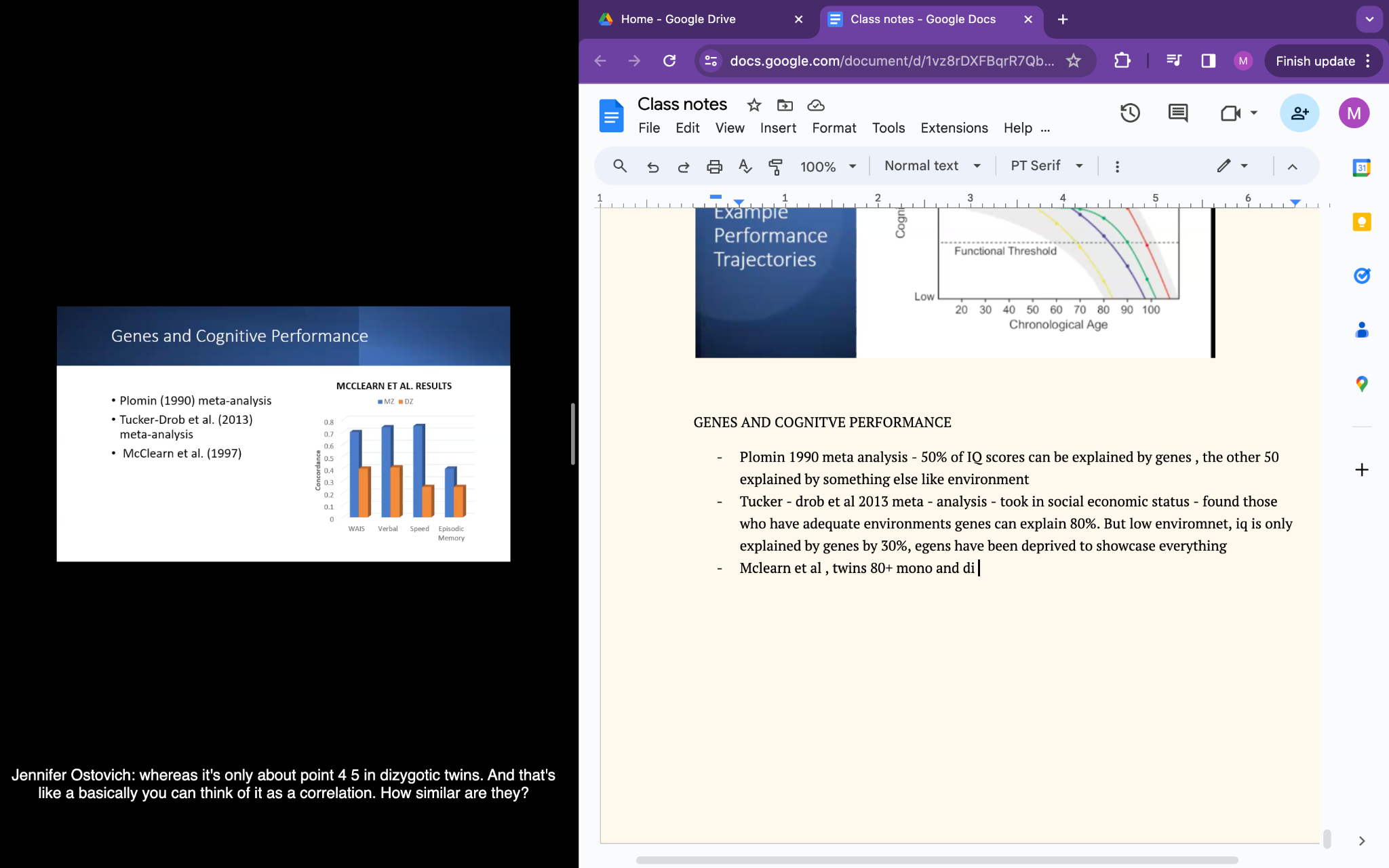
Dyzygotic were less similar than the mono.
HEALTH AND COGNITVE PERFORMANCVE
Older we get the more health affects cog performance
Chronic disease over 65
Cardiovascular disease is damaging to episodic memory and visual spatial skills
Normative sesnory losses - also results in poor cog performance
- Spinks et al ; research on young people's performance w degraded stimuli
Berlin study of aging - lindenberger and balter 1997 - tested vision hearing and cog ability
VISUAL ACUITY AND AGE
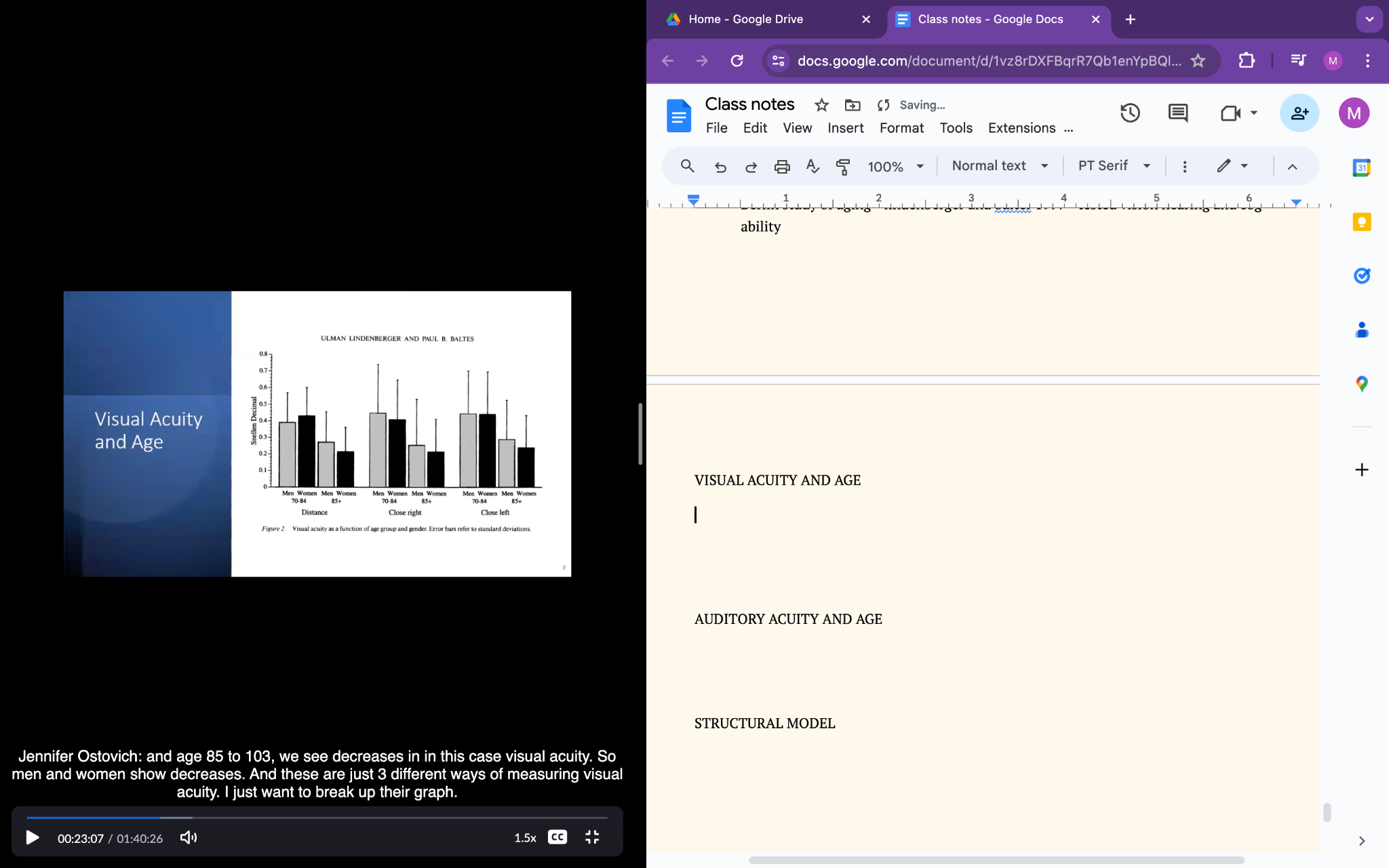
Age 85 to 103 we see decreases in visual acuity, men and women show decreases. 3 different ways of measuring visual acuity
Visual acuity is decreasing w increasing age
AUDITORY ACUITY AND AGE
As is auditory acuity
Men younger have better threshold than older people
Whe linde and baltes
STRUCTURAL MODEL
They found declines in everything w age visual, acuity and cog performance
Hearing and vision losses counted more…
Age associated negatively w vision and hearing
Increasing age decreaasing hearing
Vision losses are more likely than hearing
Age sensation intelligence, better vision better scores on everything else vision has posiuv=tve relationship
If u have them, better perfiamnce
BIOLOGICAL SEX AND CIGNITVE PERFORMANCE
Women show superior maintenance of functioning into old age
Women may respond better to interventions than men
Women have a diff curve, theyll last longer wont cross the threshold as fast as men.
SOCIAL ENGAGEMENT AND COGNITVE PERFORMANCE
People who r socially active and social they ecoerince less cog decline
Lonliness and age-related cognitive decline
Research example: Bassuk et al 1999 longtitudinal study - looked at social lives
Less cog decline in high social levels
PERSINALITY AND COGNITIVE PERFORMANCE
Neuroticism – refers to a persons likelihood of experineicng psychological distress and negativeve emotions - is associated w cog decline
Wilson et al 2003 longitudinal study
NEUROTICISM AND EPISODIC MEMORY CHANGES - WILSON ET AL 2003
People in low neuroticism didnt show any negative change at all in episodic memory “csnt remember where i put mykeys”
Ppl in high neirticism experiences a significant decline from baseline
Trait might not change but therapy can help
Maybe u know how to cope in high neuroticism
NEUROTICISM AND ALZIEHMERS DISEASE RISK
People high in neuroticism were teice as likely to have developed alziehmers disease by the end of the study as were those in low neuroticism
EDUCATIONAL HISTORY AND COGNITIVE PERFORMANCE
People w less education more cog decline
Better educated people keep cog abikuties going for longer
Normative cognitive decline
Alzhimers disease - bennet et al, anual cog functioning test and autopised brains
Those who had more education had more cog
LEVEL IF EDUCARION ANF ALZIHEMRS PATHOLGY
Found people w high education performed cognitively the same amount of alzheimers pathology than people w loe/medoim education
Their brains looked bad but theyr braisnwere more intact than those who were loe.
“Cognitve reserve hypothesis” - those w more education , they can stand to loe more neurologically and still perform well than those w less education
INTELLECTUAL ENGAGMENT AND COG PERFOMANCE
Older people who r more intellectually engaged do better cognitbvely as they age than olde people who r not engaged
Engaged meaning reading book, events, music, lectures, chess, writing, podcasts
Keeping doing things that keep u learning
Predicts normative age- graded changes in everything in cognitive functioning.
Predicts alzehimers disease risk - people who more intellectualky enaged didnt develop alzieherms the way the less ones did
FITNESS AND COGNITIVE PERFORMANCE
More active olde rpeople have better cognitive sing curves than do less active older people
Walking and cognitive functioning (kramer et al 199)
Colombe and kramer 2003 meta analysis - combing effect of all studies
FINDINGS
0.7 large
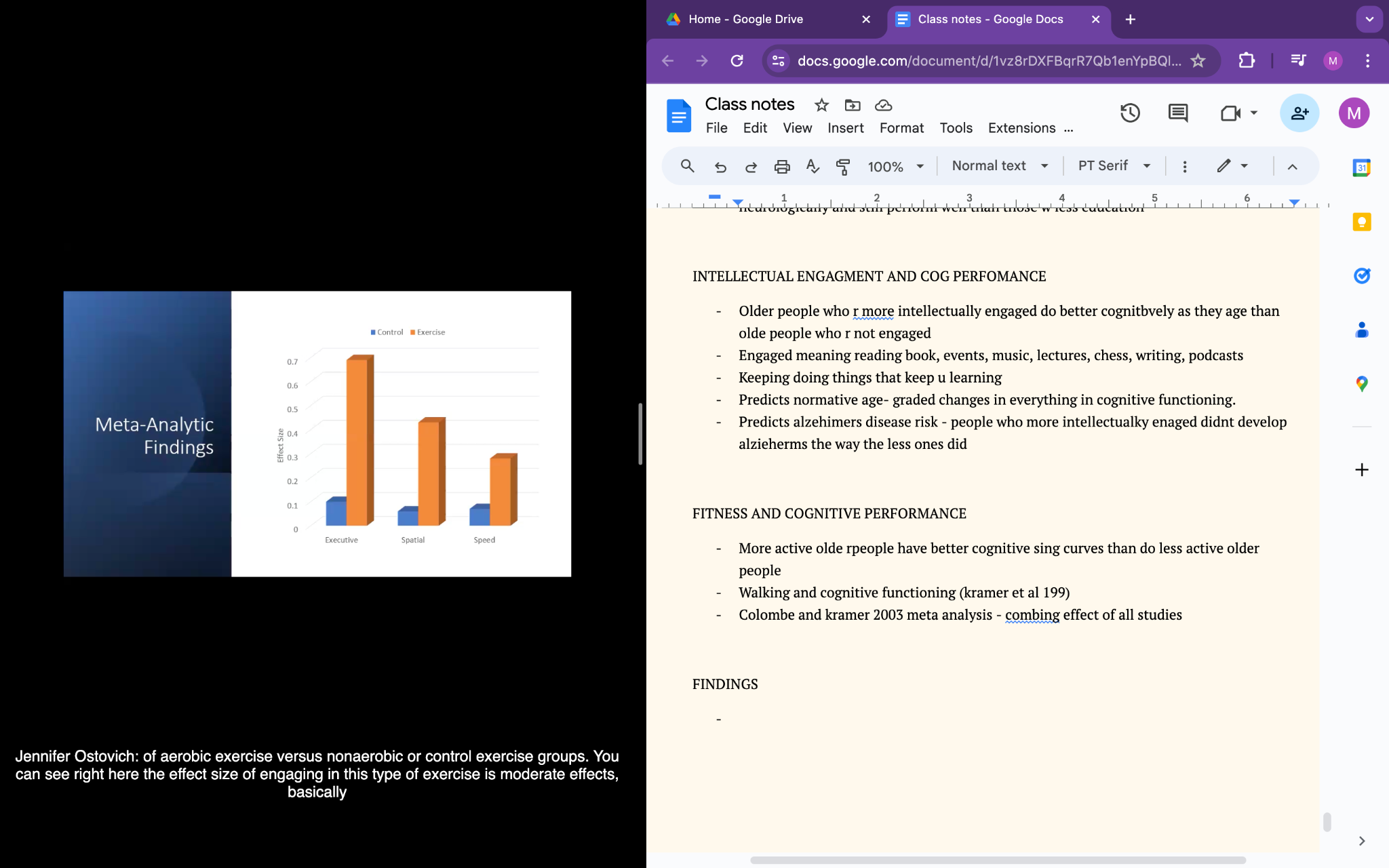
FMRI EXCERSIZE INTERVENTION RESEARCH 2004
Thos ewho did arobic exceorizing and did better
Summary
Possible interventions
Fitness
Intellectual engagement
Social engagement
Ciognitve training
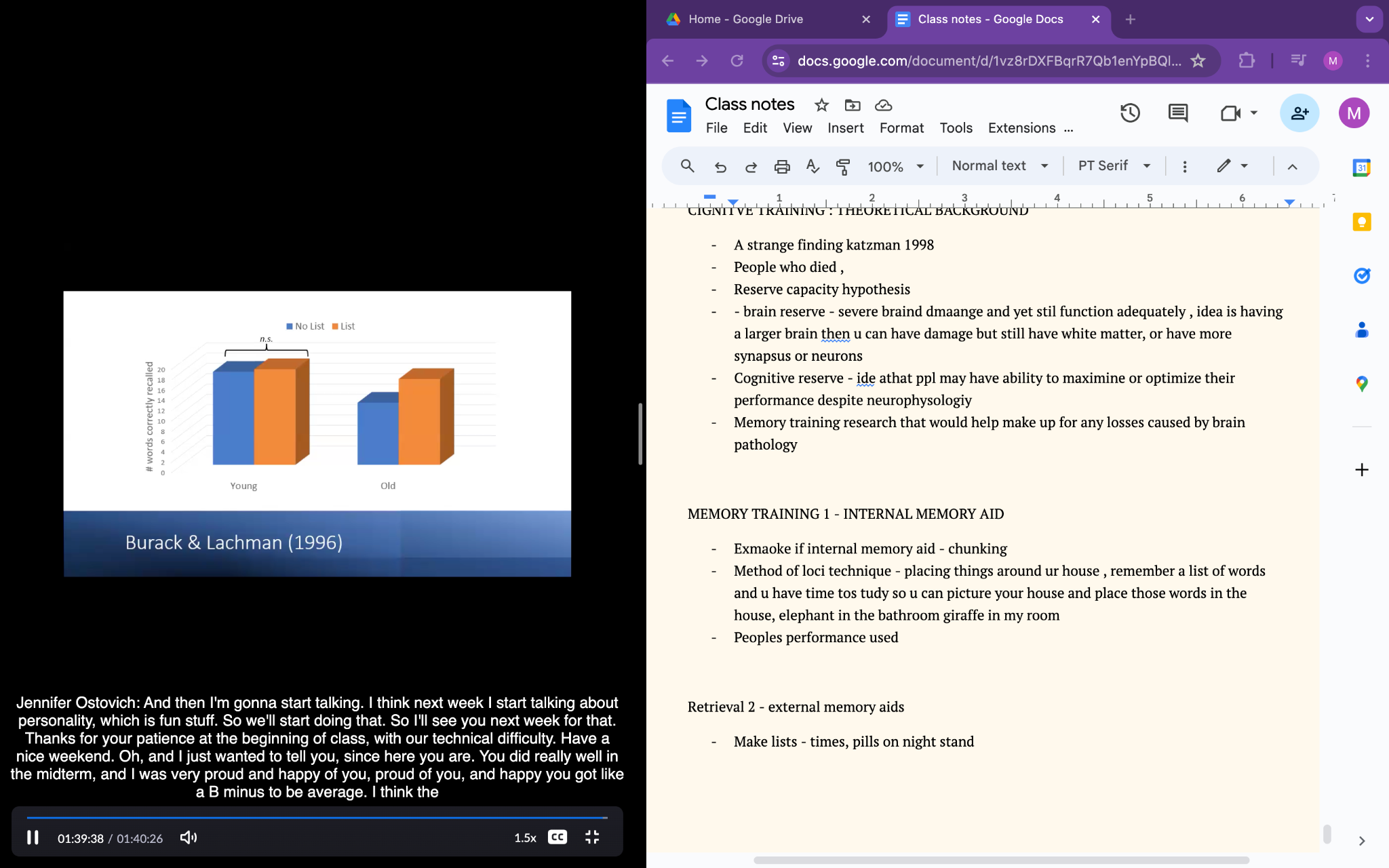
CIGNITVE TRAINING : THEORETICAL BACKGROUND
A strange finding katzman 1998
People who died ,
Reserve capacity hypothesis
- brain reserve - severe braind dmaange and yet stil function adequately , idea is having a larger brain then u can have damage but still have white matter, or have more synapsus or neurons
Cognitive reserve - ide athat ppl may have ability to maximine or optimize their performance despite neurophysologiy
Memory training research that would help make up for any losses caused by brain pathology
MEMORY TRAINING 1 - INTERNAL MEMORY AID
Exmaoke if internal memory aid - chunking
Method of loci technique - placing things around ur house , remember a list of words and u have time tos tudy so u can picture your house and place those words in the house, elephant in the bathroom giraffe in my room
Peoples performance used
Retrieval 2 - external memory aids
Make lists - times, pills on night stand
MARCH 14: PERSONALITY
MOEMRY 3 SKILL SPECIFC CGNITVE TRAINING
Training helps w performance on
- specific taks
Genera strategies
Training can improve performance but its task specific (shaie and willis 1986)
Some had decline some didnt
Spatial orienataiton ,sptail taks
SHAIE ND WILLIS - LONGTITDINAL STUDY
Improvement regardless of previous decline
7 yr follow up \- previously trained vs =never trained
Effects of booster - 1 hr if reminder teaining
Peopel did better thn those who never reecoeved the training
Booster ould still show decline but those who didnt stuklll had less decoine
Maintain impact for much longer
SUMMARY
As we age someone of our coignitiuve abilities will remain unchanged but me wills start to decline
Decline can be delayed , slowed down, or even revered w intervention
Most effective intervention is life style
PERSONALITY
Refers to behaviour traits that make up individuals
Is personality stable or does it change across the lifespan
Controversy is maintained due to
- cintradictiry data - dta suggest perso does change thru out life and data shows that it doesnt
LEVELS OF ANALYSIS (MCADAMNS)
Levels tell u if youll chang eo rstay the same
Trait theory suggest you'll stay the same
Level 2 - personal concerns
LEVEL 1: TRAIT THEORY
OVERVIEW
Purposes that we can summarize the important enduring aspects of a person using traits
Our perso is made up of traits
Focus on the content of personality
Goal is to identify and measure the most important traits
Does not discuss origins of personality traits
Does not try to tell the story of a persons life
THEORETICAL ASSUMP-TIONS
Trait are relatively stable and enduring
Traits can be quantified
Some traits are more important than others
Personality traits exists on continua
WHICH TRAITS ARE MOST IMPORTANT
Big 5 or five factor model
Ocean or canoe
Neoroticuism
Extraversion
Openness to experience
Agreeeablemness
Consitnessness
NEUROTICISM
NOT neuto = emotionally stable
Irrational ideas
Poor stress management
Lowe in neiritism are calmer
U could be high in nweor but d=u could still not be diagnosed w depression
Emotional - related facets
Peoples ecperie ce of emotional states that are fundemaletal of being neuroitism
Anxiety
Hostility
Self - consciousness
Depression
Behavioural facets
Impulsiveness
Vulnerability
SAMPLE NEO-PI N
Different version of neuroticism
EXTRAVERSION
INterpersonal facets
Warmth
Gregarionousness
Assertive
Temperamental facets
Activity
Excitement seeking
Positive emotions
OPENNESS TO EXPERIENCE
Fantasy
Aesthetics
Action
Ideas
Values
Feelings
AGREEABLENESS
Trust
Staightforwardness
Altruism
Compliance
Modesty
Tender-mindedness
CONSIOUSNESS
Competence
Order
Achievement striving
Self- disciplin
Deliberation
Dutifulness
OUR AGING TRAITS - DO TRAITS DEVELOP IN ADULTHOOD
EARLY ADULTHOOD
Costa and macrae 1988 - looked at 5 model questtionalre
Neurotism decreases from the 20’s to the 50s
Consiioutness and agreeableness increases
MIDLIFE
Costa et all 2000
Neuroticism extraversion and opennes show significant decreases during the 40’s and early 50s
Consciousness and agreeableness increase
OLD AGE
Kandler et al 2015
Twins - measured big 5
Also measured
- perceived control
Emotion regulation
Subjective well being
Results
Increase in neurotism decrease in extraversion
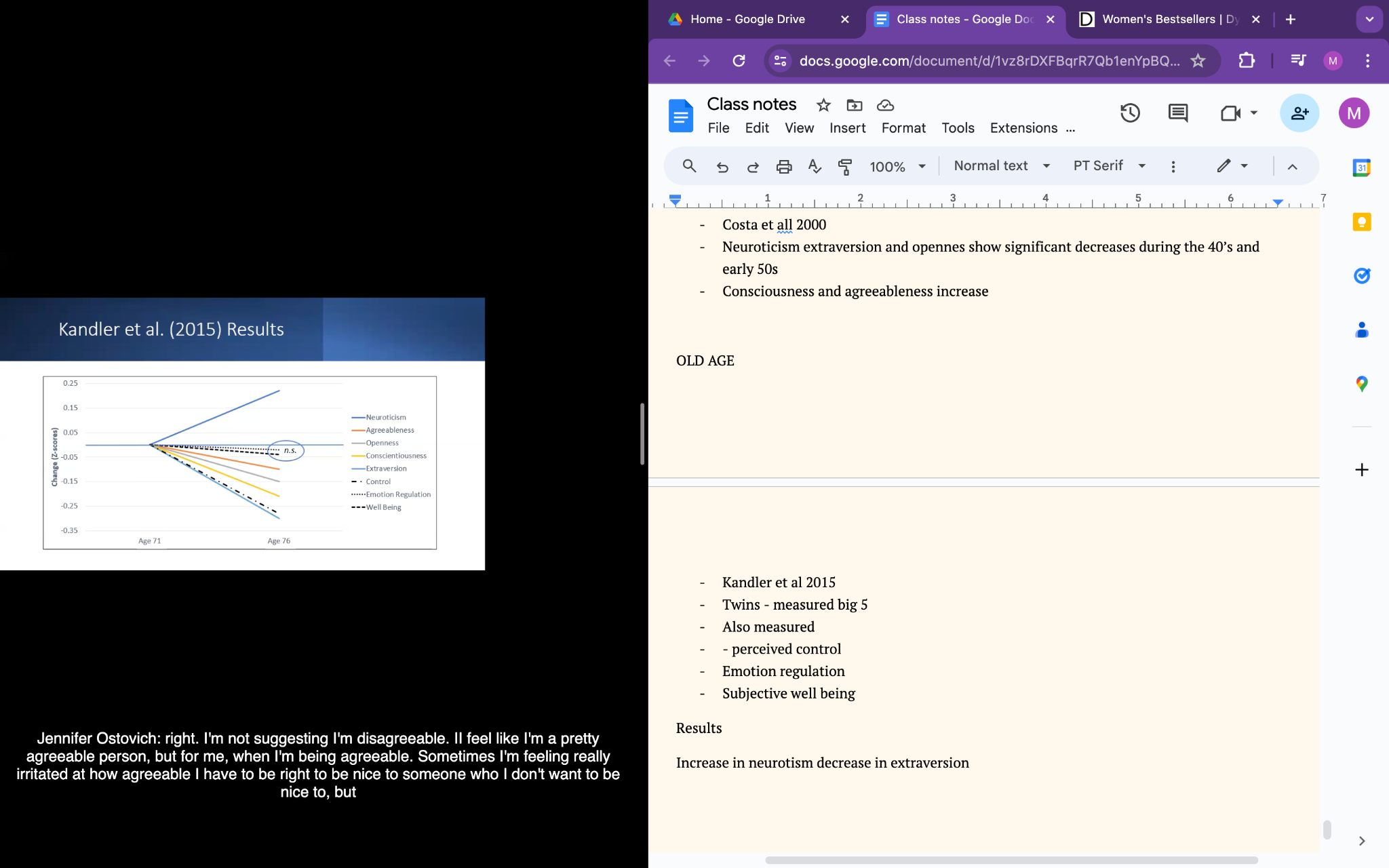
KANDLER ET AL ON THE ADAPTIVENESS ON PERSONALITY DEVELOPMENT
Aearly adulthood and midlife changes help us adapt to our new roles
Late adulthood trait changes look dire but also can help adapt
Recal baltes slewectdion and optimization w compensation SOC MODEL
INCREASINGINDIVIDUAL DIFFERENCES IN PERSONALITYW INCREASING AGE
TRAIT THEORY CRITISM
REDUCTIONIST
- nos tory
Were do traits come from
What ab context and situinal factors
MARCH 21 PERSONALITY PT 2
Mcadams levels of analysis
Level q trait theory - ignores context
Level 2 - personal concerns - argue thru liofespan that more important to us ins hfhits can cause in our personality
Erikson thought our life is towards crissi that we r going to go thru
Freud didnt care he ab ego or super ego , everything is unconsiopuis to him and wanted to talk ab real observable problemsthat people have to solve in order to navigate their lives - psychosocial crisis
Diff types of problems come to us and we solve them
ERIKSON
He lived really long so his theories r really interesting and would make adjustments to his theories the longer he lived ‘
Stage theory of lifespan personality development - gping thru ;ife tasks and u solve between the time u r born and died,
We go thru 8 ;ife tasks
HOW DO STAGES WORK
Each taks has a psychosocial task
Each task involves a struggle between two oppsoing tendencies . can trust 100 percent but cant be untrusting, so u have to find a balance between tendfencies
Optimal resolution results in basic strength. If u find the right balance then u can move on the next task happily
Suboptimal resolution results in maladaotion or malignancy - malignancy is bad and theres tooooo much =mistrsut , ur not stuck in this stage, but ur gonna struggle to move thru the next stage successfully.
ERIKSON STRENGTHS GATHERED BY ADULTHOOD
Hope (trust vs mistrust) -> infancy
Determination (autonomy vs shame/doubt) -> early childhood - toilet training
Purpose (initituve vs guilt) -> young childhood
Competence (industry vs inferiority) -> school age) - can we make it in the world
Fidelity (identity vs role confusion) -> teens - pick a self, who r u? Find an identity and be faithful to it but not so faithful that its rigid
ERIKSON STRENGTHS GATHERED in ADULTHOOD
Love (intimacy vs isolation -> young adulthood - can i be myself while being intimate and sharing all my parts w them
Care (generativity vs stagnation/self-absorption) -> middle adulthood - generate children and raise them well if u succeed in ur life tasks, being a vi=ulennetr is generative, but leaving behind something there is good. -> middle adulthood
Wisdom (ego integrity vs despair) -> old age - “was it ok to be me” “am ok w leaving the world w what i am” - evaluate iur life
EGO INTEGRITY SCALE (TORGES 2008)
I FEEL GENERALLT CONTENT W WHAT I HAVE ACCOMPLISHED - how youd feel if u were more towards ego integrity
I still feel angry ab some of my childhood experiences (reveresed) - not good,, more despair emd of things
If i had just a couple more lucky breaks, my life would have turned out differently (reversed) - despair end of things
My life has been fulfillunh, and i'm not frightened by the thought of death - ego intergrioty
It doesnt bother me to think ab goals i have not reaches and probably never will - ego integrity
Reading old diaries andletters usually bring more pain than pleasure - despair
There are many people whose life i would prefer to my own - despair
When i consider the ups and downs of my past life , they somehow fit together in amusic a meaningful way
MODERN AOPPROACHES TO ERIKSON LOGAN 1986 3 LIFE TASKS
Build trust - establish trust w others and ourselves
Achieve -
Understand ourselves -
RESEARCH ION GENERATIVITY AND EGO INTERGRITY
Cox et al 2010 on relationship between the ffm snd generativity
Torges et al 2008 on relationship between generativity and ego integrity
Mcadms 2004 on how we become generatitive actors
Mcadms 2004 MULTIDEIMENTIONLA MODEL OF GENERATIVITY
Generative concern
Commitment
Action
Meaning
THE MIDLIFE CRISIS - THE SEASONS OF A MANS LIFE , LEVINSON 1978
Fear of mortality and aging lead to emotional and behavioural changes
We get string emotions
Little evidence in favour of midlife crisis
Levinson took elite white men
EMPRICAL CHALLENGES TO THE MIDLIFE CRISIS IDEA
Costa n mcrae 1970s ‘
Midlife crisis scale
Big 5 and mcs
Berkeley lingtituindal study clausen 1981
Why do people continue to believe in midlife crisis
MARCH 28 - AGING AND MENTAL HEALTH - DEPRESSIONS
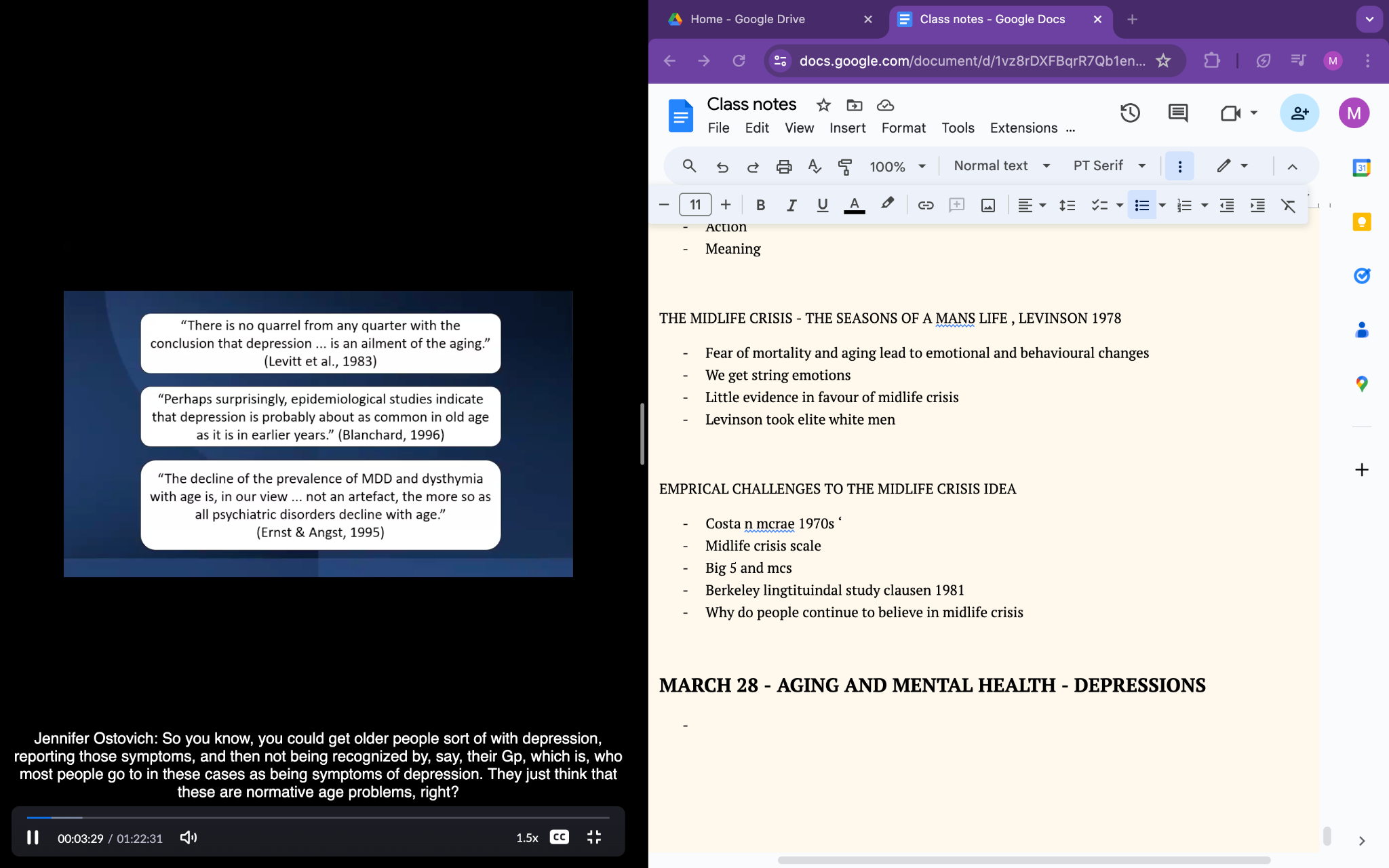
EXPLORE W DEPRESSION IN OLD AGE
WHAT IS MENTAL HEALTH
Canadian mental health association
Positve lpsychology perspective - interested in what causes good mental health
SATISFACTION W LIFE SURVEY (DINER 1985)
In mist ways my life is close to ideal
The conditions of my life are excellent
I a satosofoed w myt lufe
So far , i have gotten the important things in life
If i could live my life over, i would change almost nothing
You anser yes, u are not depressed
DSM DIGNISTIC CRIRTIERA - MAJORE DEPRESSIVE DISORDER
Dysphora fro at leats 2 weeks , sadness in any and anything , unless suicidal
Must have 4-5 emotional symptoms
MDD EMOTIONAL SYMPTOMS
Irratibilty
Feelings of worthlessness, inappropriate guilt , helplessness
Feelings of hopelessness
Loss of previously enjoyed activity
MDD: PHYSICL SYMPTIMS
Insomnia
Appetite cvhanfes
Fatuguye, sluggishness
Dogestuve problems, headaches and chrnic pain
COGNITVE SYMOTONS
Difficulty thinking, concentration, memory, decision making
Thoughts of death
HOE COMMON IS DEORESSION IN OLDER PEOPLE
Mdd numbers r very low - not diagnosed often
Subthreshold depression numbers high, u have the symptims, but u dont acc meet the criteria fo the dignisuis and lots struggle w it
Whats goin on - r older adults unmlikely to get deprssied decribed as in the dsm , or r they just not getting diagnosed bc of their age. Is their depression different bc theyre old, do we not have a secion for them
POSSIBLE EXPLANATION
Presentation if symptoms to gp
Liklihood of using thr word depressed
Likelihood if reporting dysphoria
Symptoms older adults do report
Physcial symtoms may be igniried
GERIATIRCV DEPRESSION SCALE - SHORT FORM - SHEIK AND YESAVAGE 1986
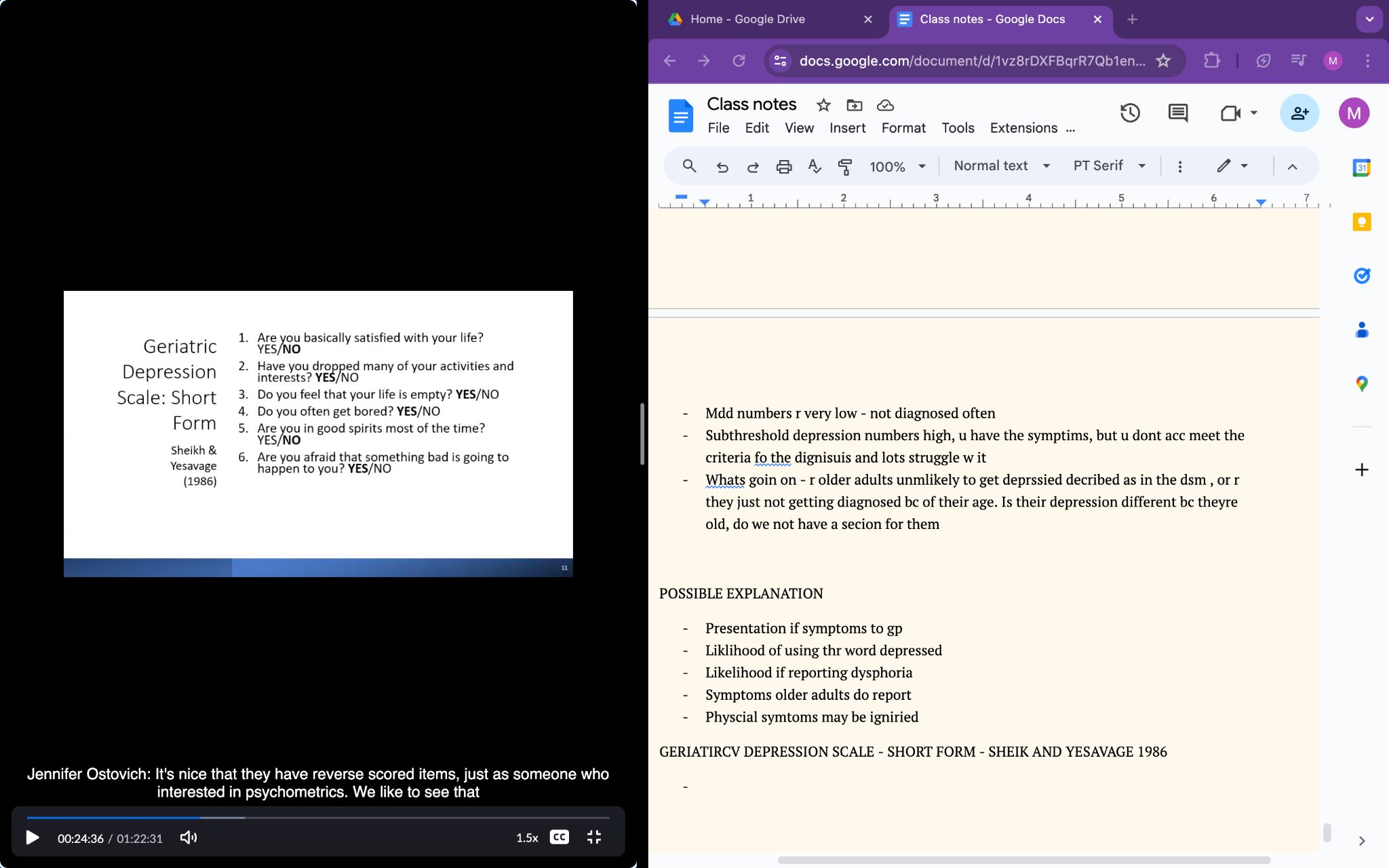
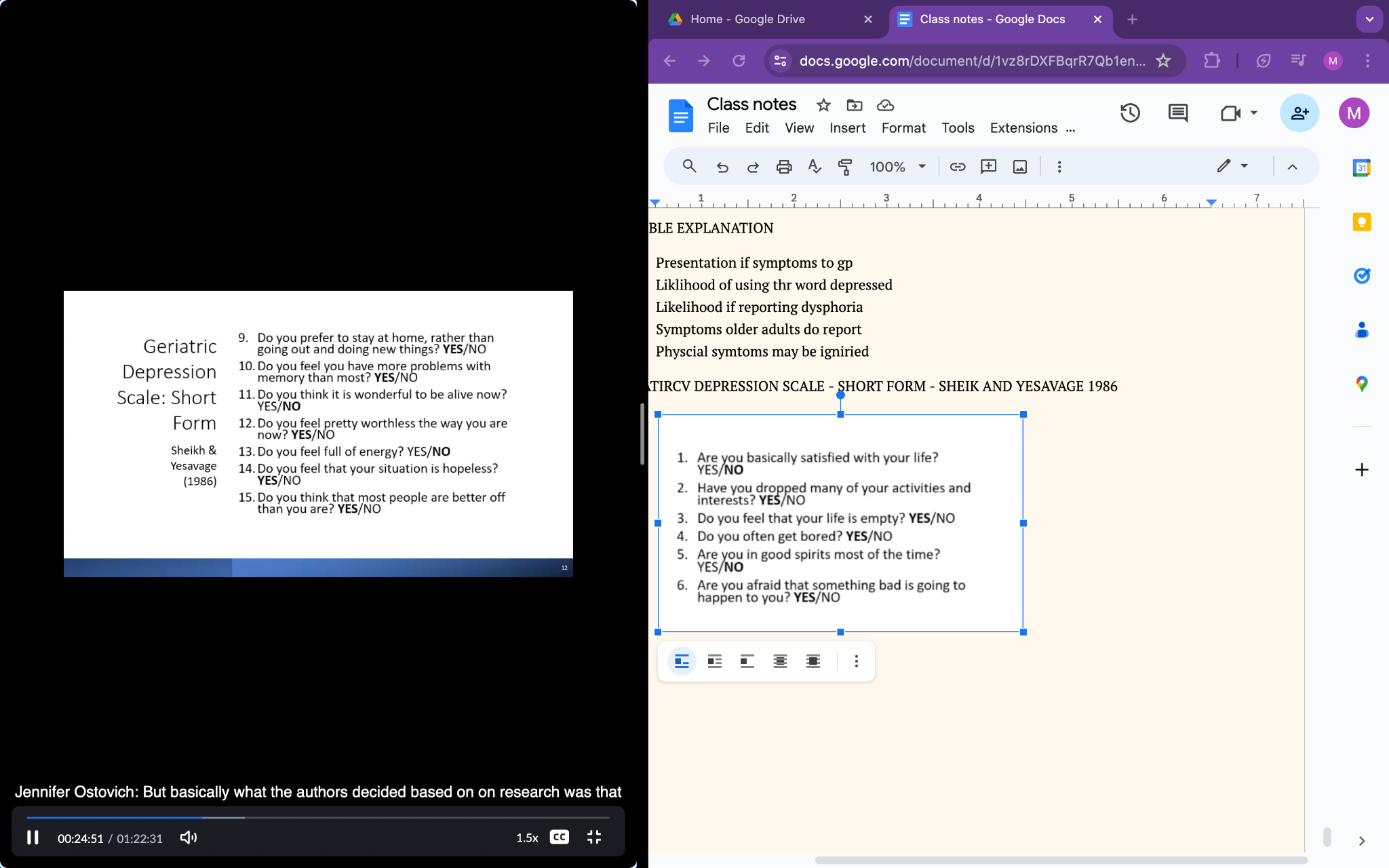
Basdicallt asking people r u depressed w out acc asking them
RESEARCH EXAMINING aging and depression
Jorm 2000 review
Depression rates decrease slightly across age group
Critiques
Mdd was diagnosed using dsm criteria but it may nit be valid within older population
Data is cross sectional so these r just cohort effect, olderr cohorts being just as depressed as yiung coherts but wont mention it
Rothermund and bradstader 2003
Sequentuional ensign
Used gds and dsm criteria
RESULTS
Things look good and then at age 70 get worse for both men and women
Women r more likely to look depressed on these scales
Is this everyone or is it just a few people i n their 80’s whats happening and why
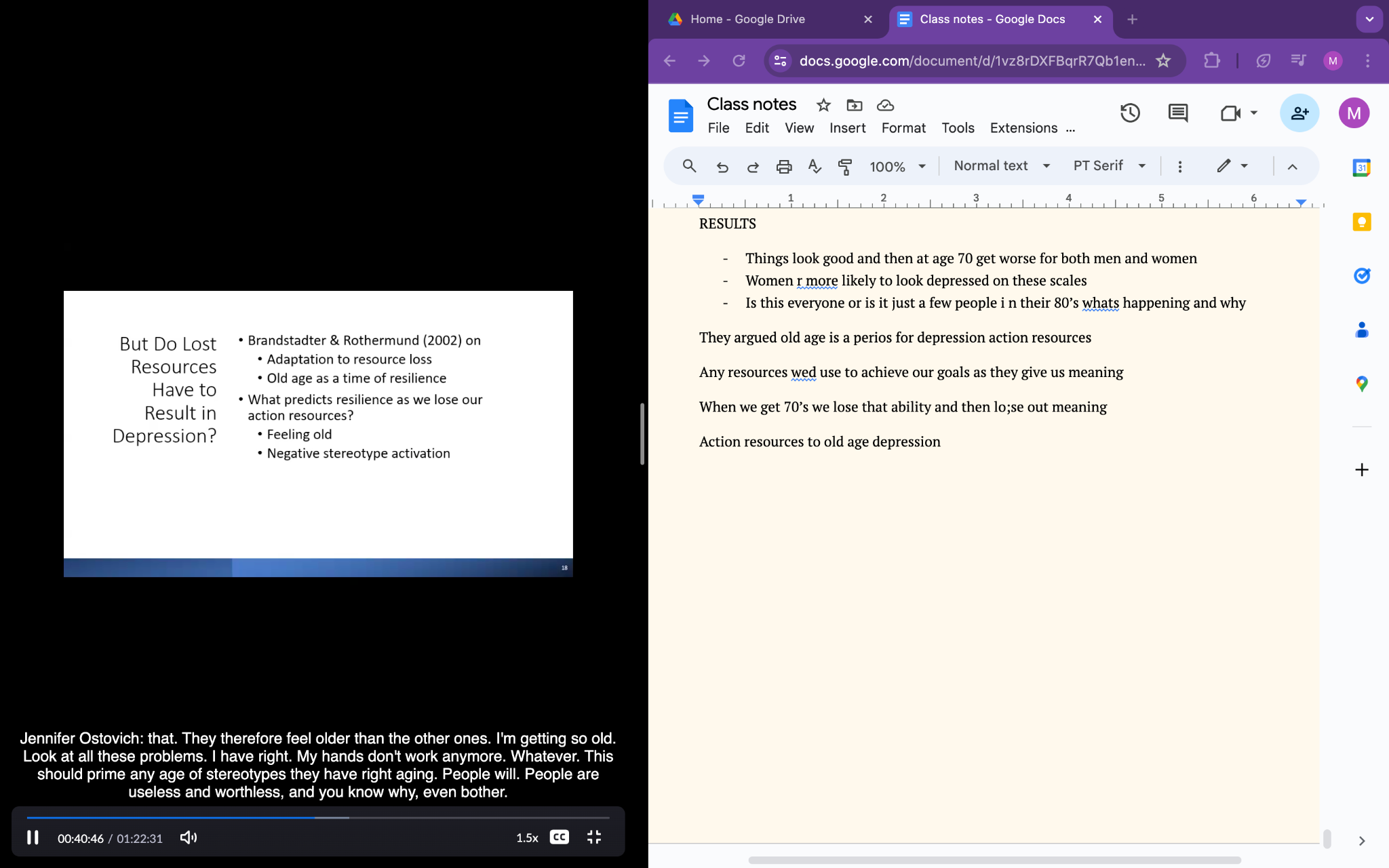
They argued old age is a perios for depression action resources
Any resources wed use to achieve our goals as they give us meaning
When we get 70’s we lose that ability and then lo;se out meaning
Action resources to old age depression
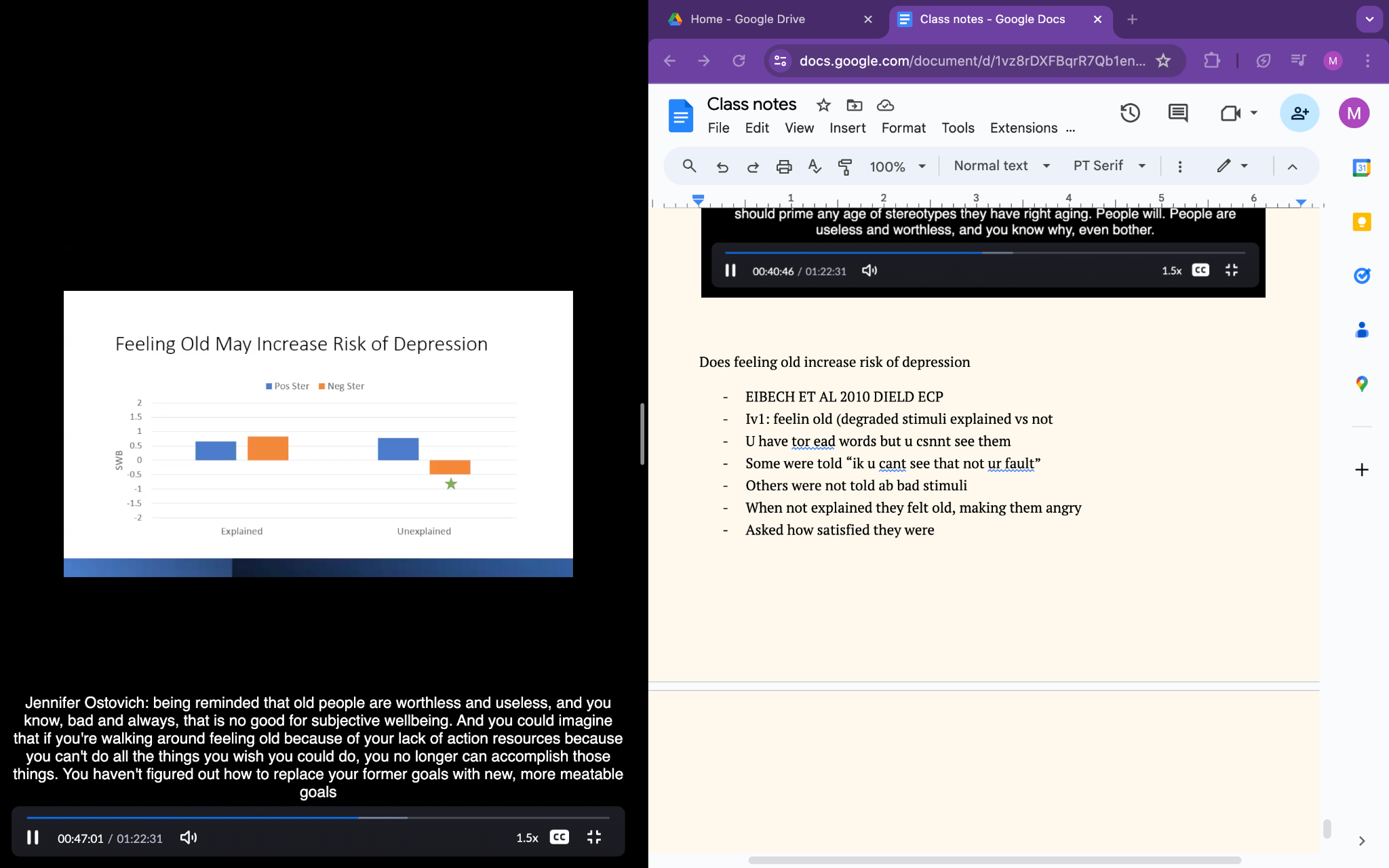
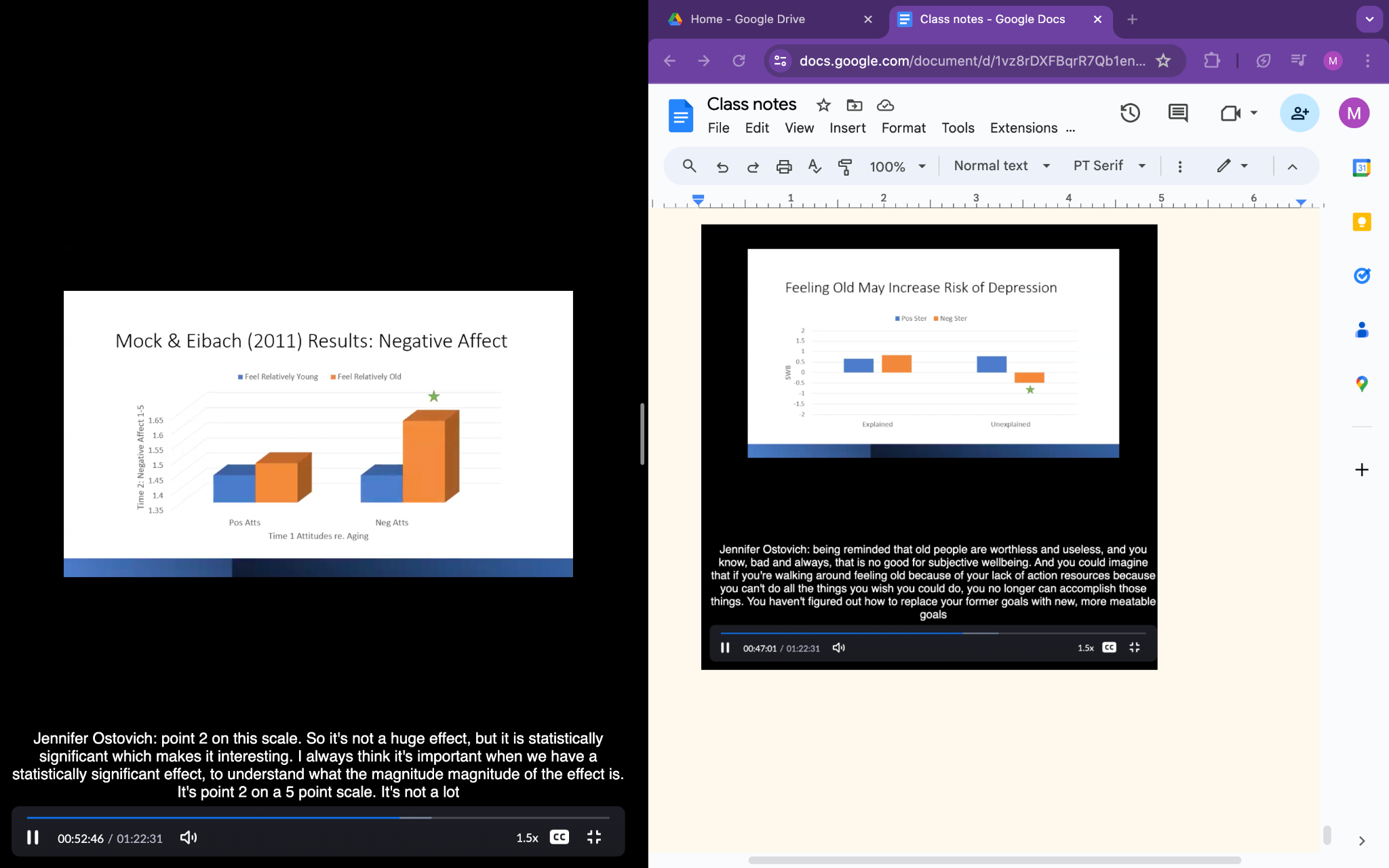
Does feeling old increase risk of depression
EIBECH ET AL 2010 DIELD ECP
Iv1: feelin old (degraded stimuli explained vs not
U have tor ead words but u csnnt see them
Some were told “ik u cant see that not ur fault”
Others were not told ab bad stimuli
When not explained they felt old, making them angry
Asked how satisfied they were
WHY MIGHYT DEORESSION DECREASE
3 hypothesis
Increased emotional control
Psychological immunization - ur good w deasling w things
Decreased emotional responsiveness -
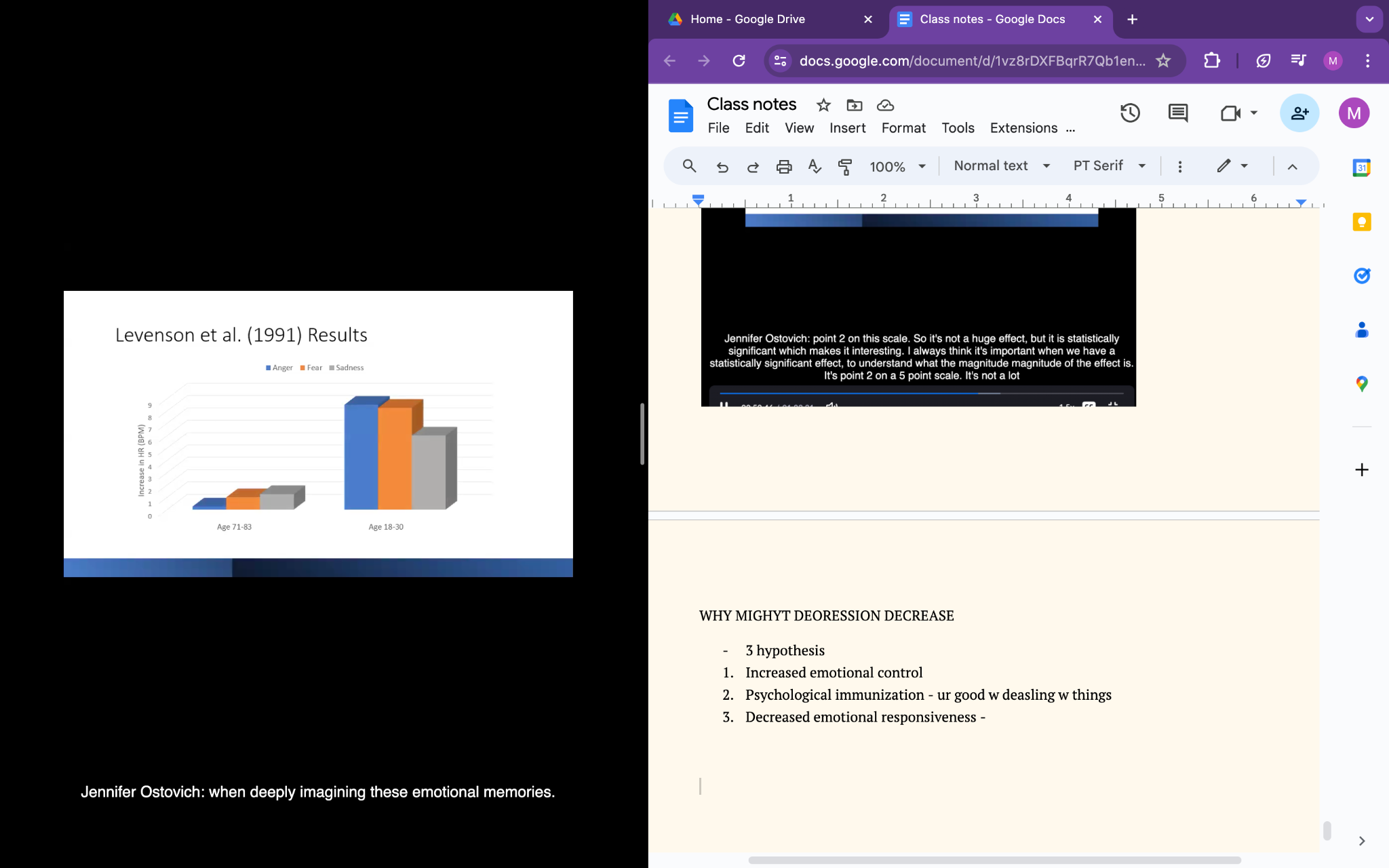
Old people did not care as much as the young people ab traumatic experiences
DIAGNOSING DEPRESSION IN OLDER PEOPLE
Ecidence for two separate syndrokles
1. Depressive syndrome - regular depression
Depletion syndrome - depression of the elderly
PREDICTORS OF DEPORESSION VS DEPLETION
Followed women for 5 years
Young aging 51-55
Older aging people 66-69
Older age group had a decrease who got depressie syndome in those 5 years so as ppl get older they get less likely for depression but more liikely for depletion
D and d were unrelated one didnt vcause the other f
Deorresive syndrome
History of mood disorer
Feelings of guilt and blame
Depletion
Linlieness was the biggest predictor
Chronic /debilitating ophyscial illness
SUMMARY
Adjustment tyo diagnostuicv criteria appear necessary to properly diagnose depression in older population
The depletion syndrome of the elderly may help identify some depressed older adults who would otherwise slip thru the cracks
Different treatments from depressive vs depletion should be developed
APRIL 4TH SUCCESSFUL AGING
OUTLINE
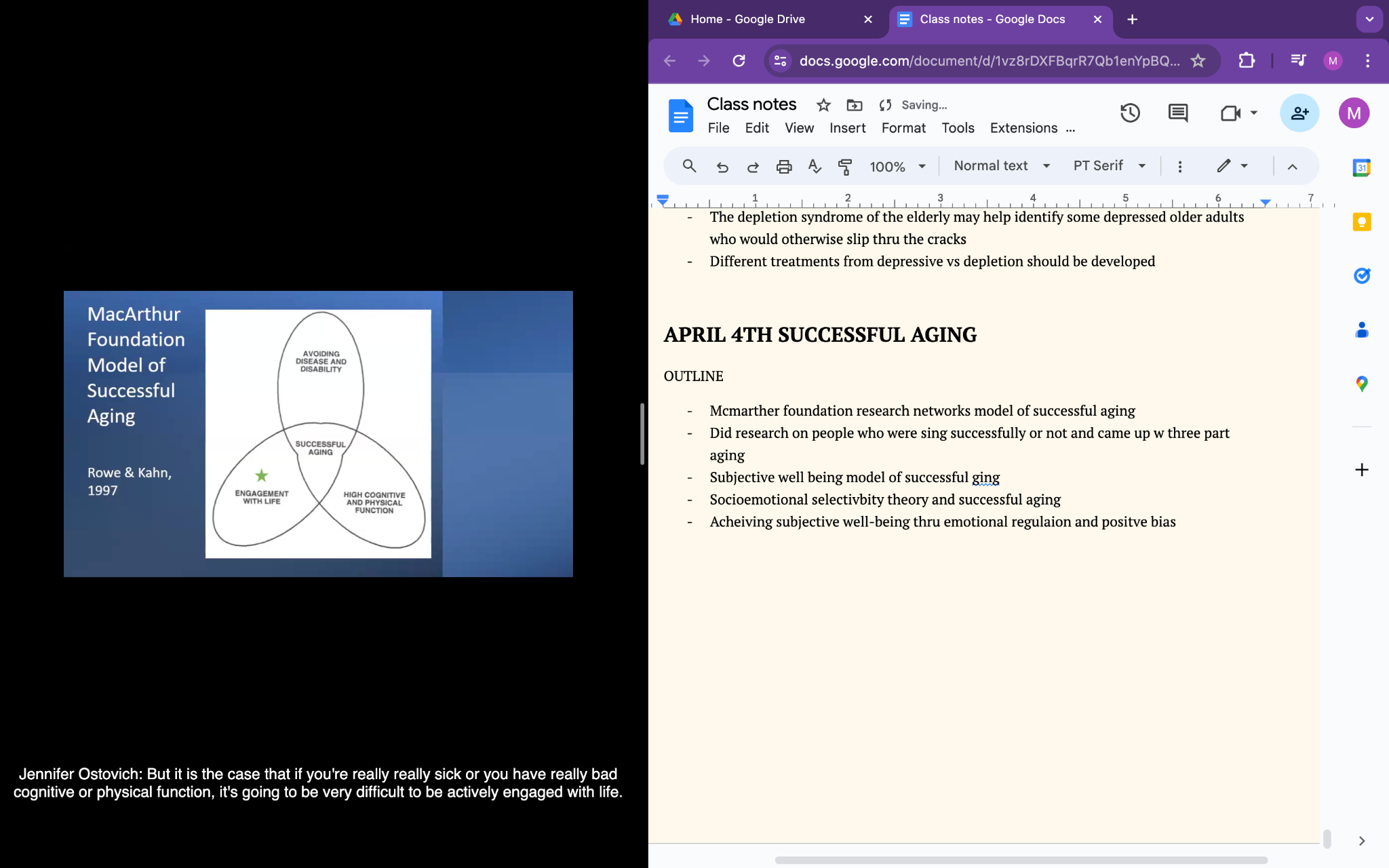
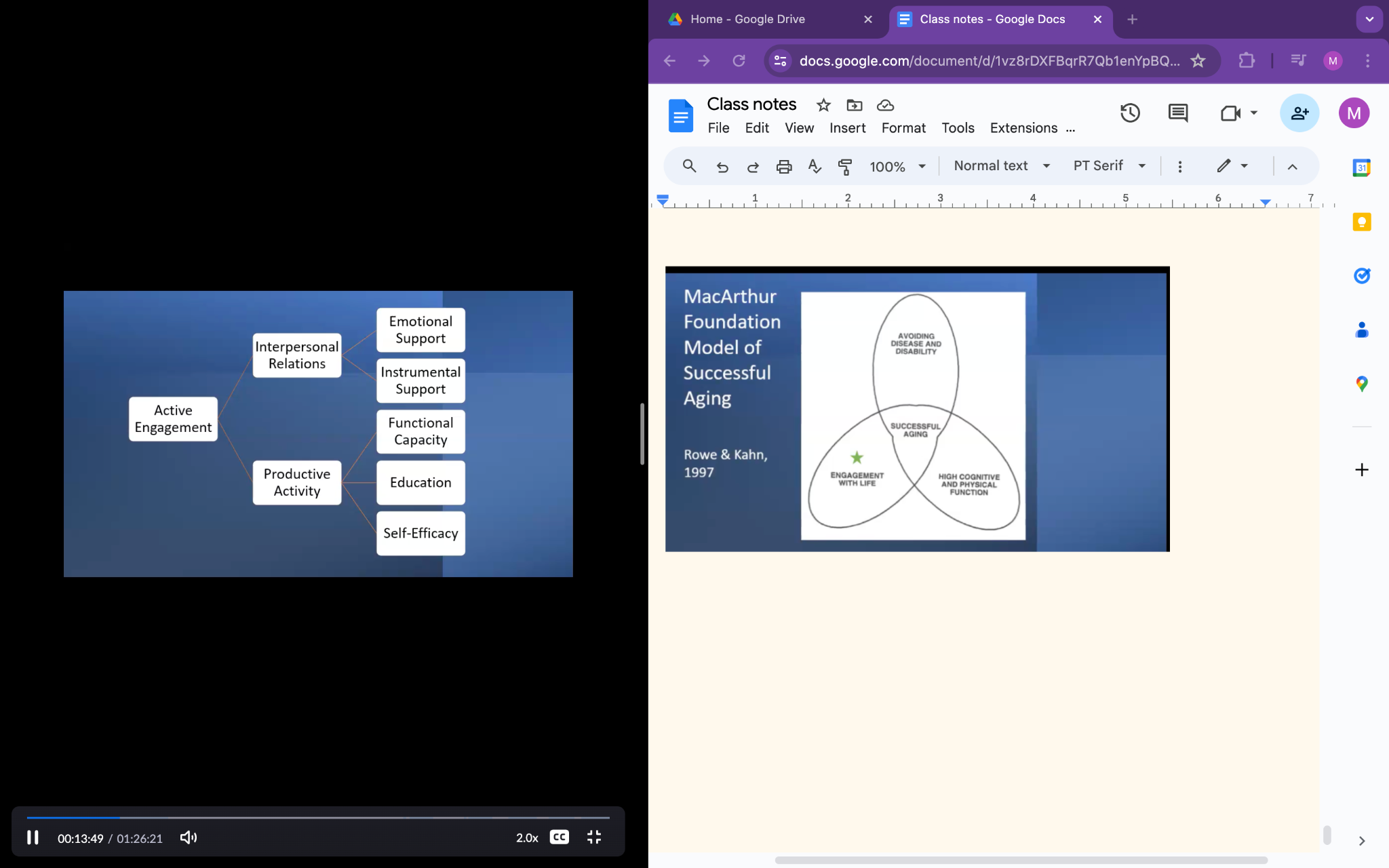
Mcmarther foundation research networks model of successful aging
Did research on people who were sing successfully or not and came up w three part aging
Subjective well being model of successful ging
Socioemotional selectivbity theory and successful aging
Acheiving subjective well-being thru emotional regulaion and positve bias
PARADIX OF WELL BEING
Despite objective difficulties , olderpeople feel relatively good
They have relatively high subjective well- being
HTREE COMPONENTS OF SUBJECTIVE WELL - BEING
Highnpisotve affect
Love negative affect
High life satisfaction
PREDICTOR OF SUBJECTIVCE WELL BEING
Ability to adapt - lady who read who became blind
Extent to which we can make progress towards our goals
Use of downwards social comparisons
Emotion regulation - contributor to well being - finding a way to react to bad things effectky and calmly
SOCIOEMOTIONAL SELECITVTY THEORY
Younger people perceive time as expansive -> FUTURE ORIENTATION
Older people, perceive time ss limited -> present orientation
Ads
SOCIOEMOTINAL SELECTIVETY AND THE POSIITVYT EFFECT
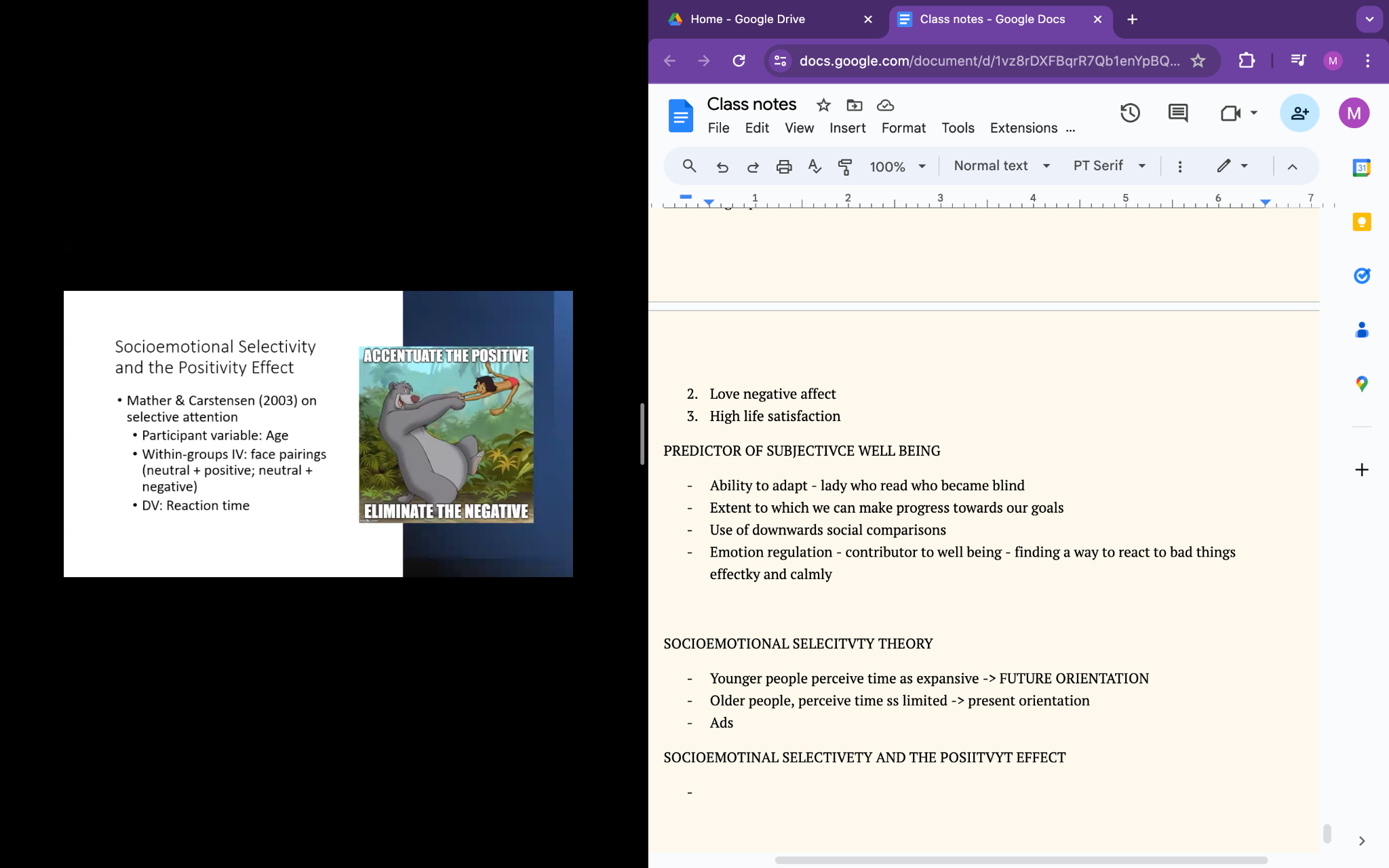
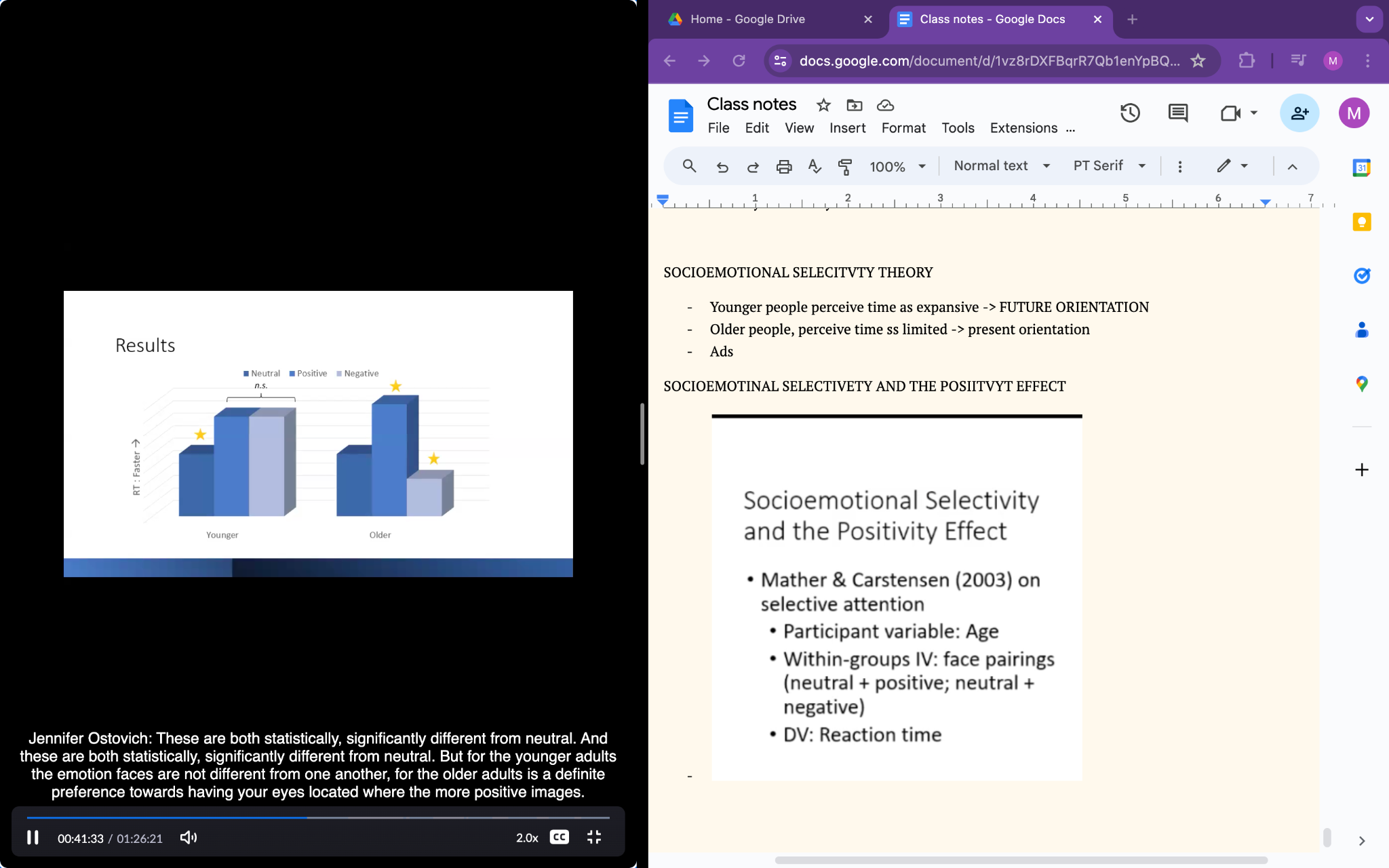
IS THIS EFFECT AB AGING BRAINS OR ABOUT INTENTIONAL EMOTION REGULATION
Aging braind model tested by stretton et al 2022
How to find that old peoples amygdalas are nt worki g well
Age younger vs older
Amygdala volume
Within groups iv
Stimulus valence - positive vs negative vs neutral
Watching instructions feel emotions vs regulate emotions
Emotions rating
Results - size of amygdala has nithing to do w it byt old people just good at controlling emotions
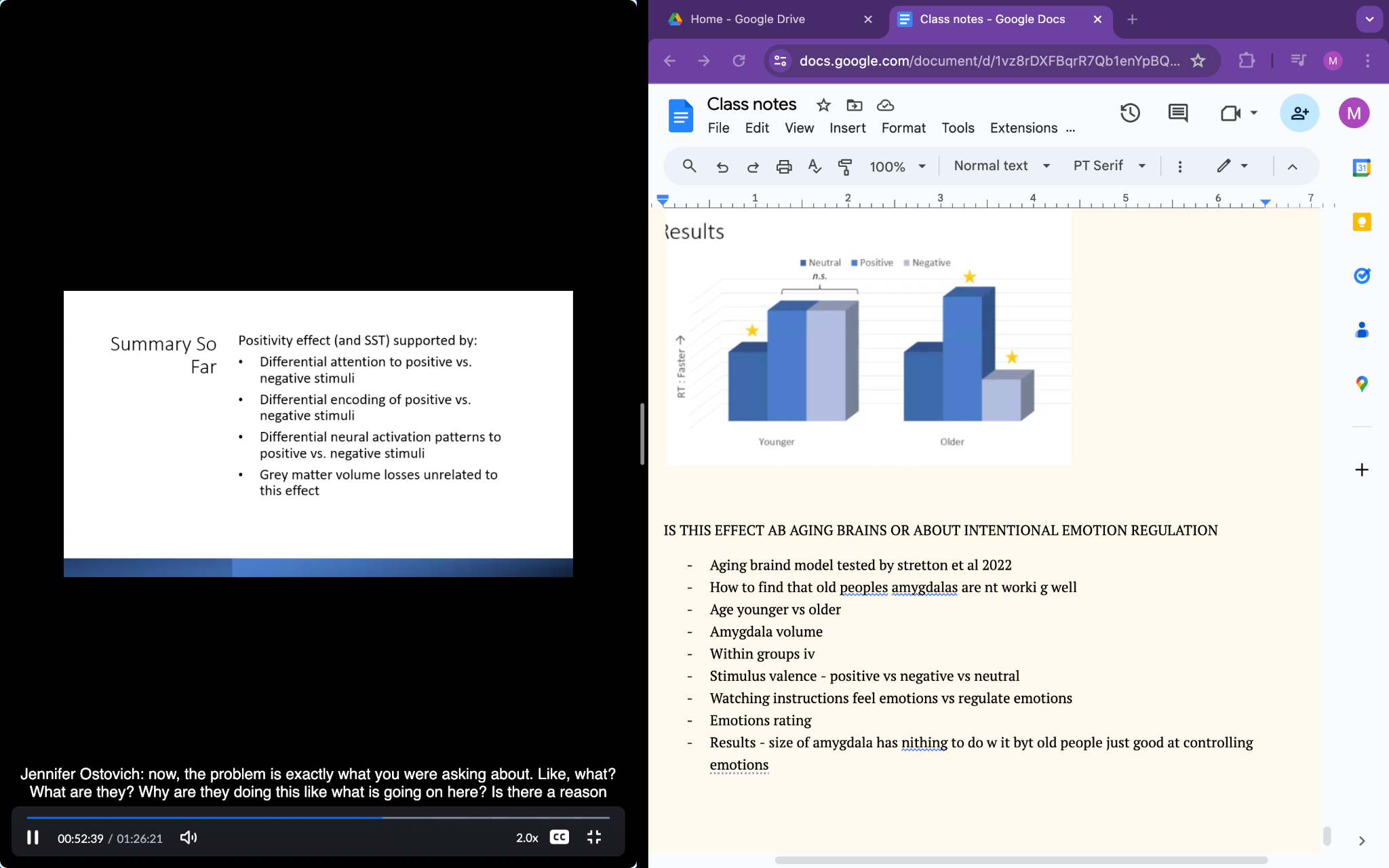
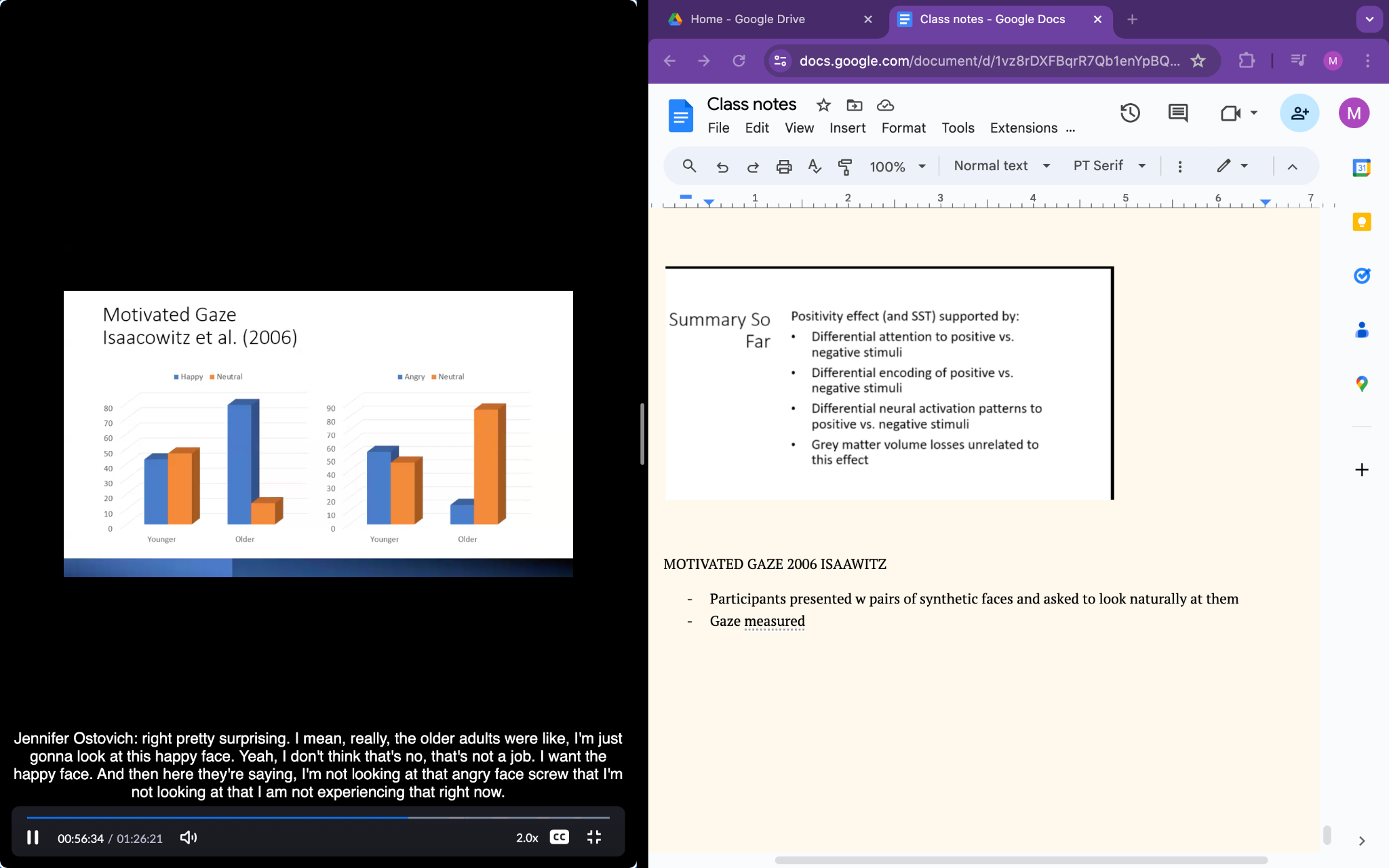
MOTIVATED GAZE 2006 ISAAWITZ
Participants presented w pairs of synthetic faces and asked to look naturally at them
Gaze measure