Classical Conditioning:
Definition (#f7aeae)
Important (#edcae9)
Extra (#fffe9d)
Learning Outcomes:
Ivan Pavlov: The beginnings.
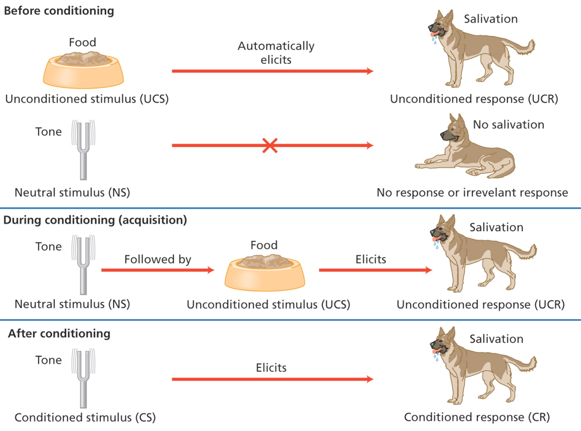
What is classical conditioning.
What is higher order conditioning.
How the CS (Conditioned stimulus) and the US (Unconditioned Stimulus) are paired.
Extinction of conditional response.
THE BEGINNING:
Born in 1849, Russia.
Pavlov was a physiologist.
Fascinated by the adaptability of the salivary gland:
The amount of saliva changes according to the type of food.
Experimented on dogs.
He realized the dog started salivating before the food was given.
Called it the ‘psychic reflexes’.
Investigating the ‘psychic reflex’:
He started to record all the external stimuli falling on the animal at the time its reflex reaction was manifested, while recording all changes in the dogs reaction.
What he found out:
After a while, the sight of food or smell caused the dog to salivate.
Sight of the person bringing the food also caused salivation.
In conclusion:
2 types of reflexes:
Unconditional reflexes: salivate when food is put in the mouth.
Conditional reflexes: salivation depends on many conditions.
Not present at birth but is acquired through experience. Thus impermanent.
HIGHER ORDER CONDITIONING:
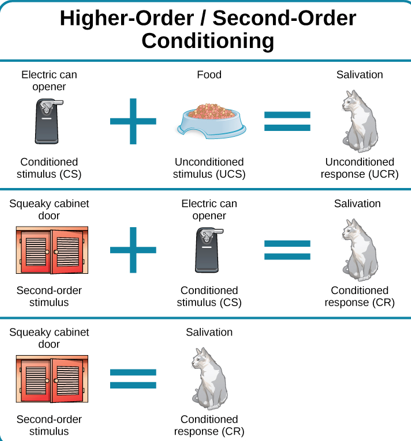
There can be upto 5 CS
Carolyn & Arthur Staats (1957):
Experimented higher order conditioning with humans.
Without the UCS.
Participants were shown on a screen nonsense syllables- YOF, LAJ etc.
Paired with these words with either positive or negative words; beauty, gift, sad, enemy. Participants were to repeat these words.
Later they were asked to describe the nonsense words and they described the positive/negative words.
Measuring Pavlovian Learning:
Latency of response:
The interval between the onset of CS and the first appearance of saliva (CR).
Test trials:
Presenting the CS alone without US periodically.
Presenting bell/food, bell/food and then just the bell
How long to make the association between the bell and food.
Intensity:
Amount of saliva secreted.
Pavlov found the first CR to be weak but increases rapidly with repeated trials.
Pseudo-conditioning:
Tendency for NS to elicit CR after US has elicited reflexes.
Variables affecting conditioning:
CS-US Contingency (if-then):
The effect of Pavlovian procedures varies with the degree of contingencies between CS and US.
Robert experimented on rats.
3 Groups:
Shock occurred without CS 10% in additional trials.
US appeared alone in 20% of trials.
US appeared alone in the 40% of the trials.
The results showed the amount of learning depended on how reliable the CS predicted the shock.
Condition 1: Shock (US), bell (CS); 10% of the time CS was not present, pairing occurred.
Condition 2: US appeared alone 20% of the time, pairing occured.
Condition 3: US appeared alon 40% of the time, pairing did not occur.
CS-US Contiguity:
Contiguity refers to the closeness in time or space between 2 events.
ISI- interstimulus intervals.
The shorter the ISI, the quicker conditioning takes place.
However, if there is no interval. conditioning is not effective.
Shorter interval is better between the CS and US.
ISI depends on the type of response being learned.
Trace conditioning: After the CS, the US is showed after a small break.
Delay conditioning: The US is showed at the end of the CS.
Stimulus Features:
The physical characteristics of the CS and US affect the pace of conditioning.
Compound stimulus:
2 or more CS presented together.
Ex: dog was presented with cold and tactile stimuli followed by mild drops of acid (for salivation).
Result: cold did not elicit CR.
Overshadowing:
The effect of 1 stimulus was found to very commonly to overshadow the effect of the other almost completely.
Depends on the intensity of the US and CS.
Prior Experiences with CS and US:
Latent inhibition:
Appearance of a stimuli without US, interferes with the ability of that stimulus to become a CS later.
Why: it undermines the contingency effect.
So: novel stimuli is better.
[What if we compound stimuli with an existing CS? (2 stimuli at the same time (new and old))
Blocking: It may not work. (May block the new stimuli)
Sensory Preconditioning:
Wilfred Brogden (1939)
What if 2 CS were repeatedly presented without US and the later paired with CR with US.
Result: Both CS resulted in CR.
Number of CS-US Pairings:
The more number of pairings, the stronger the conditioning.
However, the strength of the first few pairings is much stronger.
Inter-trial Intervention:
How long a break before the 2nd pairing.
Time between intervals; shorter intervals lead to faster learning.
Extinction of Conditional Response:
Extinction does not mean forgetting.
Spontaneous recovery, reappearance of a CR after extinction.
Other Variables influencing Conditioning:
Age:
Age can influence learning ability.
Temperament:
One’s emotional state can affect how fast the association is made.
Stress:
Extreme stress can either accelerate or interfere with the conditioning.
Other Theories Explaining Pavlovian Theory:
The stimulus substitution theory:
Conditioned Stimulus (CS) replaces the Unconditioned Stimulus (US) in eliciting the response (UCR).
Preparatory response theory:
The Conditioned Responses (CRs) prepares the body for the Unconditioned Stimulus (US).
Compensatory response theory:
Suggests that the body and brain learn to anticipate and counteract the effects of the UCR by producing a response that is opposite to its effect.