Psych of Self ~ Exam
Lecture 6 ~ February 26th
Regulatory & Executive Functions of the Self
What is Self-Regulation
Self-regulation occurs when the self modifies, alters, or otherwise changes itself or its responses
Self-regulation involves goal-directed behaviour
Self-regulation involves a set of processes or subprocesses that allow the generation, modulation, maintenance, reduction or inhibition of a given response
Many of these processes are also those involved in executive functioning
Cognitive processes needed to focus attention, formulate goals, plan a series to achieve your goals and mantain then plan in memory so that you can carry it out.
Ex. Inhibition, working memory, task switching
In Childhood
Ability to comply with a request, to initiate and cease activities according to situational demands
Requires awareness of socially-approved behaviours
Important aspect of socialization
Kopp (1982)
Model of the development of self-regulation in childhood
Neurophysiological modulation
Birth to 2-3 months
Control of arousal states to protect against intrusive or strong stimulation
Active and passive mechanisms
Ex. Non-nutritive sucking to self-soothe, neurological safeguards
Control of arousal states in nonconscious
Caregiver’s role is to provide assistance
Sesorimotor Modulation
3- 9-12 months
Ability to engage ina voluntary motor act and change the act in response to events that arise
Does not require volition
Helps infant become aware of their own actions in holding, reaching, etc.
Control
9-12 to 18+ months
Ability to…
Show awareness of social or task demands that have been defined by caregivers
Initiate, maintain, modulate, or cease physical acts, communication, and emotional signals accordingly
Requires conscious volition
Emerges out of advances in cognitive processing abilities
Increasing differentiation of self from others and objects
Control features
Compliance to demands
Self-initiated monitoring of behaviour
Active
Memory
Self-initiated inhibition
Reciprocal social interactions
Limited by memory constraints as well as affect inhibition
Self-control
24+ months
Compliance
Ability to delay an act on request and abillity to behave according to caregiver and social expectations in the absence of external monitors
Symbolic functioning
Ex. Emergence of me-self
Self-regulation
36+ months
Same features as self-control, but greater flexibility of control processes that meet changing situational demands
Different methods used to measure self-regulatory abilities
Ex. Stroop tasks
Ex. Go/no go tasks
Ex. Stop-signal tasks
Ex. Delay of gratification tasks
Gradual mastery
High self-regulatory skills linked to a wide range of positive outcomes
But there is some controversy with the marshmallow task
Initial studies by Mischel & collegues not replicated
Self-regulatory skills or trust?
Parenting plays an important role in development
Ex. Overcontrolling/intrusive parenting(Perry et al. 2018
In Adulthood
Self-control vs. Self-regulation
Used synonymously, but…
Self-control
Conscious, intentional attempts to control behaviour
Self-regulation
Includes both conscious and nonconscious control over behaviour
WHAT IS SELF-REGULATION?
Carver & Scheier’s (1982) Control Theory model of self-regulation
Derived from control theory
Basic unit is the negative feedback loop
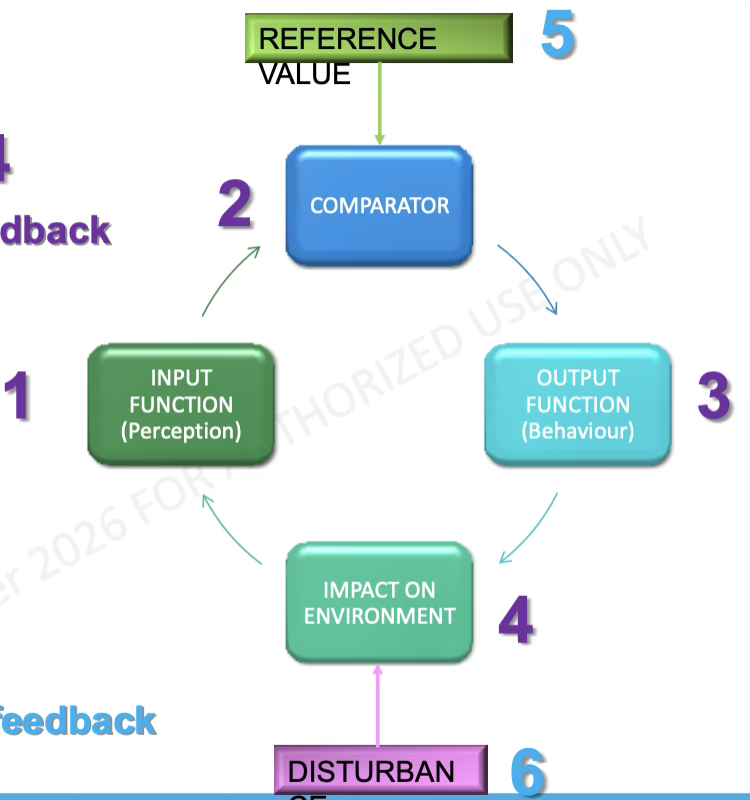
1-4 make up the feedback loop
5&6 external to the feedback group and affect the functioning of the loop
1) current state
2) comparator has two functions:
Compares Input function to some reference value to determine if there is a match or a discrepancy
Decides whether to exit loop or continue loop
Comparato will decide to exit loop if:
Input function = reference value
Efficacy expectations or outcome expectations not met
Input function ≠ reference value
Comparator decides to continue loo because
Efficacy and outcome expectations met
3) new behaviour
5) goal/ standard for behaviour — the ideal state
6) external factor that impacts environment (4)
Reference Values
Hierarchical organization
Multiple feedback loops at different levels
Self-schemas are at the highest levels
Become activated when attention is turned to the self
At the highest level
Based on overarching schemas (ex. Ideal self)
Specify which standards, as well as behaviours, minimize the discrepancy.
Carver & Scheier: Self-control vs Self-Regulation
Self-control
Requires volition (conscious action)
First, establish a goal that one wants to meet
Compare present state to reference value
If discrepant, engage in behaviours to reduce discrepancy, i.e., arrive at goal
Remember the role of expectancies
Compare new present state to reference value
If no longer discrepant, exit loop
Self-regulation
Does not require conscious volition
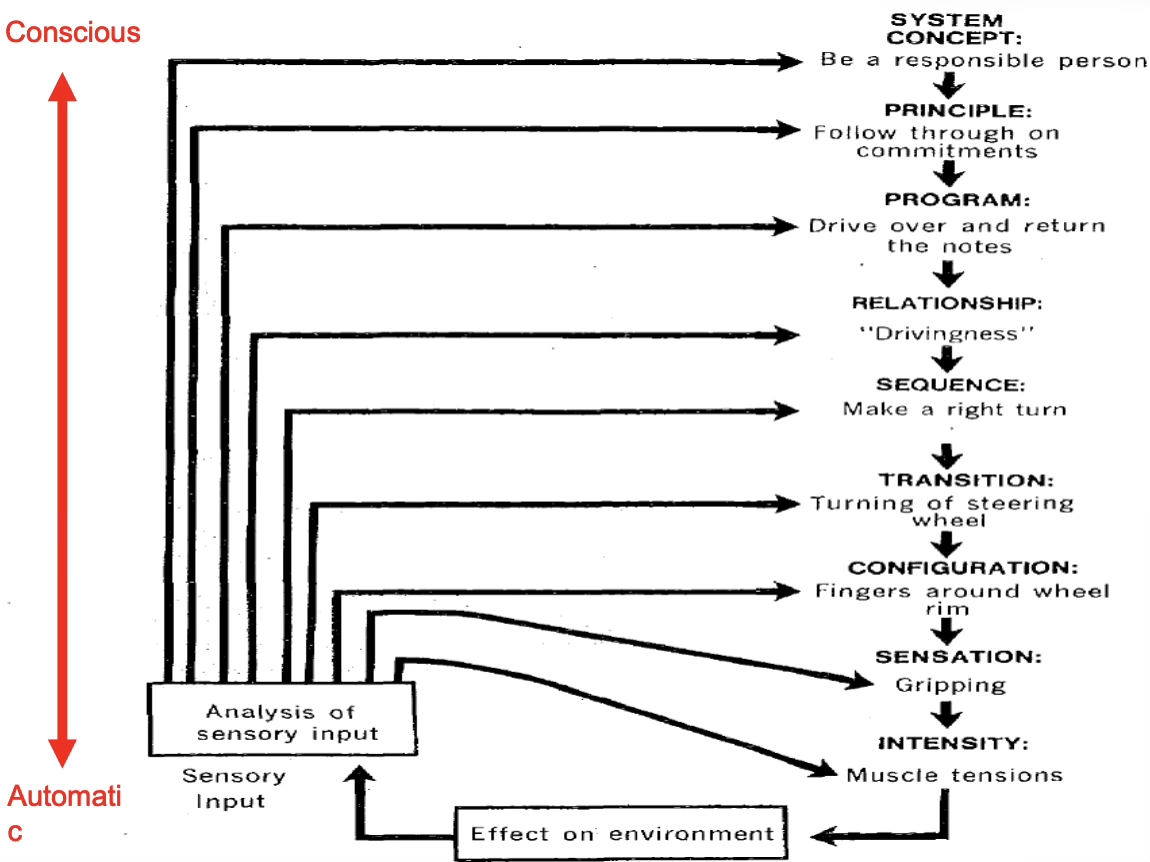
Goals (and expectancies) are represented mentally
Can be primed (triggered) outside of awareness and then run to completion, attaining the desired outcomes
Requires sufficient experience (i.e, consistent and repeated activation given a particular context) to gain automaticity
i.e., to be activated automatically
What is Self-Control
Self-control as ego depletion
Temporary reduction in the self’s capacity or willingness to engage in volitional action caused by prior exercise of volition
Volition is an important aspect of self
Energy or strength is required for acts of volition
This energy is a limited resource
Baumeister et al (1998):
Model 1: Self-control is a skill that develops gradually over time
On any given occasion, this skill remains constant across repeated trials
H1: no change in effectiveness of self-control over two successive exertions within a short time
Model 2: Carver & Scheier’s (1982) Control Theory Model
Initial act of self-control activates the ‘self-regulation’ schema, which facilitates subsequent self-control
H1: effectiveness of self-control will increase over two successive exertions within a short time
Model 3: self-control as ego depletion model
Initial act of self-control involves expenditure of energy, thus depleting supply available for future self-control
H1: effectiveness of self-control will decrease over two successive exertions within a short time
EXPERIMENT 1
Method
61 undergrads assigned to one of 3 conditions
Chocolates, radishes, no food control
5 mins to taste the assigned food
15 mins wait period - completed problem-solving task, and time taken to give up, and number of attempts recorded
Results
Radish condition gave up quicker and made attempts
EXPERIMENT 2
Act of making the choice to engage in counter-attitudinal(and also pro-attitudinal) behaviour depletes the volitional resource
Method
39 undergrads assigned to one of 4 conditions (counter-attitudinal choice, counter-attitudinal no choice, pro-attitudinal choice, no speech control)
Make an audiotape of a speech aimed at altering people’s attitudes
Results
Participants who had a choice persisted less and made fewer attempts
EXPERIMENT 3
Persistence on insolvable puzzles may not reflect optimal self-regulation
Assessed performance on solvable anagrams
Participants who were instructed to suppress emotional response had poorer performance
EXPERIMENT 4
How does self-control undermine subsequent decision-making
Used the passive-option effect
Active responses require expenditure of limited resources
Hypothesized greater persistence when persistence is passive rather than active
Ego depletion will enhance this response
Results
Participants in the ego depletion condition watched more of the movie when quitting was the active response
Some recent studies have failed to replicate Baumeister et al. (1998)) [Ex. Cater et al’s (2015) meta-analysis of ~620 depletion studies)
Why?
Publication bias overestimates effect size
But size of bias difficult to estimate
Effect non-existent
Weak manipulations
Effect is influence by moderators (ex. Beliefs regarding willpower)
Self-Regulation Success vs. Failure
Self-Change
Self-change is not always easy, as self-regulation must be sustained
Most people actually fail after that initial attempt
Why?
Remember self-motives
Self-verification: we seek out consistency in how we see ourselves
Self-enhancement: We want to maintain positive self-views
Remember self-schemas & autobiographical memory
Self-schemas are resistant to change
Focus on initial stage, not enough focus on the other stages
According to Vohs et al (2007), there are 3 ingredients for successful self-control
Having a standard (goal)
Some goals are better than others
Ex. Specific goals
Ex. Stretch goals
Ex. Self-concordant goals
Ex. Fit between goal type and regulatory style
Ex. Promotion focus + approach goals vs. Prevention focus + avoidance goals
Following a regimen to achieve the goal (operations)
Following a regimen to achieve a goal
Self-regulatory “strength” required in order to perform the operations needed to reach goal
Finite, limited cognitive resources
Monitoring progress along the way (monitoring)
Little empirical attention
Involves being aware of the self and its standards
Self-awareness plays a key role
Loss of self-control occurs with loss of self-awareness
Ex. Deindividuation when in a large crowd
Lecture 7 ~ March 5th
Self & Emotions
Emotions
What are they?
Discrete, transient, neuropsychological reactions to events that have consequences for our welfare, and require an immediate behavioural response
Emotions are reactions
Encompass:
Feelings
Subjective
We can tell emotions from eachother because they do not feel the same way
Physiological Reactions
Changes in heart rate
Sweating
Neurophysiological changes
Certain regions of the brain are involved in bringing about emotion
Cognitive Changes
Changing attentional awareness
Take in more or less information about our environment
Memory systems
Appraisal theories
Can bias us
Behavioural intentions
Part of our reactions
Some predispose us to behave in certain behaviours
Expressive behaviour
Non-verbal behaviour to express our emotions
Self-Conscious Emotions vs. Basic Emotions
Basic Emotions
More biologically based
Shared with other animals
Panculturally experienced
Identifiable via discrete, universally recognized facial expressions
Located at basic level of emotion lexicon
Easy to elicit in the lab
Emotions:
Anger
Joy
Fear
Sadness
Surprise
Disgust
Self-Conscious Emotions
More cognitively complex
Antecedent, subjective experience & consequences differ across cultures
No discrete, universally recognized facial expressions
Subsumed by basic emotions in most emotion lexicons
Difficult to elicit in the lab
Must have some idea of ourselves and who we are.
Violate some kind of standard of expectation
Emotions
Guilt
Shame
self
Pride
Hubris
Embarassement
Envy
Core Features of S-C Emotions
Emerge later in childhood than basic emotions
Basic emotions emerge ~ 9 months
S-C emotions emerge ~3rd year of life
Why
Because S-C emotions
Core Feature #1
Core Feature #2
Require complex cognitive abilities…
Recognize external standards
Remember Kopps control stage (~12 months)
Form stable mental self-representations
Remember mirror self-recognition (cognitive self) (18-24 months)
Focus attention on one’s self-representations
Adopt external standards for oneself
Internalize the emotions
Remember Kopp’s self-control stage (~24+ months)
Evaluate the self in relation to external standards
Remember self-evaluations (2-5 years and beyond)
Core Feature #3
Facilitate the attainment of complex social goals
Ex. Maintenance and enhancement of social status
Ex. Pride
Ex. Prevention of rejection by group
Ex. Shame & guilt
Core Feature #4
S-C emotions do not have discrete, universally recognized facial expressions, but..
Have distinct nonverbal expressions
Ex. Pride and shame have bodily posture or head movements combined with facial expression
Why?
Why Don’t S-C Emotions Have Discrete Facial Expressions?
The more complex nonverbal expressions may better fit the complex messages conveyed
S-C emotions convey messages that are often less urgent
S-C emotions more frequently expressed through language than nonverbal expressions
Allows for more deliberate processing of message
Allows for the production of verbal language
May, at times, be maladaptive, increases need for regulation
Facial expressions more difficult to regulate
Ex. Pride
In some cultures, open diplays pf pride lowers likability.
Self- Discrepancy Theory (Higgins)
Different mental representations of the self
We can create possible selves
Domains of the Self
Actual self
Representations of the attributes that someone believes that you possess
Ideal Self
Representations of the attributes that someone would like you, ideally, to possess
Ought Self
Representations of the attributes that someone believes that you should/ought to possess
Standpoints on the self
Own standpoint
Actual/own, ideal/own, ought/own
Other’s standpoint
Significant others, “generalized” other
Actual/other, Ideal/other, Ought/other
Central to self-concept
Actual/own, actual/other
Self-guides
Ideal/own, ideal/other, ought/own, ought/other
Self discrepency theory: Part 1
We are motivated to reach a condition where our self-concept matches our personally relevant self-guides
Discrepency:
Self-concept ≠ Self-guide
Several theories postulate that we experience psychological discomfort when there are discrepancies between our beliefs
Ex. Cognitive dissonance theory, balance
In the absence of positive outcomes
Dejection-related emotions
Ex. Disappointment, sadness, dissatisfaction
In the presence of neagative outcomes
Agitation-related emotions
Ez. Fear, threat
Self-discrepancy theory: part 2
Actual/own vs Ideal/own
Absence of positive outcomes
Dejection-related emotions
Disappointment & dissatisfaction & frustration
Actual/own vs ideal/other
Absence of positive outcomes
Dejection-related emotions
Shame & embarrassment & concern over losing affection of others
Actual/own vs. Ough/own
Presence of negative outcomes
Agitations-related emotions
Guilt & self-contempt & feelings of moral unworthiness
Actual/own vs ought/other
Presences of negative outcomes
Agitation-related emotions
Fear & feeling threatened & resentement
Self-discrepancy theory: Part 3
Availability of a particular discrepancy involves the presence discrepencies
How available a discrepency is inmemory the greater the effect of it
The greater the number of mismatches, the greater the magnitude of the discrepancies of that type that are available.
The greater the magnitude, the greater the intensity of the discomfort when that discrepancy is activated
Accessibility of a particular discrepancy involves the likelihood that discrepancies will be activated
Temporary activation (priming)
Discrepancy recently activated
Chronic activation
Discrepancy frequently activated
Remember conscious and nonconscious activation
Process Model of Self-Conscious Emotions (Tracy and Robins)
Process model of S-C emotions
Tracy & Robins (2004)
Tells you what processes give rise to specific S-C emotions
Ex. Under what conditions are S-C emotions likely to be expirenced
Based on appraisals, i.e., how you judge events
Always begins with an event
Different appraisals (green)
Emotions (rest)
Major Appraisals
Relevant to survival?
Am I going to die as a result of the event?
Is attention focused on the self?
Involves a state of objective self-awareness (or self-focused attention)
When in this state, self-representations are activated
Mental representations of the self
Is this an event that will make me question who I am ect.
Relevant to identify goals?
Does it matter to who I am or who I want to be?
Identity is threatened or elevated, and the corresponding self-evaluation
Is there congruence between identity goals and the event?
Determines the valence of the outcome emotion
Goal congruent: positive emotion
Goal incongruent (discrepancy): negative emotion
Current self-representations activated by the event are compared to stable, long-term self-representations or goals
Locus Attribution
What caused the event?
Internal cause — within the individual
External cause — outside the individual
Actual main question: ‘Is there something about ME that caused the event?’ Not “did I cause the event?”
‘ME’ = all aspects of one’s identity
Important for vicarious vs direct experience
Is it something about my self-concept that caused the event (people, objects, self)
Stability, controllability, and globality attributions
Is the cause stable or unstable?
Is thecause controllable or uncontrollable?
Is the cause global or specific?
2 Paths to NO EMOTION
1) event -> relevant survival (no) -> activation of self-awareness (no) = No emotion
No situational factors
Attention focused on the interesting ebook
2) event (pick up midterms)-> Survival (no) -> activateself domains or self-representations (yes) -> relevant to identity goals (no) -> NO emotion
Class you dont need or care about (identity goals)
2 Paths to BASIC EMOTIONS
1) Event -> survival (no) -> self awareness (yes) -> Identity goals (yes) -> congruence on identitty goals (no) -> Locus Attribution (external)= negative basic emotion
Class you need and care about
Domain is important for success
Corresponding self-evaluation is made
Discrepency = negative emotion
If it’s external, then basic
If there is conguence then positive basic emotion
2) event -> survival (yes) = basic emotion
Path to Embarrassment
1) event (date) -> survival (no) -> enhanced self-awareness (yes) -> identity goal relevance (yes) -> congurence with identity goals (Incongruent=negative emotion) -> Lcus Attribution (internal (public)) = embarrassement
Identity goal relevance
Relational context is important for success.
Corresponding self-evaluation is made (ex. I did non makae a good impression)
If you make internal public self (social self) locus attribution
Path to Shame
Event (midtem pick up) -> survival (no) -> self-representations (yes) -> identity goals (yes) -> congruence (incongruent) -> Locus Attribution (internal private) -> global, stable, uncontrollable attibutions = shame
You need the course
You wanna and need to do well, but you did not = discrepancy
If you make an internal private locus attribution (I did something to cause this)
I’m a dumb person
How smart you are will affect everything (global)
Can’t control
Stable
Something about me caused me to fall short of this standard
Path to Hubris
Event (midtem pick up) -> survival (no) -> self-representations (yes) -> identity goals (yes) -> congruence (congruent) -> Locus attribution (internal private)-> Stable, unctrollable, global = Hubris
Positvie emotion because there is congruence
If attribute it to internal casue (im smart
Stable, unctrollable, global for positive slef relevant event = hubris
When who you are exeedes the standards
Path to Guilt
Event (midtem pick up) -> survival (no) -> self-representations (yes) -> identity goals (yes) -> congruence (incongruent) -> Locus attribution (internalprivate)-> unstable, controllable, specific = guilt
If attributed to “I didn’t study enough” (controllable, unstable, and specific)
Shame you believe who you are is why you didnt live up to a standard
Guilt is you believe that actions are the reason why we fall short
Path to Pride
Event (midtem pick up) -> survival (no) -> self-representations (yes) -> identity goals (yes) -> congruence (congruent) -> Locus attribution (internal private)-> unstable, controllable, specific = pride
If you attribute it to action =pride
If attribute it to self = hubris
Envy
Feelings of inferiority, hostility, and resentment caused by a comparison with a person or group of persons who possess something we desire
Comparison must be in an important domain
Sense that the envied person’s advantage is unfair
Relatively little empirical research
Why?
Similar to other emotions
Envy vs. Longing
Envy
Involves focusing on the person who possesses what one desires
Involves feelings of hostility towards the person who possesses what one desires
Is often kept secret
Longing
Involves focusing on the thing itself that one would like to possess
Lacks antagonistic implications
Lacks worry that others will miscontrue one’s feelings
Envy vs. Jealousy
Envy
Involves two people
Occurs when one lacks something enjoyed by another
Experience is less intense than jealousy
Jealousy
Fear of losing someone
Involves three (or more) people
afraid someone else is gonna take someone from us
Occurs when one fears losing someone to another person
Experience is more intense than envy
Envy vs. Resentment
Envy
Sense of injustice (or unfairness) is subjectively derived
No objective evidence
Resentment
Sense of injustice is objectively derived
Clear violation of agreed upon standards for treatment
Beyond These Emotions
Compassion
Self-compassion?
Contempt
Something inferior about someone else
Self-contempt?
We feel we are morally unworthy
Summary
The main self-conscious emotions - envy, embarrassment, pride, hubris, guilt and shame - differ from the basic emotions in that their experience requires the self
There are 4 core features of the self-conscious emotions
Self-discrepancy theory predicts that certain mismatches between our self-concept and relevant self-guides produces self-conscious emotions
Tracy & Robin’s Process theory of emotions uses attributions to specify when self-conscious emotions will be experienced
Lecture 8 ~ March 12th
Self- & Culture
What is Culture
“A unique meaning and information system, shared by a group and transmitted across generations, that allows the group to meet basic needs of survival, pursue happiness and well-being, and derive meaning from life.”
What are the Contents of Culture?
Objective contents
Objective, explicit elements that are physical
Ex. A building, a coffee cup, a mug, a thermos, etc
Ex. Architecture, clothing, books, foods, art, eating utensils, etc.
Subjective contents
All those parts of a culture that do not survive humans as physical artifacts
Ex. Psychological processes, values, beliefs, attitudes, behaviours, norms, worldviews, etc
Cultural Values
6 dimensions
Power distance: ( acceptance of unequal distributions of power_
Uncertainty avoidance: (threatened by unknown or ambiguous situations)
Masculinity vs femininity: (importance of success/money vs caring for others
Long- vs short-term orientation: (delayed gratification of material, social and emotional needs)
Indulgence vs. Restraint: (pursuit of happiness vs. control thorugh social norms
Individualism vs collectivism: (focus on self & immediate family vs members of larger in-group)
Schwartz
Embeddedness (conservation)
Ex. Respect for tradition, social order, obedience
Intellectual autonomy
Ex. Individual pursuit of ideas
Affective autonomy
Ex. Individual pursuit of positive experiences
Hierarchy
Ex. Modesty, self-control
Egalitarianism
Social justice, equality
Mastery
Ex. Independence ambition
Harmony
Unity with nature, world peace
Culturally-Divergent Self-Construals
Culture and Self
Universal aspects of self
Ex. Self-continuity & self-coherence
Ex. Inner, private self
But there is cultural divergence
Ex. Content, structure & importance of inner, private self vs. Outer, public self
Why is there divergence?
Based on implicit, normative tasks that various cultures hold for what people should be doing with their lives
Independent Self-contrual
Western cultures
Normative imperative
To become independent from others
To discover and express one’s unique attributes
How is that reinforced?
People are encouraged to…
Discover their uniqueness
Find a way to stand out from relevant others
Independent self-construal
Self as an individual whose behaviour is organized by reference to one’s own internal repertoire of thoughts, feelings, and actions
Features of the independent self-construal:
Unique
Bouded
Singular
Autonomous
Continuous across time and contexts
Self must be responsive to the social environment
Social interactions as a means to best express or assert the internal attributes of the self
Others primarily important for social comparison and reflected appraisal (i.e., self-evaluation)
Interdependent Self-Contrual
Non-western cultures
Normative imperative:
To maintain interdependence among individuals
How is that reinforced?
People are encouraged
Find a way to fit in with relevant others
Fulfill and create obligation
Become part of various interpersonal relationships
Interdependent self-contrual
Self as an individual who is a part of an encompassing social relationship whose behaviour is determined, contingent on, and organized by what the actor perceives to be the thoughts, feelings, and actions of others
Features of the interdependent self-construal
Connected others
Less differentiated from others
Flexible and variable across time and contexts
Internal attributes understood as situation-specific
Emphasis on socially appropriate sentiment and behaviour
Internal attributes only assigned secondary roles
Must be constantly controlled and regulated because of primary role of interdependence
Greater tendency toward personal adjustments and accommodation
Self must be responsive to the social environment
Social interaction fostered for the sake of responsiveness itself
Others participate actively and continuously in the definition of the interdependent self
Does not…
Result in the merging of self and other
Imply that one must always be in the company of others
Imply that people do not have a sense of themselves as autonomous agents
Imply that attention to other is indiscriminate
Independent vs Interdependent Self-Construal
Little evidence supporting only 2 culturally-divergent self-construals
Except neuroscientific evidence
More evidence supporting a view that cultures are not associated with a single sense of self or even a primary sense of self
Mixed support for assumption that American culture is more individualistic than east asian cultures
Culture and Development of Self-Knowledge
Wang (2006)
Development of self-knowledge
Process of cultural adaptation in which children, guided by socialization agents, internalize cultural views about the self into their own self-understanding and remembering
Self- concept
Compared to Chinese children, EA children described more…
abstract dispositions and inner traits (compared to more situation-bound characteristics and overt behaviours)
Positive self-evaluations (vs. Neutral terms)
Autobiographical memory
Cultural views about the self…
Influence how individuals sample, process, retain, and retrieve autobiographical information
Directs cognitive resources toward processing and encoding certain information about one’s experiences of events
Memories for certain events thus become richly represented and highly accessible
Emphasis on autonomy
Directs cognitive resources toward elaborate encoding of personal experiences, specifically events unique to the individual and focusing on individual’s own roles and perspectives
Help individuals distinguish self from others and reaffirm their unique identity
Emphasis on relatedness
Directs cognitive resources toward elaborate encoding of social knowledge
Help individuals maintain and promote social harmony and group solidarity by directing behaviour
Family memory sharing may be a critical way to transmit cultural views of the self
Parents…
Model to children appropriate ways of organizing, evaluating, and sharing their past experiences
Help children build their critical link between self-concept and autobiographical memory
Emphasis on individuality
Use of memory sharing as a means of helping children construct elaborate personal stories to build a unique individual identity
EA mothers
Frequently supplemented, embellished, information and commented and expanded on children’s memory responses
Focused on the child, child’s roles and predictions
Scaffolds children’s participation and provides a narrative structure for the construction of personal stories
Emphasis on relatedness
Use of memory sharing to instill social knowledge and a sense of belonging
Chinese mothers
Took a directive role in posing questions, provided less embellishment, and provided feedback
Focused on social norms and behavioural expectations, and placed past events in a more social-relational context
Situates the child in a relational hierarchy, encourages them to abide and develop a sense of belonging
Consequences of Culturally Divergent Self-Construals
Consequences of self-continuity
Tafordi et al. (2004)
Purpose
To examine the experience of continuity of the inner self across different cultures
Compared to Western cultures, in non-Western cultures
Inner self-experience as less continuous, i.e., less coherent and less constant
Tafordi et al (2004)
Although previous studies showed cultural differences in identity consistency
Self-descriptions may have reflected beliefs about which descriptive features are relevant and appropriate to share
Private thoughts about the self do not to be consistent with public statements about the self
Some self-descriptions may reflect short-term activities and states
Fulfilling social expectations of how one should act in a given situation does not require that one is the action
Method
More cross-national comparisons than cross-cultural
100 European Canadian, Japanese, and Chinese participants
Participants responded to several questions regarding their inner self and its expression in their behaviour
Categorical responses (yes, no, undecided) versus rating scale
Results - differences
Both Chinese and Japanese Ps were less likely than Canadians to agree that their inner selves remain the same across activity domains
Not due to confusion
East Asians expressed inner self in fewer activities compared to Canadians
The most frequent activities were similar across the 3 groups
Results - Similarities
No differences in terms of
How good it feels to behave in a manner that contrasts with it
Extent of striving for inner self-expression
Implications and limitations
There are consequences for self-continuity
Some evidence supporting hypothesis that East Asians experience a less continuous inner self than do Canadians
But the difference is not as stark theories propose
Self-reports may reflect reports of cultural norms or beliefs about the self and not the actual experience of the self
Reliance on university students
Consequences
For emotion
Independent
Ego-focused
Ex. Anger, frustration, pride
Individual’s internal attributes as the primary referent
Results from the blocking, satisfaction or confirmation of one’s internal attributes
Experience and expression also highlights these self-defining, internal attributes
Interdependent
Other focused
Ex. Sympathy, empathy, shame
Other’s needs as the primary referent
Result from being sensitive to others, taking their perspective and attempting to promote interdependence
Experience and expression also highlights interdependence, cooperation, reciprocity
For Motivation to Avoid Cognitive Conflict
Independent
Motivated to avoid cognitive conflict
Internal attributes are regarded as the significant attributes of the self
Less tolerant of contradiction and incompatible
Interdependent
Less concerned with cognitive conflict
Internal attributes are not regarded as the significant attributes of the self
Private feelings are regulated in accordance with requirements of the situation
More tolerant of contradiction and incompatible personal beliefs
For Motivation to enhance Self-esteem
Independent
Derived from possessing good personal qualities and attributes, and personal success and achievement
Interdependent
Derived from fulfilling the tasks associated with being interdependent with relevant others
Belonging, fitting in, occupying one’s proper place
Self-esteem more based on ability to exert control over own desires and needs so that one can fit in and belong
Early studies
Members of individualistic cultures scored higher on self-esteem measures than members of collectivistic cultures
Not actually that they have higher self-esteem, Self-enhancement vs self-effacement
Better than average effect
More recent studies
Self-enhancement in culturally valued domains
Tactical self-enhancement
Mutual enhancement
More implicit
Satisfies universal need to enhance self-esteem
Summary
While there are some aspects of the self are universal, there exist differences that are culturally dependent
Culture influences both self-concept and autobiographical memory primarily through interactions with primary caregivers
Culturally divergent self-construals have consequences for subjective experience of the self, emotion, and motivation
Lecture 9 ~ March 19th
Self & Close Relationships
Attachment
A long-enduring, emotionally meaningful tie to a particular person
John Bowlby’s Attachment Theory
Infants are biologically-biased to develop attachments to caretakers
Why?
Evolutionary pressures favoured certain behaviours in infants
… because these behaviours elicited a response in adults that increased infant’s likelihood of survival
We evolved an attachment behavioural system
An inborn, preset program that functions to protect a person (esp. during infancy) from danger by ensuring that proximity to caring, supportive others is maintained
Attachment Behavioural System: Core Features
Purpose of system is to increase likelihood of survival and reproductive success by protecting individual, esp. during times of threat
Includes a set of interchangeable, functionally-equivalent behaviours for goal attainment (strategies)
Bowlby: Proximity-seeking is the primary strategy
Ex. Active approach behaviours, overt displays of negative affect, mental representations
Felt security when successful; distress when unsuccessful
Main & Cassidy: Can use secondary strategies if primary strategies fail
Hyperactivation
Deactivation
Suppressing need for the parental figure
Associated with cognitive operations
Involves processing person-environment information
Ex. Monitoring internal and external environments
Monitoring and appraising attachment figure’s responses to proximity-seeking attempts
Monitoring viability of chosen strategies
Associated with cognitive operations
Leads to the creation of Internal Working Models (IWMs)
Mental representations of person-environment interactions
Experiences are internalized and integrated with representations of self (e.g., one’s efficacy and value) and others (e.g., attachment figures’ responses)
Help guide behaviour, plan responses and shape sense of self
Organizational, motivational, protective and regulatory functions of the self
With repeated activations of attachment behavioural system, IWMs become more stable and generalized, producing a stable individual
Infant Attachment: Mary Ainsworth
Secure attachment
Connection to Bowlby’s Attachment Behavioural System:
Primary strategies successful
Felt security
Attachment figure seen as safe haven and secure base
Insecure Avoidant Attachment
Connection to Bowlby’s Attachment Behavioural System:
Primary strategies unsuccessful
Distress
Deactivation Strategies
Insecure: Resistant Attachment
Connection to Bowlby’s Attachment Behavioural System
Primary strategies unsuccessful
Distress
Hyperactivation strategies
Disorganized/ Disoriented Attachment
Connection to Bowlby’s Attachment Behavioural System
Breakdown of organized primary and secondary strategies
Infant Attachment to Adult Attachment
Several theoretical links between infant attachment and adult attachment
We carry our early internal working models (IWMs) with us (Bowlby; Mikulincer & Shaver, 2003))
Over time, IWMs are strengthened and consolidated into stable relational schemas
i.e., Adult Attachment
Adult Attachment
Adult Attachment Interview (Main et al., 1985; George et al., 1985)
60 mins
Questions about the past
Questions about the present
Questions about the future
Adult Attachment — Dimensions
Adult Attachment Interview (Main et al., 1985; George et al., 1985)
Bartholomew (1990); Frayley et al (2000)
Autonomous and securely attached adults
Honest, open and clear about their
relationships
Preoccupied, fearful
Past negatives
Dismissing
Avoid close relationships
Suppressing attachment needs
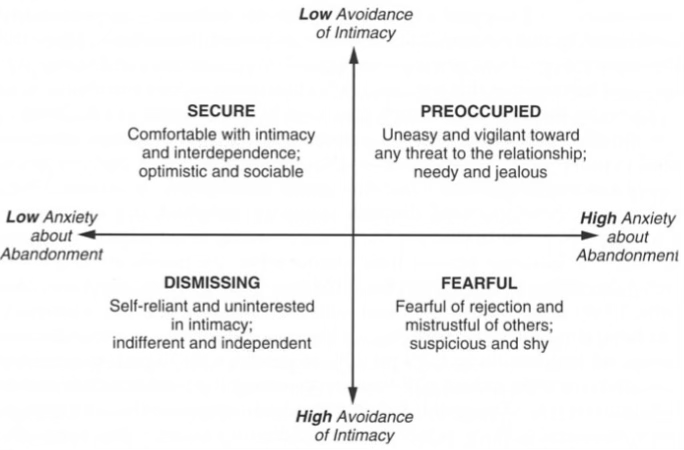
Views of self: Anxiety about abandonment
Views of caregiver: Avoidance of intimacy
Self-Expansion Model of Close Relationships
Cognitive interdependence
Committed partners think of themselves less as separate individuals, but more as a couple
Inclusion of other and the self measure
A scale designed to assess the extent to which we have incorporated our partner into our self-concept
Self-expansion
In new relationships, people more rapidly expand their sense of self
We start to incorporate the othe person into our self
Consequences of Close Relationships
Intimacy Building Within Relationships
Self-knowledge (& self-evaluation) is important for building intimacy & can provide important validation of the self
Self-disclosure important for increasing knowledge (a component of intimacy)
Disclosure that is met with responsiveness helps to validate and reinforce one’s sense of self
Intimacy as a process involving responsiveness (Reis & Shaver)
Promotes further disclosure and responsiveness
Self-evaluation Maintenance Model
Self-evaluation Maintenance Model (Tesser 1988)
Assumes that:
1. Individuals behave in a manner that will maintain or increase self-evaluation
2. Relationships with others will have a substantial impact on self-evaluation
Two dynamic processes involved
1. Reflection
2. Comparison
The impact of either reflection or comparison on self-evaluation depends on:
Closeness
Relative performance
Personal relevance
The “double-edged” nature of close relationships
When close other performs better than the self
Reflection: Enhance self-evaluation
Comparison: Derese self-evaluation
Personal relevance determines which process dominates
Personal relevance low: reflection
Personal relevance high: comparison
So how can we enjoy the benefits and avoid the costs of having a close relationship when the other is doing better than we are?
Decrease personal relevance
May have detrimental effects depending on the domain
Decrease closeness
May lead to relationship dissolution
Decrease relative performance
Reduce other person’s performance
Increase one’s own performance
Summary
Our earliest social relationships can have profound effects on our sense of self & self-evaluations
There are connections between infant attachment and the attachments we form in adulthood
Closeness in relationships can have positive and negative effects on how we view & evaluate ourselves
Lecture 10 ~ March 26th
Self & Identity
What is Identity?
Identity
Sameness and continuity of a person’s psychological functioning, interpersonal behaviour, and commitments to roles and beliefs
There are 3 levels at which can be defined:
Relational
Who are in terms of your social roles (interpersonal relationships) and their meaning
Collective
Who you are as a function of your social groups
Material Identity?
There is no clear distinction in the literature between the self and identity
Some theorists argue that there is no difference
The terms “self” and identity” are interchangeable
Some theorists propose that there is a distinction
Ex. Self-determination theory
Self: human’s innate tendency to grow and move forward, driven by 3 innate, universal needs
Identity: set of characteristics, values and representations people use to define themselves
There is no consensus on whether identity is something that we discover versus something that we construct
Discovery perspective: “true” self (or potential) exists beforehand, and the ultimate goal is to find and actualize that “true” self
Constructivist perspective: sense of identity does not exist beforehand, we have to build it
Can we reconcile these two views?
Self-construction is the pathway to actualizing one’s potential
Self-construction leads to the subjective feeling of authenticity, which we interpret as the “true” self
Theories of Identity Development
Erik Erikson (1959, 1963, 1968)
Erik Erikson, a student of Freud’s emphasizes the ego as a powerful independent part of personality worthy of attention, ego psychology
A primary function of the ego is to establish a secure identity
Identity — inner sense of who you are, of what makes you unique, sense of continuity over time & feeling of wholeness
When we feel desperate & confused about who we are, we are experiencing an identity crisis
Personality development continues throughout lifespan & proceeds through a series of 8 stages of psychological development
Each stage characterized by a psychosocial conflict (or crisis) that needs to be resolved
If conflict is unresolved, the identity development is arrested & person becomes preoccupied by that crisis
Adolescence: Identity vs Role Confusion
People with a sense of identity make decisions about personal values and religious questions
Failing to develop a strong sense of identity leads to role confusion
Adolescence: Identity vs. Role Confusion Crisis
The adolescent’s identity results from a mutual recognition between the young person and society
The adolescent forges an identity, but at the same time, society identifies the adolescent
Constant tension between the need to explore what is unique about oneself and the need to develop an identity that is accepted and validated by important others
Key to resolution lies in social interactions
Children unconsciously accumulate identifications
Identify with parents and others who are admired
Adolescence is a time for reflection upon those identifications
Formal operational thinking
More sophisticated perspective-taking abilities
Gives rise to adolescent egocentrism
Ex. Imaginary audience & personal fable
Course of identity development varies by culture and historical era
Ex. Many more career options for women than in the past means more complicated choices to make
The more alternatives that are available, the more difficult it is to establish a sense of identity
Because of these complications, adolescents may need a “time out” to figure out identity before entering adult roles
Psychological Moratorium
“Time out” from excessive responsibilities and obligations
Responsibilities of adulthood are postponed
Experiment with different roles without harsh penalties
3 main domains of life: work, love, ideology
Luxury of the affluent?
What if introspection and exploration interfere with survival or cultural beliefs and norms?
Identity diffusion
Incoherent, disjointed, incomplete sense of self
May experience disruptions in sense of time, excessive self-consciousness, interpersonal difficulties, concerns over sexuality
Identity forclosure
Bypassing the period of exploration and experimentation
Premature commitment to a role or series of roles
Negative identity
Identities that are undesirable to parents or the community
Environment may make it difficult to establish an acceptable identity
Marcia (1980, 1991)
Based on Erickson’s idea of management of identity ‘crisis.’
Identity crisis is resolved by progression through different phases or statuses
Examines whether someone has struggled with or explored their identity, and whether or not they have committed to an identity
Marcia’s Identity Status Model
Adolescents in moratorium
Trying out different roles and have not committed to or decided on an identity
Identity foreclosure
Commit to an identity
Low exploration
Identity diffusion
Lack an identity of who they are
Have not eplored ot comitted
adrift
Identity Development: Crisis Resolution
Identity generally not established before age 18
During college, vocational plans solidify
College may prolong psychosocial moratorium
Individuals may move from one identity status to another, particularly during adolescent and young adult years
Regression is possible
Disequilibrium, rigidification, disorganization
Extensions of Marcia’s Identity Status Approach
Ex. Coté and Levine (1996)
Resolvers
actively engaged in the process of forming an identity, capitalize on opportunities provided & motivated by desire to optimize their potential
Searchers
Driven by unrealistic high standards, making them unable to commit, so become locked in state perpetual exploration or in despair about inability to commit
Guadians
Internalized values of parents/society that provide strict guidelines for adulthood that prevents emotional and intellectual growth
Drifters/ refusers
Lack steady commitments to adult lifestyle and community
Refusers have more resources but seem unable or uninterested in using them
Drifters have few resources they can use
Berzonsky’s (2003a, 2004a,) Identity Styles
“Informational” orientation
Actively seeking out self-relevant information
Approach identity-related decisions with an open mind
“Normative” orientation
Conformity to family and other social expectations
Try to get identity-related decisions over as quickly as possible
“Avoidant” orientation
Procrastinate and avoid identity-related decisions
Identity Development: Berzonsky’s (2003a, 2004a,) Identity Styles
Narrative Identity
Construct a “life story” composed of individual memorable event stories involving events that somehow have significance to one’s understanding of self over time
Often, the 3-year-old’s memories are retained “the beginning” of the life story
Primarily a linguistic product & draws heavily on cultural norms and the images, metaphors and themes associated with social life
In adolescence…
The narrative takes on significance in terms of life goals, achievements, failures, intimate relationships, joys and tragedies
A means of making meaning
McLean & Thorne (2003) defined meaning-making as the report of lessons or insights
Lessons
Specific meanings that are often behaviourally driven and are applied only to similar kinds of events in parallel situations
Less developmentally advanced and more common in younger participants
Insights
Broader meanings that extend to other parts of the self beyond those indicated in the narrated event
Social (collective) Identity
Social Identity Approach
How do social categorizations become a part of the self as social identifications?
Social Identity Approach
Categorization involves differentiation of self and others into meaningful categories
Ex. Category-based stereotypes
Therefore, I can perceive myself in terms of:
Personal identity
Perception of self in terms of individual characteristics and traits
Social Identity
Perception of self in terms of stereotypical in-group attributes
Any in-group
How are personal identity and social identity different?
Points along a continuum
Different levels of abstraction of self-categorization
Functionally Antagonistic
If self-categorization becomes salient at one level, self-categorization becomes less salient at a lower level
Ex. If “Simone as Caribbean” becomes more salient, “Simone as University instructor” becomes less salient
The self-categorization is flexible and influenced by contextually-bound comparisons
How do individuals subjectively experience a self that is continuous?
Stability in individuals’ social comparisons and social frames of reference
i.e., stability in their social relationships and networks
Ex. Ethnicity
Meaning and evaluation of ethnicity can vary depending on the comparison others and social context
Social Identity ~ Barber, Eccles & Stone (2001)
Adolescent Identity: Crowds
Increasing cognitive sophistication allows adolescents to abstractly define and label peer groups as crowds
Ex. “Jocks” vs “the kids who play basketball during lunch and after school.”
Membership is based on reputation and stereotype
Ex. Don’t have to be an athlete to be a member of the jock crowd
Can be a member of more than one crowd
Adolescent Social Identity
Adolescents develop socially construed representations of their peers’ identities that serve as:
Pre-existing, symbolic categories used for peer recognition
Public identities for themselves that are recognized and accepted by peers
Voluntary participation in activities…
Helps structure peer group membership
Stimulates assessment of one’s talents, values, and interests
Offers opportunities for personal expression
Offer opportunities to belong
Question:
Are there long-term consequences to adopting a particular social identity in adolescence?
Barber, Eccles & Stone (2001)
Long-term consequences of the following adolescent social identities:
‘The athlete”’
‘The Princess’
‘The Criminal’
‘The Basket Case’
‘The Brain’
900Ps from 4 waves of the Michigan study of Adolescent Life Transitions
10th grade, 12th grade, 2 years after high school, 6 years after high school
10th grade: breakfast club social identity, activity involvement (prosocial, team sports, performing arts, school involvement)
All waves: Substance use and psychological adjustment (depressed mood, social isolation, self-esteem, clinically significant behaviour
6 years after high school: academic outcomes, Job characteristics
Results and Implications
Participation in high school activities predicted later substance use, psychological adjustment & educational and occupational outcomes
Ex. 10th-grade prosocial activities predicted lower substance use and higher self-esteem up to 8 years later
Ex. 10th grade team sports predicted positive educational and occupational outcomes up to 8 years later and lower levels of social isolation, but higher levels of drinking
High school social identity predicted later substance use, psychological adjustment & educational and occupational outcomes
There were some common patterns
Ex. Both participation in prosocial activities and the “brain” social identity were predictive of lower rates of substance use and higher self-esteem
Ex. Both participation in performing arts and the “basket case” social identity were predictive of clinically significant behaviour
But there were some inconsistencies
Ex. “Brain” social identity related to more positive outcomes than just engaging in prosocial activities
Ex. Participation in sports related to more positive educational and occupational outcomes than “jock” social identity, which was related to better psychological adjustment
Yes, there are long-term consequences
BUT…
Not a 1:1 relation between activity involvement and Breakfast Club identity
For some outcomes, there are benefits of adopting a particular social identity, whereas for others, the benefit comes from just voluntarily engaging in an activity
Ethnic Identity: Development
Unquestioning view of oneself displaced or upset by a crisis
Ex. Encountering prejudice, awareness of groups’ underrepresentation, feeling different from adolescents from other backgrounds
Period of exploration
Learning about ethnic heritage
Increases self-esteem
As value of having a strong ethnic identity becomes clear, the individual establishes a more coherent sense of personal identity that includes ethnicity
Ethnic Identity
How a minority individual responds to awareness of their ethnicity depends on:
Identification with ethnic group
Identification with majority culture
Identity & Globalization
Increasing globalization & immigration related to the development of:
A bicultural identity
One part of identity is rooted in local culture, while another part stems from awareness of relation to global culture
A hybrid identity
Integrating local culture with elements of global culture
A multicultural identity or complex hybrid identity
Ex. Combination of native culture, the local culture to which they have immigrated, and the global culture, along with various hybrid identities
Summary
Identity refers to the Sameness and continuity of a person’s psychological functioning, interpersonal behaviour, and commitments to roles, values, and beliefs
Several approaches to identity development highlight adolescence as a key life stage, however, identity-related tasks span the lifespan
Lecture 11 ~ April 2nd
Self & Adjustment
What is Adjustment
Several definitions within psychology
Physical health
Mental health
Psychopathology
Well-being vs Ill-being
Subjective well-being
Psychological well-being
Personal functioning
Interpersonal functioning
Optimal functioning
Self-concept Differentiation
How is SCD related to age & adjustment?
Diehl, Hastings & Stanton (2001)
Lower SCD related to higher well-being
Higher self-esteem, positive affect, psychological well-being
Lower negative affect, depressive symptoms
But…
Age moderates the relation between SCD and well-being
Low SCD was associated with higher positive psychological well-being and lower negative psychological well-being for BOTH young and older adults, but…
This was significantly stronger for older adults
Why?
Protective effect of a more coherent self-concept more important in old age
Negative Self-Views
Anxiety and depression
Learned helplessness (Abramson et al, 1978; Miller & NOrman, 1979; Seligman, 1975)
People become anxious and/or depressed when they make an attribution that they have no control over the stress in their lives
Internal, uncontrollable (culture plays a role)* attribution for negative events
Depressive attributional style
Internal, Stable, Global attribution for negative events
Leads to a sense of hopelessness about ever regaining control over one’s life
Depression
Negative cognitive styles (Beck, 1967;1976)
Cognitive errors that depressed individuals make
Ex. Arbitrary inference, overgeneralization, catastrophizing
(Depressive) Cognitive triad
Cognitive errors in thinking negatively about themselves, the world and their future
A series of negative events in childhood may lead to the development of a negative schema
Ex. self-blame schema
Ex. Negative self-evaluation
Perfectionistic Self-Views
Negative self-views have been implicated in eating disorders such as anorexia nervosa, bulimia nervosa & binge-eating disorder
Several studies show a link between perfectionism & anorexia nervosa
But what is perfectionism?
Sherry, Hewitt, Flett, Lee-Baggley & Hall (2007)
Trait perfectionism
Other-oriented Perfectionism (OOP)
Demanding perfection of others
Self-oriented perfectionism (SOP)
Demanding perfection of oneself
Socially prescribed perfectionism (SPP)
Perceiving that others are demanding perfectionism of oneself
Perfectionistic Self-Presentation
Perfectionistic self-promotion
Proactively promoting a perfect image of the self
Nondisclosure of imperfection
Nondisplay of imperfection
DSM-5 Personality Disorders
DSM-5 personality disorders
Enduring pattern of inner experience and behaviour that deviates markedly from the expectations of the individual’s culture and results in distress or impairment
Cluster A
Paranoid, schizoid, Schizotypical
Cluster B
Antisocial, borderline, histrionic, narcissistic
Cluster C
Avoidant, dependent, obsessive-compulsive
Perfectionism & Personality disorders
Sherry et al (2007) examined the relationships between perfectionism and personality pathology
OOP related to Cluster B disorders
Antisocial and narcissistic PP
Entitled, aggressive interpersonal behaviour
Role of agreeableness and other Big 5 traits
SOP related to cluster C disorders
Obsessive-compulsive PP
SPP related to Cluster B disorders
Negative interpersonal expectancy that drives turbulent interpersonal patterns
Expectations of others as critical and demanding
SPP related to Cluster C disorders
Anxious and fearful PP
Gravitate toward dominant and demanding others who offer strength and guidance and who expect a lot in return
Paralyzing sense of ineffectiveness may magnify unrealistic expectations
Perfectionistic self-promotion implicated in Cluster B disorders
May be an attempt to construct a socially desirable identity
May be an attempt to bolster unstable self-views or confirm inflated self-views
i.e., self-verification
Non-disclosure implicated in Cluster A disorders
Communication style
Non-display implicated in Cluster C disorders
Obtain interpersonal rewards and avoid costs
Dimensional Approach to Personality Disorders
Personality disorders represent a (1) disturbance in the continuum of the healthy self and (2) the presence of 1 or more pathological traits
Self-Direction
Meaningful short & long-term goals consistent with identity
Sense of what is productive for society & appropriate social interaction;
Appropriate self-reflection
Indentity
Self as unique person with stable boundaries between self and others
Self-continuity
Accurate self-perceptions and self-appreciation
Positive Interpersonal Relationships
Empathy and intimacy
Negative Affectivity (vs Emotional stability)
Detachment (vs. Extraversion)
Antagonism (vs. Agreeableness)
Disinhibition (vs. Conscientiousness)
Psychoticism (vs. Lucidity)
Example: ASPD:
Positive interpersonal relationships
Lack of concern for others’ feelings
Exploitativness
Dominance/intimidation
Self-direction
Personal gratification
Lack of prosocial standards
Failure to conform to legal/ethical standards
Identity
Egocentrism
Antagonism
Manupilativeness
Callousness
Deceitfulness
Hostility
Disinhibition
Risk taking
Impulsivity
Irresponsibility
Dissociative Identity Disorder
Characterized by a poorly integrated sense of self
Person does not experience their thoughts, feelings, or actions of a well-developed “I”. Rather, the person experiences different "personalities” at different times
Shows alterations in behaviours, attitudes, and emotions when in alternate personalities
Recurrent gaps in memory for personal information or everyday events
May also report experiencing trance states, sleepwalking, conversion symptoms episodes, PTSD symptoms, dissociative amnesia and fugue
Personalities may be aware of each other (Average ~15 alternate personalities)
DID is a complex disorder related to trauma occurring before age 6
Positive Illusion & Adjustment
Historically, self-views that were consistent with reality were thought to be a critical component of mental health, but…
Taylor & brown’s (1988) assertions
Most individuals hold and maintain positive illusions
Positive illusions may have positive benefits to mental health (e.g., positive affect, social skills (ex. Caring for others), intellectual functioning, motivation, performance)
Major criticisms of Taylor & Brown’s (1988) assertions
Operationalization of positive illusions
Operationalization of adjustment
Self-reports of adjustment
Contaminated by same bias
Robins & Beer (2001)
Purpose
To examine the short-term and long-term consequences of unrealistically positive self-views
Study 1 (short-term)
Positive illusions = discrepancy between self-evaluations of own performance and peer evaluations
Results
General self-enhancement effect
Individual differences in self-enhancement
Self-enhancers were more likely to experience a short-term boost in PA
Study 2
Positive illusions = discrepancy between self-evaluations and own academic ability and actual academic ability (ex. SAT scores and high school GPA)
Both short-term benefits and long-term costs of positive illusions
Positive Illusions and Interpersonal Adjustment
Long-term interpersonal benefits of positive illusions
Murray et al. (1996, 1996b)
Ps were more satisfied with their marriage when:
They had positive illusions about their partner
When their partner had positive illusions about them
Long-term interpersonal costs of positive illusions
Colvin, Block & Funder (1995)
Self-enhancers were described more negatively 5 years later by firends and trained assessors who had no prior experience with Ps
Swann Jr., De La Ronde & Hixon (1994)
Dating couples
Regardless of Ps self-views, greater intimacy was associated with more favourable partner evaluations
Married couples
For Ps with positive self-view, greater intimacy was associated with favourable partner evaluations
But…
For Ps with negative self-views, intimacy was associated with unfavourable partner evaluation
Baumeister et al., 1999
If you choose to accept negative feedback then your self-esteem will be lowered
If you reject the feedback, but now you will feel a need to defend and protect your own self-views maybe a the cost of the person who gave you the negative feedback
The Self-& Well-Being
Maslow’s Hierarchy of Needs
Needs are hierarchically organized with basic needs at the bottom, self-actualization needs at the top
Physiological Needs
Safety needs
Belongingness and Love needs
Esteem needs
Need for self-actualization
Importance of the Self for Well-Being
Self-determination theory (Deci & Ryan)
Remember the self & identity
3 basic psychological needs motivate the self (growth tendencies)
Autonomy, competence, relatedness
Psychological well-being
Autonomy, mastery (competence, self-acceptance, positive relationships, purpose, personal growth
Summary
There are several different ways to conceptualize adjustment
The self-concept is implicated in negative & positive adjustment in many ways
Positive illusions may be beneficial or harmful to well-being, depending on the duration & domain (& operationalization)
Need-based theories implicate the satisfaction of self-related needs & goals in well-being