week 3 psyc reading notes (sept 23)

its easier to test nature vs. nurture on animals vs. on humans because our traits aren’t inherited but rather acquired over time
humans dont genetically have nature traits such as personalitiy traits, but rather nurture and it depends on the conditions they live in while growing up
behavioural genetics : the science of how genes and environment work together to influence behaviours
adoption study is a good way of viewing nature vs. nurture, in addition to twin studies - these studies are called quantitave genetics (analyzes similarities dependent on how biologically related they are)
heritability coefficient : number produced meant to provide a single measure of genetics influence of a trait (from 0-1)
some traits have been proven to come from nature and nurture, the more genetically related people are, the more similar they are (intelligence, personality, etc..)
correlation does not imply causation
the inability to organize traits from more to less genetic has fallen short from nature-nurture studies, everything has turned out to be somewhat heritable but not guarenteed heritable & not much consistency for what is more/less heritable
coefficient of zero would suggest all nurture, no nature, (ex. the trait of having two arms and twins) people dont vary in the genes related to arm development
heritabilioty coefficient divides triats determinenets into two portions : genes and environment (which are then calculated for the total variability) - this is problematic because the ways genes integrate are more complex than that
epigenetics : a process in which dna itself is modified by envrionmental events and those genetic changes transmitted to children
genetic impact of behaviour is broken up over many small genes with very small effects, very distributed and havent been able to be catalogued (example of the reverse is huntingtons diseases caused by a single gene)
human behaviour is too complex to be nailed down, nature vs. nurture has shown us that genetic differences among people are vital to human moral equality, freedom and self-determination
genetics gets a vote not a veto in the determination of human behaviour
quantitative genetics : scientific and mathematical methods for inferring genetic and environmental porcesses based on the degree of genetic and environmental similarity among organisms
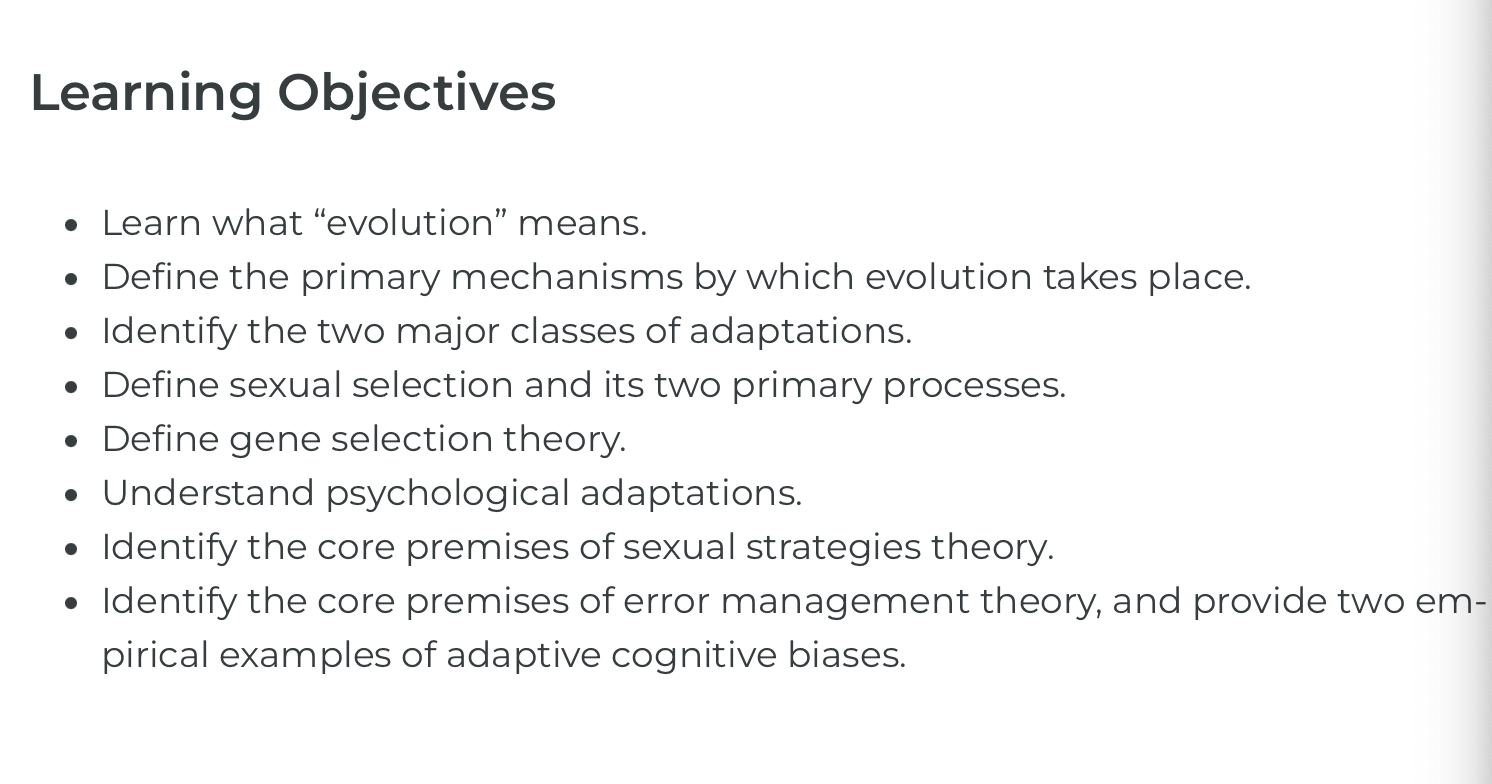
evolution : traits/behaviours changing over time because they are advantagous to our society - hardwired into us so its easy to overlook their influence
natural selectiom : differential reproductive success as a consequence of differences in heritable attributes (the strongest survive)
organisms have two large classes of adaptions that have happened over time
survival adaptations : mechanisms that helped our ancestors handle the hostile forces of nature, (ex. sweat glands developped to cool us down) these are physical adaptations
sexual selection theory : reproductive adaptations, evolution of characteristics because of the mating advantage they give organisms (ex.male peacocks developping bright feathers for mates) (created by charles darwin),
intrasex competition : members of one sex compete against one another and the winner gets the mate, whichever qualities lead to success are passed down more frequentl
intersex selection : evolution occurs as a consequence of the mate preferences of one sex exerting selection pressure on members of the opposite sex (ex. if members of one sex are attracted to a specific quality they will be passed on more)
genes are the basic units of heredity, genetic info in DNA tells the cells/molecules how to build the organism and how it should behave
genes can boost their own replicative success by influencing the odds for survival/reproduction and influence the organism to help other organisms who contain those genes (called genetic relatives)
psychological adaptations : mechanisms of the mind that evolved to solve specific problems of survival or reproduction; conceptualized as information processing devices - evolved to solve problems of survival on reproduction
physiological adaptations are in the body caused by the environment, whereas
adaptations follow the process of : input - procedure - output
psychological adaptations are developments or change of a mechanism in the mind, known as an interactionist framework, there is an interaction between the environmental trigger and the initial response to produce the outcome
in evolutionary psychology culture has an effect on adaptations (ex. status is important for reproductive success)
sexual strategies theory : based on sexual selection theory, humans have evolved a list of different mating strategies, both short/long term that vary depending on culture, social context, parental influence and personal mate value (desirability in the ‘mating market’), used to focus on differences between men/women, predicted that both sexes will be choosy when pursuing a long term mating strategy
women have inherited the evolutionary trait to desire mates who posses resources, have qualities linked with acquiring resources and are willing to share them
men desire youth and health as both are cues to feritlity
sexual strategies theory which is anchored in sexual selection theory predicts specific similarities and differences in men/womens dating preferences and strategies
error management theory (EMT) : deals with the evolution of how we think, make descions and evaluate uncertain situations, predicts that whenever uncertainty situations present us with a safer/more dangerous descision we will psychologically asapt to prefer choices that minimize the cost of erros
cost asymmetries : option that has low cost but great reward/low reward and high cost
visual descent illusion : people will overestimate the distance when looking down from a height so that people will be especially wary of falling from great heights (example of EMT)
auditory looming bias : people overestimate how close objects are when the sound is moving towards them vs. away from them, better safe than sorry mindset (example of EMT)
EMT predicts adaptive biases : sexual overperception bias

gene : specific DNA sequence that codes for a specific polypeptide/protein or an observeable inherited trait
gene-environment interactions serve to increase the number of possible connections between neurons, weak connections form to different neuronal targets - undergo remodelling where connections vanish and few stable connections remain
epigenetics : the study of heritable changes in gene expression/cellular phenotype caused by mechanisms other than changes in the underlying dna sequence. epigenetic marks include covalent DNA modifications and posttranslational histone modifications
epigenetics refers to the transmission of phenotype in terms of gene expression without changes in DNA sequence (epi=over/above - genetics)
epigenome : the genome wide distribution of epigenetic marks, highly dynamic differing among cell types, tissues and brain regions
environmental factors during early childhood can cause changes in the expression of genes
dna is wrapped around 8 proteins called histones, they form a neucleosone which is a basic unit of chromatin
twins share a common genotype when theyre young, but change as they grow up
nitrogenous bases : adenine, thymine, guanine & cytosine
DNA methylation : covalent modifications of mammalian DNA occurring via the methylation of cytosine, typically in the conext of the CpG dinucleotide
DNA methylation occurs at cytosine residues in the cytosines with guanine after them ina. cel-specific pattern
the enzymes that perform methylation are called DNA methyltransferases (DNMTs) which catalyze the transfer of a methyl group to the cytosine, these are dynamically regulated during development
DNMTs : enzymes that establish/maintain DNA methylation using methyl-group donor compunds/cofactors. the main mammalian DNMTs are DNMT1 which maintaisn methylation state across DNA replication and DNMT3a & DNMT3b which perform de novo methylation
!!!!methylation simply stops trancription from happening!!!!
histone acetylation : associated with gene activation and increased gene expression, done by the histone acetyltranferases (HATs) and histone deacetylases (HDACs)
removal of the acetyl group by HDAC enzymes is associated with DNA methylation
histone modifications : posttranslational modifications of the N-terminal “tails” of histone proteins that serve as a major mode of epigenetic regulation
nutrients can reverse/change DNA methylation and histone modifications, it affects the epigenome by directly inhibiting enzymes that catalyze DNA methylation/histone modifications or by altering the availability of substrates for reactions
epigenetic mechanisms influence genomatic activities in the brain to produce long-term changes in synaptic signaling, organization, and morphology
changes in histone modifications can influence long-term memory formation
a neuronal increase in histone deacetylase activity result in synaptic plasticity and impairs memory
examples of human genetic defects creates negative effects on cognitive function and mental health : rett syndrome and rubinstein-taybi syndrome (RTS) - highly expressed in neurons and involved in regulating neural gene expression
rett syndrome : mutation in DNA sequence in a gene called MECP2, prevents to wrong proteins from being present, MECP2 function also influences gene expression that supports dendritic and synaptic development and hippocampus-dependent memory
RTS : mutation in gene sequence in a gene called CBP it binds specific histoes and promotes acetylation, cognitive disfunction in adulthood and learning/memory deficits
DNA methylation alterations in genes involved in brain development and neurotransmitter pathways which had previously been associated with mental illness
epigenetic events that alter chromatin structure have been associated with depression-related behaviour and action of anti-depressant meds
administration of antidepressants increased histone markers of gene expression and reversed the gene repression induced by defeat stress
in rats the increased amount of licking by the mother rat increased expression of stress responsitivity which resulted in lowered hormonal response