Chemistry
Chemical substances and processes are essential for our existence, providing sustenance, keeping us clean and healthy, fabricating electronic devices, enabling transportation, and much more
Chemistry is the study of the composition, properties, and interactions of matter
Attempts to understand the behavior of matter extend back more then 2500 years
Greeks: Matter consists of four elements: Earth, Fire, Air, and Water
Alchemist attempted to transform "base metals" into noble metal"
Knowledge of Chemistry is central to understanding a wide range of scientific disciplines. This diagram shows just some of the interrelationships between Chemistry and other fields
The Scientific Method
Chemistry is a science based on observation and experimentation
Chemists often formulate a hypothesis: a tentative explanation of observations
The laws of science summarize a vast number of experimental observations, and describe or predict some facet of the natural world
Theory: A well-substantiated, comprehensive, testable explanation of a particular aspect of nature
Mass is a measure of the amount of matter in an object
Weight refers to the force that gravity exerts on an object
An object's mass is the same on the earth and the moon but its weight is different
The Law of conservation of matter states that there is no detectable change in the total quantity of matter present when the matter converts from one type to another
This is true for both chemical and physical changes
An element is a type of pure substances that cannot be broken down into simpler substances by chemical changes; the basic building block in chemistry
The known elements are displayed in the periodic table
There are more than 100 known elements
Ninety of these occur naturally
Two dozen or so have been created in laboratories
Pure substances have constant composition
Elements: Pure substance that cannot be broken down into simpler substances by chemical changes
Consist of one type of element
Examples: Gold (Au), Phosphorus (P), Oxygen (O)
Compounds: Pure substance that can be broken down into simpler substances by chemical changes
Consist of two or more types of elements chemically bonded
The properties of compounds are different from the uncombined elements making up the compound
A mixture is composed of two or more types of matter that can be present in varying amounts and can be separated by physical changes
Evaporation is an example of physical change
There are two types of mixtures: homogenous mixtures and heterogeneous mixtures
A homogenous mixture exhibits a uniform composition an appears visually the same throughout
Another name for a homogenous mixture is a solution
Homogenous mixtures is the same; from top to bottom it is uniform throughout and when everything mixes with each other
A heterogenous mixture has a composition that varies from point to point
Heterogeneous mixtures is mixed up; it is not uniform throughout the sample
An Atom is the smallest particle of an element that has the properties of that element and can enter into a chemical combination
Idea first proposed by Greek philosophers, Leucippus and Democritus, in the 5th century BCE
The 19th century, John Dalton of England supported this hypothesis with quantitative measurements
A molecule consists of two of more atoms connected by strong forces known as chemical bonds
Properties: the characteristics that enables us to distinguish one substance from another
Physical Property: a characteristic of matter that is not associated with a change in its chemical composition (density, color)
Physical Change: a change in the state or properties of matter without any accompanying change in its chemical composition
Chemical Property: the change of one type of matter into another type of matter (flammability, toxicity, acidity, reactivity)
Extensive Property: depends on the amount of matter present (mass, volume)
Intensive Property : does not depend on the amount of matter present (density, temperature)
Chemistry: the study of matter
Matter: something with mass and volume
Measurements: provide the information that is the basis of most hypotheses, theories, and laws
Measurements need to include number and units
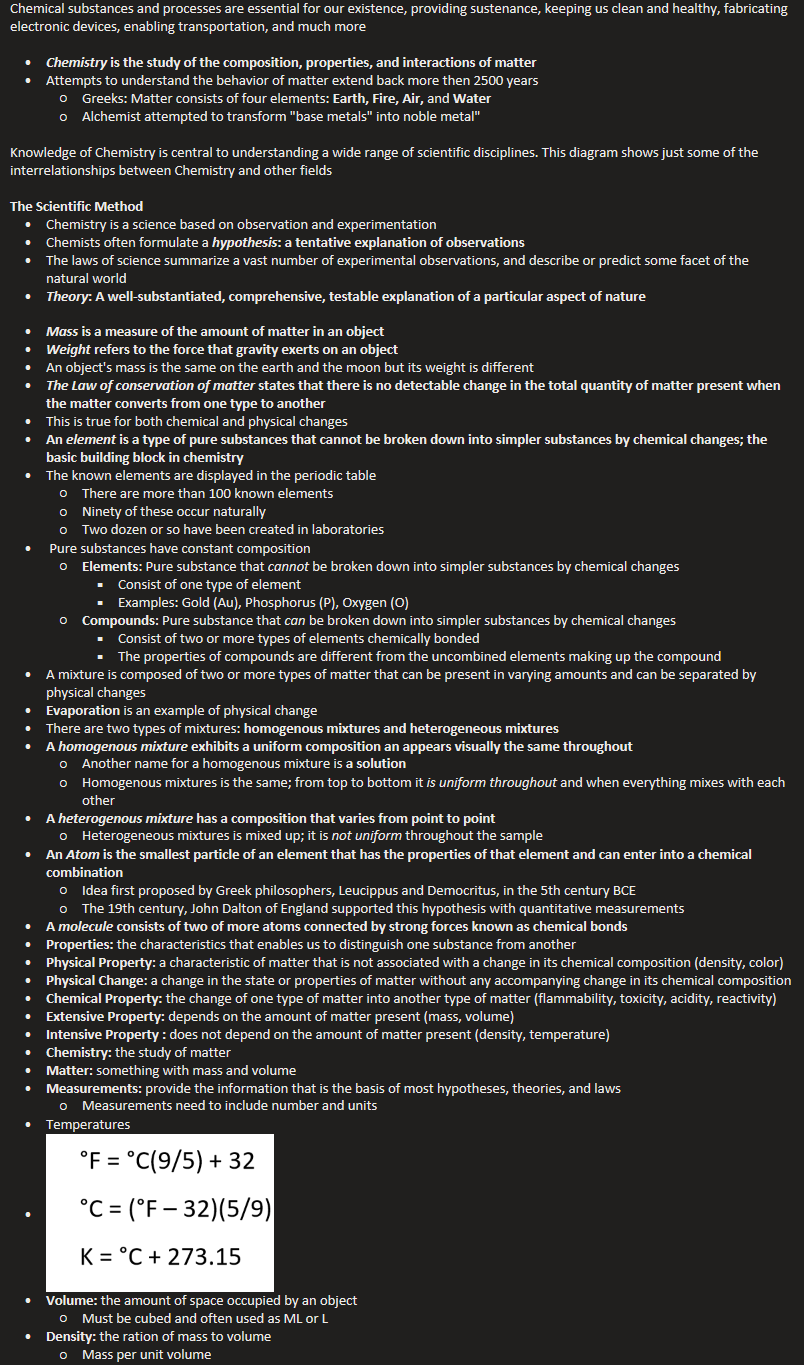
Temperatures
Volume: the amount of space occupied by an object
Must be cubed and often used as ML or L
Density: the ration of mass to volume
Mass per unit volume