2nd note
Basic composition of food
Now talking about what we put into the foods?
(specific thing to put in food to create different food product)
Define the food additives
Regulation
Food additives添加物
Twinkie part(mid term!!!)
Food companies an you
Food companies want to sell you products:
(Looking for food additives that make the food more attractive, appearing to the 5 senses)
They want to purchase their product for the product
With reasonable prices
YOU
-tasty
- 5 senses
-nutritions
Safety of food
- quality sameness
偉い人は言った、、、
I design food ingredients NOT additives
What’s the difference???
Regulate- 規制する
FDA: (Agency that regulates all food except…
eat product, poultry鶏, broken egg) if egg is still in the shell, it;s under FDA
USDA: regulate catfish, meat, poultry, broken egg
EPA: water
FDA:
Food additives- any substances that is reasonably expected to become a component成分 of food
(you can not just use food additives)
They are regulated and have to be approved before you can use them in foods
Approveいらん物もおるらしい
If you come up with new food additive or designing a new food and decide to add food additives, you have to take a look at law or need to get approve
GRAS- generally recognized as safe
You don’t need to get permission to add the substance that is classified as GRAS when you add it to a new product!
There are some exclusion…..
Food additive- substance that is expected to become a part of food
Food additivesだけを踊り食いとかは絶対にないってこと。何かに加える方法でしか使えない←あたりまえ
Two groups of food additives
サンクションド
GROUP 1- Prior-sanctioned substances
Substances that FDA or USDA had determined safe for use in food prior to the 1958
1958- food additives law settled
いくぞご飯
ex) sodium nitrite, potassium nitrite
…preserve meat, adding color
also…
このprior sanctioned substancesのなかにclassifyされている食品添加物の中で危険性があるものは科学的なデータをもとに、危険性を立証して取り除く
Group 2- GRAS
Substances that are generally recognized as safe by experts based on their extensive広範囲に渡る history of use in food before 1958 or based on published scientific evidence.
ex) salt, sugar, spices, vitamins, monosodium glutamate (MSG)
Manufacturersメーカ may also request that FDA to review the industry’s determination of GRAS status.
alos…
If the maker think substances shouldn’t be in GRAS, they can request the FDA to review that substance
additives=
Any substance or mixture of substances other than the basic food stuff which would be in food (added) as a result of during production, processing, etc.
What do food additives do?
Maintain product consistency
- Consumers expect the processed food to have the same quality every time.
(over long enough time)
ex) emulsifiers乳化剤, thickeners増粘剤, anti-caking agents
Improve or maintain nutritional value
ex) vitamin, minerals
Maintain palatability and wholesomeness
ex)
To provide leavening or control pH
USA- Over 3,000 approved food-additives
Of those 98% are familiar ingredients:sugar, salt, citric acid, corn sweeteners, pepper, vegetable coloring, yeast, mustard baking soda
EU: ~400 approved food additives
Europe
The EU uses E numbers
What does GRAS stand for?
- Generally recognized as safe
Classes of Food Additives
Indirect Additives: one that becomes part of the food in trace amounts(very small) due to production, processing, storage or packaging
Food additives that end up becoming part of the food, no human’s intention behind it.
It’s indirectly added.
ex) pesticides防虫剤 used in agriculture
野菜を育てる過程でどうしても入ってしまう
Food manufacturers must show the FDA that all food contact materials接触する物たち are safe!
Unwanted consequence!
鍋のコッパーが熱によって食べ物に混入してしまったりする
Direct Additives: compounds intentionally added to foods to get specific functions
ex) add sugar to oatmeal, so it would taste sweet!
9 major food additive groups
- Antimicrobial agents/preservatives
Food additives that aim to kill microorganisms, pathogens specifically, which might cause disease, or kill spoilage organisms(that spoil the food)
Goal: stop microorganisms from growing
(so they won’t spoil the food and make you sick)
Most common- sodium benzoic, sulfide, sodium nitrates nitrites(to control clostridium botulinum)
Usually ends with ~ates or acid ~cine (for usually preservative)
Acid is usually for preservative
Benzoic acid and its salts
Benzoate
- Sodium, potassium
Sorbic acid and its salts
Sorbates
Sort of acid is generally preservative
(sometime flavory agent)
- Coloring agents
Definition: any dye, color pigment which added to a food etc to give the color
色を与えしもの
ex) tomato lycopene extract
Kartin gives orange looking color
For appearance!
Why add then?
To attract the consumer, appearing to the visual!
(looks fresh)
Color could be lost during food processing, add some color chemical to brings back the lost color.
Enhance natural occurring color
Provide identity to foods
(tomato paste, should be red color)
Give and protect flavor, stop vitamin degradation劣化
Decorating for art!
Natural color from food would not consider as food additive
FDA Coloring agents
- Certified colors (can e artificial): synthetic合成されたsubstances that are used to add color in foods etc.
some are made from petroleum material.
These colors are regulated by the FDA
certified colors food additives that FDA has approved
(safe for consumption)
- 9 approved
(some are soluble, not soluble)
- Manufacture to be approved to use
- Certain colors are only approved to use for certain specific foods.
What is colorant and emulsifier and antimicrobial
Colorant- substance that is used for coloring a material
Emulsifier-a mediator that helps mix two things that normally don’t mix well, such as oil and water
Antimicrobial- a substance that kills or stops the growth of microorganisms especially pathogens which cause the illness.
FDA coloring agents
- Exempt免除 from certification (natural)
- If it’s natural, you don't have to go through certification.
ex) natural color of cranberry
- Doesn't mean they are always safe even though they’re “natural”
- Natural color may add unintended flavors
Cranberry color comes with its flavor too!
Twinkies
- Flavoring Agents
Includes:
Salt
Herbs
Spices
Extracts (concentrate forms of flavor that is made of natural ingredients) vanilla extract

If it’s natural, it doesn't have to go through certification process
If it’s not natural, go certification process
Synthetic flavors(vanillin)
No alcohol
Use of Flavoring Agents
When we lose the flavor during food process
ex) orange juice
When they crush the oranges, the compounds get volatile as they contact air
They capture those compounds and throw those flavor compounds back in for the finished product.
augment(increase), modify a flavor
For medicine, there are cherry, orange etc flavors so that medicine bitterness gets covered up and gets easier to take.
To make the original flavor
Antioxidants-Antioxidants are substances that protect body cells form harmful molecules called free radicals
ex) fruits, veges, beans, etc
Not only sugar provide the flavor
Colorants or flavor agents, those antioxidants can also provide flavor
They can provide multiple things
Can be colorant, preservative, protection at same time
Acid brings the pH down, preserve the food
(keeps it for longer) controlling microorganisms
And provide the acidic flavor as well!
- Sweetness
(in their own category)
- Natural sugars
End with OSE
- Sugar alcohols
Naturally occurring
Not cal free, less cal than cane sugar
TOL at the end
ex) sorbitol, erythritol
Synthetic sugar
- Low or no cal
- Artificial sweeteners
Stevia
Approved artificial sweeteners
- artificial sweeteners have to go through approval process
Have to be approved!
- Antioxidants
- Protect against deterioration劣化 when compounds comes in contact with oxygen in air
(certain chemical reaction took place and produce off flavor, bad looks, smell)
Throw in antioxidants to stop or reduce the process of oxidation to not to produce off flavors and colors.
Free radicals tend to produce in the body(especially stress happens)
Throw the antioxidants help maintain and keep the cell healthy
Antioxidants also help maintain health!
勝たんしかantioxidants!!!
ex)grape, carrots, tomatoes
Colorants food
- Living systems are protected against oxidation as long as they are alive
- Oxidation can occur due to enzymes(browning reaction)
ex) once you start cutting the apple, breaking it up, remove from alive source, the oxidation gets taking place, and color will change(browning reaction)
Oxidative reaction takes place
Oxidation can decrease the nutritional values of the food
- Degradation劣化 of vitamins A,E,D,C, K
- Oxidation of fats produces rancid off odors
ex) butter, doesn’t smell like butter, because of oxidation
Oxidative stress
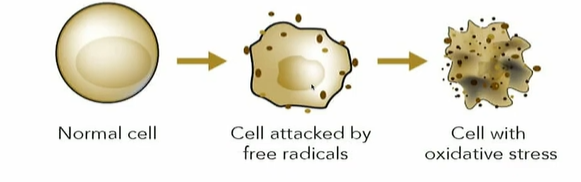
Throw in the antioxidants so the tomato looks still.
Type of food antioxidants
- Synthetic antioxidants
BHA, BHT, PG, TBHQ
- Natural antioxidants
Vitamin C, E, flavonoids
Question!
All natural coloring agents are safe for consumption
False!!!
Natural doesn’t mean it’s safe
Antioxidants added to food are there to improve the consumers health
True! Actually false!!
Why?
Antioxidants are not necessarily be added for health purpose, it could be for preservative of food
Moreover, they are not always in the amounts required to impact your health
(it’s often difficult to add the enough amount of antioxidants to protect people’s health in the food)
High in vitamin safe←セーフ
There are enough vitamin to reduce some disease←health claim
- Anti-caking agents
allow food to flow流れる
- Usually added in powder or granulated material粒状の物 to prevent the formation of lumpsしこり、だま(caking)
- Remain smooth, creamy
ex) calcium, silicate, calcium carbonate, sodium dioxide
If it’s twinkies, it would be on midterm
- Bulkingかさばる agents
- Used in foods and beverages to increase weight or alter変更するthe texture without the modification of flavor
Commonly non-starch polysaccharides
- Gums
- Also add texture, thickness
Increase the bulk and hence sense of satiety満腹
ex) Gum, cellulose gum, agar, carrageenan
- Stabilizers, gelling agents and thickeners
- Add thickeners to achieve certain texture
- Hydrocolloid materials
Can form gel when water is present
- Used for unique textural, structural, and functional characteristics
- Usually it’s made of natural source but may be chemically modified
- Generally used at concentrations<2%
Properties and functions
Gel formation
Product thickening
Inhibition阻害 of ice crystallization
Stabilization of emulsions and foams
Improvement of icing, reduction of stickiness
Encapsulationカプセル化 of flavors
Reduce or slow the drainage排水 of liquid from a foam泡
ex) most of them are gum at the end
- Emulsifiers
Emulsifier-a mediator that helps mix two liquids that normally don’t mix well, such as oil and water, mayo
ex)
Oil in water: water is the continuous phase, oil exists in droplets
ex) milk, mayo, vinaigrette
Water in oil: oil is the continuous phase(most part), some water inside there
Butter and margarine
Ice Cream is an oil and air in water emulsion
Emulsification
Emulsifier:special substance that is able to bind water and oil molecules at same time so it becomes one product
Mechanical force:
Creaming or sedimentation: a process in which the less dense oil droplets rise to the top and a fatty cream appears
Phase inversion反転: occurs when agitated興奮 oil in water emulsion revertsもとに戻す to a water in oil and vice versa逆に
ドレッシングが二層に分かれちゃう的なこと
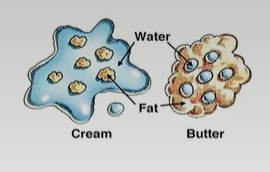
Emulsifiers are charged
Have two side
hydrophobic side(attracts oil)
Hydrophilic side (attracts water)
That’s how it keeps those two liquids together
Mediator
It binds the hydrophobic side and hydrophilic side together and holds it them together
Called surfactants or detergents
They reduce the surface tension between the two phases
Might form protective layers as well.

What kind of emulsion is milk?
Oil in water.
Twinkie
- Great invention
- Lasting for much longer time
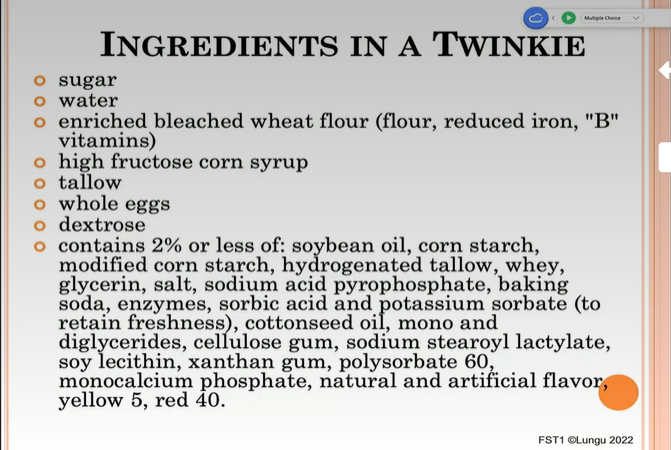
Twinkies
Sweetness num.4
Cornstarch is thickener and stabilizer too
Know everything about twinkies
Which category each substance in twinkies belong to?